The Ring (1927)

Although this wasn’t Hitchcock’s first film (he made at least five before this one, although at least one of those in deemed ‘lost’ [1926’s The Mountain Eagle] and another two unfinished [Number 13 and Always Tell Your Wife, from 1922 and 1923 respectively]) The Ring is the earliest one I can get my hands on at present, so my travels through the history of Hitch will have to begin here. Telling the story of an amateur boxer working at a carnival who gets a shot at the big time after he is scouted by a renowned heavyweight, The Ring almost knocked me out for being a Hitchcock film about one of the least Hitchcockian subjects, sport.
Carl Brisson is Jack ‘One Round’ Sander, who makes his living by challenging regular schmoes to a boxing match at a carnival. His fiance (Lillian Hall-Davis) chews gums as she works the ticket counter, and his friends are his assistants and announcer. One night, after dispatching the usual rag-tag band of hopefuls fairly promptly – one of whom defeats himself as he enters the ring – Jack meets his match against Bob Corby (Ian Hunter), who unbeknownst to Jack is an Australian heavyweight champion, and has already been making moves on his girl. After the fight, Bob claims his reward (a grand total of £2.00), and tells Jack he plans to give him his chance with the professionals. Bob and Jack’s fiance, and eventually his wife, become much closer as Jack becomes more successful, which leads to a love triangle developing between the three, coming to a head when Jack and Bob fight on another at the end of the film.

Had I not known this was a Hitchcock film, I would have been very surprised to discover the fact. Other than themes of deception and suspicion, this does not seem to fit within the rest of his work. Even the leading female is a brunette! Now I’m sure that Hitchcock obviously didn’t start out as a master film-maker – truly brilliant debut films are few and far between – but I had hoped for more than this, as this film is at best just mediocre. The plot is nothing special, and feels dragged out even at less than 90 minutes, and when you consider that the last 10+ minutes of this are a boxing match that feels like it lasts at least an hour, then the pacing is really quite a problem.

Hitchcock’s infamous mysogany and sexism is evident in places. Though she is essentially the third lead, Hall-Davis’ character is only ever referred to as ‘The Girl,’ even though her character has is called Millie. In both the opening credits and her introductory title card she is given that fairly vague, nondescript title. There is some interesting camerawork, especially early on in the initial fight, with the camera remaining stationery, pointed at Jack’s opponent’s corner of the ring, as the would-be fighter heads off screen to fight, only to be thrown back a second later, dishevelled and clearly defeated. However other than this and some occasional semi-dream sequences and video distortion to emulate rage, drunkeness and being knocked out, there isn’t much to take note of.

The title of ‘The Ring‘ most obviously refers to the boxing ring within which a fair amount of the film takes place, however it also refers to the wedding ring (this is possibly the first cinematic incarnation of a best man losing the ring), a bangle given to Millie by Bob, a forune-teller’s ring of cards and the circular nature of the plot, as the final scenes are very similar to the opening one, with Millie watching on as the two men fight it out. By the end, they are no longer just fighting for money and a title, but for honour, pride and the hand of the woman they both love.

I had one major gripe with the film. Throughout the story we are shown countless posters advertising boxing matches, upon which are the names of dozens of boxers. Yet of them all, Jack is the only one with a nickname. (Although at one point someone dates the movie a tad by referring to a boxer in a less than affectionate racial slur that I don’t care to repeat.) Surely at least one of the others would have a stage name, for the sake of realism? Also, look out for one of Bob’s assistants, who looks spot on like Jack Nance in Eraserhead.

Before watching this, I’d yet to see a Hitchcock film I hadn’t at least liked. I hope dearly that his learning curve was steep, and he got better very quickly.

Choose life 4/10
Transformers

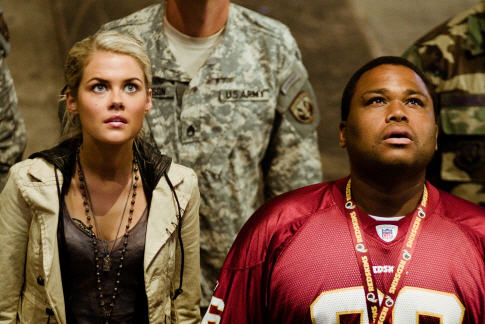
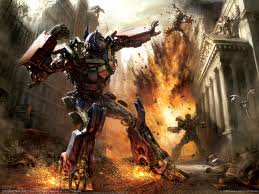
Part 2 in my Shia LaBoeuf: the Scourge of Cinema double-bill sees him taking on giant, transforming robot aliens as he attempts to save the world using a weird little cube, and cop off with Megan Fox. I’ve got no historical connection to the Tranformers franchise, as I neither saw the cartoon series or the animated feature from the 80s, and I’ve never played with any of the toys as a child. So unlike many people, I feel that so far my childhood has been unmolested by Michael Bay, something I was afraid I’d no longer be spared from with his intentions to paint his own brand of ridiculousness onto the Teenage Mutant Ninja Turtles, which I think now has been fortunately abandoned.I first saw the film in cinemas five years ago, when I was barely 20. At that point, I must have been just on the outside cusp of the film’s target audience, as I thought it was amazing. At that point in my life, Michael Bay was something of a favourite director of mine – I even liked Pearl Harbor – and a film that followed cars transforming into robots and beating the scrap out of each other, interspersed with eardrum-bursting explosions, comic cameos and gratuitous shots of Megan Fox bending over an engine at sunset was of course going to do nothing but good to my barely-older-than-teenage mind. Now, however, I see the film for the hollow, disorganised, puerile mess that it truly is.Granted, I’m no longer the film’s target audience, but this is my review, so I’m giving my opinions. This film is stupid. I’m on board for a story about robots from outer space that can somehow transform into cars, planes and, um, a stereo, but unfortunately most of this film is about Shia LaBeouf’s Sam Witwicky, a typical the-only-character-LaBeouf-can-play annoying, dumb every-kid stereotype with embarrassing parents, mediocre grades, stupid friends, a crappy car and a complete and utter lack of charm and charisma. As always, LaBeouf plays an annoying tit rather well, as you’d expect from having had so much practise. It transpires that Sam’s great-grandfather was an Arctic explorer who discovered the allspark – the movie’s maguffin that is capable of creating new transformers – and Sam holds the key to it’s whereabouts, because somehow a map has been engraved into his ancestor”s spectacles. Ludicrous. Two warring tribes of robot aliens – the human-loving Autobots, led by Optimus Prime (voiced by series original Peter Cullen), and the world-conquering Decepticons, led by Megatron (a wasted Hugo Weaving) – somehow learn that Sam has the glasses, and trace his location using eBay. Of course. Along for the ride is Megan Fox’s Mikaela, the girl of Sam’s dreams who is clearly from such a broken home that her family is unable to replace the clothes she clearly grew out of some years ago.There’s also a couple of sub-plots involving the squad of marines – a Michael Bay trademark – who initially encounter a Decepticon attack, and attempts by the government to decode a message recorded from the bots. Each of these strands involves barely fleshed out caricatures instead of actual characters – the marine who sporadically speaks in Spanish even though no-one else understands him, the immature ‘world’s greatest hacker’ with his irritating dance-gaming friend – and does anyone else remember when Jon Voight was a respected actor, and not reduced to offering dry exposition as the Secretary of Defense? The government strand featured one of my biggest pet peeves in films. The film focuses on a group of hackers. This group is predominantly made up of guys who look like hackers – they’re overweight, scruffy, and generally appear socially awkward. And of course the one who’s better than all of them is played by Rachael Taylor, who looks like a supermodel. There is no girl in the world who looks like that and knows how to hack. I’m aware that of all the things in the film that don’t make sense, this is relatively minor, but it’s something that has always annoyed me.

This kind of films lives or dies by the CGI, and I’ll be the first to admit that it’s damn impressive. There are some sequences that look absolutely bad-ass, most notably the opening Scorpiok attack, and a massive-scale battle between both sides at the end. Starscream, the Decepticon who is able to transform into a jet, has the coolest moments, especially when he transforms in mid-flight and swings on a bridge during a strike on the Hoover dam, so in those respects the film has some enjoyable moments. The problem is that in a film for which the entire draw is robots hitting each other, there’s just not enough of it. At one point, the robots are in the middle of a catastrophic fight, yet we are left watching Voight and the hackers searching for some microphones and using morse code.

There were a lot more attempts at juvenile comedy than I remembered from my earlier viewing, and very few of them were gratefully received. At one point, a diminutive robot capable of transforming into a machine attempts to walk nonchalantly passed some people looking for it, and it tries to cover it’s face whilst walking! This is not comedy, nor is it clever, it;s just stupid. There are many more scenes like this – an Autobot ‘lubricating’ (peeing) on John Turtorro’s government agent, Sam’s asinine chihuahua Mojo, everything LaBeouf does – and the only comedic scenes that really do the job are those involving Bernie Mac as a car salesman, and Kevin Dunn and Judy White as Sam’s all-too-familiar parents.

If the idea of giant metallic creatures from space beating each other up has you foaming at the mouth with excitement – and at times this is a category I’d class myself in – then you’ll probably like about half this film. If you’ve recently had a lobotomy or are a prepubescent male, then you’ll probably like the other half. If not, just leave it alone.

Choose life 5/10

Indiana Jones and the Kingdom of the Crystal Skull

Yep, the questionably necessary fourth Indiana Jones instalment is on the List. And if anyone has any problem with that (like me, for example) then the only place to point the finger of blame is at the public, as the List it appears on is the one voted for by Empire readers. Granted, the film came out in 2008, the year the poll was taken, so many readers who may have only ever seen 10 films would have been forced to put it in their top 10. This also explains the inclusion of Transformers and Juno on the same list, and it’s pretty much assured that if the poll were taken again, these films would be unlikely to retain their positions. But the important thing is that the film is on there, and I had to watch it.

When I first saw the film in the cinema, on the weekend it was released, I didn’t actually think it was that terrible. Hell, if anything I enjoyed it, and left the theatre happy and fulfilled. Granted, it was certainly no Raiders of the Lost Ark, or even The Last Crusade, but it was a damn sight more fun than The Temple of Doom. I was somewhat shocked to discover that these feelings were not necessarily shared by the rest of the world, but now, after a couple more viewings, I have realised my mistake.
For me, the film has four main problems, all of which I’m sure have been covered many times before, but not by me. Firstly, the movie seems to be completely devoid of a strong narrative path. It’s more like a bunch of scenes that the writers thought would look cool, all strung together without really flowing into one another. On their own, or within a more cohesive plot, some of them would work fine. Case in point: the opening, in which Indy (Harrison Ford) and his ally Mac (Ray Winstone) are taken to the warehouse at the end of Raiders in search of a sporadically magnetic alien skull, is in itself a pretty entertaining scene, and a great way to start off the film. The use of Indiana’s instantly recognisable profile (when he’s wearing the hat, anyway) is well implemented, and the eventual chase through the warehouse is frenetic and action-packed, even if Ford no longer looks like he’s quite as capable of offing army thugs as he used to be. After this scene, we go straight into the now infamous fridge-nuke catastrophe, a scene which has no place in any film, let alone directly after a really fun, if a little silly, opening action sequence. This problem occurs again later, when some pages from a low-budget 80s B-movie are accidentally stapled in, when out hero finds himself in quicksand, a genre staple that I’m fairly sure has been made illegal.

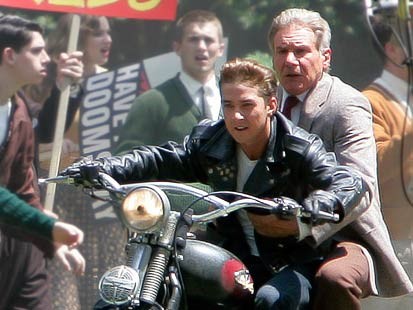
The second problem, and this is a big one, is Shia LaBoeuf. The man is a scourge to cinema. Every film he touches becomes a travesty. Seriously, look down the guy’s resume and you’ll find some of the worst reviewed films of the past few years: the Transformers sequels, Charlie’s Angels 2, Dumb and Dumberer. If he’s the sidekick or plays only a small part in the film, he’s the worst character or in the worst part (I, Robot, Constantine, Bobby) and yet, he still makes movies. In fact, he’s soon to appear in Lawless, in which I can only imagine Tom Hardy will overshadow him in every way possible as the two play brothers. Honestly, the film is going to put LaBeouf up against Gary Oldman! Though I sincerely hope that Shia’s performance in Lawless blows me away, insomuch as he wins an academy award for it, I highly doubt this will be the case, and it may even ruin that film, that I’m otherwise looking forward to, for me. In Crystal Skull, LaBeouf plays Mutt Williams. If you’re a fan of the Indy franchise, it should come as no surprise that (SPOILER) Mutt is Indy’s son, mainly because Indiana is famously named after his own father’s dog, and Mutt is of course another term for a canine. From his costume, it’s clear LaBeouf is foolishly attempting to emulate Marlon Brando from The Wild One, which he pulls off to absolutely no effect, and if anything it’s a reminder of just how terrible LaBeouf is. The fact that there were rumours suggesting this film would see the handing over of the reigns from Ford to LaBeouf to continue the saga still give me nightmares to this day. I’m almost tempted to announce Mutt as being more annoying than Short Round. Almost.

The Mutt/Indy connection brings me on to my third issue. Crystal Skull tries far too hard to be a member of the Indiana Jones family. I’ve got nothing against a sequel making subtle references to it’s predecessors, offering knowing nods and winks to fans, but here there is far too much time spent to this effect. Whilst Karen Allen, returning as Raiders’ love interest Marion Ravenwood, Mutt’s mother, is a nice touch and offers a believable romance with Indy that you are willing to at times root for, there were all too many moments and scenes that felt like the film-makers were just trying too hard to make it an Indy film. Unfortunately, they only succeeded in making it seem more like the parodies of the Indiana films that filled the gap during it’s 21-year hiatus. This felt far more like National Treasure 3 or The Mummy 4 than an Indy film.
Finally, there’s just too many characters and subplots fighting for screen time. Jim Broadbent filled in for the sadly departed Denholm Elliot as Indy’s fellow university staff member, and John Hurt was a nice inclusion as a crazy old former colleague, but both felt very sidelined, as did Ray Winstone, who should have been pretty integral to the plot. Sadly, they, and Cate Blanchett’s questionably accented Ukrainian skull-hunter were at times almost forgotten in favour of Jones’ relationships with Marion and Mutt.
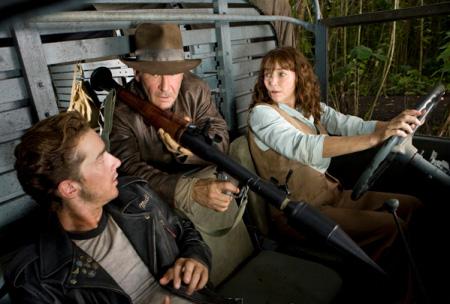
There were ways that the film could have been fixed. Raiders and Crusade proved that Indy doesn’t need a sidekick, and Temple proved that he shouldn’t have one, so nixing Mutt is pretty much a given. At least 2 scenes should have been cut, as the film feels like it runs at half an hour longer than it’s two hour runtime. I’d suggest the fridge and the diner scene with Mutt. Keep Marion, but make her be in love with John Hurt’s Oxley or Winstone’s Mac, to give Indy a bit of rivalry, and change that goddamn ending. About five minutes before the end of the film, when I first saw it in cinemas I burst out with raucous laughter at how ridiculous the climax was, and this time around it felt even more ludicrous.All that being said, it’s not exactly a horrible film, there are some entertaining sequences – I really enjoyed the jungle-set car chase, up until Mutt starts swinging with the CGI monkeys for no reason whatsoever – and it’s always thrilling to see Harrison Ford wearing a fedora, even if its not the only thing looking a bit dusty these days. I always used to defend the film for being good, just not when compared to the rest of the franchise, but I now know that even if you take it on it’s own, it still really isn’t worth it.

Choose life 5/10

Rabbit-Proof Fence

Three mixed race aboriginal girls – fourteen year old Molly Craig (Everlyn Sampi), her younger sister Daisy (Tianna Sansbury) and their cousing Gracie (Laura Monaghan) are taken from their home in the Australian outback and forced to train as serving staff at a settlement 1200 miles away. The three manage to escape, and set out to trek the arduous journey back home, but are being hunted by the camp’s tracker (David Gulpilil) and the government’s Chief Protector of Aboriginees, Mr. A. O. Neville (Kenneth Branagh).

This is one of those films that is supposed to make you angry and upset at the injustices and hardships endured by the protagonists. The three girls, and indeed all the other girls kidnapped and taken to the Moore River camp, have been captured in an attempt to prevent the creation of an ‘unwanted third race.’ The girls, you see, are all the product of white men sleeping with their aboriginal mothers, and the government believed that this ‘new race’ would cause problems, predominantly for those within the race. Once within the camp, the girls would only be able to breed with white males, and their offspring would in turn breed with white people, until the ‘aboriginal gene’ was all but eradicated. So yes, to this extent I felt sorry for the girls, as their capture was essentially an attempt to wipe them out. However, their escape attempt is supposed to be exceedingly difficult and deadly, yet this never really came through.
Whilst the concept of three pre-pubescent girls navigate across 1200 miles of unforgiving outback obviously sounds not only impossible, but so ridiculous its out of a comic book, the film depicts it as the girls drifting from one helping hand to the next, rarely encountering any obstacles that cannot be easily resolved. Even when, at one point, the three are separated, it is not long before they are reunited, despite the great distance that must have been covered. Even though it’s based on a true story, I still felt at times that it was either thoroughly unbelievable, or that major leaps were taken in the timeline. Granted, there’s probably only so much trudging through a bleached desert landscape that I can handle watching at any one time, but still.
The three leads perform well, especially given this was their first acting role, though only Sampi has worked since. Branagh, on the other hand, seems delighted to sink his teeth into a proper villain role (one that he would reprise again in all but name for The Boat That Rocked seven years later). Known to the girls as Mr. Devil, Neville is deeply hatable at every turn, even though he is working to what he believes to be the best intentions, doing what he things is right and indeed beneficial for the girls.
There are some nice burueacratic red-tape scenes, with the government debating who should pay for the country’s hunt for the girls, but the ending, which all the way through seemed a foregone conclusion, takes a little wind from the film’s sails with a “well what was the point of all that then” attitude. All-in-all, though I was impressed with the performances, there was a missed potential in what could have been a more harrowing and intense picture.
Choose life 5/10

Doctor Zhivago

One of those Sunday afternoon sweeping epics that never seems to be off the TV schedule but before the List I’d never seen before (see also The Sound of Music, Gone With the Wind, The Ten Commandments), Doctor Zhivago was a bit of a disappointment.
For starters, it’s well over 3 hours long, but very little of that mammoth runtime left any kind of impression. Other than some striking imagery – a splash of blood in freshly fallen snow, a burst of yellow sunflowers against a dull, beige hallway – and a few admittedly impressive set pieces, there’s very little from this film that’s been committed to my memory banks.

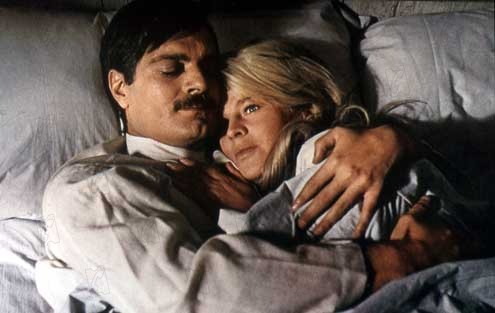
Given there’s so much time to handle, the characters don’t receive much characterisation. This is a real shame, particularly for Omar Sharif as the titular medical man, who gives an engaging a bright-eyes performance, but of a character I still know very little about. His Sharif is born into a wealthy family in Russia, a little before the Bolshevik Revolution, and the film tells of his many and varied troubles throughout his, and Russia’s, history. On many occasions the history overshadows his life, as well it should, but the focus of the film is instead on him and his loves, for his childhood sweetheart Tonya (Geraldine Chaplin), whom he marries, is forcibly separated from Zhivago, forming a love triangle when he works closely with Julie Christie’s Lara.
At times the film reminded me of – whisper it – Pearl Harbour, particularly when I was asked to try and forget about the major historical event taking place in the background of a scene, and instead focus on the trivialities of the relationships of the leads, but just like Michael Bay’s explosion-fest, the grand scale of the set pieces was very impressive. Be it the hundreds of singing extras at a rally that becomes a battleground against an army of sword-wielding Cossacks, or the miles-long trudge Zhivago sets out on to return home through the snow, there is little shortage of spectacle.
Look out for Klaus Kinski on a train, and listen as your cries for more Alec Guinness – as Zhivago’s brother Yevgraf – go unheard. Whilst the film is certainly at times impressive, especially for its time, today it doesn’t really hold up, though it is certainly better than Pearl Harbour.
Choose life 6/10

The Piano

First off, an apology for the forthcoming review. I watched the film three months ago, and have gotten so far behind on my post writing that I’ve not had any real desire to review it, as to be honest it wasn’t that inspirational of a film. Nonetheless, I shall do my best, but I’m relying almost solely on the notes I made during the movie, as I can’t for the life of me remember very much of it. As you can probably guess, this isn’t going to be much of a recommendation to watch the film.
Holly Hunter plays Ada McGrath, a woman who, aged six, willed herself mute, and has since never spoken a word. She moves from Scotland to New Zealand for an arranged marriage with Sam Neill’s landowner/writer Alisdair, and brings her young daughter Flora (Anna Paquin in her first live action picture) and their piano, Ada’s pride and joy. Neill is less than impressed with his new bride-to-be (“You’re small, I never thought you’d be small”), and refuses to cart her piano across the difficult swampland between the beach and his home, so they abandon it on the sand, much to Ada’s discontent. Fortunately local plantation worker George Baines (Harvey Keitel) takes a shine to Ada, and trades some land with Alisdair for the piano, and agrees to trade it back to Ada in return for ‘piano lessons,’ during which George will get to know Ada far more intimately than she’d like.

Hunter and Paquin both won Oscars for this film, and Hunter at least thoroughly deserved hers (Paquin is excellent for an 11 year old, but though I haven’t seen any of the performances she was nominated against I wouldn’t be surprised if any of the actresses, including Emma Thompson and the aforementioned Hunter, performed more capably). Hunter’s Ada is utterly repressed, yet still emotive and expressive, all pursed lips and passive eyes, her skin a deathly pale against the stark black of her dresses and bonnet. Keitel is also good, though his proclivity for whipping his pecker out is always a distraction, and is for the most part unnecessary.
I got the feeling that the film was made to prove the point that a lead character doesn’t need to speak (see also: Dumbo). There isn’t too much of a story here, with the events built entirely around the character and her very existence rather than the exciting or emotional events in her life. Her character is well realised, especially the bond with her daughter, and her slowly breaking down walls against Baines’ advances. Communicating only through sign language, facial expression and a small chalk-board locket, she says more than any other character, and with far less.
Despite the poetry of the film, such as Keitel’s Baines being willing to just sit and watch the piano hammers dancing gaily along the strings, I didn’t take much away from this film, and it has had little to no lasting impact on me. It’s very slow, and the message is muddled, though I think it has something to do with choosing the correct way to woo someone. Alisdair goes about things in entirely the wrong way with Ada. If only he’d coerced her into, essentially, prostitution, he’d have been much better off. Oh, and the best part about the film? It features an actress called Geneviève Lemon.
Choose life 6/10

The Money Pit

I had high hopes for this film. I’ll gladly watch Tom Hanks in anything (I didn’t even mind Larry Crowne that much), and it co-stars Shelley Long who, having starred in Cheers, must be good for something. Well, OK, maybe not high hopes, but some hopes that I’d enjoy this film, but alas even those hopes were too high. I understand now why ASDA were recently flogging this DVD for £3. It’s not that it’s a terribly bad film, it’s just confused, contrived and desperately unfunny, which considering it’s an 80s comedy, makes it something of a failure.
Hanks is Walter Fielding who, along with his partner Anna (Long), find themselves in desperate need of a place to live after a series of silly  and easily avoidable plot points. When they discover an astoundingly cheap yet extravagant mansion, they buy it with an almost reckless abandon, despite the inevitability of it collapsing upon them. Needless to say, everything that can go wrong with the house does.

My main problem with the film is that at no point did I feel sorry for the two leads. I’m a home-owner, and have had a fair few problems with my flat, but unlike Walter and Anna, I didn’t have a wealthy employer/ex-spouse or client who would pay for everything, as is what happens here. Other than having to live in a building site for an extended period of time, the two don’t really have any long term problems, other than each other.
Also, the film is decidedly short on laughs. There were some farcical moments – the bathtub falling through the floor and Hanks getting stuck in the floorboards – that were a bit humorous, but mostly the film tried too hard and came up with nothing. One sequence involved Hanks in a ridiculous chain reaction involving a moved plank, circular saw, pit of wet cement and collapsing scaffolding. The setup can be seen a mile away, and the scene offers almost no payoff. It looks like Walter is about to be ousted as a KKK member when a black builder spots him on the roof dressed head-to-toe in white and wearing a hood, but no, the cement all gets washed off in a fountain, so there isn’t even any chance for him to become a kind of living statue. So many opportunities were missed for greater comedy, and there’s very little else that sticks in my memory about the film.
When Joe Mantegna pops up as a building contractor my hopes picked up, but then he never came back again, so I was deprived of getting to watch Fat Tony as well as listen to him  Even if you’re a Hanks fan and have a desire to watch everything he’s been in I still wouldn’t recommend this film, as though he has great comic timing and can pratfall like the best of them, even he can’t make this film watchable. Avoid.
Choose life 3/10

Born on the Fourth of July

Does anyone else find it funny that Tom Cruise, whose birthday is the third of July, starred in a film called Born on the Fourth of July? No? Just me then.
Olive Stone is one of those film makers that I don’t really get. I’m not that much of a Platoon fan, nor can I say I have any affiliation with Wall Street. Natural Born Killers has it’s moments, and I can’t remember a single scene of Any Given Sunday, though I saw it less than 2 years ago. Other than that, I haven’t seen anything he’s made, though my hopes are up for JFK, whenever I eventually get around to seeing it. Born on the Fourth of July seems like a typical Stone movie, in that it comes deeply ingrained with a message (war is hell and will mess you up), and though at first glance it may seem patriotic, if you look a little deeper it’s really a chance for Stone to voice his own personal feelings about his country.
Tom Cruise is Ron Kovic,who growing up in 1950’s Long Island idolised the war heroes in the Independence Day parades. He looked past the wheelchair, crutches and missing limbs, seeing only the glory and patriotism of being a hero. Kovic spent his school years working hard and being committed to being the best, and after his wrestling attempts didn’t quite work out, he responded positively to a presentation from the US Marine Corps, and signs up with a few buddies, including Stephen Baldwin.The scenes of Kovic’s childhood are shot with a hazy, wholesome, rose-tinted nostalgia, and his family, especially his mother, are all very supportive of Ron’s decision to head to Vietnam and fight for his country, and die there if he has to. The era is well realised – particularly though the soundtrack, as Ron’s brother learns Bob Dylan on the guitar – and the TV broadcasts, with Kennedy’s “What you can do” speech seemingly speaking directly to Kovic.

After signing up and heading to war, the action skips straight over boot camp and the green-horn period – Stone covered all that in Platoon three years earlier – and drops us straight into the now Sergeant Kovic’s Second tour of Vietnam in 1967. These sequences are atmospheric and well-realised, but they’re less impressive than almost any other war film. It’s a good thing then that this film isn’t really aiming to show an accurate, visceral depiction of warfare, instead focusing on the disillusionment of volunteers, the effects that warfare can have on those who fight it, and the disconnect between the soldiers and the families they’ve left behind. For when Ron is discharged – in a wheelchair, with the promise that he’ll never use his legs again (though his main concern is being able to use what is between those legs) – he discovers that his brother doesn’t believe in the war, and his friends that stayed home became prosperous and affluent, whilst he had everything taken away from him.

The cats is full of familiar faces from anyone who’s watched Platoon – alongside Tom Berenger’s Marine recruiter is Willem Dafoe’s similarly paralysed veteran, and John C. McGinley turns up for a very small role (as do Wayne Knight and Tom Sizemore).

The film takes a very long time (145 minutes) to put across some fairly simple ideas. The first 90 minutes are thoroughly predictable, and there were very few surprises in the last hour either. Tom Cruise isn’t bad in the role, but as ever he always does better when he isn’t front and centre (Magnolia, Tropic Thunder), and I couldn’t shake the feeling that he was desperately pursuing an Oscar. Though he was nominated, it’s no surprise that it went instead to Daniel Day-Lewis for My Left Foot, and I’d still have been happy had it gone to fellow nominees Robin Williams or Morgan Freeman, for Dead Poet’s Society or Driving Miss Daisy, instead of Cruise.

It’s worth watching if you’re a Stone or Cruise completist, but there’s little new here, and what there is still won’t surprise, or impress you.

Choose life 5/10

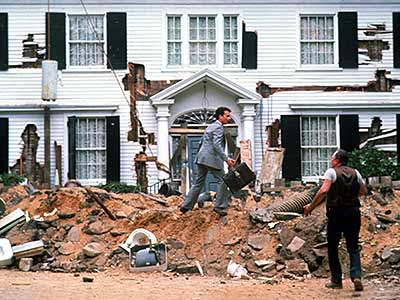
Sophie’s Choice

The unfortunately named Stingo (Peter MacNicol) moves from his southern home to be a writer in New York. He rents a room in a house, and so finds himself firm friends with a neighbouring couple, Sophie and Nathan (Meryl Streep & Kevin Kline). Sophie and Nathan have a tumultuous relationship, as she has a tragic past and he has issues of his own, and slowly Stingo learns of their history, and the hardships Sophie has had to endure.
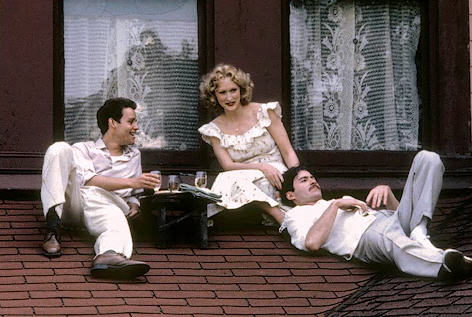
In the world, there are happy films. They are stories about underdogs overcoming adversaries, battling against hoards of naysayers as they set out to win the court case/football game/heart of the cheerleader. The kinds of films where, upon finishing, you punch the air and yell something, just to join in the triumphant atmosphere. And then there’s Sophie’s Choice. Watching this film is like receiving one punch to the gut after another, rounded out with a swift thwack to the head with a two-by-four. It’s like watching Schindler’s List whilst listening to country music and drinking a glass of orphan’s tears. If you have a big grin plastered over your face after watching the film, I’m guessing you wouldn’t have been out of place in the Hitler Youth back in the 1940’s. The happiest parts of this film occur between the three leads as they enjoy a life of carefree wonder, visiting Coney Island dressed in period garb, but even these moments have the rug pulled out from them eventually.

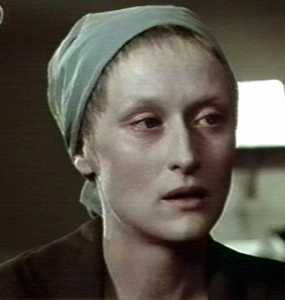
As with many films on this list, I have a history with this movie. I’d heard it was good, so I borrowed a copy from my Grandad – a copy he’d got free from a Sunday newspaper and never intended to watch, yet he still required it returned after I watched it. Free DVDs don’t tend to have much in the way of DVD extras, up to and including DVD menus. In fact, most will just play straight out, without you needing to touch a button. In fact, I’ve watched one before that didn’t even have chapters. I tried to skip back to catch a line I’d missed, and ended up back at the start of the film, and had to fast-forward to the scene again. What a time we’re living in. Anyway, Sophie’s Choice was such a film that had no extras, just a big old ‘PLAY’ button. I’d heard that, for Streep’s Oscar-wining performance she’d learnt Polish and German for the role, which was not something I’d given a second thought to until, over halfway through this 2 1/2 hour film, there’s the first of a few flashback sequences of Streep’s Sophie in WW2-era Germany, and the DVD had no subtitles, leaving me to attempt to watch and understand what are probably the more famous and pivotal scenes of the film, without the aid of knowing what anybody was saying. To the actor’s credit, for the most part I think I understood it, but still. I’ve known someone to go through a similar situation with Vicky Cristina Barcelona, but that was their fault for watching an illegal download.There are some actors who have a very famous role that they simply cannot overcome for some people, or in this case a role they’ve only played once but that has been seen many times. For me, Peter MacNicol will always, and only, be Dr. Janosz Poha from Ghostbusters 2. The mild-mannered southern writer Stingo doesn’t stand much of a chance against Janosz, seeing as he’s given very little characterisation here, but then this isn’t his film, he’s a cypher through which we get to know Sophie. This film belongs entirely to Meryl Streep, whose performance is just as good as it’s ever been suggested. No superlative can be left unused when describing the levels she goes to, mentally, physically and linguistically, to completely transform herself into the concentration camp surviving Sophie. Her accent is spot-on, and you completely forget you’re watching Meryl Streep. If it weren’t for Kline and MacNicol sharing the screen with her, I’d occasionally have sworn it was a documentary. I’m guessing that Julie Andrews, Jessica Lange, Sissy Spacek and Debra Winger, the other Leading Actress Oscar nominees that year, didn’t even bother showing up to the ceremony. Not only did she learn Polish and German, but Streep goes so far as to convince that they are her first languages, as she trips and stumbles her way through near-broken English, whilst during her flashbacks of the camps she looks to be several days passed Death’s door with her pallid skin, sunken eyes, roughly shaved head and frail, skeletal frame. This performance should be mentioned in the same breath as DeNiro in Raging Bull. It’s hardly a surprise that the rest of the cast pale in comparison.

It’s a shame then that her performance is the only outstanding part of the film. I had an understanding of the meaning of the title before watching, so assumed it would play a large focus in the film, but it is only at the climax that we see the pivotal scene, and it’s very nearly glossed over. We get a sense of the ramifications and the how it has made Sophie who she is today, but it eventually turns out that the choice she made would have made absolutely no difference anyway. As a story detailing the personal effects of concentration camps and World War 2 this is compelling, yet there are too many detours to detract from the story in an attempt to lighten the mood – Stingo’s date with the nymphomaniac Leslie Lapidus (Greta Turken). There are some nice comparisons between the camp prisoners and the guards – an officer’s daughter complains about the lack of a heated swimming pool.

The film also falls into two of my bigger pet peeve pits, in that a 28-year old MacNicol, who looks about 35, is playing a 22 year old, and at a couple of times there are phone conversations where the person on the other end is almost inaudible, but not quite, so some volume control had to be undertaken.

Despite possibly the greatest acting performance ever, this film is unfortunately let down by an incredibly depressing plot and an unsatisfying ending. There’s no doubt it’ll stick with you for a long time, but I highly doubt you’ll ever want to watch it again.

Choose life 7/10

Troy

Regardless of whether you know the story of Homer’s Iliad, it’s a certainty that you know of the expressions Helen of Troy, Achilles’ Heel and The Trojan Horse. These plot points have become more than the legend of which they are a part, and have entered the modern lexicon as sayings and day-to-day phrases. They aren’t anything new, you know what is means and have heard them a million times before, and the same can be said for every aspect of this film.

Continue reading