Bunuel Marathon

I’ve made no secret that I dislike the films of Spanish surrealist/Mexican politicist Luis Bunuel. I find his work arduous, unpleasantly illogical and disconcerting, so I thought it would be a good idea to remove the remainder from the list in quick succession, allowing for 8 films to be bundled together in another overlong post that no-one with a modicum of sense will ever read.

Our first is Belle de Jour, a senseless, semi-plotless effort typical of Bunuel, following Severine (the beautiful Catherine Deneuve) who behaves frigidly towards her husband of one year, but finds herself stepping out to work at a brothel without his knowing. What little plot there is is predictable – inevitably a lecherous friend of Severine’s husband visits the brothel and propositions her, with only Deneuve’s performance is worth watching. Mercifully, little intercourse is shown.
In the Discreet Charm of the Bourgeoisie, I was shocked to find an almost coherent story running throughout, as six upper crust respectable people – drug dealers, no less – struggle to all come together for a meal, but are denied the chance at every turn, be it from confused calendars, a dead restaurant manager, a bout of pre-lunch nooky, a shortage of tea and the unexpected arrival of a branch of the military. There is indeed a certain charm to the story, nicely balancing the ludicrous dining catastrophes with the concern that the drug pedallers are being tracked by terrorists, but alas all this is blown to bits with interruptions from a tragic Lieutenant, telling of how his mother’s ghost told him as a child to poison his father, or a dream he had meeting dead people on a street. The bishop is also an unnecessary distraction, and the Inception-like dream within a dream finale adds nothing but disappointment.

It’s Catherine Deneuve again, this time playing Tristana, a woman in mourning for her recently deceased mother, who goes to stay with the lecherous yet refined Don Lupe. He spouts bizarre philosophies (“a woman only stays honest with a broken leg – and at home!”) which begin to rub off on Tristana as he makes several advances towards her yet she does not seem to object. She makes a point of always choosing between two things, so it’s safe to assume she will eventually be called upon to choose between two men, and she suffers from the kinds of bizarre, unexplained dreams that are Bunuel’s bread and butter. There’s a fair stab at an actual plot, but bland or irrational characters, large periods of time passing with little acknowledgement and an unsatisfactory, inconclusive ending mars the film.

After an unexpected yet poorly edited explosive opening that had to be rewound to work out who it happened to, That Obscure Object of Desire heads downhill. Using an annoying and repeatedly referred to narrative device of a man telling his story to other passengers in his train carriage, we hear of the events that led up to him pouring water over a woman on the train platform. The other passengers continually tell the man that his story is fascinating and remarkable, but it is nothing of the sort, concerning a duplicitous young women employed as a maid by the man, who leaves when he shows her affection, and bear in mind that the positive adjectives used to compliment the man’s story were written by the same person who wrote the story he is telling, making them nothing more than egotistical propaganda.

Los Olvidados began positively, but I’m sure not in a way hoped by those involved in its production. Expecting a 95 minute film, the DVD clocked in at a much more tolerable 76 minutes, so I settled down with a grin on my face at the extra 19 minutes I could spend asleep that evening. Having just escaped from prison, young gang leader Jaibo rejoins a band of youths and sets them up to rob a blind busker. The plan fails and one of their number is stabbed, so later the gang pelt the busker with mud and stones, destroying his instruments. All the gang members look at least a little alike and are hard to distinguish from one another, and there are few genuinely likeable characters in the cast. One young hoodlum steals food from his own mother, but to be fair, when asked if she loves him, the mother replies “Why should I love him? I don’t even know who his father is.” The film shows a mildly interesting look at those trying to escape a life they’ve been born into, but not a lot happens, and when it does it isn’t terribly interesting.

Inconclusive and pointless, Viridiana sees a nun visiting her sick uncle, only to find she is eerily identical to her deceased aunt. Her uncle, Don Jaime, is willing to do anything to prevent Viridiana from returning to the nunnery, though drugging her and pretending to rape her is a little extreme, as is hanging himself when his plan fails. Believing herself to be deflowered and therefore unable to return to her calling, Viridiana brings in some homeless people to help out around her late uncle’s house – much to the chagrin of her uncle’s other relatives – and the previously homeless do a less than acceptable job of helping out. Long periods of silence make it easy to drift off, as does the boring story with little to retain interest.

To begin with in Land Without Bread, I thought the worst part of this half hour documentary about an obscure poverty-stricken Spanish village in 1932 was going to be the production values, with a poor quality transfer resplendent with cracks and scratches, terrible sound and mistakes in the subtitles, bit it turns out I was quite wrong. The film is horrific in its depiction of a town where the only water source is a muddy stream running through it, children’s parents steal the bread their offspring bring home from the school and almost everyone is diseased in some way – a 32 years old woman looks at least 55, with a revoltingly bulbous goitre on her neck. We see a child with inflamed gums, and two days later she is dead. The only milk available is from the goats that thrive on the barren, rocky landscape, and is reserved only for the very sick, and goats are only used for their meat when they die of natural causes. At this point the film takes a turn. We see a goat fall from the rocks to demonstrate the previous point, and also a donkey being stung to death when a bee hive it is carrying falls off. After watching the film, I later discovered both events, each ending in the very real death of an animal, were both staged, with Bunuel even smearing the donkey with honey. Words fail me for home disgusting this is. A group of dwarfs are filmed as though the focus of a nature documentary (“Some are dangerous. They flee from people or attack them with stones. They are found at nightfall as they return to their village. We found it very hard to film them.”) There are repeated shots of a dead baby. This is a thoroughly depressing film that does not broach the subject of why the village’s inhabitants remain there, and it’s only redeeming feature is making the viewer grateful for what they have.

And finally, The Young One. Racism runs rampantly throughout this tale of a black man fleeing the accused rape of a white woman, and discovering an island inhabited only by a young girl and her abusive guardian. It’s a fairly straightforward plot, with the accused criminal attempting to leave the island, but there are bizarre and inappropriate sexual overtones between the girl and both men, especially because she is clearly underage, though no-one, not even the girl herself, knows how old she is. There isn’t as much wrong with this film as in most of Bunuel’s, but also nothing really noteworthy.

Belle de Jour: Choose life 5/10
The Discreet Charm of the Bourgeoisie: Choose life 6/10
Tristana: Choose life 4/10
That Obscure Object of Desire: Choose life 3/10
Los Olvidados: Choose life 5/10
Viridiana: Choose life 4/10
Land Without Bread: Choose life 1/10
The Young One: Choose life 6/10
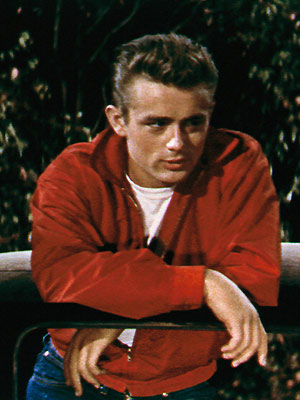
Rebel Without A Cause

The most iconic of James Dean’s 3 major roles, after East of Eden and before Giant, sees him inspiring numerous Eagles songs as Jim Stark, the new kid in a small town, eager to butt against any system willing to oppose him. He takes a shine to Judy, the girl of gang leader Buzz, and finds troubled social outcast Jon, calling himself Plato, takes more than a shine to Jim. A young Dennis Hopper plays one of the gang members – who I was half expecting to start clicking and dancing to Officer Krupke at some points, but thankfully this was not the case.

The film’s notoriety as a touchstone for a generation of rebellious kids with little to rebel against has raised expectations to levels left wanting, and though Dean’s performance shows potential it cannot be judged against those that might have been. Two scenes stand out – the ‘chicky run’ and tense observatory-set finale, but the film doesn’t even come close to its reputation.
Choose life 6/10

La Haine

The morning after a destructive rioting on a French housing estate, three youths involved – Jewish Vince, Arab Said and black Hubert – freefall through the aftermath as the community struggles to pick itself up. A gun was lost by a policeman, the gym the reformed Hubert built was trashed and Said is in bad need of a haircut. The 3 leads perform ably, particularly Vincent Cassel as the livewire yet inexperienced Vince, who does a pretty good De Niro impression when needed. There’re some nice comic touches – the three struggle to hot wire a car before realising no-one can drive – and the ending is abrupt, shocking yet completely fits.

Choose film 8/10

Disney Weekend

I needed to (and to be fair, still do) catch up on my film watching and post writing, so the opportunity to watch several short films that could all be written up in one post was something that needed to be implemented (and will soon be repeated with an upcoming Luis Bunuel collective post, watch this space). So what better way to do this than with an entire weekend devoted to the Mouse House and it’s timeless catalogue of classics? After a quick LoveFilm reshuffle, some DVD borrows and a root through my parents VHS collection the scene was set.

As was the recent Star Wars marathon, progress was made chronologically, so let me begin by taking you back to 1937, when an evil queen kept her beautiful step daughter locked up and dressed in rags, forced to work cleaning the castle, with singing to birds her only enjoyment. When Snow White’s beauty begins to surpass that of her stepmother, the evil queen orders a huntsman to lead the young housemaid into the woods to kill her, but he cannot and she flees instead. Her journey through the woods is terrifying – floating logs become crocodiles, trees grow hands and grab at her (but stop short of Evil Dead-style harassment, this is a kids film after all), but fortunately she finds an abandoned house in the woods and ploughs straight in with half the woodland in tow. A message that should have been made clear in this film, but was bizarrely omitted, is hat wild animals should not be used to aid cleaning, and especially not in serving food. Licking a late clean is an expression uncle Walt took all too literally, and I highly doubt the tails used to dry the crockery and measure ingredients were ever sanitised.
Imagine, if you will, that you’ve been at work all day with your six diminutive brothers. The disreputable state of your house when you left it that morning shows that cleanliness has never been high on your list of priorities, and the lack of a dog bowl shows that animals have no place under your roof, yet when you arrive home you discover an undeniable case of breaking and entering – the culprit is still asleep in 3 of your beds after all – and I’m guessing an at least light scattering of feathers, fur and footprints everywhere you look. If your reaction is celebration rather than immediate calls to the police and pest control, chances are you randomly break into song on a daily basis. Typically for an early Disney film, the plot is non-sensical and wafer thin (so the evil Queen is also a witch who can transform her appearance – why not either make herself more beautiful or Snow White ugly?) and the songs – other than the timeless Hi Ho Hi Ho – are forgettable and saccharine. Often scenes are entirely superfluous – Snow dances with the dwarfs for a straight 5 minutes – and, whilst notable for being the first feature length animation, many better films along similar lines have now eclipsed it.
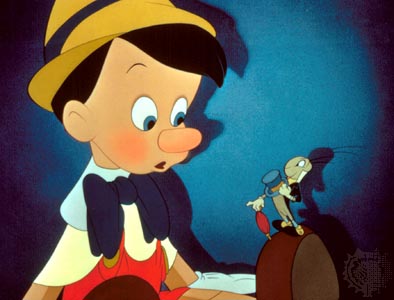
One such eclipser is Pinocchio, raising the bar in both quality and insanity stakes, as lonely toy maker Geppetto wishes on a star that his latest puppet were a real boy. Of course this happens, and a cricket is made his conscience, (because why not?) and the next day an overjoyed Geppetto sends his new son off to school, presumably to have the sap kicked out of him for being made of pine, threatened with matches, woodpeckers, beavers, or just a good old fashioned junior hacksaw. Arguably saved from this fate, Pinocchio is instead befriended by a couple of talent scouts, who are probably evil because in a film where almost all of the characters are people, these two are a talking fox and cat, wearing hats and smoking cigars. Their boss puts Pinocchio on stage – neglecting the idea that talking animals would prove just as lucrative – and sets him up for more episodic adventures, as Pinocchio learns valuable lessons about not smoking and drinking – they’ll turn you into a donkey – and it’s OK to be eaten by a whale. It’s a testament to Walt’s creativity that Pinocchio’s nose growing whenever he tells a lie is such a small part of the story, yet is the most quoted and parodied aspect, with everything else – all equally ludicrous – being all but forgotten.
The only film appearing here that I hadn’t seen before in Fantasia, though I knew of clips like Mickey cleaning up with magical mops and hippos dancing with crocodiles. It turns out that the reason I’d heard of those two segments and no others is that they are the only ones worth mentioning amongst the 8 extended animated shorts – each set to music played by the Philadelphia Orchestra. The first 7 ½ minutes are wasted on the arrival, tuning and introduction of the various orchestra sections and an introductory speech from the conductor, and more time is wasted in between each song by going back to him to set up the next section. At one point, he ridiculously introduces the soundtrack as a character, showing different instruments causing a line to wiggle differently as though part of a basic music lesson, and do we really need to see the orchestra leaving for a break half way through, then setting their instruments up again upon their return?
As for the shorts, most are tedious and pointless, neither improving nor complementing the music backing them. At one point my hopes were unforgivably raised with the promise of a dinosaur-filled segment, only for the dinos to only appear briefly and not do a great deal whilst on screen. With too much time dallied on single-celled organisms and ambiguous evolution. We also see what appear to be very young centaurettes dolling themselves up, with the help of some naked infant fairies, for a bout of hanky-panky with a gang of much older looking centaurs, the moral to be taken from which is only date someone the same colour as you. I can only recommend the aforementioned Mickey Mouse caper the Sorcerer’s Apprentice and the animal ballet Dance of the Hours, with ostriches, hippos, elephants and crocodiles set to La Gioconda, though I think the elephants should have been replaced with something smaller, like monkeys for instance, to offer a greater level of contrast between themselves and the similarly rotund hippos. 1001 comments that the films contains a good hour and a bad hour – a generous statement in my opinion – which makes me wonder why it was included, and not bumped for the more iconic and prolific Steamboat Willie.
Back to the more traditional Disney – talking animals larking about, learning life lessons and suffering horrific tragedies. Ask someone what they remember about Bambi and just like Pinocchio they’ll all respond in one way, his mother getting shot. Maybe they’ll say they cried, seeing it for the first time as a young child, or how it traumatised them for life. This is nonsense, for nothing is shown, his mother is there one moment, you hear a shot, and then she isn’t. Any traumatising was more likely done by the parents in a presumably well-meaning but poorly handled attempt at an explanation that Bambi’s mum has headed to the big meadow in the sky, or perhaps mounted above a fireplace. The knowledge that the mother will die – shot in a meadow by a hunter – is common information, yet mars every visit to the meadow before it with a layer of apprehension for the viewer, for there is little else in the film even close to depth. The lead is cute but empty, the life lessons – forming friendships, meeting a girl, accepting responsibility, growing up – are all trite, and other than a seamless transition from falling raindrops to the song April Showers one wonders whether the film would still be discussed if the mother had survived.
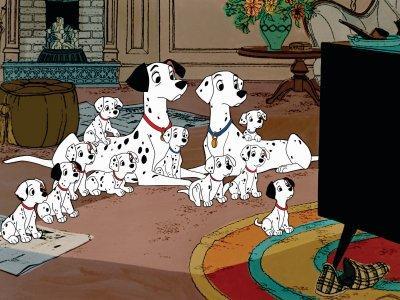
Disney began to develop their winning formula with 101 Dalmatians. What was needed you see was cute protagonists, lovable yet clumsy sidekicks, lessons to be learned on a great adventure, a cracking soundtrack and an iconic villain. All had been seen at least in part across the previous films, and here not all are present – there are no real life lessons and only one song, but one that remains to this day to be a particular favourite from the Disney canon; the catchy yet effortlessly simple Cruella DeVille, also one of the greatest and most memorable bad guys in cinematic history. The plot involves a batch of Dalmatian puppies (I forget how many) DeVille wishes to make a coat from, and though the first half has its moments – dog and owner pacing frantically outside the room the female dog is giving birth in, women outside of a window all bearing a strong resemblance to their dogs – it is the action-packed second half that is the key to this film, possibly the only children’s movie to feature the line “the blacker the better,” a quote I doubt Uncle Walt approved of.
And now we’re on to our first true classic, as young man-cub Mowgli is raised by a pack of wolves in the jungles of India, but is cast out when a tiger threatens his life in this retelling of Rudyard Kipling’s the Jungle Book. The cast of characters is creative and varied, from the hypnotic snake Kaa, sensible panther Bagheera, partying bear Baloo, human mimicking orang-utan King Louie, militaristic elephant herd and of course the menacing, fearsome tiger Sheer Kahn, a clear inspiration for Alan Rickman in Die Hard. The songs are wonderful, particularly Bare Necessities and I Wanna Be Like You, and the animation is spectacular. Other than the inexplicably Liverpublian vultures and the fact that Kaa sounds exactly the same as Winnie the Pooh (both are voiced by Sterling Holloway), the film is flawless, and carries an important message – females are devious.
So how do you improve on the Jungle Book? What was the missing ingredient? Dancing cutlery of course, in what else but Beauty and the Beast. It’s easy to forget just how wonderful this film is, even for an adult male such as myself. Featuring the most recommended female role model in a Disney film (other than perhaps Tiana from the Princess and the Frog, but that wasn’t a very good film) as Belle, a non-princess brunette inventor’s daughter, has inspirations of her own that do not involve a loveless marriage to a handsome yet rude and oafish brute, but she is extraordinarily beautiful, but considered strange by the rest of the village as she always has her nose in a book. When her father is captured by a hideously deformed beast (ooooh, now I get the title), Belle offers to take his place if her father is released. Of course Belle and the beast fall in love (after he gives her a goddamned library he already frickin’ had), but aside from the traditional plot (Remade from 1946’s La Belle et la Bete) the songs are far better than I’m willing to admit without being castrated, and are still stuck in my head more than a month after watching the film, not that I’m complaining. Undoubtedly the character who makes the biggest impact is the Bruce Campbell-chinned, Conan physiqued town meatball Gaston, a complete bastard willing to have Belle’s father committed if it means she will marry him, and who’s only redeemable feature is his brilliant rabble-rousing song (“I’m especially good at expectorating”).
And finally, my personal favourite, and my earliest memory of going to the cinema, The Lion King, or Hamlet for kids. Undoubtedly the greatest soundtrack of any Disney film, and easily among the best of other movies too, composed by Elton John and Tim Rice and featuring classics like I Just Can’t Wait To Be King, Circle Of Life, Be Prepared, Can You Feel The Love Tonight and of course Hakuna Matata (we don’t talk about Rowan Atkinson singing the Morning Report through his nose). The cast is stellar, including Jeremy Irons, Matthew Broderick, Nathan Lane, Whoopi Goldberg and James Earl Jones, and the story is terrific fun, yet still deals with the hardship of losing a parent, as lion cub Simba flees his family after believing he killed his father Mufasa. The scenery is stunning, taking in the African plains, lush jungle and elephant graveyard, and the script is full of humour, laden with lion puns (“a matter of pride,” “the mane event”).
Well that didn’t really work, did it? This was supposed to take less time than writing 8 individual posts. Ah well. I’ve got to say I wouldn’t recommend watching this many Disney films in such a short amount of time. Since watching them all, I’m taken by surprise when a passing animal refuses to have a conversation with me, or when my neighbours fail to spontaneously break into song.
Snow White: Choose life 5/10
Pinocchio: Choose life 6/10
Fantasia: Choose life 3/10
Bambi: Choose life 5/10
101 Dalmatians: Choose film 7/10
The Jungle Book: Choose film 8/10
Beauty and the Beast: Choose film 9/10
The Lion King: Choose film 9/10

Moulin Rouge!

This is that rarest of creature; a heavily female-pitched film – a musical, no less – that appeals to guys just as much as the gals. The main problem Moulin Rouge faces though is that not many men have actually seen it, immediately being put off by the idea of watching a soppy romance in France for 2 hours, where the closest thing to a bit of totty is a vapid Nicole Kidman, face set to simper, and that goddamned Lady Marmalade song is likely to be played every 10 minutes. But put aside the prejudice and you’ll find a film positively brimming with style and creativity.

Embracing its stage show inspirations we open on a curtain, a conductor commanding the orchestra to play the 20th Century Fox theme. Abandon any buttoned-up fustiness here, for what follows is a tale of bohemian values, elephant-shaped boudoirs, mistaken identity, forbidden love and some of the most gloriously hammed-up performances since the days of silent pictures, especially Jim Broadbent as red faced showman Harold Zidler and Richard Roxburgh’s snivelling Duke. The songs – mostly rejigged versions of classics from Nirvana to Queen via Shirley Bassey – are worthy of owning the soundtrack, as long as you don’t mind skipping track 2 every time, and far as I can tell the choreography isn’t bad either. The Roxanne Tango, Broadbent’s hilarious Like a Virgin and the showstopping central Elephant Medley are easily the highlights, though some of Kidman’s slower numbers do begin to drag.
Whilst Kidman and Ewan McGregor are usually far from being my favourite performers, here she is adorable and sexy, he is charming and sweet, and it is refreshing to see a cast clearly having a great time, being given the opportunity to overact to their hearts content whilst still giving tremendous performances.
Choose film 8/10

Cyrano de Bergerac

Gerard Depardieu is Cyrano de Bergerac, there is no doubt in the matter. He was born to play the role, in one of those instances where no other actor could possibly be even imagined playing the role. Even the great Steve Martin gave it a stab in Roxanne, but he couldn’t quite match the heady heights (or should that be lengths?) achieved by Depardieu and a handful of putty on his proboscis.

Though wittier and more romantic than any man within smelling distance, the Cyrano de Bergerac has to his mind but one fault; his comically oversized snout. Though he loves his cousin Roxane, he feels he can never voice his feelings, for she would surely laugh away his advances, so when Roxane falls for the much more handsome yet far less eloquent Christian, Bergerac proposes to assist the pair by writing her letters on Christian’s behalf. Depardieu adds more than a sniff of life and colour to the picture, his red cape like a beacon amidst the otherwise muted palette as his noble showman takes on all comers at both word and swordplay, defeating a man whilst with both rapier wit and real life equivalent after being told his “nose is very big.” By beginning with arguably the greatest scene the film can only go downhill, but it doesn’t go far, maintaining a level of quality and tension throughout.
An unexpected turn occurs in the third act, and comedy is mined when Christian is forced to make wooing attempts without his wordsmith aide (“I love you”/”Yes, and then?”) and the attempt to resolve a love triangle amidst an epic battle is equal parts humorous, heartbreaking and dramatic.
Choose film 7/10

Scream

It says something about the sheer volume of horror movies made in the 70s, 80s and 90s that in 1996 Wes Craven, himself creator of such classics as A Nightmare on Elm Street and the Hills Have Eyes, was able to create a film almost entirely about other horror movies, whilst still existing as a genre-defining horror-comedy along the way. Namechecking the likes of his own works (whilst having a dig at the sequels he wasn’t directly involved with) as well as Halloween, Friday the 13th, the Exorcist, Basic Instinct, Frankenstein, Prom Night, the Howling, Evil Dead, Hellraiser, Clerks, Psycho, Carrie, I Spit on Your Grave, the Texas Chainsaw Massacre and the Silence of the Lambs to name but a few, the script revels in its horror knowledge, with one character, Jamie Kennedy’s Randy, working in a video store (remember them?) and dictating the rules of surviving a horror movie (don’t have sex, never drink or take drugs, never say “I’ll be right back”).

Scream was one of the first horror movies I ever saw, and rewatching it now brings a much greater level of enjoyment and understanding, for now I’ve seen most of the films it references as a masked killer stalks the inhabitants of Woodsboro, one year after the mother of Sydney Prescott (Neve Campbell), a high school student, was raped and murdered. Hilariously, most of the characters refer to the serial killer as though it were a horror movie (“there’s a formula, a very simple formula – everybody’s a suspect!) and the script is full of other little notes that you’ll enjoy this a great deal more if you like films in general.

Typically with all franchises, the sequels deteriorate in quality, but it’s clear this was set up as a franchise from the beginning, with Sydney predicting Tori Spelling would play her if they made the story into a movie (as happens in Scream 2’s film within a film, Stab), and Liev Schreiber’s role of convicted killer Cotton Weary beefed up a great deal for part 2. This is exactly the horror film needed to reinvigorate the once tired genre; a horror film made for people who love horror films, by people who love horror films, about people who love horror films.
Choose film 8/10

The Sting

When small time conman Johnny Hooker (Robert Redford) accidentally steals $11,000 from racket running mob boss Doyle Lonnegan (Robert Shaw), he finds himself on the run after his partner is killed. Skipping town, Hooker teams up with long con artist Henry Gondorff (Paul Newman) to exact revenge. This reteaming of the stars and director (George Roy Hill) of Butch Cassidy and the Sundance Kid doesn’t quite reach the heady heights of the original, though a lot of attention has been paid to recreate a 1930s feel, from an old-fashioned opening logo, character introductions and hand-drawn chapter cards to everything being tinged with a sepia hue. 

I used to be a big fan of Hustle, so the route the plot takes was no surprise to me, with only one moment really catching me out. This let down the film in my expectations, and though the acting is solid, all involved have done better, most notably Shaw in Jaws and the Taking of Pelham One Two Three. Still, it’s a lot better than most other heist movies, it’s just a shame that watching them all ruined this one for me.

Choose film 7/10

As Good As It Gets

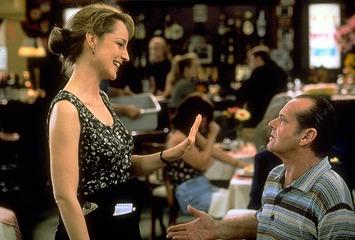
Jack Nicholson is on fine form here as OCD-afflicted writer Melvin Udall, the least likely man ever to be described as a people person. He spends his days eating at his favourite cafe, being attended by his favourite waitress Carol (Helen Hunt good but not great, though she won the leading actress Oscar in what appears to have been a slow year) and annoying everyone else he comes across, most notably his gay artist neighbour Simon (the always reliable Greg Kinnear), whose dog we find Melvin depositing in the garbage disposal chute at the opening of the film. There’s barely a minority that isn’t critiqued in some way; Cuba Gooding Jr. is described as being the colour of “thick molasses,” the Jews dinging at Melvin’s table (Taub and Cuddy from House!) are informed that their appetites aren’t as big as their noses and, my personal favourite and a line I try to use as often as I can in everyday life, when asked how he writes female characters so well, Melvin replies “I think of a man, and I take away reason and accountability.” Genius.

Whilst focussing on Melvin, easily the more entertaining character, this is essentially a triple character study, with the second half of the film following Melvin, Carol and Simon on a road trip to visit Simon’s parents. The supporting characters loss is noticeable, but more than one eye is kept on the comedy even in the more dramatic or sentimental scenes. If this is as good as it gets, I’m fine with that.

Choose film 8/10

Casablanca

I’ve finally watched Casablanca! After Gone with the Wind and Singin’ in the Rain I’ll finally be able to call myself a film fan. Don’t worry, they’re on the list, and GWTW is on my DVD shelf, so watch this space. There are many films – these three included – that are held with such high regard in the cinematic community – nay, the world – that one cannot possibly expect to leave the film having had expectations met and a smile on the face, so I went in expecting nothing but misquoted famous lines, romantic clinches and a bitter sense of disappointment, yet when those closing credits rolled the sense of elation tingling up my spine cannot be exaggerated. What we have here is more than a film, it’s a landmark in history.

Humphrey Bogart is of course Rick, owner of Rick’s Cafe American in Casablanca, French Morocco around the outbreak of World War 2. Bogey set the template for cynics on screen, sticking his neck out for nobody but those that will help him along. Rarely is there a moment when he isn’t drinking, smoking or both. The story involves a concentration camp escapee and secret documents containing a letter of transit allowing a safe departure from the town, but what you’re really here for is the script. Everyone knows the classics, “Here’s looking at you kid” “all the gin joints…” and “we’ll always have Paris” (“play it again, Sam” is never actually uttered) but the lesser known phrases are just as good, if not better: “I have given him the best, knowing he is German and would take it anyway” “this gun is pointed right at your head”/”that is my least vulnerable spot”.

Long scenes make the film seem longer than it is (for a classic it is surprisingly sleight at only 102 minutes) and Ingrid Bergman wears a distractingly terrible blouse for much of the film, but if yuo haven’t seen this film, I urge you to do so soon.I think I’ll go watch it again.

Choose film 9/10