The Magnificent Seven

A small farming community is being terrorised by a band of thieves and murderers, led by the charismatic but ruthless Calvera (Eli Wallach, previously only known to my girlfriend as the elderly neighbour in The Holiday). He and his gang steal almost everything worth taking from the villagers, leaving them just enough to carry on farming for another year, at which point Calvera will return and repeat the process over again. Sick of this injustice, three villagers head to the nearest saloon and recruit someone to either train or protect them, finding Yul Brynner’s Chris as the perfect fit for the role after he volunteers for something that could get him killed, and offers no reward – a situation very similar to that of defending the village. Chris then goes about assembling a team – you can probably guess how many – of similarly minded men based on Chris’ previous dealings with them or their reputations. 

The line-up has since become a member of the great pantheon of Pub Quiz Questions – I can never remember Brad Dexter or Horst Buchholz, but I’ve won a DVD by naming James Coburn before. The remaining members are Charles Bronson, Robert Vaughn and, of course, Steve McQueen, who all have various reasons for signing up, be it running from the law, spotting a money-making opportunity or just plain boredom.

This is one of those films that I remembered through a rose-tinted haze as being a far greater film than it turned out to be. It’s not a bad film, not at all, it’s just not the stone-cold classic I had remembered. My main problem was in the amount of time it took for the Seven to assemble, and the attempts to shed doubt on whether certain members will join or not. It’s clear from the very title of the film that there will be a group of seven defending the village, but the group isn’t together until about halfway through the film! Also, I felt that for the most part enough screentime was given to each of the seven, except for Buchholz’s Chico being given far too much time as the young rookie looking to prove himself, and Coburn’s stoic knife-throwing Britt barely getting a look in after receiving the best introduction of the guys. I’m especially sore about Coburn because he’s my favourite character (and accent) in The Great Escape (coming soon), and he voiced Waternoose in Monsters, Inc. Most of the seven are given some kind of arc of character trait, but Britt’s appears to be just falling asleep under any available tree, and being completely unable to hide behind cover whilst shooting.

Based on The Seven Samurai, I had hoped to watch Akira Kurosawa’s classic epic before seeing The Magnificent Seven again, but alas my Steve McQueen adventures and requests from my weekly movie night made this impossible, but hopefully I’ll get to it soon. What I hadn’t realised is that this film was also remade (not as Battle Beyond The Stars, I haven’t seen that yet), but as A Bug’s Life. Granted, the plots aren’t identical, but there are some startling similarities. I’m not entirely sure how happy Charles Bronson would be to know he’d been recast as a ladybird.

There are some gloriously over the top death sequences, and the finale is a great shoot out, though it doesn’t compare to some other classic ones. It’s a very enjoyable film, but alas it’s not the one I remembered. Still the best Steve McQueen film I’ve seen so far on this journey.


Choose film 7/10

Guaranteed Happiness: Kiss Kiss Bang Bang

Kiss Kiss Bang Bang is a film I’ve loved since the fist time I watched it, and always proves to be an enjoyable experience, yet I fear that from now on I won’t enjoy it any more, because I will have horrific, Vietnam-style flashbacks to my latest viewing, or rather the repercussions from it. You see, I volunteered to appear on The Lamb‘s weekly podcast, The Lambcast, for their Movie Of The Month segment, and I was overjoyed to discover that said movie was Kiss Kiss Bang Bang. Granted, I may have voted 7 or 8 times for it and hoped that one of the primaries would drop out so I could discuss such a great film with some similarly-minded individuals, so I can’t say I was overly surprised when it won. However, this was my first ever podcast (recorded last Sunday), and I was so horrifically bad in it that I’m not sure I’ll ever be able to enjoy said film again. The episode has now dropped, and is available on iTunes (search Lambcast in podcasts) or via this link. I urge you to listen to it more for the scintillating discussion between Dan Heaton, Justin Gott, Kristen Lopez and Nick Jobe  than for my dismal contribution, however if I’ve ever wronged you in the past (a list longer than I’d like), then you may also enjoy the podcast, for different reasons. If you could just ignore my horribly grating, nasally drone whenever it aggravates your eardrums and pretend instead it was just a four-way chat then I’d appreciate it.
Maybe it was because I’m a first timer and everyone else there seemed far more experienced at it than I, probably because they are and some of them regularly hold podcasts of their own, or maybe it’s that I’m genuinely not very good at talking about films with real live actual people without using a keyboard (it doesn’t happen very often), but I’d like to issue an apology to Dan, Justin, Kristen and Nick for lowering the quality of the podcast, and for relentlessly interrupting and talking over them when I had nothing very interesting to say. I was nervous, and it’s never been more abundantly clear that when talking about films, I truly do not know what I’m talking about. Also, I hate public speaking, so signing up for a podcast was probably a pretty dumb thing to do. Don’t worry, I won’t do it again.
Continue reading

Battle Royale

There are some films where you hear about the concept and think “Yes, this will be a truly amazing film.” Battle Royale is such a film, with the premise being a class of 42 schoolkids are kidnapped, dropped onto an island and given weaponry and basic provisions. They are told that they have three days to kill all of their fellow classmates until only one survives, and if they fail, they’ll all be killed. Sounds pretty awesome, right? Well that’s what I thought the first time I watched it too, about 5 years ago, and since then I’d kind of forgotten a lot of it, and thought to myself that surely that film but have been amazing, because how can you go wrong with a concept like that? There’s endless possibility for inventive deaths and character drama, what with these kids now having to kill their best friends or even their boyfriends and girlfriends, but unfortunately there were perhaps some reasons as to why I’d forgotten it.

For you see, Battle Royale is nowhere near as much fun as it should be. No, wait, that’s an unfair statement. The premise is excellent, far better than most other films, and it is handled well, but it fails to deliver on the promise of a gruesome kill-fest that I’d not necessarily been hoping for, but had at least thought I’d be delivered. So basically my problem is that though I didn’t want an incredibly gory film, I thought I was going to get one, but didn’t. I think the problem here may well lie within me, and not the film. Oh, and don’t expect many comparisons to The Hunger Games – a film with a similar yet far from identical conceit – as I’ve neither seen the film nor read the book.
The film’s scope is very ambitious, especially when you consider there are essentially 44 ‘main’ characters – the 42 school children (including two ‘exchange students’ – we’ll get to them later), their teacher and the man in charge of running the program. Obviously, quite a few of these people don’t make it very far into the film, and even fewer are left at the end, but even so I felt there was possibly too much going on than could be comfortably contained within a 2-hour film. I understand that the book goes into far more detail – as books tend to do – so I’ve added it to my Amazon wishlist, and if someone were to get it for me for Christmas, that would be fine. I felt that an adaptation may have been better suited to a television series, or by cutting down the cast considerably – as I understand it, The Hunger Games only has 24 participants – as that would have allowed far greater depth for most of the characters. As it stands, only a handful are given much in the way of any history, and only perhaps three or four could have something generously described as a character.The film is peppered with flashbacks to the kids’ lives before being selected for the battle, but rarely did this add very much, especially when said flashback consists almost entirely of a slow motion basketball game, presumably the only time when all of the characters were ever in the same room, considering the amount of truancy apparently on display. The only person who benefits from a little history is Mitsuko (Ko Shibasaki), a ruthless, determined killer whose hatred for people – and a certain area of men in particular – pays off in a particularly brutal and wince-inducing scene late on.Too many subplots with great potential fizzled out without really going anywhere, in particular those regarding the tech-nerds attempting to bring the system down, the inclusion of never-used death zones and the motivation behind one of the ‘exchange students’, the deranged, suit-wearing Kazuo (Masanobu Ando). Kazuo appears to be something of an interesting character – I don’t think he utters a word throughout the film – yet no reasons are provided for even why he volunteered to take part. I can understand this though, as he is one of the three predominant ‘bad guys’ (along with Mitsuko and Kitano (Takeshi Kitano), the former teacher running the game), and sometimes not providing an antagonist’s back story can make them a more powerful presence in a film. For example, Hannibal Lecter was far more imposing when his past was only hinted at in The Silence of the Lambs etc, but less so after everything was more or less explained in Hannibal Rising.

The ending felt in parts rushed and glossed over – some areas aren’t really explained – and drawn out in others. There’s also a moment of farce and ridiculousness when a character just gets up and walks around after being shot which is never even partially explained, and as to the reasoning behind the inclusion of several flashback sequences after the film has ended, most of which had already been seen anyway, is beyond me. The two main leads, Shuya and Noriko (Tatsuya Fujiwara and Aki Maeda) felt bland and underdeveloped, especially in the case of Noriko, who doesn’t really get to do anything in the film other than be protected by those around her.

There were some great moments, especially the lighthouse scene, showing the real consequences of friends turning on one another in an environment of complete guilt and paranoia, and the initial briefing scene, in which the over enthusiastic instructional video offers some brilliant comedy, but overall this felt far too rushed, which is a real shame, as this could have been truly amazing.

Choose life 6/10

Departures

Once again I find myself writing under the influence of various prescription narcotics as I recover from my latest malady, so please accept the usual apologies for any slurred typing or off kilter ramblings. Well, any more than usual, anyway.

Departures is a film I feel I should have heard more about. I don’t stay abreast of foreign features as much as I’d like, but I feel that whenever any that are widely deemed great come along, then the chances are that I’ve at least heard of them, yet ‘s slow, personal, moving story of an unemployed cellist discovering self confidence in the most unlikeliest of places has completely passed me by, despite winning the Best Foreign Language Oscar in 2009, beating out the likes of Waltz With Bashir, The Baader Meinhof Complex and The Class, all of which I’ve heard of and two of which I’ve seen. I can’t really explain why I’ve not heard of it, though I’m certain it was never released in any cinemas near me, hardly surprising, considering how many screens were booked up for Twilight: New Moon, released one week previously.

The aforementioned cellist is Daigo Kobayashi (Masahiro Motoki), a possible relation to Pete Postlethwaite’s character in the Usual Suspects. His Tokyo orchestra plays for more-than-half empty audiences, so the owner dissolves the group and Daigo, lacking the self confidence the seek employment elsewhere, sells his cello and moves back with his wife, Mika (Ryoko Hirosue) to the house his mother left him when she passed away. Daigo’s search for employment leads him to a vague newspaper advertisement and a nondescript building. Without even fully realising the job he has unwittingly applied for, Daigo is hired. The career path he has just found himself travelling along? Preparing the dead for their funerals.

Now to me, this job doesn’t sound quite as disgusting as is made out in the film, as similarly to Daigo I’ve never seen a corpse or even a coffin. Yet Daigo’s initial reaction is shame and repulsion – he tells his wife that his job is doing ‘ceremonies’ which, although technically correct, is probably not what she was thinking. His first encounter with a member of the deceased results in a trip to the baths probably longer than advised (though in all fairness the corpse in question had been left to fester for two weeks, and there were maggots crawling around on the nearby plates of food), and when the people around him begin to realise the nature of his profession, he is soon told to get a ‘proper’ job, or be shamed forever. I don’t think it’s racist to say that this may have something to do with the greater focus on dignity and shame in the Japanese culture, in fact I consider it an admirable quality, and one that we could indeed use more of in the West, but I find the extreme nature of the reactions Daigo’s career choice receives to be more exaggerated than I was expecting.

The film is beautifully shot, and though I’ve only seen one of his films. I can see a clear influence from Yasujiro Ozu, especially in the limited camera movements, with most of the scenes imbued with a quiet stillness, shot with the same level of calmness and precision with which Daigo attends to his clients. Although music played a large part in the film, I cannot for the life of me remember it having a great effect upon me, which I find especially surprising considering the amount of praise other reviews have lauded upon that aspect. From what I can remember, the occasional cello performances were beautiful, but I’m afraid my personal knowledge of classical music is far from extensive, so the overall effect was a little lost on me. It did add to the serene nature of the film though.

I’ve been known to at times criticise a film for being too slow, but here I felt the more lethargic pace was very fitting, and I rarely felt the need to glance at my watch even at 130 minutes long. However, there are only so many scenes of someone breaking into tears at a funeral that I can take, and seeing as the film takes place at a lot of different ceremonies, this took up a larger portion of the film than was strictly necessary. 

Plot-wise, there were a couple of elements that I was certain were going to result in an annoying third-act twist, but I’m grateful this wasn’t the case, and the story played out entirely straight, yet wasn’t necessarily predictable. There was a great deal more comedy than expected – Daigo’s first ceremony, and the role he plays on his first day of the job in a marketing video – which definitely helped to alleviate what would have otherwise been a very sombre affair.

Though initially I had put off watching this film, for fear of an overly morbid subject matter, I was left not necessarily bounding with joy, but satisfied, and content.

Choose film 8/10

Guaranteed Happiness: Wall-E

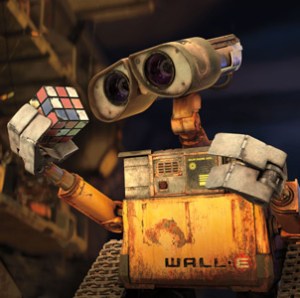
Welcome to the first post in my new semi-regular feature, Guaranteed Happiness. I’ve discovered that a lot of the films I’ve watched recently haven’t necessarily dealt with very happy subjects, and this has been getting me down a bit. Now and then, I’d quite like to watch a happy film, or one that’s uplifting and ensures that I’ll have a big stupid grin on my face for at least 80% of it, and definitely at the end. After all, I’d much rather write about a film I’m passionate about, and I tend to have more to say about films that make me smile than those that make me suicidal. Praise should be aimed squarely between the shoulders of my girlfriend then, for sticking on Pixar’s gem Wall-E when I was in a decidedly cranky mood a little while ago. The aim was for me to sit down and write some posts, which to be honest I was in no mood to do after a fairly crappy day at work and having to shell out over a considerable amount of cash to fix my bike, yet as soon as the film began all thoughts of blogging and even glancing at my laptop screen were out the window.So, why do I love Wall-E? The simple answer is robots. It’ll come as no surprise to regular readers that a film featuring robots (or dinosaurs, time travel or Stephen Tobolowsky) will immediately be watched with heightened levels of glee. And the fact that it’s made by Pixar, a company that has made some of my favourite films to date, and is where I’d be willing to sell several members of my immediate family to work at, then so much the better.This is my favourite Pixar film, which is definitely saying something. I adore the Toy Story trilogy (especially, predictably, Rex), but there’s something about Wall-E‘s simplicity, its pared down scope and focus on telling a straightforward story in new, interesting, and above all, beautiful ways.

The plot is basic: in the not-too-distant future, the human race has polluted and destroyed the world so much that life has become unsustainable, and the only hope lies in the Axiom, a titanic spaceship resplendent with every luxurious convenience to fulfil any desire. Earth has been abandoned and left to the robots, who spend the next few hundred years tidying the place up. Wall-E, our intrepid hero, is the last surviving ‘bot, and he spends his days making and stacking little cubes of garbage into towering skyscrapers of trash, accompanied by his only friend, a cockroach. One day, a ship descends from the heavens, carrying EVE, a futuristic, high tech reconnaissance droid, and Wall-E is instantly smitten.

The tale of a schlubby, down-on-his-luck guy falling in love with an out-of-his-league wonder girl is hardly new, but as far as I know this is the first time it’s been told almost entirely wordlessly, and about mechanical beings. A certain amount of disbelief needs to be suspended to watch the film – the robots seem to have far more personality than they should have been implanted with in the factory – but this results in one of the most well-rounded characters in all of Pixar’s history. Wall-E (which stands for Waste Allocated Load Lifter – Earth Class, something I know from memory) has a love for all things quirky, unusual or fascinating, be it a Rubik’s cube, egg whisk or an old VHS of Hello Dolly!, and watching him investigate the functions of each item – wearing a bra like sunglasses, accidentally erupting a fire extinguisher – are a joy to behold. As are his attempts to woo the evidently disinterest EVE (whose acronym would be a spoiler). The couple’s dates are more moving and say far more than any scene of dialogue could.

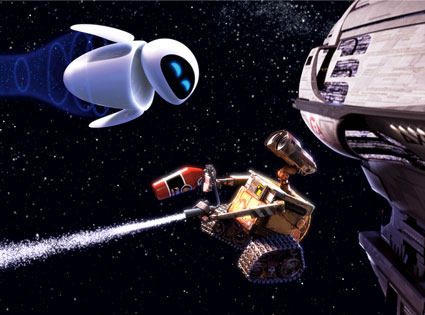
It’s almost impossible to narrow the film down to my favourite scene, but I’d probably say EVE and Wall-E’s space flight. It’s nothing short of a work of art, as the two bots fly a merry courtship dance around one another, set to Thomas Newman’s beautiful score. In fact, every scene between just those two, all almost entirely devoid of dialogue, are so very easily lost in. Their relationship feels natural and real, and if anything the films is at a detriment as the plot moves away from Earth, and the story looks past our central couple.

There’s a few messages hidden not too deeply in the film – stop fucking up the Earth, grow your own food, get off your arse and exercise – but to be fair these are all fairly good messages, when compared to the standard Disney fare of wait for a handsome prince to come and rescue you. Wall-E’s messages are ones I personally agree with (“even if I don’t necessarily live by them,” he says, patting the spare tyre around his midriff) so I don’t really mind such unsubtle preaching in a film, especially one as entertaining as this.

I’ve made no secret of the fact that I’d have loved nothing more than to have been part of the character design team on this film. Wall-E himself has been so carefully thought out with regard to how he works and fits together. I may have appreciated this more than most, being a mechanical engineer by trade, but I think everyone should be impressed by the level of detail. Apparently the design team at Pixar meticulously analysed various machines, working out which ones were ‘male’ and which were ‘female’, and what characteristics defined these genders. Wall-E has clearly been inspired by more clunkier, mechanical machinery, as seen in factories and assembly lines, whilst the sleek, white plastic of EVE is straight out of an Apple store.

As you’ve probably realised, I love this film. The Wall-E poster, a giant pair of his eyes looking inquisitively out of the frame, justifiably hangs in in my lounge, yet I think it almost qualifies as one of the ‘other’ Pixar films that isn’t about toys, fish or superheroes. From the small details – sci-fi queen Sigourney Weaver voicing the Axiom’s tannoy – to the fully realised plot and the brilliance of casting Ben Burtt, the voice of R2D2, as Wall-E, I cannot fault this film in the least, and nor would I want to. And I’d still be trying to get Randy Newman’s closing credits song out of my head if it wasn’t so bloody good.

Choose film 10/10

The Descendants

I’ve had The Descendants, currently the only Blu-Ray I own, sat on my shelf for a few weeks now, ever since I won it from the Empire Podcast, by answering a question about E.R., even though I’ve never seen a single episode. All praise IMDb. I’m something of a fan of Alexander Payne, and both Sideways and Election are just wonderful, so I’d been looking forward to sitting down and watching this, especially with all the Oscar buzz it had garnered earlier this year. The Descendants was nominated for five awards in all, including Best Picture, Director, Editing and Actor, and eventually won for Adapted Screenplay.

George Clooney, the aforementioned acting nominee, is Matt King, a wealthy landowner living in Hawaii,  and on the brink of a massive retail deal, in which his family’s historic heritage is to be sold, as requested by many of Matt’s less wealthy cousins. As if life weren’t stressful enough, Matt’s sporty wife Elizabeth (Patricia Hastie) suffers a horrific speedboat accident, leaving her in a coma, and Matt boosted from his former role as ‘back-up parent’ to the sole guardian of their two children, 10-year old Scottie (Amara Miller) and 17-year old Alexandra (Shailene Woodley), and soon becomes lumbered with Alexandra’s lunkheaded friend Sid (Nick Krause).
There’s a certain level of expectation for an Alexander Payne movie. The ones I’ve seen (not including Citizen Ruth or Inside Out 1 and 3) have all dealt with a story with dour aspects – be it failure, adultery, fraud, unhappiness or Kathy Bates’ backside – yet the sadness has been all but shrouded in comedy, yet here Payne’s reputable light touch is fighting against a brick wall of melancholy with the probable impending death of a spouse and mother. Such a morbid topic is no match for any level of wit, and the film almost always retains a depressing tone. This isn’t to say its a bad film, far from it in fact, its just that I was expecting a much more enjoyable watching experience that didn’t leave me deeply moved and my girlfriend literally in tears.
Payne made exactly the right casting decision in Clooney as Matt. The character is, let’s be honest, a bit of a dick. Yes, he’s a hard worker with a balanced head on his shoulders (he believes in giving his children enough money to do something, not so much that they’ll do nothing) yet he is practically absent when it comes to being a father and husband. Frequently away on business, he has little-to-no knowledge of his daughter’s lives, and it comes as no surprise to learn that prior to her accident, his wife was having an affair. It’d be a heartbreaking moment in most other actor’s hands, but Clooney breaks the tension with a ridiculously stone-faced flip-flop run. Under his command Matt is almost likable, and definitely relatable, even though he’s obscenely wealthy. Clooney is, in my opinion, a thoroughly under-rated comedic actor, and in one memorable scene (pictured) he has some genuinely hilarious eyebrows. Matt always seems to do the right thing and have the best of intentions at heart, yet his methodology and timing aren’t necessarily sound.
The revelatory performance of the film however is Shailene Woodley as Matt’s eldest daughter Alex, who lives on a different island to her father both literally and figuratively. Woodley is perfect in the role, her first in a film after appearing regularly on television since 1999, aged 8. Here she captures the exact transition from petulant teenager to woman-of-the-house, becoming a surrogate mother to her younger sister and a confidante to her father. Nick Krause is also great as Sid, a cliched dumbass who still gets to set up some of the film’s funniest moments. His first interaction with Matt’s father-in-law is just genius.
Beau Bridges and Judy Greer crop up in small roles, and Matthew Lillard does surprisingly well as a guy you really should hate deeply. The script has subtlety – offhand remarks to Elizabeth’s alcoholism and Alex’s drug taking – and definitely deserved at least the Oscar nomination, and whilst much of the action is fairly predictable, there are still a few unexpected turns along the way. This is still probably the least enjoyable of Payne’s films that I’ve seen – mostly due to the subject matter – but it’s still moving, well acted and performed, and all the locations are stunning.
Choose Film 8/10

Memento

Christopher Nolan’s first major picture (after 1998’s Following, which is interesting but a tad too confusing, and really for completists only) is at first glance nothing but a gimmick, using a reverse-narrative to tell the detective noir of Guy Pearce’s Leonard Shelby as he hunts for the man who raped and killed his wife whilst suffering with a rare condition that prevents him from making new memories. However it turns out that telling the story backwards, scene by scene and with an expositionary telephone conversation spliced in between, is the only way to give the story justice.
Famously, there is an easter egg on the Memento DVD that plays the film in chronological order, and I’ve discovered that in that orientation the film just doesn’t work. It’s not just because the last few seconds of every scene are replayed again moments later at the start of the next one (surely that wouldn’t have taken much to edit out?) but it’s also because the film is completely lacking in tension or pacing when that way round. Which just goes to show that Nolan was able to use a plot technique to it’s fullest advantage, which in the hands of a lesser director could have proved disastrous.
Pearce is excellent in an unforgiving role, especially given that Leonard has no character arc longer than a scene. He’s always been a brilliant actor, and often hides his Brad Pitt-esque looks behind obscuring facial furniture or heavy make-up – see Ed Exley’s glasses in L.A. Confidential, or large amounts of Play-doh in Prometheus – and here is no exception, with Shelby’s body plastered with tattoos and a shock of peroxide blonde hair to distract from those razor-sharp cheekbones. Pearce is ably supported by Carrie-Anne Moss and Joe Pantoliano as Natalie and Teddy, people who may or may not be out to help Leonard on his quest.We discover elements of the story as Leonard does, and the true meaning of almost every scene is altered by the one that immediately precedes/follows it. Surprisingly, a scene can hold just as many surprises, and just as much tension, if you know how it ends but not how it begins. You can’t help but feel sorry for Leonard, in a situation that would drive most of us insane – as long as we could remember the insanity long enough – and his life would be hard enough without everyone screwing with him. Even the clerk at his motel (Batman Begins‘ Mark Boone Junior) charges him for two different rooms, and doesn’t even hide it from Leonard, as there’s no chance he’ll remember.

There’s more comedic moments than you might remember, and some darkly so, for example the conversation where Leonard reveals to Natalie that the last thing he remembers is his wife. She says that’s sweet, before Leonard concludes “…dying.” I probably shouldn’t have, but this got a start of laughter from me.

I remember that my first viewing of this movie was ruined when I borrowed it from a housemate some years ago. He basically told me the ending, and that the film was crap, but I watched it anyway and remained intrigued and fascinated by how the plot would tie together – which it does nicely. Rest assured I never took that housemates movie advice again.

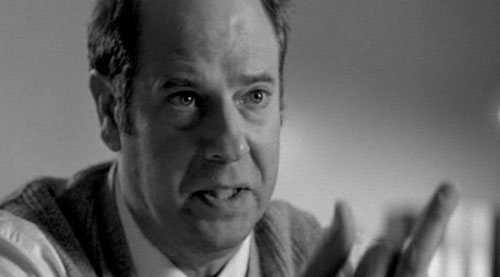
If Stephen Tobolowsky is in a film, then I’m legally obliged to mention him in a review, and here he crops up in grainy, black and white flashback as Sammy Jankis, a case Leonard looked into as an insurance claims investigator before his memory loss. Jankis suffered from a similar condition as Leonard, and Tobolowsky’s wonderfully big blank face is perfect for the look of someone not recognising anything new in the world around him, and his bursts of anger at annoyance – at an elctro-shock test and not understanding TV shows – is also great.

The story, written by Christopher Nolan’s brother Jonathan, is well thought out and takes into account the minutiae of Leonard’s predicament. Such a high concept (though scientifically possible) film could have left many annoyances at skipped over details, loose plot strands or inconsistencies, but by the end/beginning no such problems are left.

Choose film 9/10

The Piano

First off, an apology for the forthcoming review. I watched the film three months ago, and have gotten so far behind on my post writing that I’ve not had any real desire to review it, as to be honest it wasn’t that inspirational of a film. Nonetheless, I shall do my best, but I’m relying almost solely on the notes I made during the movie, as I can’t for the life of me remember very much of it. As you can probably guess, this isn’t going to be much of a recommendation to watch the film.
Holly Hunter plays Ada McGrath, a woman who, aged six, willed herself mute, and has since never spoken a word. She moves from Scotland to New Zealand for an arranged marriage with Sam Neill’s landowner/writer Alisdair, and brings her young daughter Flora (Anna Paquin in her first live action picture) and their piano, Ada’s pride and joy. Neill is less than impressed with his new bride-to-be (“You’re small, I never thought you’d be small”), and refuses to cart her piano across the difficult swampland between the beach and his home, so they abandon it on the sand, much to Ada’s discontent. Fortunately local plantation worker George Baines (Harvey Keitel) takes a shine to Ada, and trades some land with Alisdair for the piano, and agrees to trade it back to Ada in return for ‘piano lessons,’ during which George will get to know Ada far more intimately than she’d like.

Hunter and Paquin both won Oscars for this film, and Hunter at least thoroughly deserved hers (Paquin is excellent for an 11 year old, but though I haven’t seen any of the performances she was nominated against I wouldn’t be surprised if any of the actresses, including Emma Thompson and the aforementioned Hunter, performed more capably). Hunter’s Ada is utterly repressed, yet still emotive and expressive, all pursed lips and passive eyes, her skin a deathly pale against the stark black of her dresses and bonnet. Keitel is also good, though his proclivity for whipping his pecker out is always a distraction, and is for the most part unnecessary.
I got the feeling that the film was made to prove the point that a lead character doesn’t need to speak (see also: Dumbo). There isn’t too much of a story here, with the events built entirely around the character and her very existence rather than the exciting or emotional events in her life. Her character is well realised, especially the bond with her daughter, and her slowly breaking down walls against Baines’ advances. Communicating only through sign language, facial expression and a small chalk-board locket, she says more than any other character, and with far less.
Despite the poetry of the film, such as Keitel’s Baines being willing to just sit and watch the piano hammers dancing gaily along the strings, I didn’t take much away from this film, and it has had little to no lasting impact on me. It’s very slow, and the message is muddled, though I think it has something to do with choosing the correct way to woo someone. Alisdair goes about things in entirely the wrong way with Ada. If only he’d coerced her into, essentially, prostitution, he’d have been much better off. Oh, and the best part about the film? It features an actress called Geneviève Lemon.
Choose life 6/10

Born on the Fourth of July

Does anyone else find it funny that Tom Cruise, whose birthday is the third of July, starred in a film called Born on the Fourth of July? No? Just me then.
Olive Stone is one of those film makers that I don’t really get. I’m not that much of a Platoon fan, nor can I say I have any affiliation with Wall Street. Natural Born Killers has it’s moments, and I can’t remember a single scene of Any Given Sunday, though I saw it less than 2 years ago. Other than that, I haven’t seen anything he’s made, though my hopes are up for JFK, whenever I eventually get around to seeing it. Born on the Fourth of July seems like a typical Stone movie, in that it comes deeply ingrained with a message (war is hell and will mess you up), and though at first glance it may seem patriotic, if you look a little deeper it’s really a chance for Stone to voice his own personal feelings about his country.
Tom Cruise is Ron Kovic,who growing up in 1950’s Long Island idolised the war heroes in the Independence Day parades. He looked past the wheelchair, crutches and missing limbs, seeing only the glory and patriotism of being a hero. Kovic spent his school years working hard and being committed to being the best, and after his wrestling attempts didn’t quite work out, he responded positively to a presentation from the US Marine Corps, and signs up with a few buddies, including Stephen Baldwin.The scenes of Kovic’s childhood are shot with a hazy, wholesome, rose-tinted nostalgia, and his family, especially his mother, are all very supportive of Ron’s decision to head to Vietnam and fight for his country, and die there if he has to. The era is well realised – particularly though the soundtrack, as Ron’s brother learns Bob Dylan on the guitar – and the TV broadcasts, with Kennedy’s “What you can do” speech seemingly speaking directly to Kovic.

After signing up and heading to war, the action skips straight over boot camp and the green-horn period – Stone covered all that in Platoon three years earlier – and drops us straight into the now Sergeant Kovic’s Second tour of Vietnam in 1967. These sequences are atmospheric and well-realised, but they’re less impressive than almost any other war film. It’s a good thing then that this film isn’t really aiming to show an accurate, visceral depiction of warfare, instead focusing on the disillusionment of volunteers, the effects that warfare can have on those who fight it, and the disconnect between the soldiers and the families they’ve left behind. For when Ron is discharged – in a wheelchair, with the promise that he’ll never use his legs again (though his main concern is being able to use what is between those legs) – he discovers that his brother doesn’t believe in the war, and his friends that stayed home became prosperous and affluent, whilst he had everything taken away from him.

The cats is full of familiar faces from anyone who’s watched Platoon – alongside Tom Berenger’s Marine recruiter is Willem Dafoe’s similarly paralysed veteran, and John C. McGinley turns up for a very small role (as do Wayne Knight and Tom Sizemore).

The film takes a very long time (145 minutes) to put across some fairly simple ideas. The first 90 minutes are thoroughly predictable, and there were very few surprises in the last hour either. Tom Cruise isn’t bad in the role, but as ever he always does better when he isn’t front and centre (Magnolia, Tropic Thunder), and I couldn’t shake the feeling that he was desperately pursuing an Oscar. Though he was nominated, it’s no surprise that it went instead to Daniel Day-Lewis for My Left Foot, and I’d still have been happy had it gone to fellow nominees Robin Williams or Morgan Freeman, for Dead Poet’s Society or Driving Miss Daisy, instead of Cruise.

It’s worth watching if you’re a Stone or Cruise completist, but there’s little new here, and what there is still won’t surprise, or impress you.

Choose life 5/10

Seven Brides For Seven Brothers

I’m not normally a huge fan of classic musicals. I quite liked West Side Story, but couldn’t abide The Sound Of Music, so my hopes weren’ exactly high for this 1954 classic of which I knew very little, other than there were presumably at least fourteen characters. I’m relieved to tell you that not only did I not find this film terrible, I frickin’ loved it.Set in 1850’s Oregon, the film predominantly follows Adam Pontipee, the eldest of seven brothers (duh) who all live away from society in a secluded shack, as woodsmen. Whilst visiting town to trade, Adam sets out to find a wife, and somewhat surprisingly the local cook Milly agrees to take the position, and they marry as soon as she finished her chores, before heading back to his house. Once home, Milly discovers the rest of her new husband’s clan, whom he’d neglected to tell her about before, and soon finds herself playing Snow White for these seven giants, doing all the cooking and cleaning in their initially disgusting hovel. When the other boys decide they too would like a wife, Milly steps in to see if she can teach them to be gentlemen.

The plot is, frankly, ridiculous, and full of so full of sexism its funny. Adam (Howard Keel) is chauvinistic, slovenly and completely tactless (“What do I need manners for? Already got me a wife.”) and he has absolutely no qualms about essentially conning a woman into being a slave for him and his six siblings. His proposal to Milly (Jane Powell) will probably go down in history as the most romantic in cinematic history. Sidling up to Milly whilst she milks a cow he proclaims “Ain’t got a woman, how ’bout it?” Clearly, back in the 1850s romance was far from dead.

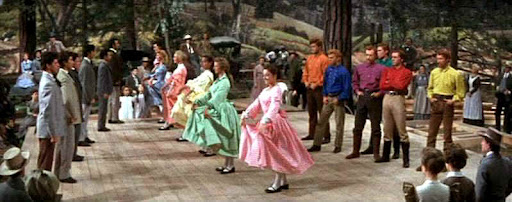
Unusually for a musical, I actually approved of the music, and even the dancing. Some of the songs weren’t terribly memorable, but others are still stuck in my head, most notably “Bless Yore Beautiful Hide” (again with the romance), “Goin’ Courtin'” and “sobbin’ Women.” The dancing too is very impressive, probably because most of the eponymous brides and brothers are professional dancers. The barn-raising sequence is great even though it’s very long, with the brothers competing for the affections of the locals girls against the men that brought them there. A prime opportunity was missed for some colour-coordinated dancing though. Some of the later axe-dancing is a little silly, but it does fit in with the overall tone of the film.

The plot is based on Stephen Vincent Benet’s short story The Sobbin’ Women, itself influenced by the Roman legend of The Rape of the Sabine Women (back then rape meant abduct, this film isn’t that dark). The script takes some interesting turns and has a great, if a little predictable, ending. The brides being just as willing to resort to fisticuffs as the men was a nice touch.

At times the film gets a bit sombre, when various groups become lovesick and lonely, but there’s always an upbeat musical number not too far away, and unlike most classic musicals, this one isn’t unbearably long. I’d quite like to see a remake, with an allstar ensemble cast in the lead fourteen roles, but I get the feeling it would be terrible.

Choose film 7/10