 I’ve already discussed my disliking of George Lucas’ recent decision to withdrawn from movie making, and my distaste for those who’ve lobbied against him for years here, so I’ll say no more about that at this time.
I had a problem before even starting to watch these cultural milestones; in what order should they be seen? I’m one of those obscure creatures (also known as ‘young people’) who initially saw the Star Wars films chronologically, from Phantom to Return. My father was never an avid SW fan (to this day he still speaks of the films with a level of disdain and mockery usually reserved for discussing his son), so there were none of the Saturday afternoon viewing marathons subjected upon my friends, and I was left to discover the films by myself, with my first experience being Ewan McGregor and Liam Neeson kicking some robot butt, and I’ve seen all the major scenes more time in Lego format via the videogames than on DVD. So, to solve my chronological dilemma, I consulted some of the aforementioned friends, and after being beaten to within an inch of my life with plastic light sabres and busts of Darth Vader, I concluded that release date order was the wisest option (although alphabetically was also suggested, but 4-2-5-1-6-3 is just silly). I should also note that episode 2, Attack of the Clones, did not appear on the list, but is featured here so it doesn’t feel left out, and because there are some (admittedly few) bits I like in it. And yes, this review contains spoilers.
So just what is it that makes Star Wars so iconic? Other than an ever-growing army of fans, the answer lies in the creation of an entirely new universe, where seemingly every minute detail of life has been mapped out. From the robot-hoarding Jawas of Tatooine to repulsive slug-like space mobster Jabba the Hutt, each new and exciting world has its own rules regulations and customs, although most worlds seem to have only one characteristic, be it desert, ice, cloud-city, forest or lava. Throw into this vast cornucopia a story of bounty hunters, intergalactic warfare and a dying breed of oddly magical humans, as well as a buddy comedy about two bickering robots, and you’ve got a license to print money and flog a limitless amount of merchandise to people who really need to get out more (that said, last year my advent calendar may have been from the Lego Star Wars range).
I’m hardly breaking new ground when I say that however big a cult following this saga may have, it also owns a few slaws. The dialogue and mythology are often hokey and cringeworthy (“May the force be with you”) and when not are hardly original (“It’s them, blast them!”) and George Lucas shows a racism and sexism unseen since Disney was room temperature, with one black man in the original trilogy (not counting Vader’s voice), and he is an opportunistic traitor, and no other human races bar whites, and aside from Leia and one other woman in power, all of the female characters are strippers or dancers.
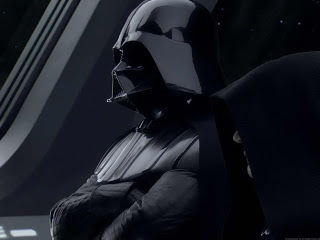
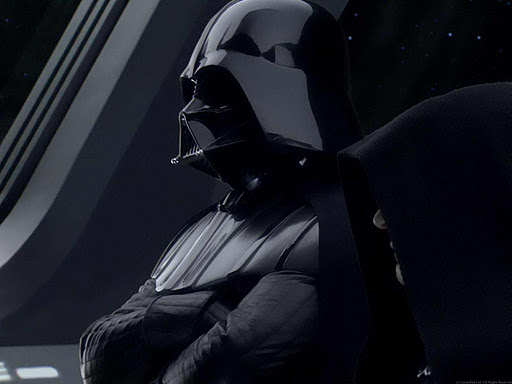
 That said, the character designs are phenomenally memorable by being really quite simple – Chewbacca’s walking carpet, clean white stormtroopers and the perfect villain in the glossy helmeted, all black Darth Vader, employing both David Prowse’s imposing figure and James Earl Jones’ mellifluous tones, no other character has so richly deserved their own theme tune.
hough the plot has many aspects to it you never lose track, and any scenes of dialogue and exposition are soon broken up with spaceship battles, light sabre action or new and interesting discoveries in the mythology. A New Hope is easily the most stand-alone film, with no initial setup required (other than rogue paragraphs travelling through space) and a satisfying ending only hinting at a sequel, but the Empire Strikes Back is widely regarded as the superior film, with the inclusion of diminutive Jedi master Yoda and jetpacking bounty hunter Boba Fett, two of the most enduring and iconic characters from the franchise, yet who only have a small fraction of the screen time between them. It also features that great twist ending, now sadly ruined by endless parodies and misquotes. Episode 6, the Return of the Jedi, is the weakest of the three, though there is no shortage of spectacle with the giant Rancor, the Sarlacc Pit and a landspeeder chase through the dense woodland of Endor. It is everything else of Endor that is the problem – the teddy-like Ewoks in particular – that explain the negativity, for if such crude creatures as these cuddly toys can take out the stormtroopers, why has everyone been so worried this whole time? That, and C3PO being heralded as a deity and the Emperor’s flawed plan to kill the rebels – if you’re leaking a plan to send the rebels somewhere deliberately so you can kill them, why not send them to a place where you don’t keep the shield generator for your new planet-destroying Death Star? – deters from the lofty levels of the earlier films.
 And so we arrive at the new trilogy. As a child of 12 I must admit I really enjoyed these films, so in some aspect George Lucas succeeded. The Phantom Menace was the most anticipated movie of all time, and there was no possible way it would ever live up to expectations (something I hope is not suffered by the Hobbit, the Dark Knight Rises or the Avengers later this year) so instead Lucas aimed the film not at the hoards of devoted fans he already had, but at newcomers and younglings. The fans would flock in anyway, their money was guaranteed, if not their approval, and which is more important to a movie studio? But, in a vain attempt to pander to the fans, attempts were made to tie the prequels in closely with the originals, and to expand upon the elements most popular in the older films.
And so it is that we see Jake Lloyd’s infant Vader Anakin building C3PO and playing with a child alarmingly similar to Greedo, we discover the stormtroopers are all clones of Boba Ferr’s father Jango, Jabba starts the podrace and Chewbacca pops up with Yoda in Revenge of the Sith. It’s a wonder we aren’t shown Han and Chewie thrown into detention together at school.
Across the trilogy there are some astounding set pieces – the adrenaline fuelled, Greg Proops’ commentated pod race, Attack of the Clones’ gladiatorial battle and Obi-Wan’s light sabre battle with four-sabred robot General Grievous being particular highlights, but too much emphasis is placed on the politics of the Trade Federation and the soppy romance of Anakin and Padme that has no place in a Star Wars film. That, and too many mysteries are uncovered – no-one cared that the force comes from midichlorians in the blood stream and Vader’s rise and conversion to the dark side was more effective before every detail was explained and we weren’t shown him as an annoyingly precocious brat or lovesick teenager.
 Some performances are terrible – both Lloyd and his grown up counterpart Hayden Christensen are wooden and aggravating, especially when placed alongside Liam Neeson, Ewan McGregor and Samuel L. Jackson, and even Natalie Portman gives an uncharacteristically poor performance. The final film, Revenge of the Sith, is also disappointingly, but inevitably, bleak, lumbered with having to set up the gloom and oppression at the start of A New Hope. This sense of inevitability ruins the final battles between Obi-Wan and Anakin and Yoda and the Emperor, for we know everyone involved will survive, as they all appear in the original trilogy.
But however poor it seems in comparison, the new trilogy still contains films far superior, and more entertaining, than a lot else out there, and therefore should still be viewed, if a little less frequently.
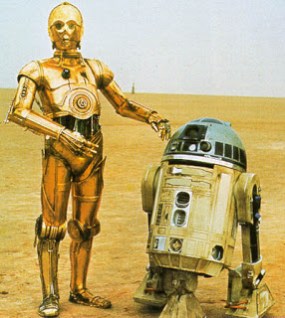
This post could have gone on a lot longer – I haven’t even mentioned Jar Jar, Han shooting first, Luke Skywalker, Peter Cushing’s most evil face in the world™ or the glorious key to the series, R2D2, but I’m guessing no-one is actually still reading this, and I’ve still got over 30 posts to write, so I think I’ll call it a day.
A New Hope: Choose film 8/10
The Empire Strikes Back: Choose film 9/10
Return of the Jedi: Choose film 7/10
The Phantom Menace: Choose film 6/10
Attack of the Clones: Choose film 5/10
Revenge of the Sith: Choose film 6/10
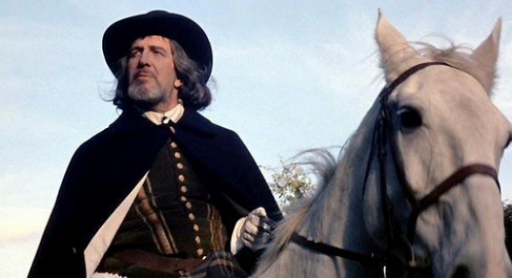 Can a poor accent really spoil a film? Vincent Price, here playing England’s witchfinder general during the English Civil War, doesn’t even attempt a Limey tone, an oversight so distracting it mars the rest of the film. Other than this detail his performance is spot-on as the man bought in to rid villages of accused witches for a princely sum, owning every scene he’s in as he accuses all those in his way of being in league with the devil. When he confronts the accused Satanist uncle of a soldier’s wife, brutally torturing, half-drowning and hanging the poor priest, the soldier sets out to wreck vengeance upon him. The film is at times maddening at what is hoped to be fictionalised accounts of what was gotten up to back then – see the look of mirth upon the face of a torturer when he spies a colleague raping the soldier’s wife, and methods of proving witchcraft include continually stabbing a person until finding a spot that neither bleeds or causes pain, so this isn’t always the easiest film to watch. But get past the gore and inaccurate inflections and what lies beneath is a gripping look at 17th Century brutality.



 Life Vs Film