Dirty Harry

Would this film have had such a cultural impact without Clint Eastwood’s performance as the eponymous San Francisco detective ‘Dirty’ Harry Callahan? Probably not, as Eastwood’s depiction of one of cinema’s most legendary and hardest badasses is the only thing worth watching in this picture. After the infamous early scene, where Harry foils a robbery using only a .44 Magnum and one of the most quoted lines in the history of people saying something someone else said first, the action peters out, leaving a fairly standard, character driven police procedural, as Callahan attempts to solve the case of the Scorpio killer, loosely based on the real life Zodiac killer recently seen in David Fincher’s film of the same name.
The film rises a little when it detracts from the central plot – the dealing with an attempted suicide is a particular highlight, but is Eastwood’s performance and a decent script enough to watch this movie? Will I choose life, or film? Can’t tell myself in all this excitement.
Choose life 5/10
Shaun of the Dead/Hot Fuzz

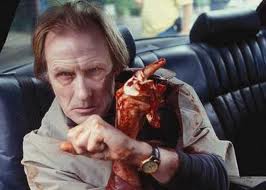
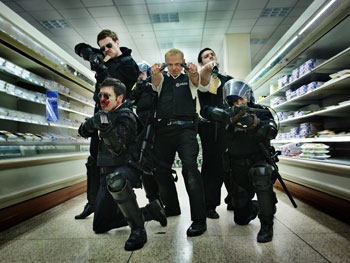
How does one create two of the best loved British comedies of recent years? Initially it seemed purely to involve director Edgar Wright and stars Simon Pegg and Nick Frost, but recently Wright’s foray across the pond, Scott Pilgrim vs. the World, was well reviewed but barely seen, whereas the Pegg/Frost scripted Paul drew huge crowds but lacklustre reviews. No, the secret it would seem is to keep this trio together, with Wright and Pegg on scripting duties, Pegg in the lead role and Frost as his incompetent sidekick. Pepper the rest of the cast with the cream of British acting and comedy, including Jim Broadbent, Timothy Dalton, Peter Serafinowicz and Dylan Moran, with Bill Nighy and Martin Freeman appearing in both films. Also, there must be cameos you can miss even without blinking – in Hot Fuzz, Cate Blanchett plays Pegg’s ex-girlfriend behind a decontamination mask and Lord of the Rings director Peter Jackson is the Santa who stabs him through the hand- but crucially, the film must remain thoroughly British.
For this is the true secret of these films. Whereas other great British filmmakers seem to shy away from their country of origin (Danny Boyle, Ridley Scott, Alfred Hitchcock) opting instead to embrace the more commercial stylings of Hollywood, Wright and co. make sure that if you cut the film in half, it reads Made in England all the way through. From the settings – the zombie-infested streets of London or the sleepy rural village of Sandford, to the cast, sense of humour and the solution to any problem (“I dunno… pub?”) there have never been comedies this British since Kind Hearts and Coronets.
 It is also difficult to pin down what kind of a comedy the films are, as they feature equal quantities of character driven sitcom (Shaun’s vying affections for girlfriend Liz and best mate Ed), genre pastiche (there are more references in both films than could ever be listed), social commentary (upon discovering a zombie, Ed and Shaun first assume she is drunk), outlandish set pieces (battering a zombie with pool cues to Queen’s Don’t Stop Me Now) and subtle farce (The foam housing of twin pistols either side of a thermos in a pensioners bag). This cornucopia of comedic styles means that, if you didn’t like the last joke, it’s OK as another will be along shortly.
The most important aspect though seems to be to make sure there are repeated, quotable lines, whose meanings change throughout the course of the film (“He’s not my Dad,” “You’ve got red on you.”) or off-hand or unintentional predictions that inevitably come true. Of the two films, Fuzz rates a little lower due to a bout of Return of the King syndrome, with more explosive endings than are strictly necessary. Shaun also offers more rewarding repeat viewings, with many lines not landing their full impact without prior knowledge of the rest of the film.
Shaun of the Dead Choose film 9/10
Hot Fuzz Choose film 8/10

Aladdin

What better way to kick off a lazy Bank Holiday Monday than with a Disney classic? With a Pixar one of course, but I’ve watched most of those, so Disney it is. Notable in the Disney archives for being the first to use big name actors to voice its characters (Robin Williams steals the show as the Genie, even though he isn’t in the first third of the film) , Aladdin doesn’t have a lot else going for it to set it apart from the more renowned Disney pictures such as Beauty and the Beast, the Lion King or the Jungle Book. Yes, the devious royal advisor Jafar is a masterclass in how to draw an evil character (acute angles, lots of acute angles, think a dehydrated Peter Cushing), Gilbert Gottfried is excellent as the cantankerous parrot Iago and there is some of the studios greatest comedy from Williams’ improv and one liners (“10,000 years will give you such a crick in the neck!”), but the plot is thin, the Arabian stereotypes broad (and at times a little racist, a wink to Uncle Walt maybe?) and most of the songs are forgotten before the credits roll, with only A Whole New World and Genie’s Never Had a Friend Like Me leaving any kind of impression.
The animation is largely flawless, although touches of CGI sap the warmth from the otherwise hand-rendered imagery, and it is hugely impressive just how much characterisation has been given to a tasselled rug, but the plot is too thin and predictable, the morals daubed too thickly, even for a Disney, to make this a must-see.
Choose life 6/10

Dangerous Liaisons

John Malkovich: object of desire? Talk about playing against type. As the Vicomte Sebastien de Valmont in 18th Century France, he is challenged by the Marquise Isabelle de Merteuil (Glenn Close) to deflower Uma Thurman’s virginal bride-to-be Cecile. Deeming the task too easy, he instead chooses to bed Michelle Pfeiffer’s Madame de Tourvel, a virtuous, devout, happily married woman staying with the Vicomte’s aunt. The Marquise then drafts in Keanu Reeves’ Danceny to woo Cecile instead. If the plot sounds familiar, it’s because it was adapted more recently (and poorly) in the modern-set Cruel Intentions, which succeeded in dumbing down the many deceits and allegiances in the plot, but retains the deeply unlikable protagonists, too rich for their own good and revelling in destroying the lives of those around them.
More erotic than most period dramas, with necklines set to plunging and cleavages set to stun, this sees more bedhopping than a season of Desperate Housewives. Malkovich is on excellent form as the callous, vain and calculating lothario, deemed “conspicuously charming” and Close walks the line between on/off romance and hardnosed bitch, but every time Keanu opens his mouth you get the feeling Bill and Ted got their time travelling phone booth stuck in the reign of Louis XV, so thick and distracting is the slacker dude lilt he so desperately tries to hide.
Choose life 5/10

Bad Lieutenant Port of Call

This is not a remake, nor is it a sequel or prequel to Abel Ferrara’s Harvey Keitel-starring 1992 Bad Lieutenant, although there is one key similarity, in that the titular law enforcement officer is a corrupt drug addict attempting to solve a crime, in ’92 the rape of a nun, in Port of Call, the murder of a drug dealer, using their own, unconventional methods.
In this film, the drug-fuelled lead role is not so much played as inhabited, snorted, smoked and injected by a wired, tense and almost hunched Nicolas Cage, giving his best performance since Leaving Las Vegas, alongside a cast of largely unknowns or non-actors (including Xzibit as the drug kingpin lead subject of the investigation). As is traditional with maverick cop movies, there is more than just the case plaguing Cage’s Lt. Terence McDonagh, and at one point he must also juggle looking after his father’s dog, protecting a witness to the case, his friendship/relationship with Eva Mendes’ high class hooker/partner in narcotics and an investigation into his unorthodox interrogation of the witness’ grandmother, jeopardising the life of an elderly woman in her care. The very fact that McDonagh faces the repercussions of his actions sets this aside from other films in the genre, that so usually see their protagonists commit crimes in the name of justice with no consequences.
As amazingly intense as Cage’s performance is, the film itself never quite grips the attention. There is little here that hasn’t been seen before (other than hallucinations of iguanas and the break-dancing of a recently deceased hoodlum), but director Werner Herzog should be commended for rewriting the script to set the action in New Orleans in the aftermath of hurricane Katrina in order to provide the city with jobs and income.
Choose life 5/10

Capote

Philip Seymour Hoffman is a great actor, this cannot be questioned. Whether leading a small film in the likes of Synecdoche New York, Before the Devil Knows You’re Dead and the Savages, outshining the rest of an ensemble cast in Magnolia, Boogie Nights, the Boat that Rocked and the Talented Mr. Ripley or chewing the scenery as the bad guy in a big screen blockbuster like Mission Impossible 3, he always sinks completely into his characters, be they good-natured yet uncouth storm chasers, an intimidating phone-sex supervisor/mattress salesman or an outspoken rock journalist. With Hoffman’s acting ability in little doubt, it’s a wonder this film was made, as other than showcasing his talent for inhabiting the persona of another individual, there is little to recommend for this drab, largely plot-less offering .
Hoffman plays acclaimed writer Truman Capote (Breakfast at Tiffany’s), visiting a small town to document the aftermath of a murder for a magazine. Fascinated with the case, and even more so by one of the convicted killers, he expands his piece to become the last book he ever finished, In Cold Blood. The only real narrative drive is that of the court proceedings and Truman writing his book, interspersed with various parties and conversations with his friend Harper Lee (Catherine Keener) as she herself achieves publication and film adaptation of her own seminal novel To Kill A Mockingbird, but what the film lacks in purpose it makes up for in performances.
Choose life 5/10

The Challenge – Overdue Posts

I’m still alive, still here, don’t worry, just got really far behind on the posts, and the sheer volume I haven’t written is putting me off writing more, so I’m just going to list those that I’ve seen but not yet reviewed, with a score and rating. I promise they will be reviewed eventually, hopefully over the next few weeks in dribs and drabs, but they’re never going to get done otherwise.
Shaun of the Dead – Choose film – 9/10
Hot Fuzz – Choose film – 8/10
Dirty Harry – Choose life – 5/10
Wallace and Gromit and the Curse of the Were-Rabbit – Choose life – 5/10
Kick-Ass – Choose film – 7/10
Avatar – Choose film – 6/10
Muriel’s Wedding – Choose life – 4/10
Big Trouble in Little China – Choose life – 2/10
Shine – Choose life – 5/10
The General – Choose film – 9/10
Seven Chances – Choose film – 8/10
Our Hospitality – Choose film – 7/10
Steamboat Bill Jr. – Choose film – 6/10
Sherlock Jr. – Choose film – 9/10
There’s Something About Mary – Choose film – 7/10
Shallow Grave – Choose life – 6/10
Monsters – Choose film – 7/10
Easy Rider – Choose life – 6/10
Titanic – Choose film – 7/10
The Thing – Choose film – 7/10
Paranormal Activity – Choose life – 5/10
The Blues Brothers – Choose film – 9/10
Heimat – Choose life – 6/10
Fish Tank – Choose life – 5/10
Dumb and Dumber – Choose film – 8/10

The Red Balloon

A woman went out walking one day and discovered a snake’s egg on the path. She took the egg home and cared for it until it hatched, when she kept the snake as a pet. She doted on the snake for years, attending to its every need and treating it better than any snake had been treated before. Then, one day, the snake bit the woman, and with her dying breath she asked the snake “Why?” and the snake replied “Bitch, you knew I was a snake.”
It is this sense of inevitability and apprehension that fills the Red Balloon, as beautiful and well crafted as it is, that almost ruins the short about a boy who befriends a bright red balloon, but finds owning it proves problematic when all the other children want it as well. Yet however destined the ending may seem, it is the journey up to it, and indeed the repercussions that make the film so endearing, at times unexpectedly hilarious and beautifully heartwarming, especially the moment the balloon encounters an equally bright and vivid blue inflatable friend of a young girl. The ending, too, is truly uplifting.
Choose film 9/10

L’Atalante/Zero de Conduite

French director Jean Vigo died at the age of 29, having made just four films (these two, A Propos de Nice and Taris). Undoubtedly Vigo’s untimely demise is a tragedy, but I disagree with the level of promise and potential he apparently showed, as these two films are dull, uninspiring and possessing of paper thin plots.
L’Atalante sees a young couple, Jean and Juliette, get married and set sail on a boat with their captain, Pere Jules, his cats and his cabin boy. After time, Juliette wants to settle down in the city and Jean wants to keep sailing, so he abandons her in port, leaving without her. There is little characterisation of any of the main players, so there is little to care about as to whether the couple resolve their differences or not, other than it will hopefully bring about the end of the film. Only the games of draughts between a desperately cheating Jules and a depressed Jean adding a dash of fun to the proceedings.
Zero de Conduite is even worse plot-wise, following a group of school children planning a rebellion during their school’s upcoming commemoration day. The film is interesting for showing an outdated education system – the house master sleeps in the same room as the students in his charge, making them stand at the foot of his bed for the night as punishment, but it’s hard to feel any sense of joy at the successful rebellion when the full extent of it is flying a Jolly Roger and instigating a pillow fight.
L’Atalante Choose life 3/10
Zero de Conduite Choose life 2/10

Annie Hall

Woody Allen famously has a tendency to write himself into most, if not all, of his scripts. It is usually difficult to distinguish where Allen ends and his characters begin, and this is none more so than with Alvy Singer, Allen’s neurotic obsessive from this, arguably his greatest and funniest film. It is this ability to use himself, or at least a variation of himself, as his protagonist that has allowed Allen to create such a well rounded, nuanced persona. One wonders if he hasn’t been living life as this character since birth, honing the pessimism, the paranoia and awkwardness, so now all he needs to do is put the ‘character’ into a slightly heightened situation, and a natural comedy will emerge.
Not that character is the only weaponry in Allen’s arsenal. The script is hysterical yet droll enough to quote in everyday life (“we can walk to the curb from here”), the performances perfect, particularly Diane Keaton as the eponymous Hall, both Singer’s ideal partner and greatest foe, and the film is peppered with fourth wall breaking with moments of originality, from a narration that admits it may be exaggerating to direct-to-camera conversations and asides.
Thee almost sketch-like format of the film, flitting backwards and forwards in Hall and Singer’s relationship, suits Allen well, as he is a filmmaker of varying styles and techniques, so he is able to showcase this without jarring the rest of the film, such as when he used split-screen to compare different family meals, or stopping random people in the street for relationship advice.
Oh, and the woman waiting with Singer at the end of the film, out of focus and silent in the distance for a matter of seconds? None other than Sigourney Weaver.
Choose film 8/10