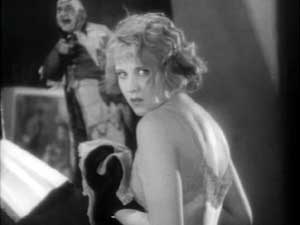
Hitchcock, now with added sound! Yes, we’ve moved on from Hitch’s silent pictures (until I can find the ones I’ve had to skip) and onto his first to use audible dialogue, as well as the first I’ve seen that doesn’t appear to have been filmed entirely on a set, although knowing the director built the entire apartment block set of Rear Window inside a studio, you never can tell with Hitchcock.
Blackmail focuses on a young couple, John Longden’s Frank, a Scotland Yard detective, and Anny Ondra (yep, her again) as Alice, the daughter of a shop owner. Alice has become bored of Frank’s obsession with his career, and has eyes for another man, the irrationally posh artist Mr. Crewe (Cyril Ritchard). Crewe invites Alice back to his studio apartment one evening, and things don’t necessarily plan out how either of them would have expected, so Frank gets involved to try and help Alice out of the sticky situation she finds herself in.
Continue reading
Tag Archives: Alfred Hitchcock
The Manxman
Pete Quillam (Carl Brisson from The Ring) is a penniless fisherman. His best friend, Philip Christian (Malcolm Keen), is a hot-shot lawyer. The two have been inseparable since birth, being raised as essentially brothers despite their wildly different lifestyles. They’ve even found a way to combine their various career paths, with Philip pushing through a petition that will prevent steam trawlers from encroaching on the fishermen’s haul, but when they meet Kate Cregeen (Anny Ondra), the barmaid daughter of the local pub The Manx Fairy, they both instantly fall for her. Pete, the more headstrong and forward of the pair, is the first to make a move, so the loyal Philip hides his feelings for the sake of his pal. But when Pete heads to Africa to make his fortune to win over Kate’s father (Randle Ayrton), things get complicated when Philip is asked to look after Kate in his absence.
You cannot imagine how shocked I was to discover that this film has an almost identical central plot to Michael Bay’s Pearl Harbor. I was in no way expecting any similarities between a film made by Alfred Hitchcock and what many believe to be the worst film made by one of the worst blockbuster makers working today, but plot-wise they are pretty much spot on, so I managed to guess almost every element that happened within the first hour of the story. It’s interesting that the love story in Pearl Harbor – a triangle between Ben Affleck and Josh Hartnett’s Army Air Corps pilots and Kate Beckinsale’s nurse – was widely regarded to be the most superfluous and tedious aspect of that film, but here it is the primary – and often sole – focus, and it is handled far more deftly and in depth in Hitchcock’s 80 minutes than Bay’s 3 hours. This is probably because no-one goes to see a Michael Bay film for a tepid, mopey love story, especially when said film is about one of the most momentous events in the history of international warfare that’s literally made from explosions, so those of us who found ourselves having to wade through the hours of treacle to find nowhere near enough shiny fireworks to keep us entertained for even half the film’s length were of course disappointed – a feeling I’ve since become familiar with from Bay’s output. How exactly did this review of a 1929 Hitchcock silent film become me slandering Bay’s 2001 nadir? The two weren’t even made in the same century!
Anyway, The Manxman. The most interesting thing I found about this film was that at the start, the story seemed to be entirely about Philip, and the woes he would endure withholding his unrequited love for the promised bride of his best mate. The story is mostly told from his point of view, which is generally the case of the hero, yet as the plot progresses and the three points of the love triangle become further entangled with one another, it becomes clear that he is not the hero of his own story, but the villain, or at least the antagonist, of Pete’s. Though Philip and Kate never intend to do anything untoward against Pete, they still effectively destroy his life by doing what they believe is right at the time. Pete, meanwhile, is nothing but a lovable, earnest oaf, whose only crimes are an obliviousness to his friends clear affections for a girl, and his shame at believing himself not wealthy enough to be an acceptable husband or son-in-law.
There are no decisions made throughout that can really be judged against, as everyone always acted with the best possible intentions – initially at least – which makes it very easy to empathise with and feel sorry for almost everyone involved, and at times it’s all a bit of a downer. There’s some elements of Cyrano de Bergerac in there as well – Pete asks Philip to put in a good word for him with Kate and her father, because he has a way of making things sound better.
In terms of Hitchcock-ness, there wasn’t anything that stood out thematically or cinematically, although I did like the use of Kate’s diary entries and the way she referred to Philip – Mr. Christian, Phillip and finally Phil – to indicate her growing affection for him and the increasing closeness between the two. That was a nice touch. Also, the climax was delectably tangled, even if it was clear how everything was going to unravel.
Choose film 7/10
Champagne
There are some films that are just difficult to like, mainly because the lead is so detestable. Recent examples I’ve seen include Napoleon Dynamite, Vagabond and Transformers, and Champagne joins that far from hallowed list, although this time I feel that the lead, Betty Balfour’s simply named The Girl, is meant to be unlikable as she’s a spoilt little brat who only comes to realise she can be a good person when her father (Gordon Harker, Hitchcock alumnus from The Ring and The Farmer’s Wife) loses all his money and she is forced to take care of him.
The Girl, who at one point is referred to as Betty, so I’ll call her as such, is the kind of poor little rich girl who is accustomed to the world bending to suit her every whim. When Jean Bradin’s ‘The Boy’, her lover, is on a cruise liner from America to France, she commandeers a plane to land in the sea nearby, knowing a rescue boat will be sent out to save her and bring her aboard, and she doesn’t even thank the men who come to her aid. Whilst aboard said boat, she also catches the eye of the wealthy yet clearly sinister (he has a moustache and everything) ‘The Man’ (Ferdinand von Alten), and the two men then spend the rest of the film making awkward looks at one another as their affections for Betty wax and wane with such rapidity I’m surprised neither of them has whiplash.
The overall story is fairly simple: Betty has done far too little with her life to justify the amount of her father’s money she is spending. When he comes to France to tell her he’s lost everything and they are ruined, she takes care of him in a tiny apartment, cleaning and cooking abysmally for him, but she learns to be a better person because of it. Except that she doesn’t, and the decisions she makes after this point are only made out of spite or for her own personal gain, so I can’t really see what the overall message is. The last minute reveals, of which there are a couple too many, are all fairly well signposted too, so didn’t come as much of a surprise, except for the final shots which added another layer of intrigue and deception into the mix, as to a character’s true intentions, which were basically the intentions we assumed he had before an earlier reveal, making that reveal a little bit pointless anyway.
If it all sounds confusing, it only slightly is, but there’s not a lot of point trying to wrap your head around it as this is definitely a lesser Hitchcock (as I fear most of his silents are going to be), so personally I’m not going to recommend it. Some of the messages and parallels are handled with too heavy a hand – Betty gets a job as a flower-girl at a swanky club where she looks longingly at the wealthy clientele, but still feels the need to underline that she used to pay to go to places like that, and now they pay her, which was pretty much the whole point of those scenes, so didn’t really need to be explained quite so succinctly.
There are some nice moments of comedy – Betty giving her flowers out to the band because her boss told her to give them to men wearing eveningwear – meaning of course only the customers – but elsewhere it often goes too far, for example when she tries to make the bed by dragging the mattress over her father who is doing push-ups nearby. Before losing the money her fashion taste is also diabolical, with her dresses being far too elaborate and are frankly horrible, though that could be a product of the times more than anything, and I’ve never been too up on even today’s styles, so what do I know?
There’s good use of a swaying camera and actors to mimic seasickness – though I wouldn’t be too surprised to see Hitchcock utilising a swaying set instead – after all he built the entire apartment block from Rear Window inside a soundstage – but though the swaying wasn’t convincing it was at least a good touch. The early lifeboat rescue however looks like it was performed on a set previously used for a school play – even in 1928 – and I’m fairly sure in the first couple of takes the plane probably fell over.
Overall, not a lot to recommend here. A simple story unnecessarily overcomplicated and with terrible effects.
Choose life 3/10
The Farmer’s Wife
In the late 1920s, having just wedded Alma Reville, marriage was clearly at the forefront of Alfred Hitchcock’s mind as he adapted this play be Eden Phillpotts about a farmer who, after the passing of his wife and the marriage of his daughter, seeks to find a new wife within the small group of eligible women within his village. Farmer Samuel Sweetland (Jameson Thomas) is by and large a good man, though he has difficulty in expressing himself, often fails to see what is directly in front of him and has a heightened ego. Still, he means well. After his wife’s death, in which her last words are reminding the maid (Lillian Hall-Davis, returning from The Ring) to air out her master’s pants, Minta the maid takes over all of the wife’s duties as well as her own. Once the farmer’s daughter has been given away, Minta is given one more job to do, help Sweetland find a wife, so the two of them sit down and make a list of the four potential candidates.
This being a comedy, things inevitably do not go to plan, mainly due to Sweetland’s pomposity and the various faults of the women. It probably didn’t help that his first proposal attempt involved calling his prospective fiance a fat hen, and that he announces that he is getting married, before actually asking if she is OK with the situation. The script is full of mild – and not so mild – put downs, largely aimed at the women (“Her back view’s not a day over 30.” “But you have to live with her front view.” “I don’t mind pillowy women, so long as they be pillowy in the right places.”). Elsewhere, the film featured possibly my favourite title card from a silent film ever, with the completely unexpected line “You are the first man who has accepted my sex challenge,” made all the more hilarious by the frail, demure woman who utters it.
As the farmer, Jameson Thomas has mastered the art of looking flustered with wide-eyed rage and exasperation, although at times I felt he was just as likely to strangle some of the women as propose to them, not helped by his Snidely Whiplash moustache and sneer. I can’t help thinking the women who turned him down were lucky not to wake up tied to the train tracks. I felt the film seemed to lose it’s way a little later on, and the ending is clearly signposted within the first 15 minutes, but is done so sweetly that you really don’t mind, and the overall theme of the plot reminded me of Keaton’s Seven Chances, which similarly involves a largely unsuccessful attempt at finding a wife, but for different reasons entirely. The handyman, Mr. Ash (Gordon Harker) gets the short end of the stick comedically, having to endure a series of pratfalls, mostly involving oversized trousers, but this doesn’t detract from the film too much. These may have been an attempt to distance the film from the largely dialogue-based play, as is the case with a climactic fox hunt that would have been almost impossible to perform on a stage.
This was far more enjoyable, and funnier, than I was expecting. If you don’t mind silent comedies, and I’m learning that I don’t, then this isn’t a must-see, but is enjoyable if you can find it.
Choose film 7/10
The Ring (1927)
Although this wasn’t Hitchcock’s first film (he made at least five before this one, although at least one of those in deemed ‘lost’ [1926’s The Mountain Eagle] and another two unfinished [Number 13 and Always Tell Your Wife, from 1922 and 1923 respectively]) The Ring is the earliest one I can get my hands on at present, so my travels through the history of Hitch will have to begin here. Telling the story of an amateur boxer working at a carnival who gets a shot at the big time after he is scouted by a renowned heavyweight, The Ring almost knocked me out for being a Hitchcock film about one of the least Hitchcockian subjects, sport.Carl Brisson is Jack ‘One Round’ Sander, who makes his living by challenging regular schmoes to a boxing match at a carnival. His fiance (Lillian Hall-Davis) chews gums as she works the ticket counter, and his friends are his assistants and announcer. One night, after dispatching the usual rag-tag band of hopefuls fairly promptly – one of whom defeats himself as he enters the ring – Jack meets his match against Bob Corby (Ian Hunter), who unbeknownst to Jack is an Australian heavyweight champion, and has already been making moves on his girl. After the fight, Bob claims his reward (a grand total of £2.00), and tells Jack he plans to give him his chance with the professionals. Bob and Jack’s fiance, and eventually his wife, become much closer as Jack becomes more successful, which leads to a love triangle developing between the three, coming to a head when Jack and Bob fight on another at the end of the film.
Had I not known this was a Hitchcock film, I would have been very surprised to discover the fact. Other than themes of deception and suspicion, this does not seem to fit within the rest of his work. Even the leading female is a brunette! Now I’m sure that Hitchcock obviously didn’t start out as a master film-maker – truly brilliant debut films are few and far between – but I had hoped for more than this, as this film is at best just mediocre. The plot is nothing special, and feels dragged out even at less than 90 minutes, and when you consider that the last 10+ minutes of this are a boxing match that feels like it lasts at least an hour, then the pacing is really quite a problem.
Hitchcock’s infamous mysogany and sexism is evident in places. Though she is essentially the third lead, Hall-Davis’ character is only ever referred to as ‘The Girl,’ even though her character has is called Millie. In both the opening credits and her introductory title card she is given that fairly vague, nondescript title. There is some interesting camerawork, especially early on in the initial fight, with the camera remaining stationery, pointed at Jack’s opponent’s corner of the ring, as the would-be fighter heads off screen to fight, only to be thrown back a second later, dishevelled and clearly defeated. However other than this and some occasional semi-dream sequences and video distortion to emulate rage, drunkeness and being knocked out, there isn’t much to take note of.
The title of ‘The Ring‘ most obviously refers to the boxing ring within which a fair amount of the film takes place, however it also refers to the wedding ring (this is possibly the first cinematic incarnation of a best man losing the ring), a bangle given to Millie by Bob, a forune-teller’s ring of cards and the circular nature of the plot, as the final scenes are very similar to the opening one, with Millie watching on as the two men fight it out. By the end, they are no longer just fighting for money and a title, but for honour, pride and the hand of the woman they both love.
I had one major gripe with the film. Throughout the story we are shown countless posters advertising boxing matches, upon which are the names of dozens of boxers. Yet of them all, Jack is the only one with a nickname. (Although at one point someone dates the movie a tad by referring to a boxer in a less than affectionate racial slur that I don’t care to repeat.) Surely at least one of the others would have a stage name, for the sake of realism? Also, look out for one of Bob’s assistants, who looks spot on like Jack Nance in Eraserhead.
Before watching this, I’d yet to see a Hitchcock film I hadn’t at least liked. I hope dearly that his learning curve was steep, and he got better very quickly.
Choose life 4/10

Top 5… Films of the Film-Makers I’m Watching
Sabotage
This early Hitchcock sees him dealing with familiar themes – espionage, deception, blackly comic beats and playful cinematic references – as a cinema owner (Oskar Homolka) acts as a terrorist agent in London unbeknownst to his wife (Sylvia Sidney) and her young brother, whilst Scotland Yard’s detective sergeant Spencer (John Loder) poses as the local greengrocer in an effort to catch the saboteur. The relatively slight length – a brief 76 mins – is still padded with background lines and squabbles, as Hitch unusually detracts from his otherwise straightforward plot. The greatest sequence involves the young Stevie (Desmond Tester) unwittingly transporting a bomb across town, only to be held up by a toothpaste salesman, a bus conductor and heavy traffic, with tension mounted with wordless cuts between the bomb, the boy, the obstacles in his way and every clock in the vicinity. The acting is top notch too, with more said in Homolka’s eyes than any line of dialogue.Rope
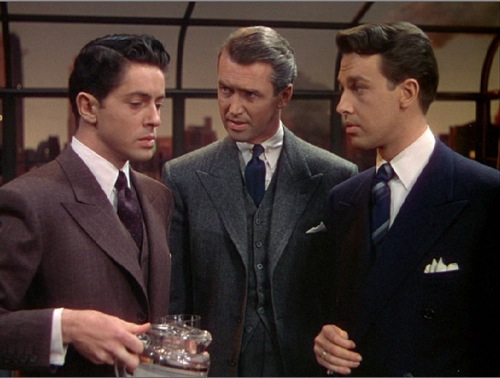
The first of many Hitchcock films on this list – probably more than any other director, and rightly so – shows the great man at his most experimental, as he attempted to shoot this film, based on a play by Patrick Hamilton, in one continuous shot. Limited only by the maximum length of a film reel at the time (10 minutes), a fact cleverly, if unsubtly hidden by editing shots of the backs of suits or a close up on an open chest lid, he pulls it off, utilising moving walls and tracking shots to accommodate the action as it pans out in the three rooms of an upmarket apartment.
The film follows two young men – the charming yet callous Brandon and his nervous, increasingly agitated friend Philip, as they attempt to cover up the perfect murder of their classmate David, whose body is hidden in the chest they use as a centrepiece for a party held for David’s family and friends. The acting is flawless, particularly from the two leads and James Stewart as their inquisitive former house master Rupert, and Hitch earns his moniker as the master of suspense, accomplishing an ever mounting level of tension with minimal music and meticulous plotting.
Choose film 9/10