The Goonies

The self-styled Goonies are a group of kids – Mikey, Mouth, Chunk and Data – who find their childhoods in jeopardy when a golf course is scheduled to be built in place of their homes. Days before the final contracts are to be signed by their parents, the kids find a treasure map in Mikey’s attic and, accompanied by Mikey’s older brother Brand and girls Andy and Stef, the kids set out in search of the treasure that could save their homes. However, the villainous Fratelli family have just busted one of their number out of prison, and they stand in the kids’ way.

still-of-sean-astin-corey-feldman-jeff-cohen-and-jonathan-ke-quan-in-the-goonies-1985-large-picture-chunk-is-how-old-the-goonies-cast Continue reading

The Color Purple

Celie and her younger sister Nettie are being raised by an abusive father in southern USA, near the start of the 20th Century. They have just lost their mother, and so far their father has taken the two children he raped into Celie and killed them in the woods. Now, though, their father’s eye has begun to wander onto the blossoming Nettie, so Celie is married off to a widowed man who needs a wife to take care of his house and his three unruly children. This new man turns out to be just as bad as Celie’s father, and it doesn’t help when he spends all his time pining for a lost love, in the form of Shug Avery.Purple03

Continue reading

6 Degrees of Separation Blogathon

SixDegreesofSeparationBlogathonLogoIt’s been a while since I’ve gotten involved in this kind of blogathon, however when Tom from At The Back nominated me, I couldn’t resist. It’s been set up by Nostra at My Film Views, and the original post can be viewed here. Essentially, this blogathon asks each participant to connect one actor/actress/director/movie to another actor/actress/director/movie in six connections or less. I’ve been asked to connect The Birth of a Nation to Daniel Bruhl, because apparently I did something wrong in a past life, and am now being punished for it. Continue reading

Raiders of the Lost Ark

I think I may be approaching the 1001 Movies List (and the other lists I’m going through) from something of a skewed perspective, in that I may be crossing off a few too many of the “better” movies before I get to the ones I’m not looking forward to as much. Bearing in mind yesterday I reviewed Ferris Bueller’s Day Off and today sees me tackling Raiders of the Lost Ark, I need to make sure I don’t eat all of my dessert before getting to the vegetables, as I also recently crossed off Back to the Future, Taxi Driver, RoboCop, To Kill A Mockingbird, Fargo and Boogie Nights as well. That being said, Bueller and Raiders made for a most enjoyable weekend of movie watching, with a little Jurassic Park: The Lost World thrown in for good measure (I’ll be writing something about that for French Toast Sunday this weekend, where we’re celebrating July with a month dedicated to Steven Spielberg, hence the Raiders viewing). Spielberg is one of my favourite directors, which shouldn’t be too much of a surprise considering he’s the guy behind Jurassic Park, the greatest movie ever made, but now I get the chance to talk about another one of the masterpieces he brought into cinemas. Continue reading

Top 10… Active Directors

I recently appeared on episode #164 of the Lambcast, along with Nick from the Cinematic Katzenjammer, Pat from 100 Years of Movies and Kristen from Journeys in Classic Film. Our chosen topic of discussion was our top five active directors, and provoked some interesting thoughts including why none of us like Terrence Malick. I recommend listening to the episode, if only to hear us ruthlessly mock Nick for his first-time presenting skills, but the show also inspired me to expand upon my list for this week’s Top 10.

So today, here is my list of Top 10 Active Directors. My choices are generally based on two things: the director’s recent body of work, and their upcoming work or last film(s). This prevented me from putting, say, Steven Spielberg as no. 1 purely on the basis of Jurassic Park and Saving Private Ryan, because technically he is still working today, but in my opinion he peaked a good few years ago

Honourable mentions:

Fincher

This is a list for which there could potentially be dozens of honourable mentions, but I’ve managed to narrow it down to just a few. First up is David Fincher, who has yet to make a film I haven’t at least liked, if not really loved. The reason he hasn’t placed higher is that although I’m always eager to see his films, I’ve never actually made it into the cinemas to see them, and I’ve had the DVD of The Girl With The Dragon Tattoo sat on my bookshelf for almost 6 months and still haven’t watched it. There’s no real reason for this other than finding the time to watch it with my girlfriend not around – there could be more rape scenes than she’d enjoy – but I feel my lack of excitement excludes him from the list. Next is Joss Whedon, whose Avengers Assemble was every bit as awesomely exhilarating as I’d hoped, and the trailer for Much Ado About Nothing looks decent too. Plus, the dude made Serenity, and has Avengers 2 on his slate. Other names I’d considered include Zack Snyder (who alas has had two unappealing flops for his most recent films, but Man of Steel looks promising), Martin Scorsese (I don’t deny he makes incredible films, but I don’t actually out-and-out love any of them as much as others seem to) and Sam Mendes (I loved Skyfall, Away We Go, American Beauty and Road to Perdition, but I don’t think he has any films in the works). The likes of Andrew Stanton, Danny Boyle, Robert Zemeckis, James Cameron, Adam McKay, James Gunn and Gore Verbinski can be considered as honourable mentions for the honourable mentions list. Continue reading

Lincoln

Four Years into the American Civil War, Abraham Lincoln (Daniel Day-Lewis), the 16th King of the United States of America, has his eyes set on not just ending the conflict, but abolishing slavery – over which the war is being predominantly fought – in the process. In order to do this he must pass the 13th amendment to the United States House of Parliament, which would outlaw involuntary servitude, but there’s two problems. One, he’s twenty votes short, and two, he needs to pass it before the war ends, or else it may never happen. And on top of this he’s got some familial woes too – a nutty wife and bull-headed son who wants to go off and fight for his beliefs.

Continue reading

Indiana Jones and the Kingdom of the Crystal Skull

Yep, the questionably necessary fourth Indiana Jones instalment is on the List. And if anyone has any problem with that (like me, for example) then the only place to point the finger of blame is at the public, as the List it appears on is the one voted for by Empire readers. Granted, the film came out in 2008, the year the poll was taken, so many readers who may have only ever seen 10 films would have been forced to put it in their top 10. This also explains the inclusion of Transformers and Juno on the same list, and it’s pretty much assured that if the poll were taken again, these films would be unlikely to retain their positions. But the important thing is that the film is on there, and I had to watch it.

When I first saw the film in the cinema, on the weekend it was released, I didn’t actually think it was that terrible. Hell, if anything I enjoyed it, and left the theatre happy and fulfilled. Granted, it was certainly no Raiders of the Lost Ark, or even The Last Crusade, but it was a damn sight more fun than The Temple of Doom. I was somewhat shocked to discover that these feelings were not necessarily shared by the rest of the world, but now, after a couple more viewings, I have realised my mistake.
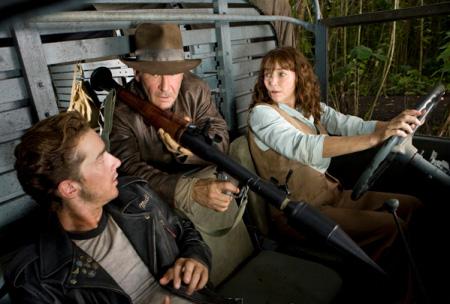
For me, the film has four main problems, all of which I’m sure have been covered many times before, but not by me. Firstly, the movie seems to be completely devoid of a strong narrative path. It’s more like a bunch of scenes that the writers thought would look cool, all strung together without really flowing into one another. On their own, or within a more cohesive plot, some of them would work fine. Case in point: the opening, in which Indy (Harrison Ford) and his ally Mac (Ray Winstone) are taken to the warehouse at the end of Raiders in search of a sporadically magnetic alien skull, is in itself a pretty entertaining scene, and a great way to start off the film. The use of Indiana’s instantly recognisable profile (when he’s wearing the hat, anyway) is well implemented, and the eventual chase through the warehouse is frenetic and action-packed, even if Ford no longer looks like he’s quite as capable of offing army thugs as he used to be. After this scene, we go straight into the now infamous fridge-nuke catastrophe, a scene which has no place in any film, let alone directly after a really fun, if a little silly, opening action sequence. This problem occurs again later, when some pages from a low-budget 80s B-movie are accidentally stapled in, when out hero finds himself in quicksand, a genre staple that I’m fairly sure has been made illegal.

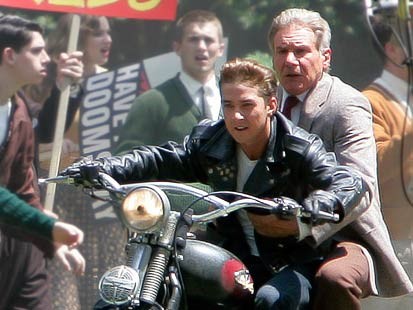
The second problem, and this is a big one, is Shia LaBoeuf. The man is a scourge to cinema. Every film he touches becomes a travesty. Seriously, look down the guy’s resume and you’ll find some of the worst reviewed films of the past few years: the Transformers sequels, Charlie’s Angels 2, Dumb and Dumberer. If he’s the sidekick or plays only a small part in the film, he’s the worst character or in the worst part (I, Robot, Constantine, Bobby) and yet, he still makes movies. In fact, he’s soon to appear in Lawless, in which I can only imagine Tom Hardy will overshadow him in every way possible as the two play brothers. Honestly, the film is going to put LaBeouf up against Gary Oldman! Though I sincerely hope that Shia’s performance in Lawless blows me away, insomuch as he wins an academy award for it, I highly doubt this will be the case, and it may even ruin that film, that I’m otherwise looking forward to, for me. In Crystal Skull, LaBeouf plays Mutt Williams. If you’re a fan of the Indy franchise, it should come as no surprise that (SPOILER) Mutt is Indy’s son, mainly because Indiana is famously named after his own father’s dog, and Mutt is of course another term for a canine. From his costume, it’s clear LaBeouf is foolishly attempting to emulate Marlon Brando from The Wild One, which he pulls off to absolutely no effect, and if anything it’s a reminder of just how terrible LaBeouf is. The fact that there were rumours suggesting this film would see the handing over of the reigns from Ford to LaBeouf to continue the saga still give me nightmares to this day. I’m almost tempted to announce Mutt as being more annoying than Short Round. Almost.

The Mutt/Indy connection brings me on to my third issue. Crystal Skull tries far too hard to be a member of the Indiana Jones family. I’ve got nothing against a sequel making subtle references to it’s predecessors, offering knowing nods and winks to fans, but here there is far too much time spent to this effect. Whilst Karen Allen, returning as Raiders’ love interest Marion Ravenwood, Mutt’s mother, is a nice touch and offers a believable romance with Indy that you are willing to at times root for, there were all too many moments and scenes that felt like the film-makers were just trying too hard to make it an Indy film. Unfortunately, they only succeeded in making it seem more like the parodies of the Indiana films that filled the gap during it’s 21-year hiatus. This felt far more like National Treasure 3 or The Mummy 4 than an Indy film.
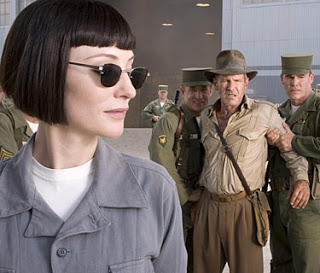
Finally, there’s just too many characters and subplots fighting for screen time. Jim Broadbent filled in for the sadly departed Denholm Elliot as Indy’s fellow university staff member, and John Hurt was a nice inclusion as a crazy old former colleague, but both felt very sidelined, as did Ray Winstone, who should have been pretty integral to the plot. Sadly, they, and Cate Blanchett’s questionably accented Ukrainian skull-hunter were at times almost forgotten in favour of Jones’ relationships with Marion and Mutt.
There were ways that the film could have been fixed. Raiders and Crusade proved that Indy doesn’t need a sidekick, and Temple proved that he shouldn’t have one, so nixing Mutt is pretty much a given. At least 2 scenes should have been cut, as the film feels like it runs at half an hour longer than it’s two hour runtime. I’d suggest the fridge and the diner scene with Mutt. Keep Marion, but make her be in love with John Hurt’s Oxley or Winstone’s Mac, to give Indy a bit of rivalry, and change that goddamn ending. About five minutes before the end of the film, when I first saw it in cinemas I burst out with raucous laughter at how ridiculous the climax was, and this time around it felt even more ludicrous.All that being said, it’s not exactly a horrible film, there are some entertaining sequences – I really enjoyed the jungle-set car chase, up until Mutt starts swinging with the CGI monkeys for no reason whatsoever – and it’s always thrilling to see Harrison Ford wearing a fedora, even if its not the only thing looking a bit dusty these days. I always used to defend the film for being good, just not when compared to the rest of the franchise, but I now know that even if you take it on it’s own, it still really isn’t worth it.

Choose life 5/10
A.I.: Artifical Intelligence

Kubrick’s visionary ideas, social commentaries and moral dilemmas don’t quite gel with Spielberg’s family oriented sentimentality in this disjointed and overlong offering, conceived and planned by the former but implemented by the latter after his death in 1999.

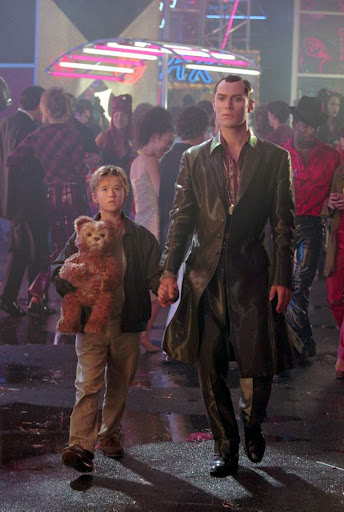
Now, I love me some robots. Whether they’re compacting waste into trash skyscrapers, travelling through time to save Sarah Connor or trying to kill Will Smith, you show me a film with robots in and I’ll watch the Hell out of it (though I’ve never actually seen the 20th Century Fox film Robots starring Ewan McGregor and Robin Williams, just never came around). There’s a robot clock watching me from atop a bookcase in the lounge, robot cushions on the sofa and a robot cookie jar whose head seems to rotate around and look at me wherever I am. But the key characteristic that joins these all together, is that they all look like robots, which is where A.I. looses my interest, for here they look like people. Yes, I know that’s the point. Haley Joel Osment’s mini-mecha David has been created to fill the hole left when his new parent’s son goes into a coma, and Jude Law’s robo-gigolo Joe (that’s fun to say) would be downright weird if he didn’t look a lot like a human, but that’s not what I want to see in a film about mechanical men. It isn’t until over half way through the film that we see some older models and exposed innards, and even then it’s far too briefly.

Osment is good, too good, as the automated child, and occasionally he passes for human, but for the most part he’s in full-tilt terrifyingly creepy mode, following his ‘mother’ Monica (Frances O’Connor) around the house all day, standing and watching her until she justifiably locks him in a cupboard. The first 45 minutes could quite easily be the start of a horror film, so disturbing is David: “I can never go to sleep, but I can lay quietly and not make a peep.” Nothing he does is endearing or even likable, but then I’ve always felt this way about children, but still the brief amount of time it takes for Monica to bond with this mechanised horror is jarring, especially given there seems to be no real scenario that draws them together. Also, David is only programmed to ‘love’ one parent, and his new ‘father’ Henry (Sam Robards) seems devoid of emotions, either for his comatose son or the new replacement, so that fits together nicely.

The movie is comprised of a series of episodes that, once passed, are all but forgotten. The story could have been interesting, and the world has potential for a more enthralling film within it, especially in the city scenes, and the brutal Flesh Fairs, where rogue ‘bots are hunted and tortured to a baying crowd’s delight, but over an hour of watching David desperately wanting to be a real boy becomes terminally dull. The future technology and gadgetry is generally good, subtle yet insightful, although the cars look a bit silly. And the ending is polarising, I found it terrible and unsatisfying, whilst Aisha thought that, whilst it seemed tacked on and unnecessary, it was still very moving.


Choose life 5/10

Jaws

Der-dum. Derr-dm. Derrr-dn. Derrrr-dn. Der-dn. Derr-de der-de de-de de-de de-dn-de-de-de-de!
Two notes. The most memorable two notes in history, signalling to the world that a skinny dipper won’t be home for dinner.  Composer John Williams, here winning his second of five Oscars – so far – and whom celebrated his 80th birthday last Wednesday, used these two notes to produce a primitive, devastatingly simple theme tune more recognisable than any other in cinema. Would Jaws have had such an effect without the tune? Probably, but it might not be quite so memorable.
Some credit should be given to the director too. A 26-year old working on only his second feature after the mild success of The Sugarland Express and his direct-to-TV man vs. truck classic Duel, cocky young upstart Steven Spielberg was eager to prove his worth. After purchasing the rights to Peter Benchley’s novel, what followed was one of the most famously arduous shoots ever experienced until Apocalypse Now. The actors hated each other. Boats almost sank or repeatedly drifted unwanted into shot. The pissed off Martha’s Vineyard locals incessantly badgered the crew, it all cost too much and took too long, with reshoots needed to make it just right (some scenes were reshot in the editor’s swimming pool). And of course, the shark didn’t work. The eyes looked weird, the jaws wouldn’t close, the thing wouldn’t float or just didn’t work full stop. Everything had to be geared around that giant mechanical fish. But in a way, all these obstacles came together to add to the whole. The three leads – Roy Scheider’s chief of police Brody, Robert Shaw’s salty sea dog Qunit and Richard Dreyfuss’ techie oceanographer Hooper are supposed to distrust each other, so a mutual dislike between the actors could only heighten that. Continued reshoots allowed shots to be perfected. And a malfunctioning shark meant they couldn’t show the monster, allowing audiences imaginations – always able to outdo any Hollywood special effects – to add in the gnashing teeth, piercing eyes and circling fins where needed. The film set the template for every blockbuster and mainstream monster horror since – only the best creature features save the big reveals to the end.
Whilst there is much to thank Mr. Spielberg for with regard to Jaws’ impact, there are some downsides too. Jaws was released nationwide in over 400 screens – unheard of in its day. Everyone involved assumed it would flop, so they prayed for a fair to middling opening weekend with which to gain back the millions lost in the making. Instead, they found the weekly grosses did nothing but rise, so a complete market saturation became the norm for all summer blockbusters, most notably Star Wars two years later. So nowadays you can blame the tentpole summer pictures – the floods of superheroes and giant robots beating the crap out of each other – at least partially on Jaws.
Not everything good came from the bad or accidental though. The script and staging is impeccable, with one notable scene – the three leads in the galley of Quint’s boat the Orca – passes from tension, to camaraderie, through heavy emotion, back to a sense of fun and then intense action, all without any sense of confusion or feeling rushed. There is some great blindsiding; assuring you something obvious is going to happen, before smacking you in the face with the exact opposite, and even the little moments – the ominous clicking of an unwinding fishing line under Quint’s steely gaze, Hooper’s boyish glee at the menagerie of jawbones hanging in Quint’s shack – all register with great impact.
Choose film 10/10

War Horse

Went to see War Horse last night, and to be honest I wasn’t expecting that much, a kind of Au Hasard Balthazar combined with a WWI Band of Brothers, following the exploits of a boy and his horse as they navigate the major events of the first world war trying to find one another. But what I found was an uplifting, beautifully shot old fashioned film that was far more entertaining than I could have hoped.
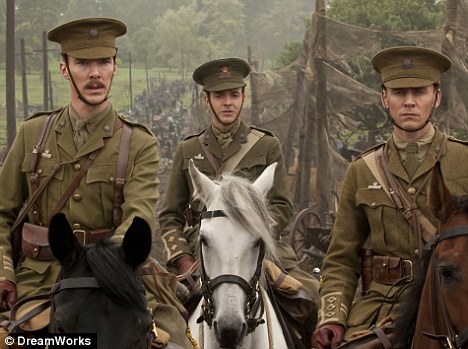
Though at times the plot gave way for nosebags of sentimentality (this is a Spielberg film, after all), and few of the characters are onscreen enough to leave a resounding impression, though their parts of the story are some of the most touching (hello, Tom Hiddleston, Benedict Cumberbatch, Toby Kebbell and Eddie Marsan) every second of footage used is shot so perfectly, by Spielberg’s regular director of photography Janusz Kamisnki, who will surely receive an Oscar nod, if not a statue. The most beautiful moments are those in a far from beautiful setting, with Joey, the horse, jumping over and through trenches on No Man’s Land, only to be ensnared in barbed wire, or a sunset-backlit ride up a distant hill, and the sheer scale of some scenes, with hundreds of extras running from trenches or preparing for war. John Williams’ sweeping score is good but forgettable, and this is hardly one of Spielberg’s best (it isn’t quite the Saving Private Equine I was hoping for), with perhaps not quite enough time focussed on those fighting the war (it’s a good 45 minutes or so before the horse and boy, played by OK newcomer Jeremy Irvine, are separated), this is still a very entertaining watch. I think it’s better if you don’t really care about horses, as I enjoyed it immensely, but my horse-obsessed girlfriend spent at least a quarter of the two and a half hour run time watching through her fingers, so desperate was she not to see anything bad happen to a horse. It’s also remarkable that they made a film whose central character is a horse, yet at no point did I think it would be better if the horse could talk, or had an internal dialogue, even when he makes friends with another horse.
Choose film 7/10