Frankenstein/Bride of Frankenstein

Although at times laughable now, back in 1931 James Whale’s adaptation of Mary Shelley’s classic horror may well have been truly terrifying. Everybody knows the story; a mad scientist and his hunchbacked assistant rob some graves and, with the aid of a handy lightning bolt, create life in a giant, shambling monster, who eventually escapes his castle prison and is hunted down by a screaming mob with pitchforks and torches. This sense of inevitability is what lets the film down, and the limited effects available 70 years ago makes the film pale in comparison to however you can picture it in your imagination. Boris Karloff (replaced with a large ‘?’ in the opening credits for maximum levels of mystery) is brilliant as the monster, displaying childlike innocence in a giant, rigid, wordless performance that sees him throwing a young girl into a river to see if she’ll float, yet remains the victim in this tale.
The sequel picks up at the exact end of the first film, but is not encumbered by knowledge of the plot, or at least not for me, as all I knew was that at some point a female monster was created with a big black Marge Simpson hairdo with a white streak through it. The film uses a nice reminding device – the story is being told by original author Mary Shelley to her husband ad Lord Byron – which although takes you out of the film, adequately reminds of the climax of the previous picture. There are some cringe worthy scenes, most notably a blind man teaching the monster how to speak reminiscent of the worst scene of Terminator 2, with John Connor teaching Arnie how to be cool. The bizarre scene where Dr. Frankenstein’s former mentor Dr. Pretorius reveals the miniature people he has created in jars, including a king, a queen and a mermaid, is just insane, and Pretorius himself is a perfect combination of Doc Brown and Grand Moff Tarkin.
Frankenstein: Choose life 5/10
Bride of Frankenstein: Choose life 4/10

Ivan the Terrible

Oh dear God how many films about Russian history do I have to watch? Jesus I’m getting tired of typing about this, so you must be tired of reading this (I’m under the misapprehension that anyone is actually reading this. Or I’m talking to the voices in my head. But then why would I type that? Now I’m confused.). Our old friend Sergei Eisenstein (Battleship Potemkin, Alexander Nevsky, October) has been at it again, and fortunately I’veonly got one more of his films to watch now (1924s Strike, available to watch online at LoveFilm, yet I just can’t bring myself to do it yet). As I’ve said before, I don’t know anything about Russian history, nor do I really care about it, and I’m trying not to do any extra research to review these films, to help my ‘man of the people’ style reviews. I’m not going to recommend you watch a film that requires you to pass a history A-Level to a high degree beforehand.
So, in a nutshell, Ivan the Terrible tells the story of the man who united Russia in the 16th century. It was conceived as a trilogy, but Eisenstein passed away after making part two (I really shouldn’t be, but at least a small part of me is glad about this, although of course I’d have preferred he lived but just not made it, or anything else, ever again). The subtitles are difficult to read – white text on a light grey background – so much of the dialogue is lost, but I think he takes on the Russian leaders who opposed him, and the general people turn against him for going against God. There is a song including the lines “Sew a cloak of fox fur, trim it with beaver,” and the use of shadows is nice, with Ivan’s (Nikolai Cherkasov) distinct beard silhouetted against a wall, but the plot is dull and impenetrable without the aforementioned qualifications.
Choose life 3/10

The Big Chill

Imagine if Diner or St. Elmo’s Fire had a reunion twenty years later, and you’ll be picturing something like this, when a group of friends meet up for a weekend to attend the funeral of one of their number who killed himself. Kevin Costner filmed scenes as the departed Alex before they were cut, but his presence isn’t missed amongst those that remained, including Jeff Goldblum, William Hurt, Glenn Close, Kevin Kline and Tom Berenger. The weekend reveals that none of them are as happy or settled as they may initially seem, and each character is inhabited totally and wholly; the cast even shared a house together before the shoot, and remained in character throughout it. The soundtrack is also exquisite, featuring the Rolling Stones, Procul Harum, the Beach Boys and Marvin Gaye.

Choose film 8/10

The Dollars Trilogy

Widely regarded as the first spaghetti western (actually 1959s Il Terrore dell’Olkahoma), Sergio Leone’s A Fistful of Dollars is at least the first important one, birthing the greatest western icon since John Wayne in Clint Eastwood’s drifter, immortalised by a hat, beard, poncho and a squint. Before Leone, Eastwood was known best for his TV western Rawhide (the theme tune of which is sung at the country and western bar in the Blues Brothers) , but this shot him into not just the Hollywood A-List, but into the pantheon of American icons as the nameless cowboy out to make a profit from a small town heading into ruin. Run by two warring families, the Baxters and the Rojos, Eastwood sees a unique opportunity (unique that is unless you’ve seen Yojimbo, from which this borrows heavily) and sets about pitting the two families against one another. Leone’s direction, only cutting a shot when he has to, combined with Ennio Morricone’s whistling score and the spectacular cinematography of a barren, bleached landscape under a harsh, unforgiving sun makes for a spectacular western steeped in both American characters and European style.
Inconceivably, Fistful’s lesser yet still unmissable semi-sequel For A Few Dollars More didn’t make it onto the list, but I watched it again anyway. This time, Eastwood’s identically attired yet still nameless drifter finds that it may be beneficial to team up with Lee Van Cleef’s rival bounty hunter to catch their latest target. Look out for Klaus Kinski as a hunchbacked member of the gang they’re chasing.
The closer to this trilogy is widely regarded as one of the best films in the world, and currently holds the number 4 spot of IMDb’s top 250. From the opening score, undoubtedly one of the greatest in cinematic history that would be my ringtone were it not Reservoir Dogs’ Little Green Bag, you can tell you’re in for something special. The Good, the Bad and the Ugly follows, as the title suggests, three men, whose lives converge around a loot of gold buried in a grave. Eastwood’s Blondie is debatably the ‘Good’, a bounty hunter returning criminals for reward, then shooting the noose when they’re hanged so he can collect it again in the next town. Eli Wallach’s Tuco is the ‘Bad’, one such vagrant Blondie hands in, and Lee Van Cleef is given short shrift as the ‘Ugly’, as hired killer Angel Eyes, who always goes through with a job he’s been paid for. Unlike the previous two films, this is not the Clint Eastwood show, and if anything Wallach, the most interesting and entertaining character, is given the most screen time as the three set out to torture, beat and murder the others for a shot at the gold. Although the plot gets lost a little in the middle, when the US Civil War takes over, but by the three-way standoff at the end any flaws are forgiven. It’s the kind of scene that just doesn’t work on paper (shot of eyes, then a gun, then feet, eyes again, repeat for 5 minutes) but is unequalled on screen, and the ending is perfect.
A Fistful of Dollars: Choose film 8/10
For a Few Dollars More: Choose film 7/10
The Good, the Bad and the Ugly: Choose film 9/10

October 1917: 10 Days that Shook the World

I’ll be honest, about 10 minutes into this film I got up and started making my dinner, occasionally glancing at the screen just to make sure I wasn’t missing anything important. This is a propaganda piece made for the 10th anniversary of the Russian revolution, made by several filmmakers, led by Sergei Eisenstein. The ‘film’ re-enacts the first days of the revolution, shows inspirational imagery of men drinking together, and is occasionally intercut with large text proclaiming FRIEND! or BROTHER! or some such nonsense. I’m sure it served its purpose back in the day, but is it really necessary to include this on a list of films you must see before you die? I could have quite happily died without seeing this film. Hell, halfway through I could have quite happily just died.

Choose life 1/10

A Fish Called Wanda

An Englishman named George Thomason (Thomas Georgeson, seriously), his American partner Wanda (Jamie Lee Curtis), her supposed brother Otto (Kevin Kline) and the stuttering animal lover Ken (Michael Palin) successfully perform a diamond heist, but an elderly witness dobs George in, and John Cleese’s henpecked lawyer Archie Leach is appointed to defend him. All of these people are liars, murderers, adulterers and thieves, most notable Curtis’ Wanda, who finds herself seducing everyone else to get her own way, with arousal via foreign languages being her only weakness. The film belongs to Palin and the Oscar winning Kline. Though the other performances are all excellent, the characters of the timid Ken and the philosophical but very, very stupid Otto are so comically rich that they deliver the most laughs, particularly when they share the screen, be it Otto declaring his undying love to Ken, or sticking ketchup-covered chips up his nose to extract information. Cleese should also be commended, if only for prancing around naked singing in Russian.

Choose film 9/10

Top Hat

My first encounter with Fred Astaire and Ginger Rogers, this does not make me look forward to any others. The plot is paper thin and rests upon a simple, easily clarified misunderstanding – Astaire’s dancer Jerry Travers falls for Rogers’ Dale Tremont staying in the hotel room below his, but she thinks he is married to a friend of hers and rebukes his advances. Every plot point, from their initial meeting (he is dancing in his room, alone, for no reason, waking her up, so he dances on sand to not make any noise, instead of, I don’t know, just not dancing) seems to have been contrived simply to show off the dance skills of the two leads. Seeing as I’m incapable of telling good dancing from bad, or even if the dancers are in time to the music, this is entirely lost on me, the dance sequences left me bored and awaiting a scene where someone didn’t spontaneously burst into song for no apparent reason.
Choose life 5/10

Friday Night Lights

I’ve heard before that this is one of the better sports movies and, though I know very little about American football (or women’s rugby, as I like to call it), the games shown here were well shot and captivating. But, a good sports movie is still just a sports movie, and is therefore about nothing. I didn’t play sport in school. I dabbled in cricket a little, very briefly played football but then gave up when I saw the little benefit that could be achieved with the maximum effort put in. So instead I studied hard, did my homework and did OK in school, and from there went to college and university on my academic qualities, got a job and now make a living. I’m not a natural genius, I worked hard to get what I have, so when a film tells me that these kids playing football aren’t the brightest, and their only way out of their backwards hick town is via throwing a bag of air across a line or between two posts or whatever the hell they do over there, I just have to sit back and try not to throw everything to hand at my TV. I don’t care how committed the rest of your town is to a game, and it is just a game after all, if you don’t have yourself a backup plan when you’re relying on not damaging that oh-so-fragile body of yours to secure you’re future, you’re even dumber than anyone could have predicted.

Anyway, rant over, as you can guess, I’m no sports guy, so good luck to this film. Billy Bob Thornton is the football coach to a high school football team in a town full of meat sacks that shuts down every Friday night come game time. Every man, woman and inbred child in this town has an opinion they’re only too willing to share as to how the game should be played, and generally a different one after to the event as to how it should have been played. Local radio shows take call-ins from fans, on suggesting that they’re “doing too much learnin’ in this school,” and the kids themselves are under more pressure than is healthy from all around, particularly in the case of Garrett Hedlund’s Don Billingsley, whose father was a star in his day, yet Don is playing third string (I think this is a bad thing). Meanwhile current star quarterback Boobie Miles enjoys a celebrity lifestyle and just has to show up to training, with all the plays centred on him, so guess which players going to receive an unrecoverable injury? This true story from director Peter Berg, helmer of least anticipated film of 2012 Battleship, follows the Permian Panthers, for that is their team name, from the play-offs to the final, and though the outcome of the final match isn’t inherently obvious, everything else in this film is.
Choose life 4/10

Aguirre: Wrath of God

In 16th century South America, a large group of conquistadors are exploring the jungles, searching for El Dorado, the city of gold. Among this group are knights in full armour, maidens riding in slave-carried sedan chairs, monks, llamas, pigs and men dragging cannons, desperately trying to traverse knee deep mud and extremely dense rainforest. It was these images that first made me think this was a comedy, as the shots of these 100s of people blindly heading deeper and deeper into the lush undergrowth without even contemplating what could possibly be ahead is frankly hilarious, but when a smaller (but still fairly sizable, and weighed down with unnecessary items and people) is sent forward as a scouting party, they are rapidly picked off one by one by natives, illness and each other. Eventually leading this group is Klaus Kinski’s wild-eyes Aguirre, desperate to divert to mission to his own gain via any means necessary, even shooting the man currently in charge. After the initial hilarity the movie takes a dive towards bleaker, more surreal pastures, and although some shots, the final one for instance, of Aguirre finally controlling his raft, apart from the hoards of monkeys, are memorable, this film really isn’t worth the time.

Choose life 5/10

The White Ribbon

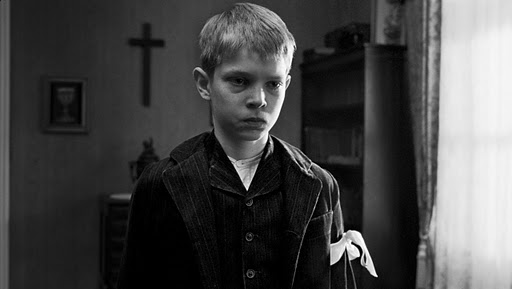
One cannot deny that this is an excellent, well made film by director Michael Haneke about a pre WW1 German village suffering from seemingly random acts of terrorism – the doctor’s horse is tripped on his way home from work, a barn is burned down, a woman dies when some rotten floorboards give way beneath her. Yet viewing is not a satisfying experience, as our narrator, speaking from the future about years long past, seems reluctant to release all the details of his story. The children of the village are severely mistreated by the pillars of their community, namely the pastor, doctor and baron. The pastor labels them with the titular white ribbon for the smallest offence, and when his pubescent son admits to self gratification; his hands are tied to the posts of the bed when he sleeps, to prevent any further sinning. It is obvious from the start that the children are behind the village’s incidents, having formed a kind of gang, yet these suspicions are never fully confirmed, with the most validation provided by a character approaching a bird’s cage holding a blade, and then the bird later found dead. Though Haneke has made a living from ambiguous works, some of his other features – Hidden or Funny Games for example – are superior to this in that you feel you have been told at least most of a story, rather than excerpts from a couple of chapters.

Choose life 7/10