Winchester ’73

The first things I have to say about this film are that it features one of the earliest credits for Tony Curtis, and that Rock Hudson is buried in the cast, and he plays an Indian. Right, now that’s out of the way, let’s talk about the film.

I like this kind of film. Now, that statement’s not much good to you without knowing what kind of film it is, but regardless of that I like it anyway. It’s the kind of film where several smaller stories are all tied together through coincidence, or an object being passed from one to another, as is the case here. There are some exceptions – I wasn’t wild about Au Hasard Balthazar or Babel – but these types of collective narratives, like Magnolia, Short Cuts, Crash and Traffic, usually appeal to me, and having a great ensemble cast never hurts either. Here, the element that ties the stories together is a rifle.

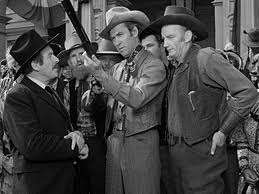
Our introduction to the eponymous weapon is through James Stewart’s Lin McAdam, a cowboy on the trail of Dutch Henry Brown (Stephen McNally), a dangerous man with whom the two share a bitter past. When Lin rocks up in the town of Dodge City, presided over by Will Geer’s Wyatt Earp, he finds Dutch has entered into a shooting competition to win the rifle, so enters as well, mainly to stop his foe from winning the gun that won the West. After the competition, which also sees lookalikes of Davy Crockett and Colonel Sanders, so feels a bit like a western parody, the gun is passed from one person to the next, either by honest trade or dishonest force, and not always with it’s ammunition present. We follow the gun through the film until a fairly obvious and clearly signposted finale, where Lin eventually catches up to the on-the-run Dutch.

This film felt incredibly stagey and unnatural, so I rarely felt engrossed with the movie. For example, there’s an indoor scuffle early on that in which, mid-fight, someone draws the blinds to make the fight look more dramatic. Granted, this was also to try and hide the fisticuffs from those outside the window, but seeing as they were on the first storey I don’t think there was too much danger of that, and it’s clear it was done entirely to increase the dramatic tension. Also, a moment where Shelley Winters, who is great as the film’s predominant female presence, is sat tossing a coin up and down is just waiting for someone to come along and catch it mid-throw, and it just appears as if that’s the very reason shes sat there throwing it in the first place, which is just silly.

Stewart is good in the lead role, and he must have gotten on well with director Anthony Mann, as this is the first of 8 collaborations the pair shared, including The Naked Spur and The Man From Laramie, both of which also appear on the List. Some of the supporting cast are terrible though, particularly every bartender in the film, and there’s a moment where a man tries to hit on the girl whose fiance he just shot, which is bad form in my books.

If, like me, you love the sound of a bullet’s ricochet, then you’ll adore the final showdown, however I feel that there isn’t much here to hold the attention of people who don’t really like westerns. Now, I quite like them, so I thought the film was pretty good, though more could definitely have been done with the central premise, and the film peaks too early with the opening shooting competition. 

Choose film 6/10

Somebody Up There Likes Me

After a couple of small TV roles and an uncredited appearance in 1953’s Girl On the Run (I haven’t found it yet, but I will) Steve McQueen’s second film role, again uncredited, was in this Paul Newman boxing film that I’d previously never heard of and can kind of understand why. It’s not that it’s a terrible film, it’s just thoroughly underwhelming, and tells a familiar story in a genre that has since far superseded it. To start with, it’s a boxing movie where the lead character is Italian and called Rocky Barbella (Newman). If that’s not a coincidence I’ll be shocked.

Rocko ‘Rocky’ Barbella (later Braziano) is a street hoodlum son of a former boxer. As a kid, his Dad Mick (Harold J. Stone) embarrassed Rocky in front of his friends whilst he tried to teach him how to box, and ten years later his layabout father has clearly had a prominent effect on Rocky, as he’s on the lam from the cops, and refuses to either get a job or an education. Things don’t work out too well for the lad, and he gets himself in trouble and locked away for a few years and, upon his release, is immediately conscripted to fight in World War 2. During this time, he discovers an aptitude for fighting, and is able to mould it into a boxing career, which comes in useful when he needs to raise a little money later on.
I can’t really pick out much that was terrible about this film, but nor can I find many reasons to recommend it. Newman was good (other than sounding like Jackie Gleason), but had yet to reach his shining greatness (he is definitely a front-running candidate for a future Film-Makers run, even if I have to watch Cars again) and there were some shots that I loved, particularly a receding tracking shot as Rocky makes his way through a busy market, but this happens near the start of the film, and I kept my hopes up for more cinematography of this calibre but sadly was left wanting. As well as being reminiscent of many boxing films that have been released since (not a fault of this film, but certainly not a reason to watch it either) there were some plot points eerily similar to another Newman classic, Cool Hand Luke, most noticeably his incarceration into a chain gang, during which he has a life-changing fist fight.
There were a couple of obvious gaffs – at one point a man knocks on a very wooden-sounding tent – but otherwise the script was generally entertaining (when offered a cup for a boxing match, Rocky declines and says he’ll drink out of the bottle). Some beats seemed a little extreme – a prison guard pulling a gun when an inmate doesn’t move his towel, a judge awarding Rocky with a prison sentence of indeterminate length – but these could be a product of the time the film was made and set. I loved the scene where Rocky’s manager (Everett Sloane) was telling him his love life (with his sister’s friend Adrian, sorry Norma, Pier Angeli) was making him too happy and healthy to be a boxer.
McQueen plays one of Rocky’s gang early on in the film, and his trademark doing-something-in-the-background-eve-when-he’s-not-supposed-to-be is evident even here. I was expecting him to show up again later in the film, when Rocky revisits his old town and meets up with other ruffian Romolo (Sal Mineo), but alas he only got a few scenes at the start, and didn’t have too much to do in them, but it’s only his second film so it’s OK.
I felt the film seemed to drag near the end, even though it skipped through the dense plot pretty quickly and remained under two hours long. I definitely felt like they couldn’t think of a name (or last line) for the film, and someone saw the title of Perry Como’s song, which coincidentally plays over the credits, and thought they may as well use it for this. It didn’t really fit, going by the amount of bad luck Rocky endured throughout most of his life, but it didn’t jar too much either. For all I could tell Newman was convincing in his boxing scenes, and fans of his won’t be disappointed, but unless you’re a completist like me, or have a particular fixation with boxing movies, there’s not much else here to keep you engaged.
Choose life 6/10

Doctor Zhivago

One of those Sunday afternoon sweeping epics that never seems to be off the TV schedule but before the List I’d never seen before (see also The Sound of Music, Gone With the Wind, The Ten Commandments), Doctor Zhivago was a bit of a disappointment.
For starters, it’s well over 3 hours long, but very little of that mammoth runtime left any kind of impression. Other than some striking imagery – a splash of blood in freshly fallen snow, a burst of yellow sunflowers against a dull, beige hallway – and a few admittedly impressive set pieces, there’s very little from this film that’s been committed to my memory banks.

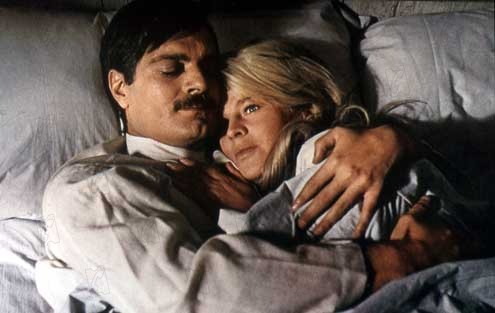
Given there’s so much time to handle, the characters don’t receive much characterisation. This is a real shame, particularly for Omar Sharif as the titular medical man, who gives an engaging a bright-eyes performance, but of a character I still know very little about. His Sharif is born into a wealthy family in Russia, a little before the Bolshevik Revolution, and the film tells of his many and varied troubles throughout his, and Russia’s, history. On many occasions the history overshadows his life, as well it should, but the focus of the film is instead on him and his loves, for his childhood sweetheart Tonya (Geraldine Chaplin), whom he marries, is forcibly separated from Zhivago, forming a love triangle when he works closely with Julie Christie’s Lara.
At times the film reminded me of – whisper it – Pearl Harbour, particularly when I was asked to try and forget about the major historical event taking place in the background of a scene, and instead focus on the trivialities of the relationships of the leads, but just like Michael Bay’s explosion-fest, the grand scale of the set pieces was very impressive. Be it the hundreds of singing extras at a rally that becomes a battleground against an army of sword-wielding Cossacks, or the miles-long trudge Zhivago sets out on to return home through the snow, there is little shortage of spectacle.
Look out for Klaus Kinski on a train, and listen as your cries for more Alec Guinness – as Zhivago’s brother Yevgraf – go unheard. Whilst the film is certainly at times impressive, especially for its time, today it doesn’t really hold up, though it is certainly better than Pearl Harbour.
Choose life 6/10

The Piano

First off, an apology for the forthcoming review. I watched the film three months ago, and have gotten so far behind on my post writing that I’ve not had any real desire to review it, as to be honest it wasn’t that inspirational of a film. Nonetheless, I shall do my best, but I’m relying almost solely on the notes I made during the movie, as I can’t for the life of me remember very much of it. As you can probably guess, this isn’t going to be much of a recommendation to watch the film.
Holly Hunter plays Ada McGrath, a woman who, aged six, willed herself mute, and has since never spoken a word. She moves from Scotland to New Zealand for an arranged marriage with Sam Neill’s landowner/writer Alisdair, and brings her young daughter Flora (Anna Paquin in her first live action picture) and their piano, Ada’s pride and joy. Neill is less than impressed with his new bride-to-be (“You’re small, I never thought you’d be small”), and refuses to cart her piano across the difficult swampland between the beach and his home, so they abandon it on the sand, much to Ada’s discontent. Fortunately local plantation worker George Baines (Harvey Keitel) takes a shine to Ada, and trades some land with Alisdair for the piano, and agrees to trade it back to Ada in return for ‘piano lessons,’ during which George will get to know Ada far more intimately than she’d like.

Hunter and Paquin both won Oscars for this film, and Hunter at least thoroughly deserved hers (Paquin is excellent for an 11 year old, but though I haven’t seen any of the performances she was nominated against I wouldn’t be surprised if any of the actresses, including Emma Thompson and the aforementioned Hunter, performed more capably). Hunter’s Ada is utterly repressed, yet still emotive and expressive, all pursed lips and passive eyes, her skin a deathly pale against the stark black of her dresses and bonnet. Keitel is also good, though his proclivity for whipping his pecker out is always a distraction, and is for the most part unnecessary.
I got the feeling that the film was made to prove the point that a lead character doesn’t need to speak (see also: Dumbo). There isn’t too much of a story here, with the events built entirely around the character and her very existence rather than the exciting or emotional events in her life. Her character is well realised, especially the bond with her daughter, and her slowly breaking down walls against Baines’ advances. Communicating only through sign language, facial expression and a small chalk-board locket, she says more than any other character, and with far less.
Despite the poetry of the film, such as Keitel’s Baines being willing to just sit and watch the piano hammers dancing gaily along the strings, I didn’t take much away from this film, and it has had little to no lasting impact on me. It’s very slow, and the message is muddled, though I think it has something to do with choosing the correct way to woo someone. Alisdair goes about things in entirely the wrong way with Ada. If only he’d coerced her into, essentially, prostitution, he’d have been much better off. Oh, and the best part about the film? It features an actress called Geneviève Lemon.
Choose life 6/10

Nosferatu: A Symphony of Terror

There are at least six variations on the Dracula myth on the List, and probably hundreds that aren’t. I’m ashamed to admit that the only other vampire movies I’d seen prior to this (other than Les Vampires, which doesn’t really count) are a half watched Bram Stoker’s Dracula, and Twilight, which I did not choose to watch and am still trying to scrub from my retinas. And yet, though my life has been surprisingly devoid of vampire fiction (I’ve never even seen an episode of Buffy, or an instalment of the Underworld or Blade films), I’m still well versed in the vampire mythology, as indeed is everyone else. It seems one is almost born knowing that vampire’s transform into bats, suck your blood and can be vanquished with a stake in the heart, exposure to sunlight or too much garlic on their pizza.

This version is one of the earliest vampire films, having been released in 1922 and directed by German silent director F. W. Murnau. It follows the traditional Dracula beats (though the vampire is named Count Orlok as this is an unofficial retelling), and stars Max Schreck as the titular creature of the night.
Jonathan Hutter (Gustav von Wangerheim), a clerk from the town of Bremen in Germany, travels to Transylvania (ominous thunder roll) to complete some legal paperwork with the mysterious Count Orlok, who wishes to buy a house in Bremen. Though there are many clues as to what is in store for Hutter, including terrified locals speaking of nocturnal spirits and his creepy, Orlok-controlled boss hinting that the journey will cause him pain and cost him blood, Hutter merrily laughs everything off as ludicrous superstition and hokum, until he arrives at the castle and meets the Count, who keeps unusual sleeping hours and sleeps in a coffin in the basement.
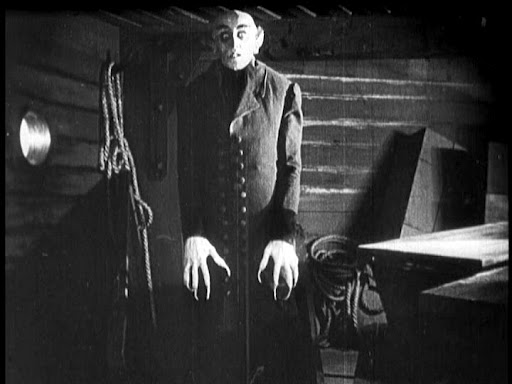
Most of this film is predictable if you know the traditional Dracula legend, but what makes it truly memorable is Schreck’s performance. His distinctive appearance – all pale skin, pointed ears, giant eyebrows over sunken eyes and clawed hands on arms stuck firmly to his sides – sticks in the mind, and his presence is greatly missed whenever he’s off screen. Scenes of Orlok’s stark shadow descending on a prone figure, or his body, stiff as a board, rising from a coffin, stick firmly in the memory, and at the end of the film, when he is staring, unmoving, from a window, is genuinely disconcerting and more than a little terrifying.
It’s unfortunate then that the score for the film is more than a little insane. It kicks off with a cartoonish plinky-plonk tune over the supposedly doom-laden title cards detailing “Nosferatu! That name alone can chill the blood!”, and later the score goes crazy when Hutter is merely reading a book. Also some scenes are let down by a distinct lack of quality in the print. I understand that the film was made 90 years ago, but the scene in which Hutter is discovering bite marks on his neck is ruined by the fact that the bite marks are not even slightly visible on his bright white skin.
The ending is a little hurried, though by that time I was starting to get bored anyway. I was also surprised by how little the character of Van Helsing had to do with the plot, as I’d always thought he was pretty integral to the story, yet he turns up from nowhere halfway through as an expert on vampires in nature.
All in all, this is a good example of an early telling of a classic horror, that unfortunately has become very dated since its release. I’m sure that one of the more recent versions on the list – 1931’s Bela Lugosi starring Dracula or the 1958 Hammer version starring Christopher Lee – will be much better.
Choose life 6/10

A Nightmare on Elm Street

I can only imagine Hallowe’en parties in 1984, but I’m guessing quite a lot of people were dressed up in a battered fedora, red and green striped sweater, poorly applied ‘burned’ make-up and a glove with cardboard blades glued on, for if anything has endured from Wes Craven’s multiple-sequel spawner, it’s Robert Englund’s nightmare-stalker Freddy Krueger.

If it’s true that a horror movie lives or dies (generally by running upstairs instead of out the front door) by it’s killer, then there’s no surprise that this franchise is still going. I haven’t seen the 2010 reboot and I’ve only heard bad things, but I’m intrigued to see Jackie Earle Haley’s take on the former child murder released from prison on a technicality but burned alive by the parents of Elm Street. Krueger is an icon from horror history, up there with Michael Myers, Jason Voorhees and the Guy in the Scream mask, making up the B-team behind the likes of Frankenstein, Dracula and the Wolfman. For Krueger, you see, is unstoppable. He’s risen from the dead to take the children of those that murdered him, but he does his killing in the one place he cannot be caught; the children’s dreams. This is a genius conceit, but also the film’s biggest let down.
If you want to terrify your audience and instill in them genuine fright once they have stopped the film and gone about their daily lives, you scare them with something ordinary. A situation they themselves will find themselves in on a regular basis. Hitchcock did it in Psycho with having a shower. Craven did it with going to sleep. There’s nothing you can do about it, eventually you’ll have to go to sleep; quite often it happens without you even planning to. And once your head is resting gently on your pillow, all you can think about is that maniacal laugh echoing around the walls. That tapping at the window, surely that’s just the branch of a tree blowing in the wind, it couldn’t possibly be the knifed glove of the man out to rip you to shreds? When asleep you’re at your most vulnerable. It can happen anywhere – at home, school, prison, hospital, and there’s no way to defend yourself (short of Inception-style techniques, crossover anyone?) and Craven knows this. In his world, a glass of warm milk is as deadly as any conventional weapon.
But the fact that Freddy exists in dreams, can defy physics by being everywhere at once and can take on any form he chooses to terrify you the most, makes him almost less scary. There’s a sense of inevitability. Much like in Ring, once you watch the tape, you’re going to die. There’s not a whole lot you can do about it. You can’t kill Freddy in a dream, you can’t stay awake forever, there’s really only one possible outcome. Yes, in this film and the ever diminishing sequels they find loopholes to temporarily get around the issue, but I’ve always found these to be annoyances and cop outs from the original story. I’d forgotten the ending of this film when I saw it, and I was almost incredibly annoyed at the backdoor excuse they try to use.
It’s a good, solid horror film, and is much more effective if you never, ever watch the sequels. Whilst they have some inventive kills (hearing aid? genius) and increase the comedy quotient, Freddy becomes a watered down pantomime villain, whose incessant survival becomes more grating the more films you watch. But here his terrorising of four teens (including a 21-year old Johnny Depp in his movie debut) is played largely for tension and scares, though there’s a few lull-in-the-score moments that are clear setups for something to jump out and grab our virginal heroine Nancy (Heather Langenkamp).
There are moments of black comedy – a cop telling a paramedic “you don’t need a stretched, you need a mop,” and the kills are satisfyingly gory. Nancy looking in the mirror got a laugh out of me, as at the time of the film’s release Langenkamp was, you guessed it, 20 years old. The image of Krueger’s hand emerging from between the legs of a girl asleep in the bath is more than a little terrifying.
Choose film 6/10

The Queen

Well it’s a bank holiday this weekend over here in Blighty, because our reigning monarch has succeeded in not dying for 60 years on the throne, and doesn’t deem any of her offspring worthy enough to take her crown whilst she has enough life in her hands to grip onto it, so what better way of celebrating than by watching The Queen?
Diana, Princess of Wales, divorced wife of the Queen Elizabeth II’s son Prince Charles and mother of her grandchildren Princes William and Harry, is killed in a car accident in August, 1997, causing uproar throughout the UK, not least for the royal family and the recently elected Prime Minister Tony Blair (Michael Sheen). In the aftermath, the royal family take a period of mourning in their Scottish residence, whilst Blair remains in London to almost take advantage of the situation.

First off, the performances in this film are mostly excellent. There was never any doubt that Helen Mirren would make a perfect choice as QE2 (the monarch, not the boat), and she gives a repressed, buttoned down portrayal of a woman few know personally. Sheen, too, is at his best when playing a real person (see also The Damned United, Frost Vs. Nixon, half of his CV) and James Cromwell is good as the Queen’s cantankerous husband Prince Philip. It is only really Alex Jennings as Charles who goes too far. The rest of the cast limit how much of an impersonation they are making of their subjects, whereas Jennings tries too hard to mimic Charles’ more exaggerated mannerisms and persona already expanded upon in the media, as though he’s performing a sketch show impression rather than showing just enough for us to know who he is.
This is the kind of film that lives and dies by it’s script. The West Wing covered a similar theme on a weekly basis, and succeeded not just because of the stellar cast and direction, but mainly due to Aaron Sorkin’s masterful way with words. Here we have a good cast and a slightly above average director in Stephen Frears (High Fidelity, Dangerous Liaisons), but the script is written by Peter Morgan, whose CV is littered with other mediocre biographies lifted only by acting talents (The Last King of Scotland). Had this film had a punchier script, with some rat-a-tat dialogue and an entertaining turn of phrase, it’d be a much better piece. As it is, the story isn’t terrible, but it is largely forgettable.
Being English, you’d think I’d be well versed in the goings on around such a recent major occurrence, even if I was only 10 at the time, but alas I’ve never known an awful lot about the events both before and after Diana’s death. Much that occurs in the film came as a surprise to me. I’d obviously heard of Diana, dubbed the People’s Princess by Blair, but knew very little of her exploits or the reasonings behind her tabloid headlines. I’ve never paid much attention to the royal family, to be honest. It’s not that I’m anti-monarchy, it’s just that I really don’t care about them. The most I’ve seen of the jubilee celebrations was some highlights I caught whilst channel surfing this evening, and were we not having family over to visit I’m sure I’d have been writing posts or watching something off the List, so would have missed it completely. This film has done little to nothing to increase my interest in the royals, though it has provided an insight behind the closed doors of their world.
The movie seems to take a fairly pro-Blair stance, as he seems to be the most considerate character in the film, especially when compared to his far more callous spin doctor Alastair Campbell (Mark Bazeley). The relationship between the Queen and Blair is nicely played out – she kicks off his first day in power by reminding him that he is her 10th Prime Minister, with the first one being Winston Churchill, so he has a fair amount to live up to. There are some nice comedic touches – in her death, Diana is still proving an annoyance to the royals, including the Queen Mother (Sylvia Syms, Helena Bonham Carter’s character in The King’s Speech), whose funeral arrangements Diana has pilfered. It’s very bizarre to see the Queen calling someone Mummy, and even more so to see this usually confident figure spending much of the film deliberating and worrying, as she finds herself in the middle of a major royal event with complete and utter media coverage.
Not much of the film has stayed with me after watching, other than Mirren performance, which is especially spot on during the Queen’s address. I’ve had a little royal history filled in for me, but it was never anything I really cared about anyway.
Choose life 6/10

Ring

I always seem to end up watching horror movies on my own. Very few of my friends, and definitely not my girlfriend, actually like scary films, and though my Dad likes a couple my Mum always essentially banned them from the house (Carrie is her least favourite film of all time, possibly the main reason my Dad still has it on video back at their house). And so it was that I ended up watching Ring, the Japanese 1998 original, alone. It’s subtitled, which rules out the only people I know that would have been willing to watch it with me, but as I was expecting something thoroughly disturbing, bordering on terrifying, I made sure to watch it first thing on a bright and sunny Saturday morning. I even left a curtain open to stream in some sunlight, just not the one that gives glare on the screen.
 
I’ve seen the remarkably successful Gore Verbinski US remake of this film and found it thoroughly underwhelming and forgettable, so much so that going in I couldn’t really remember much about it, other than the basic plot and at some point it involved a well, so I was actually largely looking forward to this viewing, to see what all the fuss was about.
 

The premise is delightfully simple – there’s an unmarked videotape that, after you watch it you receive a phone call, and exactly 7 days later you die. A group of friends watched the video a week ago from the start of the film, and they all die, with no cause of death. Two were even found in a car locked from the inside, their faces similarly locked in a mask of terror. The aunt of one of these victims is Reiko Asakawa (Nanako Matsushima) a newspaper journalist working on a story about the tape. Believing the story, she sets out to discover the truth. That point right there is where I get annoyed with the plot. I know traditionally the characters in horror films aren’t always the brightest bulbs in the box, but this is ridiculous. Reiko believes that if someone watches the tape, they will die in seven days, so when she discovers a mysterious, unmarked tape found in the youth’s cabin, she gleefully sits down and watches it, then takes it with her and shows it to her ex-husband Ryuji (Hiroyuki Sanada), thereby damning him as well. She even makes him a copy! I’d understand if she was depicted as sceptical or downright disbelieving, but from the start she seems genuinely on board with the idea that a video can kill you. Oh, and it’s not that big of a spoiler to say that she leaves it around the house for her young son to find and watch too; now that’s good parenting. I’m still not sure why, at any point in the film, no-one took a claw hammer to the video and smashed it to bits, as had this been done directly after Ryuji had seen it, the outcome would have been roughly the same, but without the need for any future work.
 
 
The video itself is quite disconcerting; a series of seemingly random images and clips of a girl combing her hair in a mirror, writing characters rearranging themselves, people crawling around on the floor, a blinking eye, the aforementioned well and a man standing by a large body of water with a hood over his head, pointing. The grainy footage and eerie soundtrack add to the feeling of discomfort, but it was nowhere near as disturbing as I was expecting. In fact, and this may be because of my immunisation by dumbed down, mainstream US horrors, I was actually disappointed that the film wasn’t more disturbing. There is a rising sense of dread throughout, but it’s not until a scene near the end that this comes to a head, and the only really scary image, the weird overly bulging eye from the disc cover, is briefly glimpsed. The point at which some characters revealed they were privy to psychic powers also took me out of the film a great deal.
 
I foolishly watched this film on a morning when I was expecting a phone call, and sure enough about an hour in the call came, but I did not jump out of my skin or cower in terror as I thought I might, but it did raise the question as to how many people out there have received a call mere moments after the film has finished, just like after those that watch the video in the film? Chances are there are dozens, if not hundreds of people out there who have experienced this, and, for a little while at least, have maybe feared for their lives. That’s the great thing about the premise; once you’ve watched the video, there’s not a lot you can do about what’s going to happen. It’s a fear of the inevitable. There is no killer, not of this world anyway, so there’s no bargaining, no reasoning, few would believe you if you asked for help and there’s nothing they could do anyway.
 
A lot is done with a little in the film, with almost no special effects and most of the film being characters worrying or performing an All The President’s Men style investigation into the tape. The conclusion though is hurried and uses a hastily arrived at, unproven theory that happens to fit the one scenario in the film, yet is taken as the only logical solution. This, along with the other plot annoyances, took me out of the film too much, but I’m very glad it didn’t ever resort to cheap surprise shocks.
 
Choose life 6/10

Body Heat

In a balmy summer heatwave in the American Deep South, the not-terribly-good defense lawyer Ned Racine (William Hurt with a 70s pornstar moustache) makes a random encounter with wealthy, sultry Matty Walker (Kathleen Turner), who is unhappily married to Edmund (Richard Crenna), a good man who is always away on business. Ned and Matty begin an illicit and steamy affair, and both decide that they’d be better off financially and romantically if Edmund were no longer around, so Ned, with the help of Mickey Rourke’s criminal consultant, sets out to murder him.
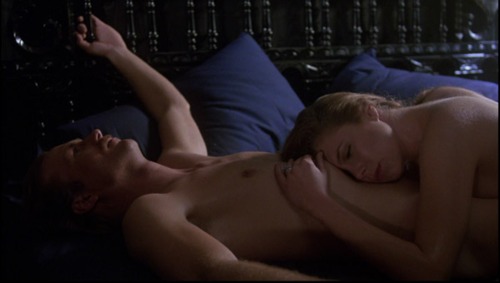
What sets this apart from the rest of the noir genre it draws obvious inspiration from is the copious nudity and sex scenes between the two leads, which are excessive even by today’s standards, as well as several shots of Richard Crenna in his underwear that I could have done without.
I was surprised that the plot didn’t contain more twists and turns, as in the end it was all fairly straightforward. For instance, I assumed early on that Matty’s husband Edmund would be in cahoots with either Ned or Matty, but in fact Edmund has very little to do in the story. In fact, his character arc is completed so early on that I was intrigued as to where the plot would go next. Also, some elements are set up with no eventual payoff – Matty’s niece catching Ned doing something he shouldn’t be doesn’t end up with her identifying him to the police – which led me to think that either we were deliberately fed loose threads to keep us guessing, or it’s just sloppy writing, though seeing as writer/director Lawrence Kasdan also wrote Star Wars Episodes V and VI, as well as Raiders of the Lost Ark and The Big Chill, it’s probably the former.
I was surprised to see just how attractive Kathleen Turner used to be, as other than her vocals in Who Framed Roger Rabbit, I’ve only ever known her as the dog trainer in Marley & Me (I have never willingly watched the film, it’s a favourite of the girlfriend) and as Chandler Bing’s drag-queen father in Friends, so I was rather confused that someone with such nice legs and skin could go on to be, well, Kathleen Turner.
There have been better noirs made before this (Double Indemnity) and after (Coen brothers’ debut Blood Simple), and if it weren’t for the aforementioned raunchiness there’s little chance of it being remembered today. The film isn’t necessarily bad, but its not revolutionary either.
Choose life 6/10

Harry Potter and the Deathly Hallows Parts 1 & 2

I’m a strange breed of muggle. I’ve seen all the Harry Potter films, most in the cinema. I’ve read all the books. Hell, I own them. Double hell, I was first in line queueing up outside Morrison’s on the morning book 7 was released. But I wouldn’t call myself a Harry Potter fan. So why have I kept with it? I read the first book in school, and found the wizarding world to be quite wonderful, a dream of a place to escape to. Granted, by the time the much darker later books came along I became much happier that this world of dictatorial terrorists with almighty magical powers didn’t actually exist (or so I’m led to believe) but back then it was nothing short of fun, and the fact that I was of a similar age to the protagonist when the books were released made it all the more so.
The books were perfect for film adaptations, and the stylistic choices throughout the series have been close to faultless. Most of the negative aspects, other than the questionable acting abilities of the children early on in the franchise, can be blamed on the books being too labyrinthine to be condensed down into a 150-minute movie, and there are arguments to make as to whether each book would have been better off as a TV series, but it’s doubtful they’d have received such a hefty budget or impressive cast, or made nearly as much money.
Of the films, part 3, Prisoner of Azkaban, is widely regarded as the best, with director Alfonso Cuaron unleashing the franchise’s dark potential, redirecting away from Chris Columbus’ more child-friendly first parts, but personally I prefer part 4, Goblet of Fire, because it’s easily the most fun and structured, following the Tri-Wizard Tournament, and it has dragons in it, which are awesome. Parts 5 and 6 are, in my opinion, the weakest, with my reasoning being that I can barely remember anything that happens in them other than some character deaths and casting decisions, but the final films really kick things into gear.
Many have questioned the decision to split the final book into two halves, citing financial gain as being the true reason, but having seen the results I approve of the choice. Whilst the earlier books could stand to lose some of the lesser plot points without the plot suffering, the amount of closure given in the finale could not have been achieved with a similar level of editing. Whilst the total runtime for the final two films could have been a little shorter than the 4½ hours achieved here, getting it down to a length the core Potter audience would be willing to sit through without complaining would have resulted in almost catastrophic levels of cutting.
The most impressive aspect of the film franchise has always been the cast. Whilst the three leads, Daniel Radcliffe, Rupert Grint and Emma Watson, were never expected to be incredible actors (and, for the most part, lived up to this promise) the film studios ensured this wouldn’t be a problem by surrounding their stars with almost every British actor working today, with more added every film. To list them all would be senseless, but the fact that, Richard Harris’ untimely demise notwithstanding, every actor returned to their roles for every subsequent film shows that the films must have been great to work on too.The Deathly Hallows alone saw the inclusion of Bill Nighy, David O’Hara, Rhys Ifans, Ciarin Hinds and Nick Moran into a cast already including the likes of Ralph Fiennes, Robbie Coltrane, Julie Walters, Helena Bonham Carter, Alan Rickman, Jason Isaacs and Maggie Smith, and the fact that so many notable actors returned for such minuscule roles is incredible. Jim Broadbent, John Hurt and Emma Thompson are barely on screen, but the fact is they are.
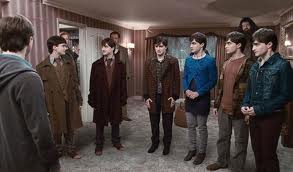
Part 7 is the only one of all eight films not to feature Hogwarts, the wizarding school where our young heroes are taught, and therefore doesn’t feel like part of the Potter pantheon. Freed from the structure of lessons, Quidditch matches and Harry being picked on by Slytherin, the film feels a little meandering, as Harry, Ron and Hermione scour the country looking for a series of magical Maguffins, horcruxes, that for one reason or another must be destroyed to help bring down the evil Lord Voldemort. The film opens strongly, with Harry’s escape from his home assisted by his wizarding friends transformed to be replicas of him, but it’s not until a later infiltration of the Ministry of Magic that any more excitement is had. There’s an awful lot of tension and relationship issues, exacerbated by a locket that builds negative feelings in whoever wears it (so… put it in a bag rather than wear it?) and a particularly cringeworthy scene wear Harry attempts to alleviate some tension by dancing with Hermione in a tent, but it feels empty without the action-balance provided by the second film. The brief animation, depicting the origins of the Deathly Hallows that grant the owner power over death, is easily the highlight of the series in total.
If watched as one long film, the two halves join together to form a perfectly balanced picture, with the final hour-long battle a rewarding epic culmination after a mammoth build-up, so if watching make sure to set aside the best part of an afternoon, however just watching part 8 alone is also acceptable. The infiltration of Bellatrix Lestrange’s Gringott’s vault, with Helena Bonham Carter gleefully impersonating Emma Watson, is tremendous fun (there’s another dragon!) and now they’ve got all the teenage angst and worrying out of the way it’s time for good and evil to get scrapping. The finale is equal parts devastating and spellbinding, as the regular cast is treated with a sporadic survival rate, literally anyone is up for the chop, up to and including Hogwarts itself, as various sets we’ve grown to feel at home in are burned to the ground. Some aspects of the battle feel crowbarred in – Mrs. Weasley’s showdown against Lestrange, Ron and Hermione’s inevitable kiss – but for the most part it’s a cinematic marvel that doesn’t disappoint.
Harry Potter and the Deathly Hallows Part 1: Choose life: 6/10
Harry Potter and the Deathly Hallows Part 2 : Choose film 7/10
Harry Potter and the Deathly Hallows Part 1 & 2: Choose film 8/10