Prometheus

Don’t ask me how, but I managed to get a ticket to the Cast & Crew Premiere of Prometheus at the Empire Cinema in London’s Leicester Square last night. Though it was disappointing not to see director Ridley Scott or the cast, who are probably saving themselves for tomorrow’s red carpet Premiere (a part of me was hoping I’d get to sit next to Charlize Theron, you can probably guess which part), the experience of going to see a film with nothing but film fans and people who respect the art, in a stunning cinema, was amazing, even if there was a bit of a post-movie crowd crushing to retrieve handed-in phones afterwards. Plus, I saw it three days before the rest of the general public, which makes me feel special. 
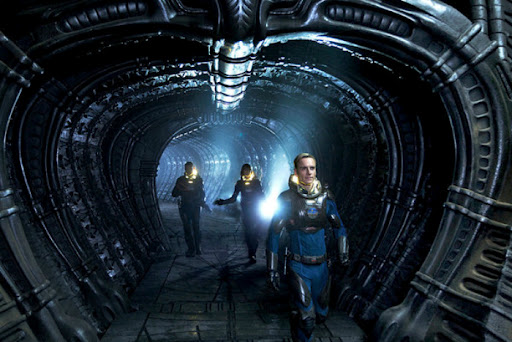
 In 2089 a group of scientists, led by Shaw and Holloway (Noomi Rapace and Logan Marshall-Green) discover ancient cave paintings on the Isle of Skye depicting giant humanoids reaching up to 6 orbs in the sky. The drawing matches others found all over the world, and point towards a distant planet that may hold some key to the origins of mankind. Four years later, the scientists arrive at the planet LV223 as part of a 17-man crew aboard the Peter Weyland-funded ship Prometheus. Once there, the crew find traces of alien life, but are the answers they receive the ones they were hoping for?

Mad Max 2 The Road Warrior

If the recent UK petrol strikes had gone on a little longer, chances are we’d have seen something not too dissimilar to the events here, in George Miller’s 1981 sequel to 1979’s Mad Max. Mel Gibson reprises his role of Australian cop Max Rockatansky, but the world he lives in is now a barren, chaotic land left ravaged by a worldwide war, leaving the survivors desperate for any fuel they can find.
Max and his dog roam the landscape looking for gasoline, eventually hearing about an enormous stash not too far away, and so with the guidance of a deranged nutcase with a flying machine (“It’s my snake, I trained it and I’m gonna eat it.”), set out to find it, but alas the compound within which the gasoline is kept is not only heavily guarded, but is also being laid siege to by a ruthless gang of miscreants.
Whilst this is certainly an improvement on the original movie, there are still a lot of things here that don’t make sense. For starters, the motivation for every character is to end up with more fuel, yet all seem to expend an awful lot more than they need to in order to get any. Whole fleets of cars and motorbikes are sent out on scouting missions, showboating and jumping as they go, and even the compound uses a bus as a gate. If fuel is so very precious, why are they all so eager to waste it?
The costume design has progressed from the previous film, and now the rebel gang has an even greater passion for leather, bondage and ass-less chaps than Max himself. The depiction of a lawless, structureless society is well done – one of the gang’s cars is a cop car, suggesting that it’s not just the general population that has lost it’s mind – and Max readily eats cold dog food, straight from the tin. There’s better characters too, including a feral kid with a deadly boomerang (played by the brilliantly named Emil Minty), and there’s some decent action and chase sequences. The epic finale, with the gang attempting to seize a petrol tanker trying to travel 2,000 miles to paradise, does get a little samey after a while, but is impressive nonetheless. The arm-mounted crossbow though is probably the least threatening weapon I’ve ever seen.
Fortunately, Mad Max 3: Beyond Thunderdome isn’t on the list, but this one is deserving of it’s place. It’s by no means the greatest dystopian future survival movie, but it’s still an enjoyable watch, and certainly has it’s moments.
Choose film 7/10

Thelma and Louise

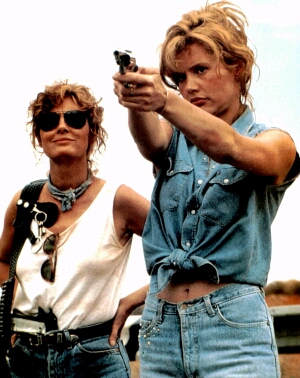
Two girls, a turquoise 1966 T-Bird convertible, a weekend vacation at a friend’s cabin up in the mountains, what could go wrong? Well, in Ridley Scott’s feminist road movie, a heck of a lot, as henpecked housewife Thelma (Geena Davis) and her world-weary waitress best friend Louise (Susan Sarandon) head out from their humdrum lives on more of an adventure than they bargained for, after a run-in with a would-be rapist at a country bar of ill repute.
The titular roles could not be more different, yet both remain well rounded characters, thanks in part to the able performances by the two leads. Though it is the men that seem to shepherd our heroines on the run, they always find a way of fighting back or turning the tables, be it on Harvey Keitel’s cop on their trail (assisted by Stephen Tobolowsky!), Michael Madsen as Louise’s boyfriend Jimmy, Brad Pitt’s first major film role as clothes-shedding hitchhiker J.D. or Christopher McDonald as Thelma’s boorish husband Darryl, eager to get his wife back so she can start making his dinner again.
There’s some great comedy – Darryl unable to watch his beloved football because the cops tapping his phone are too engrossed with Cary Grant in Penny Serenade – and though the story and ending may have been ruined by an overabundance of pop-culture spoofs and references, it is still a very good story. The accents begin to grate after a while, particularly Davis’ pronunciation of Loo-eese, but try to look beyond that at a journey that starts with an accident, and builds to become two strong female characters exploring their own limits, surprising themselves and everyone else.
Choose film 7/10

Harry Potter and the Deathly Hallows Parts 1 & 2

I’m a strange breed of muggle. I’ve seen all the Harry Potter films, most in the cinema. I’ve read all the books. Hell, I own them. Double hell, I was first in line queueing up outside Morrison’s on the morning book 7 was released. But I wouldn’t call myself a Harry Potter fan. So why have I kept with it? I read the first book in school, and found the wizarding world to be quite wonderful, a dream of a place to escape to. Granted, by the time the much darker later books came along I became much happier that this world of dictatorial terrorists with almighty magical powers didn’t actually exist (or so I’m led to believe) but back then it was nothing short of fun, and the fact that I was of a similar age to the protagonist when the books were released made it all the more so.
The books were perfect for film adaptations, and the stylistic choices throughout the series have been close to faultless. Most of the negative aspects, other than the questionable acting abilities of the children early on in the franchise, can be blamed on the books being too labyrinthine to be condensed down into a 150-minute movie, and there are arguments to make as to whether each book would have been better off as a TV series, but it’s doubtful they’d have received such a hefty budget or impressive cast, or made nearly as much money.
Of the films, part 3, Prisoner of Azkaban, is widely regarded as the best, with director Alfonso Cuaron unleashing the franchise’s dark potential, redirecting away from Chris Columbus’ more child-friendly first parts, but personally I prefer part 4, Goblet of Fire, because it’s easily the most fun and structured, following the Tri-Wizard Tournament, and it has dragons in it, which are awesome. Parts 5 and 6 are, in my opinion, the weakest, with my reasoning being that I can barely remember anything that happens in them other than some character deaths and casting decisions, but the final films really kick things into gear.
Many have questioned the decision to split the final book into two halves, citing financial gain as being the true reason, but having seen the results I approve of the choice. Whilst the earlier books could stand to lose some of the lesser plot points without the plot suffering, the amount of closure given in the finale could not have been achieved with a similar level of editing. Whilst the total runtime for the final two films could have been a little shorter than the 4½ hours achieved here, getting it down to a length the core Potter audience would be willing to sit through without complaining would have resulted in almost catastrophic levels of cutting.
The most impressive aspect of the film franchise has always been the cast. Whilst the three leads, Daniel Radcliffe, Rupert Grint and Emma Watson, were never expected to be incredible actors (and, for the most part, lived up to this promise) the film studios ensured this wouldn’t be a problem by surrounding their stars with almost every British actor working today, with more added every film. To list them all would be senseless, but the fact that, Richard Harris’ untimely demise notwithstanding, every actor returned to their roles for every subsequent film shows that the films must have been great to work on too.The Deathly Hallows alone saw the inclusion of Bill Nighy, David O’Hara, Rhys Ifans, Ciarin Hinds and Nick Moran into a cast already including the likes of Ralph Fiennes, Robbie Coltrane, Julie Walters, Helena Bonham Carter, Alan Rickman, Jason Isaacs and Maggie Smith, and the fact that so many notable actors returned for such minuscule roles is incredible. Jim Broadbent, John Hurt and Emma Thompson are barely on screen, but the fact is they are.
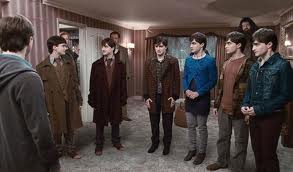
Part 7 is the only one of all eight films not to feature Hogwarts, the wizarding school where our young heroes are taught, and therefore doesn’t feel like part of the Potter pantheon. Freed from the structure of lessons, Quidditch matches and Harry being picked on by Slytherin, the film feels a little meandering, as Harry, Ron and Hermione scour the country looking for a series of magical Maguffins, horcruxes, that for one reason or another must be destroyed to help bring down the evil Lord Voldemort. The film opens strongly, with Harry’s escape from his home assisted by his wizarding friends transformed to be replicas of him, but it’s not until a later infiltration of the Ministry of Magic that any more excitement is had. There’s an awful lot of tension and relationship issues, exacerbated by a locket that builds negative feelings in whoever wears it (so… put it in a bag rather than wear it?) and a particularly cringeworthy scene wear Harry attempts to alleviate some tension by dancing with Hermione in a tent, but it feels empty without the action-balance provided by the second film. The brief animation, depicting the origins of the Deathly Hallows that grant the owner power over death, is easily the highlight of the series in total.
If watched as one long film, the two halves join together to form a perfectly balanced picture, with the final hour-long battle a rewarding epic culmination after a mammoth build-up, so if watching make sure to set aside the best part of an afternoon, however just watching part 8 alone is also acceptable. The infiltration of Bellatrix Lestrange’s Gringott’s vault, with Helena Bonham Carter gleefully impersonating Emma Watson, is tremendous fun (there’s another dragon!) and now they’ve got all the teenage angst and worrying out of the way it’s time for good and evil to get scrapping. The finale is equal parts devastating and spellbinding, as the regular cast is treated with a sporadic survival rate, literally anyone is up for the chop, up to and including Hogwarts itself, as various sets we’ve grown to feel at home in are burned to the ground. Some aspects of the battle feel crowbarred in – Mrs. Weasley’s showdown against Lestrange, Ron and Hermione’s inevitable kiss – but for the most part it’s a cinematic marvel that doesn’t disappoint.
Harry Potter and the Deathly Hallows Part 1: Choose life: 6/10
Harry Potter and the Deathly Hallows Part 2 : Choose film 7/10
Harry Potter and the Deathly Hallows Part 1 & 2: Choose film 8/10
Edward Scissorhands

First off, apologies for the lack of posts recently, I’ve been in hospital for an operation on my nose (inspiring this Top 5). Also, apologies if the posts over the next few days are a little off, I’m on a veritable Pan Galactic Gargle Blaster of meds, but I’ll try and keep everything as on topic as possible.
Johnny Depp successfully accomplished the transition from TV heart throb to serious movie actor with this, Tim Burton’s fourth directorial outing, leading to at present a further seven collaborations between the two bizarelly-haired gentlemen. Depp stars as Edward, the creation of a reclusive inventor (the legendary Vincent Price, in an all too brief cameo in his final film role) who remains incomplete after the inventor passes away. Edward looks human enough, but where five-fingered appendages should be on the ends of his arms, there are instead a multitude of blades, knives and scissors. After being discovered living alone by Dianne Wiest’s kindly Avon lady Peg, Edward is brought into the ‘normal’ world of 1950s suburban American.
As much comedy is made from Edward’s physical impairment as possible, with his blades coming into contact with waterbeds and hindering his ability to get dressed, pick up a glass, open a door or touch his face, but he shows an aptitude for carving meat, topiary, hairdressing, dog grooming, paperchain-cutting and being used as a kebab skewer. This does bring up the subject of exactly how Edward had survived alone in the castle before his ‘rescue,’ but as this is essentially a fairytale, minor plot details can be smoothed over.
As ever, Burton shows a deft hand with his casting. Depp is wonderful as Edward, showing childlike wonder at the new world around him, and expressing true depth of emotion from behind a stark appearance, all pale face, scars, bedraggled mop of hair and tight plastic and leather bondage-inspired clothing, and with minimal dialogue. Winona Ryder is cast against type (in that she wears colourful clothing and has blonde hair) as Peg’s cheerleader daughter Kim, and Alan Arkin and Wiest are wonderful as the parents welcoming Edward into their home. Anthony Michael Hall as Kim’s brutish boyfriend is more of a stretch though; the nerdy Breakfast Club star cannot be taken seriously in a bad guy role.
The film is lighthearted and entertaining, and has some genuine comic moments. The bookends of a clearly aged Winona Ryder are more obvious than the supposed narration reveal of the Notebook, but this features one of the greatest and most memorable character creations of cinema, and some fine acting too.
Choose film 7/10

Chicago

Last Monday I was not having a good day. I don’t remember having a particularly good day at work, and when I came home the LoveFilm disc of The Class (review coming soon) infected my PlayStation 3, my primary film-watching paraphernalia, with an incurable bout of Yellow Light of Death. Fortunately, after a quick 20-minutes of mucking around with SCART leads and speakers, the back-up DVD player was up and running, but alas The Class had no intentions of playing, and to be honest I was in no mood to read subtitles after that debacle, so instead we settled down for a much more easy to watch and far more enjoyable evening of Chicago.
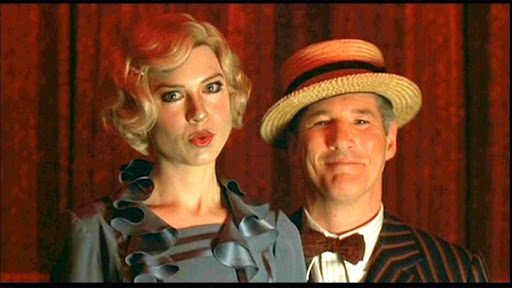
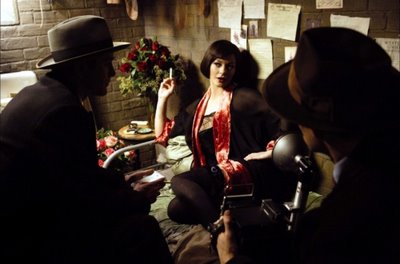
I’ve seen the story twice before, once on film and once on stage, and I think I preferred the small screen to the grand spectacle, though I think on second viewing it isn’t as good as I remembered. Renee Zellweger is as annoying as ever as the naive, waif-like Roxie Hart, incarcerated after killing the man she was sleeping around with (The Wire’s Dominic West). Whilst inside, she meets Catherine Zeta-Jones’ performer Velma Kelly, herself accused of murdering her sister and husband. The two compete for the favours of Matron Mama (Queen Latifah) and super smooth, silver-tongued lawyer Billy Flynn (Richard Gere).
Gere and Latifah seem to be the only ones enjoying themselves, and why Latifah was nominated for Best Supporting Actress I’ll never know, as her performance doesn’t compare to the award winning Zeta-Jones. There’s far too much of Zellweger simpering around the stage, and she seems to have forgotten to tell her face that she’s acting for much of her performance. Her singing is fine, but she is a thoroughly over-rated actress, who in this film is also far too skinny (but then so are all the girls in this film, Latifah aside). More of Gere’s incredibly entertaining Flynn would have gone a long way, as would more screen time for John C. Reilly as Roxie’s cuckolded husband Amos, who’s solo performance of Mr. Cellophane is my personal favourite, along with the wonderfully choreographed Cell Block Tango and Flynn’s marionette manipulation of a gaggle of reporters.
So, whilst it’s not perfect and a recasting of the lead would have been greatly appreciated (though to be honest, I’m not sure who I’d cast in her place) many of the musical numbers are still great fun. Six Oscars and thirteen nominations though? Seems a little excessive.
Choose film 7/10

Precious (based on the novel Push by Sapphire)

I knew what I was expecting when I sat down to watch Precious: being depressed, angered and infuriated by the action on screen, but doubtlessly impressed by the acting on display. Shockingly, I was correct, though thankfully most of the abuse was verbal.
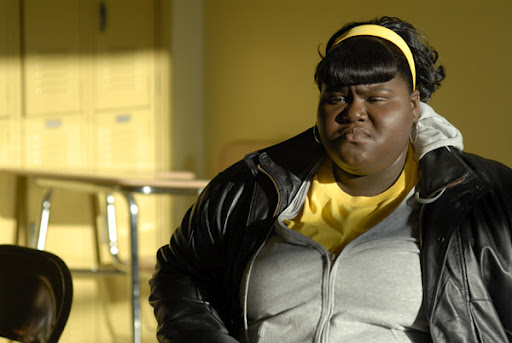
Gabourey Sidibe (more recently seen in Tower Heist and The Big C, where I’m guessing everyone else on set spends most of their time working out how to pronounce her name) is Clarice ‘Precious’ Jones, a severely obese sixteen year old, pregnant with her second child as a result of being raped by her father again. She lives in a cramped apartment with her volatile, welfare-abusing mother (Oscar-winning Mo’nique, a revelation from a woman exclusively known for comedy until this point) in Harlem in 1987. Oh, and her first child has been nicknamed Mongo for suffering Down’s Syndrome. See, told you it was depressing.
Precious’ mother is a monster of Hannibal Lecter proportions, with every word calculated to bring the most destruction to her child. We hear such gems as “School ain’t gonna help none, take your fat ass down to the welfare,” “You will never know shit, don’t nobody want you,” and “I should have aborted your fat fuckin’ ass.” Charming. Many scenes are beyond difficult to watch, from the furious tirade aimed at Precious when her headmistress (“white bitch”) drops round after school, to the fantasies of red carpets and photo shoots that make up the only escape Precious has from her unbearable existence.
It’s not all crushing depression. Mostly, but not all, for Precious seeks to improve her situation, enrolling in an alternative school for kids who’ve fallen through the cracks, so there is light at the end of the tunnel, shone from three supporting adults, her teacher Ms. Rain (Paula Patton), the nurse’s assistant who helps delivers her baby (Lenny Kravitz) and her social worker (Mariah Carey). These last two choices seem like some fairly risky stunt casting, but it pays off, as though the singers aren’t likely to be bothering the Academy any time soon, they perform ably and selflessly in places you wouldn’t normally expect them.
Though well made, directed and shot, the subject matter at times feels like a particularly sobering episode of Jerry Springer, interspersed with some truly shocking moments that generally involve potential harm to Precious baby. But it’s not as miserable as first thought, and the performances on display are worth watching.
Choose film 7/10

An American Werewolf in London

After being attacked on the Moors in rural northern England, a young backpacking American (David Naughton) awakes in a London hospital and falls for his nurse, Walkabout’s Jenny Agutter. This leads to some romcom hijinks, mostly involving Agutter’s Alex not being allowed to sleep with patients, and the vacationing David bored and alone in her apartment all day with no money and no where to go, trying to amuse himself. Oh, one last thing, David’s a werewolf being stalked by the ever-decaying remains of his zombie best friend. Sorry, forgot that bit.
This film is great, mostly memorable for Rick Baker’s stunning effects, featuring a transformation entirely CGI free that looks and feels unbearably painful and has yet to be equalled over thirty years later. There are some good jump scares and creative cinematography, with even a stationery phone box call shot seemingly on a circling bicycle. The subway sequence is particularly exhilarating, and the film is a lot funnier than you might remember, especially the scene in the porn theatre, with various undead suggesting the best ways for David to kill himself (we finally get to see director John Landis’ in-joke movie See You Next Wednesday, referenced in all his films, that turns out to not be that recommendable).
Unfortunately Landis doesn’t follow Spielberg’s rule of not showing too much monster, as the later scenes, before an overly abrupt ending, reveal the creature too clearly, gnawing away at some of the mystery. Frank Oz’s cameo as an American embassy official is also offputting, as I can’t take him seriously when he’s doing a voice that sounds exactly like the one he uses for Fozzie Bear in the Muppets. The most unbelievable part though? It’s possible to get a taxi far in London for £1.50. Ridiculous.
Still, thoroughly enjoyable and worth watching for Baker’s Oscar-winning make-up and effects.
Choose film 7/10

Four Weddings and a Funeral

Richard Curtis and Hugh Grant seem to be a match made in heaven. So far they’ve collaborated on three features (Notting Hill and Love, Actually being the other, equally enjoyable films that, for some reason or another, aren’t on the List), and Grant’s lovably foppish dithering perfectly fits into Curtis’ skill with a subtle put-down or throwaway comment.
Here, Grant plays Charles, terminally lost amidst a sea of acquaintances tying the knot, swinging from one wedding to the next seemingly every weekend. Perpetually late, lost and underprepared, Charles is a creation that, if you don’t know someone just like him, it’s probably you in your circle of friends. And it is this circle, just like in Notting Hill, that makes the film what it is. The supporting characters in any film have the potential to be more layered and interesting than the audience ciphers required as the leads. If need be they can even be people you don’t overly like or agree with, but fortunately here they’re a wonderful bunch, from Kristin Scott Thomas’ heartbreakingly brittle Fiona, John Hannah’s dependable Matthew, Simon Callow’s enigmatic, irascible Gareth and of course James Fleet’s hopelessly wealthy Tom, who trumps Charles for the worst best man come wedding number 3 (sample speech quote: “When Bernard told me he was getting engaged to Lydia, I congratulated him because all his other girlfriends were such complete dogs. Although may I say how delighted we are to have so many of them here today”).
Often hilarious and at times genuinely touching, not the least in Matthew’s moving elegy at the titular funeral, the script is also so much swearier than you remember (“fuck fuckety-fuck”), and deals with all the problems one might encounter at a wedding – drunken bride, boorish guests, horrendous dresses, improbable hats and inappropriate songs (I Will Survive, at a wedding?) as well as the more unusual scenarios, like being sat at a table full of your former partners, or being trapped in the room the happy couple are consummating their vows in.
The only problems occur are the horrendously cliché rain-soaked finale (“Is it still raining? I hadn’t noticed”) and the casting of Andie MacDowell as Charles’ American dream girl, who is only actually desirable the less he gets to know her in my opinion.
Choose film 7/10

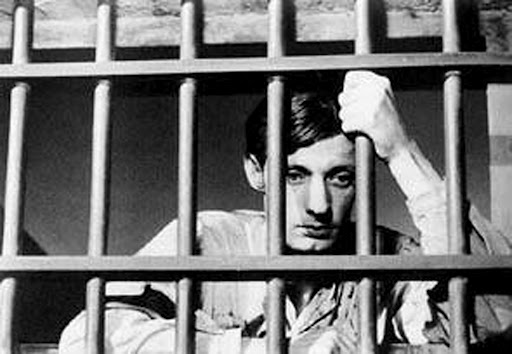
A Man Escaped

Francois Leterrier (father of director Louis Leterrier who, other than Unleashed, is really quite terrible, with a track record including The Transporter 1 & 2, The Incredible Hulk and the godawful Clash of the Titans) is Fontaine, an inmate at a Nazi execution prison. Left bloodied and beaten after an escape attempt en route, Fontaine doesn’t hang about before he tries to break out again.
This is an incredibly minimalistic film, with much of it taking place from the confines of Fontaine’s cell, tapping conversations to his neighbour or scraping away at his door with a spoon, and the camera is infatuated with the nuances of his face.
There are some glaring plot holes that could well be just a product of the time – cell checks seem to be very infrequent and less than thorough, and why exactly do the cells have a solid stone shelf, strong enough to support a grown man’s weight and accessible even to the elderly, positioned right next to the only window in the cell.
The film’s finale is at times almost unbearably tense, with no music but for the sound of trains rushing past and a mysterious creaking noise, and fans of the Shawshank Redemption – or any other prison movie for that matter – would do well to seek this out.
Choose film 7/10