Brave

Brave marks something of unchartered territory for animation powerhouse Pixar. It’s their first fairytale,, the first set in the past, the first to use magic, and the first to feature a female lead, in Kelly Macdonald’s Princess Merida. It’s also the Pixar film that I’ve waited the longest to see since it’s cinema release, seeing as it came out here over a month ago, but I only saw it yesterday because of the frankly outrageous 3D scheduling of my cinema (as always, fuck 3D). 

The long delay has added to my already high level of anticipation for the film, seeing as I started reading reviews of my American and New Zealander counterparts months ago when the film was released over there (seriously, why such a long wait for us Brits? Sort it out), and my deep love of most things Pixar (Cars? meh) meant that this film was going to have to do a lot to satisfy me. And unfortunately, it didn’t.
Continue reading

The Farmer’s Wife

In the late 1920s, having just wedded Alma Reville, marriage was clearly at the forefront of Alfred Hitchcock’s mind as he adapted this play be Eden Phillpotts about a farmer who, after the passing of his wife and the marriage of his daughter, seeks to find a new wife within the small group of eligible women within his village. Farmer Samuel Sweetland (Jameson Thomas) is by and large a good man, though he has difficulty in expressing himself, often fails to see what is directly in front of him and has a heightened ego. Still, he means well. After his wife’s death, in which her last words are reminding the maid (Lillian Hall-Davis, returning from The Ring) to air out her master’s pants, Minta the maid takes over all of the wife’s duties as well as her own. Once the farmer’s daughter has been given away, Minta is given one more job to do, help Sweetland find a wife, so the two of them sit down and make a list of the four potential candidates.

This being a comedy, things inevitably do not go to plan, mainly due to Sweetland’s pomposity and the various faults of the women. It probably didn’t help that his first proposal attempt involved calling his prospective fiance a fat hen, and that he announces that he is getting married, before actually asking if she is OK with the situation. The script is full of mild – and not so mild – put downs, largely aimed at the women (“Her back view’s not a day over 30.” “But you have to live with her front view.” “I don’t mind pillowy women, so long as they be pillowy in the right places.”). Elsewhere, the film featured possibly my favourite title card from a silent film ever, with the completely unexpected line “You are the first man who has accepted my sex challenge,” made all the more hilarious by the frail, demure woman who utters it.

As the farmer, Jameson Thomas has mastered the art of looking flustered with wide-eyed rage and exasperation, although at times I felt he was just as likely to strangle some of the women as propose to them, not helped by his Snidely Whiplash moustache and sneer. I can’t help thinking the women who turned him down were lucky not to wake up tied to the train tracks. I felt the film seemed to lose it’s way a little later on, and the ending is clearly signposted within the first 15 minutes, but is done so sweetly that you really don’t mind, and the overall theme of the plot reminded me of Keaton’s Seven Chances, which similarly involves a largely unsuccessful attempt at finding a wife, but for different reasons entirely. The handyman, Mr. Ash (Gordon Harker) gets the short end of the stick comedically, having to endure a series of pratfalls, mostly involving oversized trousers, but this doesn’t detract from the film too much. These may have been an attempt to distance the film from the largely dialogue-based play, as is the case with a climactic fox hunt that would have been almost impossible to perform on a stage.

This was far more enjoyable, and funnier, than I was expecting. If you don’t mind silent comedies, and I’m learning that I don’t, then this isn’t a must-see, but is enjoyable if you can find it.

Choose film 7/10

Heavenly Creatures

Christchurch, New Zealand, the mid-1950s. Two girls, Pauline (Melanie Lynskey) and Juliet (Kate Winslet) run terrified through the dense forest, the air streaked with their screams and their faces streaked with blood. They burst through the bushes and emerge to the concerned face of a passer-by with the words “It’s Mummy! She’s terribly hurt!”So begins Peter Jackson’s Heavenly Creatures, the true story of two schoolgirls whose problematic home lives forge a bridge between them, a bridge that leads to a fantasy world of princes and princesses, giant butterflies, murder, topiary and unicorns. But when their parents strive to separate the two, the girls hatch a plan to remain together by taking drastic actions.

Seven Brides For Seven Brothers

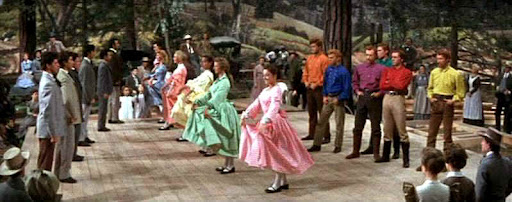
I’m not normally a huge fan of classic musicals. I quite liked West Side Story, but couldn’t abide The Sound Of Music, so my hopes weren’ exactly high for this 1954 classic of which I knew very little, other than there were presumably at least fourteen characters. I’m relieved to tell you that not only did I not find this film terrible, I frickin’ loved it.Set in 1850’s Oregon, the film predominantly follows Adam Pontipee, the eldest of seven brothers (duh) who all live away from society in a secluded shack, as woodsmen. Whilst visiting town to trade, Adam sets out to find a wife, and somewhat surprisingly the local cook Milly agrees to take the position, and they marry as soon as she finished her chores, before heading back to his house. Once home, Milly discovers the rest of her new husband’s clan, whom he’d neglected to tell her about before, and soon finds herself playing Snow White for these seven giants, doing all the cooking and cleaning in their initially disgusting hovel. When the other boys decide they too would like a wife, Milly steps in to see if she can teach them to be gentlemen.

The plot is, frankly, ridiculous, and full of so full of sexism its funny. Adam (Howard Keel) is chauvinistic, slovenly and completely tactless (“What do I need manners for? Already got me a wife.”) and he has absolutely no qualms about essentially conning a woman into being a slave for him and his six siblings. His proposal to Milly (Jane Powell) will probably go down in history as the most romantic in cinematic history. Sidling up to Milly whilst she milks a cow he proclaims “Ain’t got a woman, how ’bout it?” Clearly, back in the 1850s romance was far from dead.

Unusually for a musical, I actually approved of the music, and even the dancing. Some of the songs weren’t terribly memorable, but others are still stuck in my head, most notably “Bless Yore Beautiful Hide” (again with the romance), “Goin’ Courtin'” and “sobbin’ Women.” The dancing too is very impressive, probably because most of the eponymous brides and brothers are professional dancers. The barn-raising sequence is great even though it’s very long, with the brothers competing for the affections of the locals girls against the men that brought them there. A prime opportunity was missed for some colour-coordinated dancing though. Some of the later axe-dancing is a little silly, but it does fit in with the overall tone of the film.

The plot is based on Stephen Vincent Benet’s short story The Sobbin’ Women, itself influenced by the Roman legend of The Rape of the Sabine Women (back then rape meant abduct, this film isn’t that dark). The script takes some interesting turns and has a great, if a little predictable, ending. The brides being just as willing to resort to fisticuffs as the men was a nice touch.

At times the film gets a bit sombre, when various groups become lovesick and lonely, but there’s always an upbeat musical number not too far away, and unlike most classic musicals, this one isn’t unbearably long. I’d quite like to see a remake, with an allstar ensemble cast in the lead fourteen roles, but I get the feeling it would be terrible.

Choose film 7/10

Sophie’s Choice

The unfortunately named Stingo (Peter MacNicol) moves from his southern home to be a writer in New York. He rents a room in a house, and so finds himself firm friends with a neighbouring couple, Sophie and Nathan (Meryl Streep & Kevin Kline). Sophie and Nathan have a tumultuous relationship, as she has a tragic past and he has issues of his own, and slowly Stingo learns of their history, and the hardships Sophie has had to endure.
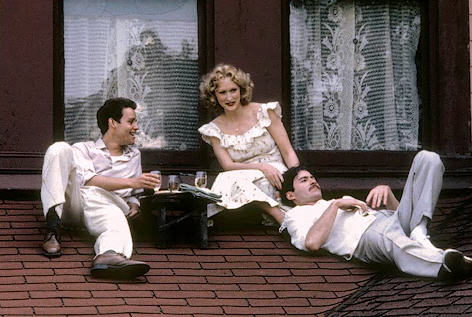
In the world, there are happy films. They are stories about underdogs overcoming adversaries, battling against hoards of naysayers as they set out to win the court case/football game/heart of the cheerleader. The kinds of films where, upon finishing, you punch the air and yell something, just to join in the triumphant atmosphere. And then there’s Sophie’s Choice. Watching this film is like receiving one punch to the gut after another, rounded out with a swift thwack to the head with a two-by-four. It’s like watching Schindler’s List whilst listening to country music and drinking a glass of orphan’s tears. If you have a big grin plastered over your face after watching the film, I’m guessing you wouldn’t have been out of place in the Hitler Youth back in the 1940’s. The happiest parts of this film occur between the three leads as they enjoy a life of carefree wonder, visiting Coney Island dressed in period garb, but even these moments have the rug pulled out from them eventually.

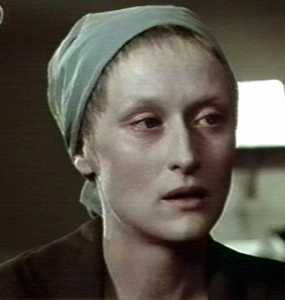
As with many films on this list, I have a history with this movie. I’d heard it was good, so I borrowed a copy from my Grandad – a copy he’d got free from a Sunday newspaper and never intended to watch, yet he still required it returned after I watched it. Free DVDs don’t tend to have much in the way of DVD extras, up to and including DVD menus. In fact, most will just play straight out, without you needing to touch a button. In fact, I’ve watched one before that didn’t even have chapters. I tried to skip back to catch a line I’d missed, and ended up back at the start of the film, and had to fast-forward to the scene again. What a time we’re living in. Anyway, Sophie’s Choice was such a film that had no extras, just a big old ‘PLAY’ button. I’d heard that, for Streep’s Oscar-wining performance she’d learnt Polish and German for the role, which was not something I’d given a second thought to until, over halfway through this 2 1/2 hour film, there’s the first of a few flashback sequences of Streep’s Sophie in WW2-era Germany, and the DVD had no subtitles, leaving me to attempt to watch and understand what are probably the more famous and pivotal scenes of the film, without the aid of knowing what anybody was saying. To the actor’s credit, for the most part I think I understood it, but still. I’ve known someone to go through a similar situation with Vicky Cristina Barcelona, but that was their fault for watching an illegal download.There are some actors who have a very famous role that they simply cannot overcome for some people, or in this case a role they’ve only played once but that has been seen many times. For me, Peter MacNicol will always, and only, be Dr. Janosz Poha from Ghostbusters 2. The mild-mannered southern writer Stingo doesn’t stand much of a chance against Janosz, seeing as he’s given very little characterisation here, but then this isn’t his film, he’s a cypher through which we get to know Sophie. This film belongs entirely to Meryl Streep, whose performance is just as good as it’s ever been suggested. No superlative can be left unused when describing the levels she goes to, mentally, physically and linguistically, to completely transform herself into the concentration camp surviving Sophie. Her accent is spot-on, and you completely forget you’re watching Meryl Streep. If it weren’t for Kline and MacNicol sharing the screen with her, I’d occasionally have sworn it was a documentary. I’m guessing that Julie Andrews, Jessica Lange, Sissy Spacek and Debra Winger, the other Leading Actress Oscar nominees that year, didn’t even bother showing up to the ceremony. Not only did she learn Polish and German, but Streep goes so far as to convince that they are her first languages, as she trips and stumbles her way through near-broken English, whilst during her flashbacks of the camps she looks to be several days passed Death’s door with her pallid skin, sunken eyes, roughly shaved head and frail, skeletal frame. This performance should be mentioned in the same breath as DeNiro in Raging Bull. It’s hardly a surprise that the rest of the cast pale in comparison.

It’s a shame then that her performance is the only outstanding part of the film. I had an understanding of the meaning of the title before watching, so assumed it would play a large focus in the film, but it is only at the climax that we see the pivotal scene, and it’s very nearly glossed over. We get a sense of the ramifications and the how it has made Sophie who she is today, but it eventually turns out that the choice she made would have made absolutely no difference anyway. As a story detailing the personal effects of concentration camps and World War 2 this is compelling, yet there are too many detours to detract from the story in an attempt to lighten the mood – Stingo’s date with the nymphomaniac Leslie Lapidus (Greta Turken). There are some nice comparisons between the camp prisoners and the guards – an officer’s daughter complains about the lack of a heated swimming pool.

The film also falls into two of my bigger pet peeve pits, in that a 28-year old MacNicol, who looks about 35, is playing a 22 year old, and at a couple of times there are phone conversations where the person on the other end is almost inaudible, but not quite, so some volume control had to be undertaken.

Despite possibly the greatest acting performance ever, this film is unfortunately let down by an incredibly depressing plot and an unsatisfying ending. There’s no doubt it’ll stick with you for a long time, but I highly doubt you’ll ever want to watch it again.

Choose life 7/10

Sense and Sensibility

 Lord Dashwood (Tom Wilkinson) passes away and, unable to split his vast estate between his two families, his wife and three daughters are ousted from their palatial mansion by their half-brother John (James Fleet) and his vile wife Fanny (Harriet Walter), and are forced to considerably downsize their opulent lifestyles. Hope, it seems, arrives in the forms of Fanny’s reserved brother Edward (Hugh Grant) and the dashing Mr. Willoughby (Greg Wise), who each take a shining to two of the Dashwood sisters (Emma Thompson and Kate Winslet).

Continue reading

The Ghost and Mrs. Muir

One of the most unusual romantic stories I’ve ever heard, Joseph L. Mankiewicz’s film sees the widowed Mrs. Lucy Muir (the achingly beautiful Gene Tierney) fleeing her haughty, oppressive in-laws and moving to the seaside with her daughter Anna (a young Natalie Wood) and their maid, Martha (Edna Best). Upon arriving at Whitecliff-by-the-Sea, Lucy seeks the assistance of estate agent Mr. Coombe (Robert Coote) in finding a suitable property. She is immediately taken by Gull Cottage, despite the disapproval of Coombe and the warning that no other resident has managed to stay there for even a night. This probably has something to do with Captain Gregg (Rex Harrison), the former owner who passed away there some time ago, and whose spirit still haunts the house. In spite of all this Lucy moves in, and she and the ghost of Gregg form an unusual bond.

This could quite easily have gone two ways. Firstly, it could have been a horror, as a family moving into a haunted house is the setup for countless creepy films, yet Lucy’s obstinate refusal to be even the least bit scared of a ghost prevents this territory from being breached. Secondly, it could have gone down the Casper/Beetlejuice route and become a saccharine-sweet, child-friendly and frankly silly comedy-romp as Gregg attempts to scare his latest houseguests away. Both of these options are occasionally dallied with – Lucy’s first encounter with Gregg is all candle-lit shadows, and there is some prank-pulling when Lucy’s in-laws come to visit and drag her back home, but for the most part the fact that Gregg is deceased is all but ignored. He acts more as a confidant and adviser to Lucy, becoming something of a catalyst to changing her life.
The casting is spot-on, and no more so than with Harrison. He is the epitome of a salty sea dog, with a rasping, salt-ravaged bark, though his overuse of nautical terms in day-to-day conversation becomes jarring after a while. Tierney is good, and George Sanders is wonderfully sleazy as a suave suitor wooed by Lucy’s beauty. Gregg is a brilliant creation – a man out of his time, especially when it comes to women. His dialogue is peppered with sexism, but it’s delivered in such a way that it’d be difficult to take offence: “You’re a woman, I suppose you can’t help it,” / “Help what?” / “Making a fool of yourself.” Though at times he does come off as more than a little creepy, even for a ghost, when he remarks that Lucy is not a bad looking women (“confoundedly attractive”) even when she’s asleep.
The relationship between Lucy and Gregg is well formed and evolves naturally, as she begins to pick up some of his coarse seahand terms that she previously disapproved of (in this world, “Blast” seems to be the worst word imaginable), and they find a way to make the best of their current situation. Like many films it does seem to imply that the only way a woman can make something of herself is if she receives the help of a man. After her husband dies, Lucy has been left just to live off his funds, and had she not encountered Gregg, all would have been lost had she not married some other man, but this notion could be a product of the times when the film was made (1947).
If I have one major flaw with the film, it’s that we’re never really made privy to the limitations and frustrations of being dead. At no point does anyone ask Gregg what it’s like to die or be dead, and there seems to be little he could do in life that he cannot do in death. He is not bound to his house, and can willingly interact with people and inanimate objects. In most instances it appears to be better to be deceased, as you are able to only appear to the people you wish to, leading to what I can assume would be much hilarity. The characters too seem unsure of Gregg’s abilities, as shown when Lucy feels embarrassed getting undressed in front of his portrait and covers it with a sheet.
 Also, many elements of the plot were quite predictable, but overall this is an original and well told story full of lightness and likable characters, even if the ending seems to forget that she was ever married.
Choose film 7/10

A Night to Remember

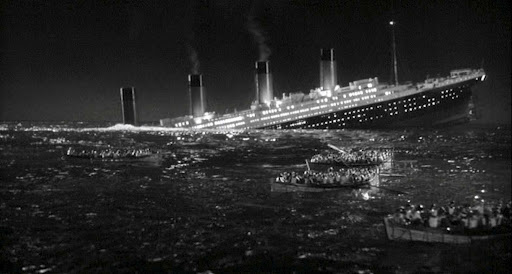
You’re probably wondering how long it’s going to take me, in this review, to mention a certain other film from 1997, directed by James Cameron, that follows a similar plot to this film, and I’ll tell you that it’ll take exactly 48 words for me to mention Titanic. If you’ve never seen A Night to Remember, but are a fan of Titanic (as indeed you should be, for it is a much better film than it’s cool to admit), then you need to start paying more credit towards Night‘s director Roy Ward Baker, for it is from his 1958 picture that Cameron stole most of his film.

Now I’m not saying Cameron stole everything, for if there’s one thing Night is missing, it’s main characters to follow through the events. Instead we follow various groups of people – Second Officer Lightoller (Kenneth More), some steerage passengers, a young 1st class couple (Honor Blackman!) – throughout the night of April 14th, 1912. This lack of focusing on a few people leaves you caring for the characters less, in the same way you didn’t care that much when Fabrizzio got hit with the funnel, here its no bother when the same fate is met by other people we’ve been following. This gives Night a more procedural, re-enactment-like tone, not helped by the generally unmoving performances that leave you cold and distant.Had I never seen Titanic, chances are I’d have been far more impressed with this film, but the remake (that’s essentially what it is) has shown that almost every shot can be composed and recorded at least a little better. The fact that it was made almost 40 years later helped drastically, as the technology did not yet exist to encompass the full scope of Cameron’s vision, but the fact that it does now has left Night a little obsolete.

I found myself mentally checking off every scene that Cameron stole – the steerage dance number, lavish 1st class dining scene, the soot-caked stokers escaping the closing doors in the engine rooms, playing football with ice on the deck, the dining cart gently rolling down an increasingly listing dining room, the steward appalled at the passengers damaging White Star Line property, the musicians disbanding then reforming to play as the boat sinks. The drunken chef even looks the same, and the shot of Murdoch turning his head away in shame, unable to stand watching the boat sink from his wrongfully claimed lifeboat seat is identical! I understand that a lot of these scenes help to set the atmosphere aboard the boat and couldn’t really be avoided, but Cameron should either have admitted he was remaking, paid some form of acknowledgement to the previous film, or at least changed the shot compositions. Mr. Andrews, the boat’s designer, even at one point gives a young couple – who may as well be called Jack and Rose – details on how to survive whilst he’s stood next to the clock on the mantelpiece, and the ‘unsinkable’ Molly Brown, here played by Tucker McGuire but more famously by Kathy Bates in Titanic, vehemently demands that her lifeboat turn around to help drowning survivors.

Based on the book by Walter Lord, and using the real-life experiences of survivors, the film paints an effective picture of the differences between the classes – made particularly clear when some steerage passengers attempt to flee the waters, but recoil in shock at the extent of the upper class facilities. After some initial scene-setting and the launch of the boat, we pick up the action on the night of the 14th, as the supposedly unsinkable liner receives warnings of ice in the area. As opposed to after 90 minutes, the immortal line of “Iceberg, dead ahead” is heard after just half an hour. After the boat has struck and a 300-foot long gash has been haphazardly carved into the hull, events play out largely in real time, and a great deal of time is spent on the engine rooms and the crew’s efforts to contact the nearest boats, of which the Carpathia, a good 58 miles and 4 hours away, is the only one to respond. There are some nice examples of the typical British stiff upper lip – a man putting on a brave face as he waves goodbye to the wife and children he knows he’ll never see again – but there are all in all far too many scenes of the crew trying to convince disbelieving passengers of the seriousness of the situation, to the point where I got so annoyed with some of the passengers that I hoped they’d stay on the boat and attempt to sit it out.

Whilst occasionally moving – the lifeboats forced to listen to the screams of the drowning – there is little reason to watch this now Titanic has made it redundant. In it’s day it was probably a much better film, but alas now it has been surpassed.Choose life 7/10

The Ides of March

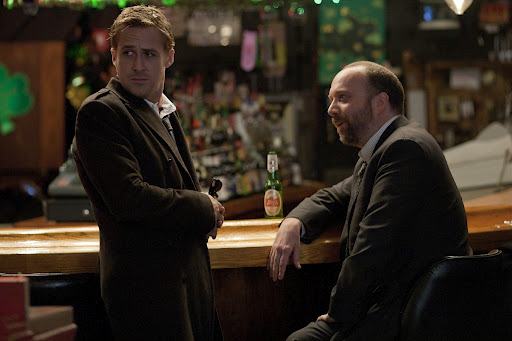
Ryan Gosling is Stephen Meyers, assistant campaign manager to Governor Morris (George Clooney, who also directed and co-wrote), who is currently locked in a battle with opposing democratic candidate Senator Pullman to win the Ohio Democratic Primary and eventually win the nomination as the next potential president. Philip Seymour Hoffman and Paul Giamatti are their campaign managers, Marisa Tomei the Times reporter out for inside information, Evan Rachel Wood a young intern with her eye on Gosling’s big man on campus, and Jeffrey Wright is the senator both sides are eager to please.

In the past few years there have been a number of talky, ‘important’ films with predominantly male all-star ensemble casts, with generally well written scripts dealing with issues whose effects can have life or death ramifications. From The Company Men, Moneyball, Margin Call and Wall Street 2, they all have something else in common – I haven’t seen them yet. It’s not that I don’t want to see them (Moneyball and Margin Call are in my LoveFilm queue and The Company Men is sat on DVD form on my shelf – Wall Street 2 will take me a while as first I must get past a hatred for Shia LaBeouf) it’s just that I don’t have many opportunities to go to the cinema, so I use them for seeing movies with a certain sense of spectacle, ones that will make the better use of a gigantic screen and that, should I happen to miss a line of dialogue from a fellow patron’s ringing phone, screaming child or popcorn-chomp, I can still follow the plot amidst the explosions and giant robots. The more dialogue-heavy, less action-y films are saved for DVD. This even applied to such masterpieces as The Social Network – I saw Toy Story 3 instead. Please don’t have a go at me about this. Rest assured that if I had the time (and the money) to see the other films at the cinema too, then I would, and there have been difficult decisions made in the past as to what must be sacrificed for a smaller screen some months down the line.
And so it is that it’s taken me a little while to watch The Ides of March, though it was well reviewed, I’m a fan of 5 of the principle players (Gosling, Clooney, Hoffman, Giamatti & Tomei) and The West Wing has made me at least interested in the ins and outs of American politics, more so than I am in the British trivialities. Plus, my girlfriend could be described as being more than a fan of Gosling (I’m still receiving backlash from my rant on The Notebook).
Now this isn’t a bad film, but I got the feeling that every actor involved was retreading ground they’d walked down many a time before. They all performed well – though Gosling goes a bit glary-eyed on a couple of occasions – but no-one really showed anything new. This is kind of a testament to the acting talents on display. Nobody does cynical schlubs like Philip Seymour Hoffman and Paul Giamatti, but they’re settled into a well formed groove, and who is Clooney’s smoothly persuasive senator than a slightly more ambitious Ryan Bingham from Up in the Air? Only Gosling gives something of a fresh performance, but only in terms of him being something of an impressionable blank slate of contradictions. His Stephen has supposedly worked on more campaigns by the time he’s 30 than most of his peers ten years his senior, yet it sends him reeling when he discovers that the world of politics is more than occasionally played with cards to the chest and the odd stacked deck.
At times the plot goes a bit overly dramatic. The outcome from who is the presidential candidate already has the potential for phenomenal consequences, yet the scriptwriters felt the need to show the devastating effects this can also have on individual people, with the fate of Evan Rachel Wood’s intern Molly being particularly distressing. It hits the point home, but does so in too severe a manner. I feel that there was greater scope for exploring the characters of Gosling and Clooney being two sides of the same coin twenty years apart. Had equal time been spent on their stories, rather than instead focusing more on Gosling – who I never really believed in as a masterful campaign manager sought after by everyone – then this could have been more interesting. The whole poster campaign was set up to show them, and their freakishly symmetrical faces, as being the same person anyway, yet this seemed completely lacking in the film.
Were this the first film I’d seen with most of these actors in I’d no doubt have been floored by the incredible performances on display. I don’t mean to take anything away from them – they are all consummate professionals who are incredible at what they do and I look forward to seeing them do it again – it’s just I’ve seen them all do it before.
Choose life 7/10

Prometheus Plot Holes

Warning, this post is literally nothing but spoilers for Prometheus. I mentioned in my review that the script had numerous plot holes, and I really need to vent them out, so I’ve listed them below. Do not read this until you’ve watched the film, and if anyone can fill the holes in for me please go ahead. I repeat, do not read this post until you have seen the film.

1.    Why is David riding a bicycle and shooting hoops? Is he trying to impress someone? I understand why he’s developing language skills, as he’s researching things as yet undiscovered, but what’s with the sports? He’s a robot!
2.    When Holloway sees the lines on the planet that prove the alien presence, why does no-one suggest scoping the area out for a while? Even just a little fly around would have been nice.
3.    What exactly are the holograms for? David starts one in the caves and another on the Space Jockey deck, but who are they for? They’re useful for him and us, but who made them? They could be some kind of ship’s log, but if so couldn’t someone have said that in one line of dialogue?
4.    When Shaw, Holloway, David and Ford flee the caves, outside there’s two go-karts and a minibus. Two get on each of the karts, and no-one gets into the bus, yet they all drive off (at the time we assume Fifield and Millburn are in there). Who is driving it? You could argue that there’s a nameless crew member that stayed behind as a driver, and headed off to avoid the storm slightly too early for the others to get in, but there’s no proof of this.
5.    Once David has rescued Shaw and Holloway, Janek mentions they don’t know where Fifield and Millburn are, but there’s a map showing their position! He uses it in the next scene. Plus, Janek seems pretty lackadaisical about two members of the crew being stranded on an alien planet. He practically says LOL. Also, how convenient is it that everyone has a surname beginning with a different letter?
6.    Why does David cave in to Vickers’ threats? He’s a robot, there’s not a lot she could do to him.
7.    Millburn the biologist is supposedly cowardly, as he is easily convinced by Fifield to run away at the site of a decapitated body (understandable), and later when he hears there’s a lifeform somewhere nearby, he says he’s heading in the opposite direction. So why, when he and Fifield go to the vase chamber, does he suddenly want to make friends with the alien there? He can’t even see the entire creature, so for all he knows it’s some giant beasty with a strange proboscis. Why did they even decide to stay in the cave full of weird bubbling vases anyway? It’s the exact room, with the dead decapitated body outside of it, that they ran away from earlier.
8.    Millburn and Fifield die when no-one is watching the monitors, because Vickers and Janek are getting it on in her quarters, right? Firstly, how come Janek didn’t order someone else to watch the monitors, and secondly, even if no-one was there, don’t these guys have TiVo? Just rewind the feed and see what happened. We have it in 2012; I’m guessing it’s still around in 2094.
9.    Why did Janek, the captain and pilot of the ship, go to investigate the disappearance of Millburn and Fifield? Surely he’s pretty integral to the running of the ship.
10.What exactly was David’s plan with the black goo? He gave some to Holloway in his drink; did he know he would have sex with Shaw and impregnate her with an alien? If so, why did he do that too? Was he curious, or trying to kill Holloway? Why?
11.Why did the infected Fifield come back to the ship to try and kill everyone? He was the one character I really wanted to die, and he’s the only one who came back to life! Typical. I thought Millburn would have come back with a chest-burster in him, seeing as an alien went down his throat and Fifield had his face melted with acid. Also, why did they go out and investigate Fifield’s clearly dead body (the helmet is smashed with a deadly atmosphere, and his legs are bent over his shoulders) seeing as there’s no way he could have just turned up there on his own, being dead and all.
12.Why does David tell Shaw she is pregnant? If he wanted an alien specimen, surely telling her will just make her try and abort it, and if he wanted to kill her, then not telling her will result in the alien bursting through her stomach and killing her that way. Being pregnant with a baby alien was probably the last thing she was expecting, especially seeing as she was barren and had only had sex 10 hours ago and not before for 28 months.
13.After she wakes up from being sedated by David, Shaw finds it pretty easy to escape from the medics and run to Vickers’ quarters with no-one chasing her. No-one comes for the entire time she is in there.
14.After the impromptu caesarean I could have done with a scene of Shaw breaking down from the intensity of what she’d just gone through. In the past few hours she’d lost her husband, found out she was pregnant when she thought she was barren, discovered the ‘child’ was in fact a killer alien, had a caesarean whilst fully awake and watching it, had the cut literally stapled shut and then fought the creature that had just gestated inside her. I’d say that warrants a little exasperation.
15.Did I miss a scene where everyone on board found out about, and was cool with, Peter Weyland being on board the ship? After Shaw’s surgery the rest of the crew seems OK with him being there. It was pretty damn obvious he was going to be onboard too, seeing Guy Pearce was highly billed in the opening credits. Stop doing that kind of thing. And making Vickers his daughter is pointless, unsurprising and ridiculous.
16.Ripping David the android’s head off is a nice nod to Ash’s fate in Alien, but is it possible for a robot to survive one of these films? Please?
17.When Vickers and Shaw are running from the crashing spaceship, why in the name of LV426 do they not run sideways? I hate when films do this. There’s something rolling behind you in a relatively straight line, so instead of getting out of the way you decide to race it. Insane. Shaw only survives because she trips and rolls out the way. I did like that the last two alive were the two main women, just like in Alien, and similarly the blonde dies and the brunette survives.
18.Shaw’s air supply is supposedly running out at the end of the film, yet she’s barely been away from the ship. Earlier, Fifield and Millburn were away for longer, and were expected to survive overnight when they got stranded. Yes, they were in the chambers with breathable atmosphere, but they had to keep their helmets up because it was going to get cold, so they must have had to survive on their own air supplies.
19.The alien that Shaw had aborted grows pretty fucking huge seeing as it’s had no organic matter to feed on other than a little blood Shaw left behind.
20.At the end, Shaw is told that there are other ships. Does she check them all for surviving Engineers, or just leave in the first ship she finds? I’d have much preferred that the final shot be of her silhouette, with an axe in one hand and David decapitated head in the other, heading off to take out the surviving aliens.
Wow, I didn’t realise I had so many problems with the script. Am I being too harsh? Or stupid? Was a lot of this explained? Let me know.
*EDIT* Thanks to everyone for all the comments and page views so far, the response I’ve had from this is phenomenal. It turns out my list of plot holes wasn’t quite complete, and many of you have posed a few more. I’ve tried to give credit where it’s due, but apologies if I’ve left someone off. Also, some of these get a bit science-y, and I’ve not researched any of the theories, so please don’t shout at me if they’re wrong. Sections in brackets are from me.
21.   How exactly did they manage to reanimate a head that’d be dead for several thousand years? I’m pretty sure in 77 years time that technology isn’t going to be available. Also, why did it explode? – Anon
22.   Organic molecules do not form in oxygen-rich running water. – Anon
23.    It’d be nice if they’d clarified at some point why the Hell the Engineers wanted to kill humans, and why did they think that the black goo, which creates a completely different, far more dangerous race, would be the best way to do it? (Personally I think it was for sport.) – J/Michael Shaw
24.   The DNA was a perfect match, yet the Engineers are big, bald and pale. (My personal theory is that had the physical differences are due to environmental differences between Earth and LV-223 in terms of gravity, proximity to the Sun, etc.) – J
25.   If the Engineers created humans, did they also create all the other life on Earth? From what, and how are they all different? Did all the different species evolve from that one Engineer? If so, how are we all different? – J/areanimator
26.   The crew are really very unprofessional and lacking in protocol for such an important and well funded mission. (Perhaps these were the only people willing to sacrifice 5 years of their lives for a wild goose chase.) – Anon
27.   Could they not have detected the oncoming storm, seeing as they just arrived from space? And don’t they have larger versions of Fifield’s ‘puppies’ they could send down to scout out the terrain first? (Hell, can’t they send the ‘puppies’ into the caves from the safety of the ship? There could have been aliens waiting just inside the cave for them.) – Anon
28.   You can’t run around after having your body cut open to your uterus, even if the wound was closed with some stitches. Your body goes into complete shock, the stitches cannot make up for the fact tissue was cut and muscles were cut which are essential for your core, and by extension for your body to perform any kind of walking movement. – Anon
29.   The two co-pilots at the end didn’t really need to kill themselves. They say Janek is a bad pilot (really? Weyland paid a fortune for a crappy captain?) but he doesn’t really do a lot of piloting, in fact he even says “Hands off” of the steering to crash into the ship. There’s also apparently a member of Weyland’s security who doesn’t go down to the planet with Weyland and co, who Janek is essentially killing at that point too, but fair enough it’s for the good of humanity. – Anon
30.   Why do the cryo-beds have a function that allows David to see their dreams? (Possibly to see if they’re in distress or suffering some kind of psychological trauma from the cryo-sleep, but that’s a stretch). – Beta Max
31.   Why was the medical machine only male-calibrated? OK, it was probably there to operate on Weyland, but it makes little sense to make machinery just for men or women. – Anon
32.   How did the Engineer survive the toxic LV-223 atmosphere without a helmet when he attacks Shaw at the end? He must have needed the helmet to breathe, yet made it from the crashed ship to Vickers’ crashed pod pretty easily.  – Anon
33.   Why was it a secret that Weyland was on his ship, and why was it pegged as a surprise reveal that Vickers’ was his daughter? (Hollywood tension-generating bullshit.) – Anon
34.   Why did the Engineers point all the ancient civilisations towards a military installation? (My guess: the Engineers thought we might have come back all guns blazing, so sent us to a battle-ready moon/planet instead of their home world.) – Anon
35.   Once they discover that the Engineers have the same DNA as humans, they don’t make the logical connection that what killed the Engineers will probably kill the humans too, and no extra quarantine methods or safety precautions are put in place. – Areanimator
36.   The Engineers were running away from something, yet ran towards a room full of deadly black goo that presumably they manufactured. (The room had the giant stone head in, meaning it could be of religious importance, and they thought prayer was their only option at that point. Alternatively, they may have been running towards the room to trap the black goo inside.) – Areanimator
37.   The hologram of Earth resembles modern Earth, rather than how it looked at the damn of man. –The Movie Waffler
38.   Why did Weyland think he could just rock up to an alien moon, have a nice chat with the Engineers and that they could give him immortality? (He was nearly dead, so was probably grasping at whatever straws he could reach.) – Anon
39.   Apparently the Engineers were trying to leave LV-223 because it had all gone wrong, but how? There was no trace of active aliens on the planet. (They may have been trying to seal off the experiment going wrong into the cave with the vases, but one Engineer tripped and got decapitated by the door?) – Lisa
40.   After decapitation, David’s head manages to stay pretty damn close to his body, even after takeoff, crashing and rolling all over the place. Seems pretty unlikely unless the white ‘blood’ is a damn good glue. – Christophe Abi Akle

Oh, and for those of you looking for a more informed, science-based look at the gaping holes woven together to form the net of this film, check out Stephen Gaskell’s post over at Creepy Treehouse.