Unlisted: The Cabin in the Woods

Five college kids head for a vacation in a deserted shack (or cabin) in a remote forest (or woods), with no-one around for miles and a very creepy basement. So far, so Evil Dead. Or Texas Chainsaw Massacre. Or… well, you get the point, but the fact this is written and produced by Joss Whedon, and co-written and directed by Drew Goddard, one of the men behind Lost, should tell you that this is no ordinary textbook horror.
The recent years have seen the horror genre be evaluated, analysed and turned on its head, with the likes of Wes Craven’s Scream franchise and Tucker and Dale Vs Evil, and also imbued with a greater sense of comedy, for example Shaun of the Dead and Severance, to name two prime British examples. Cabin in the Woods takes these films and goes much further, leaving you rethinking every slasher movie you’ve ever seen.
I’m going to do my best to not reveal spoilers here, but if you’re trying to avoid them then chances are you probably aren’t reading this. The trailers have been criticised for perhaps showing more plot than is strictly necessary, revealing that there is more to this cabin than meets the eye, but I personally feel this is essential for the trailer (though it could have been hinted at more subtly) else the only trade the film would have made would be from the slasher fans willing to pay to see them at the cinema, of which I most certainly am not. My only trailer annoyance was the use of a scene or two from the third act that, though I’d only seen the trailers once, still stuck with me and left me waiting for them, over-thinking the plot as I went.
The performances are all wonderful, particularly practically unknown Tim De Zarn as the token redneck doomsayer the kids encounter on their way, and there’s some casting coups for fellow Whedon-ites in Dollhouse’s Amy Acker and Fran Kranz (whose Topher Brink is, occasional Firefly cameo aside, the best thing about Dollhouse) as well as Chris Hemsworth, Bradley Whitford and Richard Jenkins.
I have very few faults with the movie. One came because I’m a film nerd, and caught the signposted closing cameo from a recognisable voice, and the third act feels a little off the rails at times, but in an exhilarating, thoroughly entertaining way, although I did question why exactly that big red button was there. I look forward to pouring through the features when it’s released on DVD, and it’s the first film in a while that I’m actually considering going to the cinema and watching again. Go see this film, it’s truly wonderful, especially if you’ve ever seen a film with a cabin and some woods, and chances are you have.
Choose film 9/10

The Dark Knight

What can I say about the Dark Knight that a thousand others before me haven’t? Of all modern films, this seems to be the one pored over most closely and often, heralded as the saviour of the summer blockbuster, superhero movie and crime thriller, all rolled up in the tightest of scripts. So, to take a fresh perspective, I sought out some people who didn’t like the film (thank the lord for the Internet, it makes people who don’t like something so easy to find) and found myself furious after reading just one and a half 1/10 reviews on IMDb. The sheer level of nitpicking and miniscule plot-hole unravelling proves just how far people are willing to go to disagree with the masses and stand out from the crowd, even when the crowd is so undeniably correct.
Not that this is a perfect film. There are flaws, including the Joker’s plan being at times a tad too pre-emptive, some ominous camera angles and music cues hinting unsubtly a character’s true motives earlier than should have been done, and the bit with the cellphones, which is a bit silly, but is that really enough to warrant a 1-star rating? The fact that these reviewers (I won’t give them the satisfaction of names or links, only seek them out to feel the rage bubble inside you) fail to note even one positive point in a movie overflowing with brilliance negates any opinion they deem worthy of sharing. I personally find it impossible to find nothing good in a movie – The Adventures of Pluto Nash is an abomination unto film, yet Randy Quaid is a delight as Nash’s robotic assistant; Big Trouble in Little China is easily one of the worst films I’ve reviewed from the list so far, but it has imaginative (if insane) monsters and mythology, some dialogue that surpasses cheesy to being inspired, and features Kim Cattrall back when she was attractive. Therefore, with such damning reviews as these ‘people’ have offered, they are in fact unwittingly proving how good a film it is.
Leaping from the tantalising springboard ending of BatmanBegins – Gary Oldman’s Jim Gordon showing Batman a playing card left as the mark of a new criminal, calling himself The Joker, we dive headlong into a wonderfully executed bank heist, as six masked goons effortlessly separate mob money from the vaults it was stored in. Director Chris Nolan has made no secret that Heat, Michael Mann’s superb DeNiro/Pacino cat and mouse crime epic, was a huge influence on the Dark Knight, and it shows, from a William Fichtner cameo to a central meeting of the hero and villain, even mentioning a cup of coffee.
Nolan wisely improved upon some mild mis-steps made in Batman Begins here, replacing Katie Holmes with Maggie Gyllenhall as love interest Rachel Dawes, giving Batman’s mask a cowl so he can turn his head, and giving Batman himself (Christian Bale, good but no Adam West) a little less screen time, allowing alter ego Bruce Wayne and his various accomplices and nemeses some breathing room. Aaron Eckhart is spot-on as Harvey Dent, Gotham’s shining hope against the mob, and Morgan Freeman and Michael Caine remain on hand to add a touch of old school class and grandeur as Wayne’s dependable CEO nad curmudgeonly butler/moral compass, but justifiably most of the praise has been directed at the late Heath Ledger’s Joker. A creation for the ages, his layered performance of a truly maniacal genius reveals more with each viewing, and it is unfortunate that the role showcased the true acting abilities of a man previously thought of merely as a rom-com heartthrob only after he had passed. Plus, it gave us all another Hallowe’en costume to use.
Unusually for Nolan, the film is actually quite funny. It’s not exactly laugh-a-minute (there’s certainly less than 152 jokes here), the script is still a lot more humorous than you might remember. There’s also absolutely no filler, with every strand being integral to the plot; a true achievement when you consider just how engaging the story is, even when new elements are being added right up until the last few scenes.
As always with Nolan’s films, there’s a couple of cinematography moments that I’d have tried differently (see Inception), most notably the scene where the Joker leaves a hospital, which could have looked truly tremendous had it been one unbroken shot, without needlessly cutting away to some pedestrians nearby, but this is a small matter that is more of a personal niggle than a criticism.
Anyway, for those wondering if they should watch the film again before the upcoming trilogy closer The Dark Knight Risesthis summer, the answer is a resounding yes. Even if you don’t intend to see part 3 (I assume you’re planning on gouging out your own eyeballs, just in case it isn’t any good, there’s no other reason not to see it) you should watch The Dark Knight again, just because it’s probably the best film to have been released in the last 5 years, if not more.
Choose film 9/10

Unlisted: The Muppets

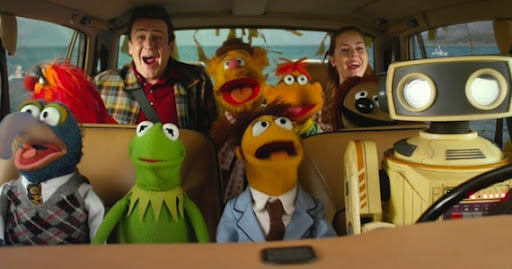
Celebrating the best film I’ve seen this week that’s not on the list, first up its The Muppets. I mentioned recently that I’ve not had a lot of dealings with the muppets in the past, and I now realise I’ve lived a previously unfulfilled life, devoid of a required amount of felt to maintain the desired level of happiness.
The cloth characters latest outing both improves upon and acknowledges those that have come before it (I’ve read that Muppets in Space and Muppet Treasure Island aren’t as good as The Muppet Movie or Muppet Christmas Carol, but I intend to find out soon) and like those other films the plot is kept nice and simple – Muppet superfan brothers Walter and Gary (co-writer and real-life Muppet super face Jason Segel) go on holiday to LA with Gary’s long term girlfriend Mary (Amy Adams), where they discover that wealthy oil baron Tex Richman (Chris Cooper) plans to buy and destroy the Muppet Theatre, giving the duo a few days to round up their disbanded heroes and raise $10 million. Just like its predecessors, the film is packed with mostly recognisable cameos, including Alan Arkin, Sarah Silverman and a very game Jack Black, and the soundtrack, including a moment where Chris Cooper quite unexpectedly raps (it’s not that bad actually) and the Oscar winning Man or Muppet is amazing, written by Flight of the Conchords Bret McKenzie, and I shall be purchasing it soon.
Improving upon the first movie by never spending too much time on one character, there are still a few flaws. Most irritatingly, a detail from the finale – Walter’s talent – is not mentioned throughout the entire film, and is pulled out of a hat at the end, and the first half, whilst good, is nowhere near as entertaining as the second, once the show the gang are putting on kicks off. Hopefully we won’t have to wait another 10 years before the next Muppet film, though if we do I’m sure it will be worth it.
Choose film 9/10


Disney Weekend

I needed to (and to be fair, still do) catch up on my film watching and post writing, so the opportunity to watch several short films that could all be written up in one post was something that needed to be implemented (and will soon be repeated with an upcoming Luis Bunuel collective post, watch this space). So what better way to do this than with an entire weekend devoted to the Mouse House and it’s timeless catalogue of classics? After a quick LoveFilm reshuffle, some DVD borrows and a root through my parents VHS collection the scene was set.
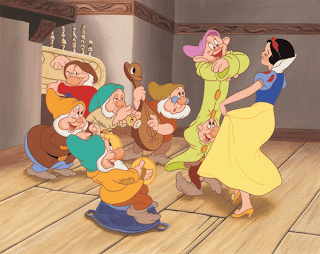
As was the recent Star Wars marathon, progress was made chronologically, so let me begin by taking you back to 1937, when an evil queen kept her beautiful step daughter locked up and dressed in rags, forced to work cleaning the castle, with singing to birds her only enjoyment. When Snow White’s beauty begins to surpass that of her stepmother, the evil queen orders a huntsman to lead the young housemaid into the woods to kill her, but he cannot and she flees instead. Her journey through the woods is terrifying – floating logs become crocodiles, trees grow hands and grab at her (but stop short of Evil Dead-style harassment, this is a kids film after all), but fortunately she finds an abandoned house in the woods and ploughs straight in with half the woodland in tow. A message that should have been made clear in this film, but was bizarrely omitted, is hat wild animals should not be used to aid cleaning, and especially not in serving food. Licking a late clean is an expression uncle Walt took all too literally, and I highly doubt the tails used to dry the crockery and measure ingredients were ever sanitised.
Imagine, if you will, that you’ve been at work all day with your six diminutive brothers. The disreputable state of your house when you left it that morning shows that cleanliness has never been high on your list of priorities, and the lack of a dog bowl shows that animals have no place under your roof, yet when you arrive home you discover an undeniable case of breaking and entering – the culprit is still asleep in 3 of your beds after all – and I’m guessing an at least light scattering of feathers, fur and footprints everywhere you look. If your reaction is celebration rather than immediate calls to the police and pest control, chances are you randomly break into song on a daily basis. Typically for an early Disney film, the plot is non-sensical and wafer thin (so the evil Queen is also a witch who can transform her appearance – why not either make herself more beautiful or Snow White ugly?) and the songs – other than the timeless Hi Ho Hi Ho – are forgettable and saccharine. Often scenes are entirely superfluous – Snow dances with the dwarfs for a straight 5 minutes – and, whilst notable for being the first feature length animation, many better films along similar lines have now eclipsed it.
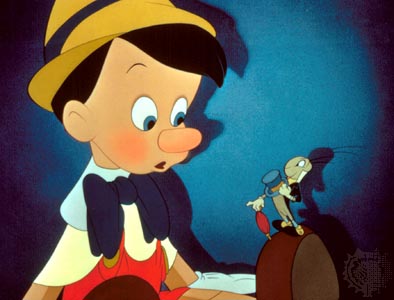
One such eclipser is Pinocchio, raising the bar in both quality and insanity stakes, as lonely toy maker Geppetto wishes on a star that his latest puppet were a real boy. Of course this happens, and a cricket is made his conscience, (because why not?) and the next day an overjoyed Geppetto sends his new son off to school, presumably to have the sap kicked out of him for being made of pine, threatened with matches, woodpeckers, beavers, or just a good old fashioned junior hacksaw. Arguably saved from this fate, Pinocchio is instead befriended by a couple of talent scouts, who are probably evil because in a film where almost all of the characters are people, these two are a talking fox and cat, wearing hats and smoking cigars. Their boss puts Pinocchio on stage – neglecting the idea that talking animals would prove just as lucrative – and sets him up for more episodic adventures, as Pinocchio learns valuable lessons about not smoking and drinking – they’ll turn you into a donkey – and it’s OK to be eaten by a whale. It’s a testament to Walt’s creativity that Pinocchio’s nose growing whenever he tells a lie is such a small part of the story, yet is the most quoted and parodied aspect, with everything else – all equally ludicrous – being all but forgotten.
The only film appearing here that I hadn’t seen before in Fantasia, though I knew of clips like Mickey cleaning up with magical mops and hippos dancing with crocodiles. It turns out that the reason I’d heard of those two segments and no others is that they are the only ones worth mentioning amongst the 8 extended animated shorts – each set to music played by the Philadelphia Orchestra. The first 7 ½ minutes are wasted on the arrival, tuning and introduction of the various orchestra sections and an introductory speech from the conductor, and more time is wasted in between each song by going back to him to set up the next section. At one point, he ridiculously introduces the soundtrack as a character, showing different instruments causing a line to wiggle differently as though part of a basic music lesson, and do we really need to see the orchestra leaving for a break half way through, then setting their instruments up again upon their return?
As for the shorts, most are tedious and pointless, neither improving nor complementing the music backing them. At one point my hopes were unforgivably raised with the promise of a dinosaur-filled segment, only for the dinos to only appear briefly and not do a great deal whilst on screen. With too much time dallied on single-celled organisms and ambiguous evolution. We also see what appear to be very young centaurettes dolling themselves up, with the help of some naked infant fairies, for a bout of hanky-panky with a gang of much older looking centaurs, the moral to be taken from which is only date someone the same colour as you. I can only recommend the aforementioned Mickey Mouse caper the Sorcerer’s Apprentice and the animal ballet Dance of the Hours, with ostriches, hippos, elephants and crocodiles set to La Gioconda, though I think the elephants should have been replaced with something smaller, like monkeys for instance, to offer a greater level of contrast between themselves and the similarly rotund hippos. 1001 comments that the films contains a good hour and a bad hour – a generous statement in my opinion – which makes me wonder why it was included, and not bumped for the more iconic and prolific Steamboat Willie.
Back to the more traditional Disney – talking animals larking about, learning life lessons and suffering horrific tragedies. Ask someone what they remember about Bambi and just like Pinocchio they’ll all respond in one way, his mother getting shot. Maybe they’ll say they cried, seeing it for the first time as a young child, or how it traumatised them for life. This is nonsense, for nothing is shown, his mother is there one moment, you hear a shot, and then she isn’t. Any traumatising was more likely done by the parents in a presumably well-meaning but poorly handled attempt at an explanation that Bambi’s mum has headed to the big meadow in the sky, or perhaps mounted above a fireplace. The knowledge that the mother will die – shot in a meadow by a hunter – is common information, yet mars every visit to the meadow before it with a layer of apprehension for the viewer, for there is little else in the film even close to depth. The lead is cute but empty, the life lessons – forming friendships, meeting a girl, accepting responsibility, growing up – are all trite, and other than a seamless transition from falling raindrops to the song April Showers one wonders whether the film would still be discussed if the mother had survived.
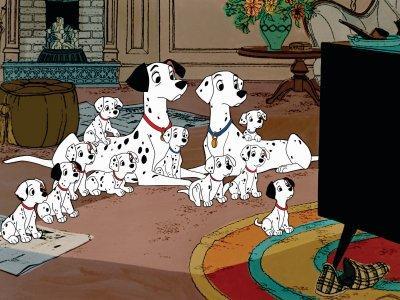
Disney began to develop their winning formula with 101 Dalmatians. What was needed you see was cute protagonists, lovable yet clumsy sidekicks, lessons to be learned on a great adventure, a cracking soundtrack and an iconic villain. All had been seen at least in part across the previous films, and here not all are present – there are no real life lessons and only one song, but one that remains to this day to be a particular favourite from the Disney canon; the catchy yet effortlessly simple Cruella DeVille, also one of the greatest and most memorable bad guys in cinematic history. The plot involves a batch of Dalmatian puppies (I forget how many) DeVille wishes to make a coat from, and though the first half has its moments – dog and owner pacing frantically outside the room the female dog is giving birth in, women outside of a window all bearing a strong resemblance to their dogs – it is the action-packed second half that is the key to this film, possibly the only children’s movie to feature the line “the blacker the better,” a quote I doubt Uncle Walt approved of.
And now we’re on to our first true classic, as young man-cub Mowgli is raised by a pack of wolves in the jungles of India, but is cast out when a tiger threatens his life in this retelling of Rudyard Kipling’s the Jungle Book. The cast of characters is creative and varied, from the hypnotic snake Kaa, sensible panther Bagheera, partying bear Baloo, human mimicking orang-utan King Louie, militaristic elephant herd and of course the menacing, fearsome tiger Sheer Kahn, a clear inspiration for Alan Rickman in Die Hard. The songs are wonderful, particularly Bare Necessities and I Wanna Be Like You, and the animation is spectacular. Other than the inexplicably Liverpublian vultures and the fact that Kaa sounds exactly the same as Winnie the Pooh (both are voiced by Sterling Holloway), the film is flawless, and carries an important message – females are devious.
So how do you improve on the Jungle Book? What was the missing ingredient? Dancing cutlery of course, in what else but Beauty and the Beast. It’s easy to forget just how wonderful this film is, even for an adult male such as myself. Featuring the most recommended female role model in a Disney film (other than perhaps Tiana from the Princess and the Frog, but that wasn’t a very good film) as Belle, a non-princess brunette inventor’s daughter, has inspirations of her own that do not involve a loveless marriage to a handsome yet rude and oafish brute, but she is extraordinarily beautiful, but considered strange by the rest of the village as she always has her nose in a book. When her father is captured by a hideously deformed beast (ooooh, now I get the title), Belle offers to take his place if her father is released. Of course Belle and the beast fall in love (after he gives her a goddamned library he already frickin’ had), but aside from the traditional plot (Remade from 1946’s La Belle et la Bete) the songs are far better than I’m willing to admit without being castrated, and are still stuck in my head more than a month after watching the film, not that I’m complaining. Undoubtedly the character who makes the biggest impact is the Bruce Campbell-chinned, Conan physiqued town meatball Gaston, a complete bastard willing to have Belle’s father committed if it means she will marry him, and who’s only redeemable feature is his brilliant rabble-rousing song (“I’m especially good at expectorating”).
And finally, my personal favourite, and my earliest memory of going to the cinema, The Lion King, or Hamlet for kids. Undoubtedly the greatest soundtrack of any Disney film, and easily among the best of other movies too, composed by Elton John and Tim Rice and featuring classics like I Just Can’t Wait To Be King, Circle Of Life, Be Prepared, Can You Feel The Love Tonight and of course Hakuna Matata (we don’t talk about Rowan Atkinson singing the Morning Report through his nose). The cast is stellar, including Jeremy Irons, Matthew Broderick, Nathan Lane, Whoopi Goldberg and James Earl Jones, and the story is terrific fun, yet still deals with the hardship of losing a parent, as lion cub Simba flees his family after believing he killed his father Mufasa. The scenery is stunning, taking in the African plains, lush jungle and elephant graveyard, and the script is full of humour, laden with lion puns (“a matter of pride,” “the mane event”).
Well that didn’t really work, did it? This was supposed to take less time than writing 8 individual posts. Ah well. I’ve got to say I wouldn’t recommend watching this many Disney films in such a short amount of time. Since watching them all, I’m taken by surprise when a passing animal refuses to have a conversation with me, or when my neighbours fail to spontaneously break into song.
Snow White: Choose life 5/10
Pinocchio: Choose life 6/10
Fantasia: Choose life 3/10
Bambi: Choose life 5/10
101 Dalmatians: Choose film 7/10
The Jungle Book: Choose film 8/10
Beauty and the Beast: Choose film 9/10
The Lion King: Choose film 9/10
Casablanca

I’ve finally watched Casablanca! After Gone with the Wind and Singin’ in the Rain I’ll finally be able to call myself a film fan. Don’t worry, they’re on the list, and GWTW is on my DVD shelf, so watch this space. There are many films – these three included – that are held with such high regard in the cinematic community – nay, the world – that one cannot possibly expect to leave the film having had expectations met and a smile on the face, so I went in expecting nothing but misquoted famous lines, romantic clinches and a bitter sense of disappointment, yet when those closing credits rolled the sense of elation tingling up my spine cannot be exaggerated. What we have here is more than a film, it’s a landmark in history.

Humphrey Bogart is of course Rick, owner of Rick’s Cafe American in Casablanca, French Morocco around the outbreak of World War 2. Bogey set the template for cynics on screen, sticking his neck out for nobody but those that will help him along. Rarely is there a moment when he isn’t drinking, smoking or both. The story involves a concentration camp escapee and secret documents containing a letter of transit allowing a safe departure from the town, but what you’re really here for is the script. Everyone knows the classics, “Here’s looking at you kid” “all the gin joints…” and “we’ll always have Paris” (“play it again, Sam” is never actually uttered) but the lesser known phrases are just as good, if not better: “I have given him the best, knowing he is German and would take it anyway” “this gun is pointed right at your head”/”that is my least vulnerable spot”.

Long scenes make the film seem longer than it is (for a classic it is surprisingly sleight at only 102 minutes) and Ingrid Bergman wears a distractingly terrible blouse for much of the film, but if yuo haven’t seen this film, I urge you to do so soon.I think I’ll go watch it again.

Choose film 9/10

Requiem for a Dream

DON’T DO DRUGS. There you go, just saved you an hour and three quarters. Except that’s just the thing, although this film can be summed up in just three little words, it’s still an exceptional piece, just thoroughly depressing and cautionary. Easily the reason I’ve never so much as even picked up a joint, this film should be mandatory viewing in schools and rehab centres the world over, with every step taken by the four leads taking them further down a spiral they really don’t want to see the end of. Firstly, there’s Jared Leto’s slacker Harry, living day-to-day by repeatedly stealing and selling his doting mother’s television with best friend Tyrone (Marlon Wayans, surprisingly good) in order to buy drugs. Harry’s girlfriend Marion (Jennifer Connelly) is a promising fashion designer, but occasionally must turn tricks when money runs low, and Harry’s mother Sara (Ellen Burstyn, Julia Roberts has your Oscar) lives alone, glued to her television, unable to deal with the direction her son has taken.

The film is at times incredibly hard to watch (double-ended dildo, anyone?) but when you do it’s nothing short of a cinematic goldmine, with director Darren Aronofsky’s editing and Clint Mansell’s spot-on score fitting the addiction-addled characters lives perfectly. Fish-eye lenses, split-screen, sped-up/slow-down footage and cameras strapped to actors focussed on their faces as they flee from the mess they’re in are all used perfectly. Compare this to Happy Together, where these same devices were used just for the sake of it, to show the director could, and you can really see how relevant they are here. Also, compare the editing, especially that of drug hits; rapid shots of syringes depressing and eyes dilating, with similar edits in Edgar Wright’s Shaun of the Dead. The two use very similar techniques, but with wildly different effects.
I felt the three youngsters should have been scrawnier and more blemished than they were, with Wayans and Leto especially being far too muscular than I’d expected a junkie to be. The storytelling though is excellent, with actions truly speaking louder than words, most shots consisting of close-ups or POV.
I had a couple of “Hey, it’s him” moments: Crash’s Keith David is a lecherous ‘party’ host, Spiderman’s Dylan Baker a Southern doctor and Office Space’s Ajay Naidu is Sara’s mailman. Also, Christopher McDonald needs some recognition for playing almost the same sleazy TV scumbag he played in Quiz Show.
Choose film 9/10

The Big Lebowski

I’ve made the point before that the list contains films of three varieties; great, popular and important. The greats arrive via the Empire 5-star 500 list, the popular from the two lists voted by the general public, and the important ones are provided by the 1001 Films to See Before You Die. Many films, though arguably important, aren’t actually very good, so one could argue that they should be remembered and acknowledged for their gifts to cinema, but not necessarily watched, as was the case with the Jazz Singer, marking the introduction of spoken dialogue to the big screen, which nowadays is dull, racist and features too many unnecessary songs. The Big Lebowski, on the other hand, is also an important film, spawning a cult following so vast there is a fan club (the Little Lebowski Urban Achievers), several books and an annual festival (creatively named Lebowski-Fest, I hope to attend one day). And yet, it does not appear among the important list, appearing here after being awarded a 5-star review and obtaining positions on both nominated lists. This is less a crime and more a cultural injustice, as the impact this film has had on society is measurable from space. Hell, they even played clips of it recently on Something for the Weekend.

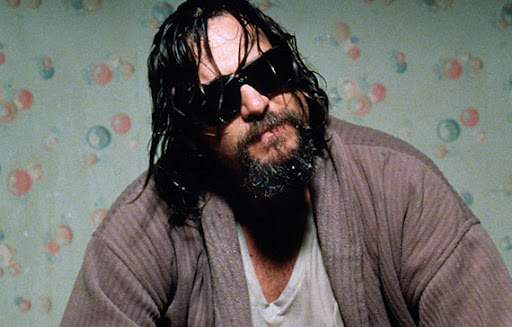
So just what is it that resonates so much with the public? Maybe it’s the snappy, endlessly quotable dialogue (“Obviously you’re not a golfer), particularly everything said in the bowling alley. Or perhaps it’s the borderline caricature roster of characters on display, from John Turtorro’s lilac-hued pederast Jesus (whom nobody fucks with) to Julianne Moore’s naked yet cultured Pollock-esque artist Maud and of course John Goodman’s psychotic ‘Nam vet Walter. It’s probably got something to do with the extremely crowded plot that bears little effect upon the characters it happens to. But mainly, it has to be Jeff Bridges turn as The Dude, a man shambling and smoking his way through life, following the flow it leads him on via nihilists, urinating Chinamen, porn moguls and private detectives. That, and it’s the first great film to feature a pot-smoking lead since Cheech and Chong, and one must conclude that many of those attending Lebowski-Fest, drinking white Russians in their dressing gowns and sunglasses have similar feeling towards the weed as his Dudeness.


Me? I love it because it’s a quintessential Coen Brothers movie. It features everything you need to make a great film – a twisting plot, stellar cast (I haven’t even mentioned Steve Buscemi, Peter Stormare, Philip Seymour Hoffman, Tara Reid, Sam Elliot, David Thewlis, Aimee Mann or the Red Hot Chilli Peppers’ Flea), terrific performances all round and a cracking soundtrack. The film introduced me to my cocktail of choice – Vodka, Kahlua and milk, easy on the Kahlua and heavy on the ice – and every time I watch it I either see something new or am reminded of a moment of pure gold I’d previously forgotten.
Choose film 9/10

The Star Wars Saga

I’ve already discussed my disliking of George Lucas’ recent decision to withdrawn from movie making, and my distaste for those who’ve lobbied against him for years here, so I’ll say no more about that at this time.

I had a problem before even starting to watch these cultural milestones; in what order should they be seen? I’m one of those obscure creatures (also known as ‘young people’) who initially saw the Star Wars films chronologically, from Phantom to Return. My father was never an avid SW fan (to this day he still speaks of the films with a level of disdain and mockery usually reserved for discussing his son), so there were none of the Saturday afternoon viewing marathons subjected upon my friends, and I was left to discover the films by myself, with my first experience being Ewan McGregor and Liam Neeson kicking some robot butt, and I’ve seen all the major scenes more time in Lego format via the videogames than on DVD. So, to solve my chronological dilemma, I consulted some of the aforementioned friends, and after being beaten to within an inch of my life with plastic light sabres and busts of Darth Vader, I concluded that release date order was the wisest option (although alphabetically was also suggested, but 4-2-5-1-6-3 is just silly). I should also note that episode 2, Attack of the Clones, did not appear on the list, but is featured here so it doesn’t feel left out, and because there are some (admittedly few) bits I like in it. And yes, this review contains spoilers.


So just what is it that makes Star Wars so iconic? Other than an ever-growing army of fans, the answer lies in the creation of an entirely new universe, where seemingly every minute detail of life has been mapped out. From the robot-hoarding Jawas of Tatooine to repulsive slug-like space mobster Jabba the Hutt, each new and exciting world has its own rules regulations and customs, although most worlds seem to have only one characteristic, be it desert, ice, cloud-city, forest or lava. Throw into this vast cornucopia a story of bounty hunters, intergalactic warfare and a dying breed of oddly magical humans, as well as a buddy comedy about two bickering robots, and you’ve got a license to print money and flog a limitless amount of merchandise to people who really need to get out more (that said, last year my advent calendar may have been from the Lego Star Wars range).

I’m hardly breaking new ground when I say that however big a cult following this saga may have, it also owns a few slaws. The dialogue and mythology are often hokey and cringeworthy (“May the force be with you”) and when not are hardly original (“It’s them, blast them!”) and George Lucas shows a racism and sexism unseen since Disney was room temperature, with one black man in the original trilogy (not counting Vader’s voice), and he is an opportunistic traitor, and no other human races bar whites, and aside from Leia and one other woman in power, all of the female characters are strippers or dancers.

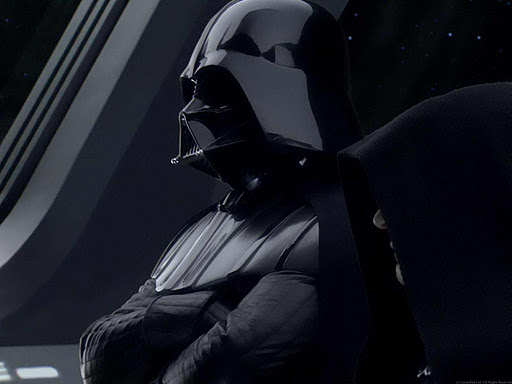
That said, the character designs are phenomenally memorable by being really quite simple – Chewbacca’s walking carpet, clean white stormtroopers and the perfect villain in the glossy helmeted, all black Darth Vader, employing both David Prowse’s imposing figure and James Earl Jones’ mellifluous tones, no other character has so richly deserved their own theme tune.

hough the plot has many aspects to it you never lose track, and any scenes of dialogue and exposition are soon broken up with spaceship battles, light sabre action or new and interesting discoveries in the mythology. A New Hope is easily the most stand-alone film, with no initial setup required (other than rogue paragraphs travelling through space) and a satisfying ending only hinting at a sequel, but the Empire Strikes Back is widely regarded as the superior film, with the inclusion of diminutive Jedi master Yoda and jetpacking bounty hunter Boba Fett, two of the most enduring and iconic characters from the franchise, yet who only have a small fraction of the screen time between them. It also features that great twist ending, now sadly ruined by endless parodies and misquotes. Episode 6, the Return of the Jedi, is the weakest of the three, though there is no shortage of spectacle with the giant Rancor, the Sarlacc Pit and a landspeeder chase through the dense woodland of Endor. It is everything else of Endor that is the problem – the teddy-like Ewoks in particular – that explain the negativity, for if such crude creatures as these cuddly toys can take out the stormtroopers, why has everyone been so worried this whole time? That, and C3PO being heralded as a deity and the Emperor’s flawed plan to kill the rebels – if you’re leaking a plan to send the rebels somewhere deliberately so you can kill them, why not send them to a place where you don’t keep the shield generator for your new planet-destroying Death Star? – deters from the lofty levels of the earlier films.

And so we arrive at the new trilogy. As a child of 12 I must admit I really enjoyed these films, so in some aspect George Lucas succeeded. The Phantom Menace was the most anticipated movie of all time, and there was no possible way it would ever live up to expectations (something I hope is not suffered by the Hobbit, the Dark Knight Rises or the Avengers later this year) so instead Lucas aimed the film not at the hoards of devoted fans he already had, but at newcomers and younglings. The fans would flock in anyway, their money was guaranteed, if not their approval, and which is more important to a movie studio? But, in a vain attempt to pander to the fans, attempts were made to tie the prequels in closely with the originals, and to expand upon the elements most popular in the older films.

And so it is that we see Jake Lloyd’s infant Vader Anakin building C3PO and playing with a child alarmingly similar to Greedo, we discover the stormtroopers are all clones of Boba Ferr’s father Jango, Jabba starts the podrace and Chewbacca pops up with Yoda in Revenge of the Sith. It’s a wonder we aren’t shown Han and Chewie thrown into detention together at school.

Across the trilogy there are some astounding set pieces – the adrenaline fuelled, Greg Proops’ commentated pod race, Attack of the Clones’ gladiatorial battle and Obi-Wan’s light sabre battle with four-sabred robot General Grievous being particular highlights, but too much emphasis is placed on the politics of the Trade Federation and the soppy romance of Anakin and Padme that has no place in a Star Wars film. That, and too many mysteries are uncovered – no-one cared that the force comes from midichlorians in the blood stream and Vader’s rise and conversion to the dark side was more effective before every detail was explained and we weren’t shown him as an annoyingly precocious brat or lovesick teenager.

Some performances are terrible – both Lloyd and his grown up counterpart Hayden Christensen are wooden and aggravating, especially when placed alongside Liam Neeson, Ewan McGregor and Samuel L. Jackson, and even Natalie Portman gives an uncharacteristically poor performance. The final film, Revenge of the Sith, is also disappointingly, but inevitably, bleak, lumbered with having to set up the gloom and oppression at the start of A New Hope. This sense of inevitability ruins the final battles between Obi-Wan and Anakin and Yoda and the Emperor, for we know everyone involved will survive, as they all appear in the original trilogy.

But however poor it seems in comparison, the new trilogy still contains films far superior, and more entertaining, than a lot else out there, and therefore should still be viewed, if a little less frequently.

This post could have gone on a lot longer – I haven’t even mentioned Jar Jar, Han shooting first, Luke Skywalker, Peter Cushing’s most evil face in the world™ or the glorious key to the series, R2D2, but I’m guessing no-one is actually still reading this, and I’ve still got over 30 posts to write, so I think I’ll call it a day.

A New Hope: Choose film 8/10
The Empire Strikes Back: Choose film 9/10
Return of the Jedi: Choose film 7/10
The Phantom Menace: Choose film 6/10
Attack of the Clones: Choose film 5/10
Revenge of the Sith: Choose film 6/10

The Artist

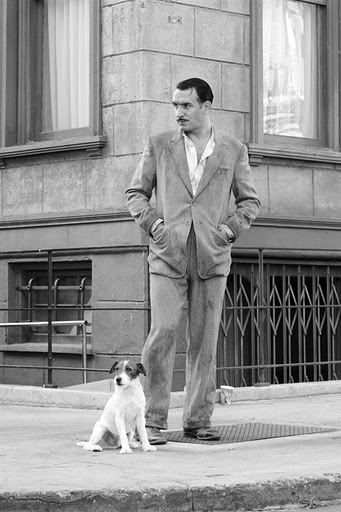
That’s right! I’ve been to the cinema twice in 5 days! Haven’t done that since I was single! Anyway, I managed to convince Aisha to come with me to see the Artist, the modern made silent film about the birth of the ‘talkies’, currently bothering awards ceremonies and set to win big at the Oscars next month. The film was excellent; it didn’t overplay the silent gimmick, even using it for some well timed and perfectly executed comic beats, and the performances were flawless, especially from leads Jean Dujardin and Berenice Bejo, and the adorable dog Uggie.
The plot was a tad predictable, concerning Dujardin’s silent movie star losing his way amid the encroaching sound-laden future, whilst Bejo’s struggling extra finds spoken dialogue could lead to a promising career, but then the plots of silent movies often were, especially by today’s standards, where 99% of stories are entirely made from previous pictures. The supporting cast of well known or know-the-face actors, including John Goodman, James Cromwell, Missi Pyle and Malcolm MacDowell, was a little off putting, as many had wordless roles I was waiting to crop up again, but other than that this was a near perfect film that’s my current frontrunner for best picture.

Choose film 9/10
 

The Dollars Trilogy

Widely regarded as the first spaghetti western (actually 1959s Il Terrore dell’Olkahoma), Sergio Leone’s A Fistful of Dollars is at least the first important one, birthing the greatest western icon since John Wayne in Clint Eastwood’s drifter, immortalised by a hat, beard, poncho and a squint. Before Leone, Eastwood was known best for his TV western Rawhide (the theme tune of which is sung at the country and western bar in the Blues Brothers) , but this shot him into not just the Hollywood A-List, but into the pantheon of American icons as the nameless cowboy out to make a profit from a small town heading into ruin. Run by two warring families, the Baxters and the Rojos, Eastwood sees a unique opportunity (unique that is unless you’ve seen Yojimbo, from which this borrows heavily) and sets about pitting the two families against one another. Leone’s direction, only cutting a shot when he has to, combined with Ennio Morricone’s whistling score and the spectacular cinematography of a barren, bleached landscape under a harsh, unforgiving sun makes for a spectacular western steeped in both American characters and European style.
Inconceivably, Fistful’s lesser yet still unmissable semi-sequel For A Few Dollars More didn’t make it onto the list, but I watched it again anyway. This time, Eastwood’s identically attired yet still nameless drifter finds that it may be beneficial to team up with Lee Van Cleef’s rival bounty hunter to catch their latest target. Look out for Klaus Kinski as a hunchbacked member of the gang they’re chasing.
The closer to this trilogy is widely regarded as one of the best films in the world, and currently holds the number 4 spot of IMDb’s top 250. From the opening score, undoubtedly one of the greatest in cinematic history that would be my ringtone were it not Reservoir Dogs’ Little Green Bag, you can tell you’re in for something special. The Good, the Bad and the Ugly follows, as the title suggests, three men, whose lives converge around a loot of gold buried in a grave. Eastwood’s Blondie is debatably the ‘Good’, a bounty hunter returning criminals for reward, then shooting the noose when they’re hanged so he can collect it again in the next town. Eli Wallach’s Tuco is the ‘Bad’, one such vagrant Blondie hands in, and Lee Van Cleef is given short shrift as the ‘Ugly’, as hired killer Angel Eyes, who always goes through with a job he’s been paid for. Unlike the previous two films, this is not the Clint Eastwood show, and if anything Wallach, the most interesting and entertaining character, is given the most screen time as the three set out to torture, beat and murder the others for a shot at the gold. Although the plot gets lost a little in the middle, when the US Civil War takes over, but by the three-way standoff at the end any flaws are forgiven. It’s the kind of scene that just doesn’t work on paper (shot of eyes, then a gun, then feet, eyes again, repeat for 5 minutes) but is unequalled on screen, and the ending is perfect.
A Fistful of Dollars: Choose film 8/10
For a Few Dollars More: Choose film 7/10
The Good, the Bad and the Ugly: Choose film 9/10