Crash (2004)

An all-star cast playing characters from all walks of life who, over a period of a couple of days, become intertwined with one another’s lives through circumstances distressing, joyous, criminal and fatal. No, I’m not talking about a masterpiece lovingly crafted by Paul Thomas Anderson or Robert Altman, instead a thoroughly commercial, awards-baiting crowd-pleaser from Paul Haggis, largely depicting themes of racism and prejudice in Los Angeles. Featuring a pair of car jackers (Chris ‘Ludacris’ Bridges & Larenz Tate), a racist cop (Matt Dillon) and his rookie partner (Ryan Phillippe), dating police detectives (Don Cheadle & Jennifer Espoisto), a TV director and his wife (Terrence Howard & Thandie Newton), the LA district attorney and his socialite wife (Brendan Fraser & Sandra Bullock), a Persian storeowner and his family and a Mexican locksmith (Michael Pena), as well as secondary characters including William Fichtner and Keith David, it is clear that Haggis wanted to make a film to be discussed, to be seen by many and considered for awards a-plenty, but not necessarily a good film. The issues he discusses are important and the situations topical, for example a black director being told to make one of his characters ‘talk blacker’, or a district attorney concerned about his public ratings after being mugged by two black criminals, but the revelations are shallow and the characters stereotypical, none of them deep enough to warrant a great deal of screen time, in contrast to Anderson’s Magnolia or Altman’s Short Cuts. That said, the film is enjoyable, the cast do well and some of the dialogue is excellent, so go ahead and watch it anyway. I could argue that it didn’t deserve the Oscar for Best Picture, but up against Capote, Good Night and Good Luck, Munich and Brokeback Mountain I don’t really know who is more worthy.
Choose film 6/10

The Red Shoes

I’ve read before that this is supposedly Martin Scorsese’s favourite film. I can’t remember why, and I’m still not sure now, but if he likes it then fair enough. The Red Shoes tells the story of Julian Craster and Victoria Page. He is a music student, given a job at the ballet orchestra after his professor steals his work for a show, and she is a promising ballerina, given a shot at the big time when a professional dancer leaves to get married. Predictably, the two end up working on the same show, the Ballet of the Red Shoes, he as composer and she as the star.  I’ve never been overly keen on dance, and I’ve never attended a ballet recital, so I can’t say I was necessarily engrossed in the backstage goings on, as the Machiavellian show director forbids the leading couple from seeing one another, but there was an interesting 20-minute wordless dream/dance sequence involving fairytale backgrounds and characters, and I liked the implication of a train passing using puffs of smoke, lights, sounds and actors following the ‘train’ with their eyes, but overall found the film was largely dull.
Choose life 4/10

The French Connection

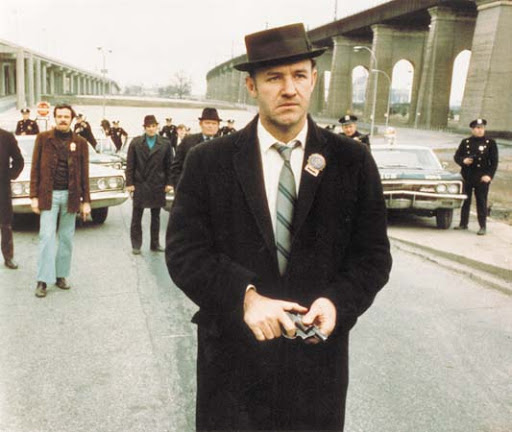
The French Connection started an obsession of Hollywood’s with gritty cop thrillers continued with Serpico and Dirty Harry (both arguably owing their places upon the list to the French Connection). Deciding to portray more than just car chases and shoot-outs, instead including the mind-numbing mundanity of spending hours listening at a wire tap, staking out a suspect’s house and dismantling an entire car to its base components, as well as the gritty violence almost required to make an arrest distances this far from more modern-day blockbuster police movies such as Bad Boys or SWAT. It’s a wonder we’re not shown policemen filling out a mountain of paperwork. Not to say that the shoot-outs and car chases in the French Connection aren’t incredible, with the chase against a criminal-carrying overground train being both the highlight of the film and possibly the greatest car chase in movie history.
Continue reading

The Blair Witch Project

I needed a short film today as I was a little pushed for time, so the 74-minute Blair Witch Project was perfect, until I realised I was watching a horror film alone in an empty flat immediately before going to bed, not always a wise decision. You’ll be able to tell when I’m really busy when I post about watching La Voyage Dans la Lune (14 mins) or the Cat Concerto (8 mins).
Continue reading

Alien

One of my favourite movie subgenres is the limited cast, limited locations films, where, for whatever reason, only a handful of characters are involved, and are confined to a small number, preferably one or two, of areas. This is best seen in 12 Angry Men, as previously discussed, where the principle cast are the 12 jurors on a case, and the principle sets are the jury room and its adjacent restroom. Similarly, Alien sees the seven crew members of the mining spaceship Nostromo largely confined to the ship and a planet it docks at in response to a distress signal. Things take a turn for the worse when, upon docking, the ship picks up an alien lifeform (later known as a Xenomorph), whose main ambition in life seems to be removing it from other creatures.
The film shows an interesting depiction of the future far removed from the more utopian worlds of more classic science fiction. Here, men seem to have retained dominance (shown by the exclusion of women from any decision making), and where class separation is still rife (the two engineers, Parker and Brett, are paid half as much as everyone else on board). The ship’s design is a far cry from the gleaming visuals of, say, 2001: A Space Odyssey. The Nostromo is, after all, a mining craft, so the ship’s functional, mechanical nature is only to be expected, although the overly futuristic sleeping pods do jar with the rest of the ship.
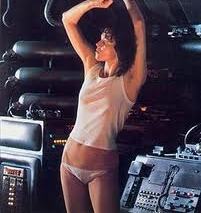
Aside from the infamous ‘chestburster’ scene (of which you can now by lifesize plush toys!), I couldn’t remember most of the film, although in my memory it does tend to blend with the other films from the franchise, as my only previous viewing was in marathon format. That said, there is much that sticks in the mind now, from Hurt’s descent into the alien nest, littered with giant eggs covered in a mysterious fog, or Ripley (Sigourney Weaver) seeing off an 8 ft alien with molecular acid for blood and far too many sets of teeth dressed only in vest and knickers (Ripley’s wearing the knickers, not the alien).
Having seen many survival films, where the cast is slowly whittled down one by one until the final confrontation, I noticed that with Alien it is not immediately obvious who the main character, and therefore the final survivor, is. Most of the characters are given fairly equal screen time, characterisation and dialogue, so it is not until the numbers start to dwindle that it is clear Ripley is the heroine, as earlier in the film she seemed to be the more heartless, professional crewmember, condemning Hurt’s Kane to death by refusing him entry onto the ship without a proper scan. That being said, she does become stupid later on, stopping to put two suffering crewmembers out of their misery minutes before the entire ship, them included, will be blown up (I’ve never understood this, why do ships have self-destruct mechanisms? Were they expecting an alien lifeform to come aboard, and the only way to kill it would be to blow the whole ship up? If so, surely some other defence mechanisms could be implemented instead?), and then she goes back for the cat, kept on board purely to jump out at random moments to scare the bejesus out of anyone in the vicinity.
Choose film 9/10

The Prestige

Fittingly, The Prestige is a trick of a movie, a plaything, director Chris Nolan toying with the audience like a cat with a ball of string. Everything, from character motivation to the narrative timeline is entangled for the audience to figure out, as the tale of two rival magicians, Hugh Jackman and Christian Bale, unfolds. Jackman’s Robert Angier is a showman, but lacks the skill of Bale’s Alfred Borden, himself too concerned with the technicalities of the illusions to be entertaining. Hell, even the film’s genre, seemingly a period drama, reveals itself to be more science fiction who-dunnit (not to mention what-dun-and-how). Nothing is as it seems, but on a repeat viewing you pick up the clues, noticing that Nolan did indeed signpost the way, but the plot, characters, setting and acting was too mesmerising, too engrossing for us to notice.

Choose film 8/10

The Shawshank Redemption

This is one of the films I’ve seen more times than any other, up there with Armageddon and Die Hard with a Vengeance (criminally, neither of which appear on the list). Shawshank tells the story of Andy Dufresne (Tim Robbins), wrongly convicted of the murder of his wife and her lover. Really though, the film is about friendship, with Dufresne meeting Morgan Freeman’s Red, a man known to locate certain items from time to time, and the two form a firm bond. The film also shows how to make the best of a bad situation, as before imprisonment Andy was in a relationship with an unfaithful women, a successful but passion-less job as a banker and had few, if any, friends (none seem to visit him throughout his sentence), yet in prison he thrives, providing sound financial advice to the guards, making friends and finding peace within himself with the aid of a newfound routine and meaning. Andy never knew that all he wanted was freedom, until what little he had was taken away from him.

Choose film 9/10

The White Balloon

An Iranian film shot almost entirely in real time, about a young girl trying to buy a goldfish before the New Year, this is hardly action-packed cinema, but was still surprisingly gripping. Following her on the various ordeals she encounters, first convincing her mother to let her buy one, then losing her money not once but twice, and diverting along the way to the strangers who help or hinder her quest, you begin to genuinely care about the girl, and desperately hope that she accomplishes her fairly pointless mission.
Continue reading

Terminator 2: Judgement Day

How do you make a sequel to Terminator? It seems like the perfect movie to create a franchise with, featuring the possibilities for labyrinthine time-travel plotting, self referencing paradoxes and a villain who can be killed, but can also always return, but therein lays the biggest stumbling block. The villain from the original, Schwarzenegger’s unstoppable mechanical monster, the main draw of the first film, surely must return for the second, especially seeing as, in 1991, he was one of the biggest stars in the world. But how could the same robot come back as the villain? The sequel must somehow build upon the original, develop it further, else why bother? Having the same villain, with essentially the same plot, would seem a waste of time. So, proving that necessity is indeed the mother of invention, director James Cameron pulled a full character flip on not just Arnie’s T-800, now here as protector rather than foe, but also of Linda Hamilton’s Sarah Connor, discarding the ditzy 80s hairdo for some badass fighting skills, tank tops and a permanent ticket to the gun show. The introduction of John Connor (Edward Furlong) as a ridiculously irritating teenager spouting laughable phrases (Asta-la-vista, baby? Seriously?) is also a diversion from the expected, as he’s the so-called saviour of mankind, but he’s so goddamn annoying that whenever he was onscreen I found myself rooting for the bad guy.

The Spider’s Stratagem

I’ll be honest, I lost track of this film. It seems to involve a man investigating the death of his father, but I really don’t know what happened after that. Every character seems to be contradictory, saying one thing then immediately changing their mind or acting oppositely, and the plot seemed to move backwards and forwards without warning, notification, explanation or reason. There was some lovely dialogue though (“I’m 74, and I’ll buy a drink for anyone who pisses further than me.”)
Choose life 2/10