Fargo

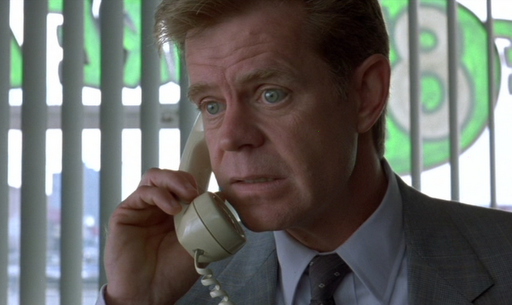
Snivelling, double-talking car salesman Jerry Jundegaard (William H. Macy, Oscar nommed but somehow losing to Cuba Gooding Jr.) has a plan. He needs money. His father-in-law Wade (Harve Presnell) has money, but hates Jerry. So Jerry hires two thugs (Steve Buscemi and Peter Stormare) to kidnap his wife and demand a ransom, of which Jerry will keep half. What could go wrong? Well, quite a lot it turns out, especially if everyone involved is an idiot and you’re being directed by the Coen brothers. The men’s escapades are chaotic, unstructured and are all heading off in different directions until, at the 32 minute mark, heavily pregnant Sheriff Marge Gunderson shows up to set them in order. Frances McDormand deservedly won an Oscar for her portrayal, nailing that wonderful sing-song North Dakota accent “Yah, you betcha” and, once full of eggs, keeping a straight face whilst clearing up the handbasket Hell’s clearly fallen out of around her. 

Few films as short as this (98 minutes) have room to divulge us with background lives – a meeting with an old school friend, conversations about stamps – whilst still keeping the action moving briskly. Every line is considered and real, every character feels genuine, and this is the greatest proof you can find against the argument that the Coens can only write caricatures. Often underrated, this film can never be over-seen, and no-one can call themselves a film fan unless they’ve both seen it, and loved it. The title of this blog was very nearly called Your Accomplice in the Wood Chipper, and a car boot opening has never made me laugh before.
Choose film 10/10

Sweet Smell of Success

I hate disappointment, yet the further into the List I delve, the more used to it I become. Sweet Smell of Success is a film I’ve had sat on my DVD shelf for over a year now (since even before the List entered and devoured my sad excuse for a life), and I’ve been waiting for a chance to watch it. Appearing on 3 lists and this month featured as Empire magazine’s monthly Masterpiece, my hopes were set to high. I knew two things: the film was endlessly quotable (a character in Diner does nothing but quote the script) and it features arguably career-best performances from leads Tony Curtis and Burt Lancaster. Whilst I cannot deny these points, I must take umbrage with the film for being far too dense. Even now I only have a vague idea as to what took place – Curtis’ ambitious yet downtrodden press agent Sidney Falco teamed up/sparred with Lancaster’s ruthless columnist J. J. Hunsecker in an effort to prevent a relationship between Hunsecker’s sister and a young jazz musician, so the Falco can get more column inches in Hunsecker’s paper. Much of the script is quotable (“You’re dead son, get yourself buried)”, but there is so much of it many of the best lines are lost. Doubtless this film will improve with repeat viewings, and if so my score shall be upgraded, but for a one-watch it doesn’t hold up. The score has also received a lot of plaudits, yet I found it really did not fit to the film – a barroom conversation sounds more like a frantic car chase. Here’s hoping the next viewing is more enjoyable.
Choose life 6/10

Walkabout

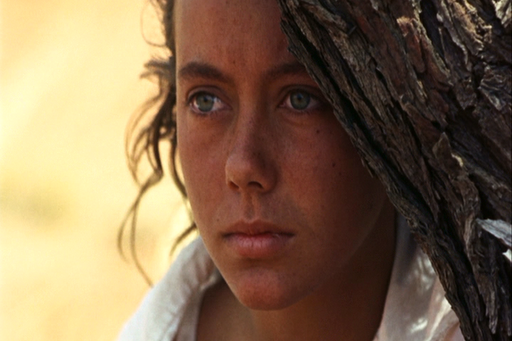
I love a good blindside. I can really appreciate when a scene is built up and plays out fairly expectedly, then at the drop of a hat something crazy drops out of the blue and completely changes the direction the film was heading. Safe to say, at some point in Walkabout this happens. I won’t say when or what, but I was pleasantly surprised by the way this film turned out, as two British children, including Jenny Agutter, a long way from the Railway Children, head out into the Australian outback with their father for a picnic. The film contains beautiful images of scenery and wildlife worthy of Attenborough, though Agutter’s skinny dipping scene is a little unnecessary – standing up in shallow water and giving a full turn, floating gracefully along on her back before putting on her tight white blouse, sopping wet against her pale, smooth skin… excuse me a moment.
 …sorry about that, got myself a bit distracted there. Anyway, this is a great little film, directed by Nicolas Roeg (Don’t Look Now, Performance), with some thought provoking editing (cutting between a kangaroo being slaughtered and a butcher cutting up chicken), occasionally lewd comedy (all the men at a research base looking up the skirt and down the top of their attractive colleague) and only a rambling nature and slightly unsatisfactory conclusion letting it down.
Choose film 7/10

Jaws

Der-dum. Derr-dm. Derrr-dn. Derrrr-dn. Der-dn. Derr-de der-de de-de de-de de-dn-de-de-de-de!
Two notes. The most memorable two notes in history, signalling to the world that a skinny dipper won’t be home for dinner.  Composer John Williams, here winning his second of five Oscars – so far – and whom celebrated his 80th birthday last Wednesday, used these two notes to produce a primitive, devastatingly simple theme tune more recognisable than any other in cinema. Would Jaws have had such an effect without the tune? Probably, but it might not be quite so memorable.
Some credit should be given to the director too. A 26-year old working on only his second feature after the mild success of The Sugarland Express and his direct-to-TV man vs. truck classic Duel, cocky young upstart Steven Spielberg was eager to prove his worth. After purchasing the rights to Peter Benchley’s novel, what followed was one of the most famously arduous shoots ever experienced until Apocalypse Now. The actors hated each other. Boats almost sank or repeatedly drifted unwanted into shot. The pissed off Martha’s Vineyard locals incessantly badgered the crew, it all cost too much and took too long, with reshoots needed to make it just right (some scenes were reshot in the editor’s swimming pool). And of course, the shark didn’t work. The eyes looked weird, the jaws wouldn’t close, the thing wouldn’t float or just didn’t work full stop. Everything had to be geared around that giant mechanical fish. But in a way, all these obstacles came together to add to the whole. The three leads – Roy Scheider’s chief of police Brody, Robert Shaw’s salty sea dog Qunit and Richard Dreyfuss’ techie oceanographer Hooper are supposed to distrust each other, so a mutual dislike between the actors could only heighten that. Continued reshoots allowed shots to be perfected. And a malfunctioning shark meant they couldn’t show the monster, allowing audiences imaginations – always able to outdo any Hollywood special effects – to add in the gnashing teeth, piercing eyes and circling fins where needed. The film set the template for every blockbuster and mainstream monster horror since – only the best creature features save the big reveals to the end.
Whilst there is much to thank Mr. Spielberg for with regard to Jaws’ impact, there are some downsides too. Jaws was released nationwide in over 400 screens – unheard of in its day. Everyone involved assumed it would flop, so they prayed for a fair to middling opening weekend with which to gain back the millions lost in the making. Instead, they found the weekly grosses did nothing but rise, so a complete market saturation became the norm for all summer blockbusters, most notably Star Wars two years later. So nowadays you can blame the tentpole summer pictures – the floods of superheroes and giant robots beating the crap out of each other – at least partially on Jaws.
Not everything good came from the bad or accidental though. The script and staging is impeccable, with one notable scene – the three leads in the galley of Quint’s boat the Orca – passes from tension, to camaraderie, through heavy emotion, back to a sense of fun and then intense action, all without any sense of confusion or feeling rushed. There is some great blindsiding; assuring you something obvious is going to happen, before smacking you in the face with the exact opposite, and even the little moments – the ominous clicking of an unwinding fishing line under Quint’s steely gaze, Hooper’s boyish glee at the menagerie of jawbones hanging in Quint’s shack – all register with great impact.
Choose film 10/10
United 93

Paul Greengrass’ (The Bourne Supremacy/Ultimatum) sobering depiction of the events that transpired on the fourth hijacked plane of September 11th 2001 is a film widely regarded as being a great film, but one you only really want to watch once. This was my third time. The first was just me watching the film. The second was due to Aisha never having seen it, and now I’m doing it for the List. I really don’t think I can take it a fourth time, so here’s hoping. Understandably, there is no humour or trace of lightness to this film. It is not enjoyable, but at times is inspiring, though more often devastating, heartbreaking and infuriating. We see the day as experienced by all involved – terrorists, passengers, flight crew and air traffic control, as for most what starts a normal day becomes one of the most significant events in modern history. The cast is impressively filled with unknowns, and in fact some of the air traffic control staff are played by those present there on that day. This greatly enhances the submersion into the film – anyone could die at any second, and any could rise up and become integral to the events. This is a must watch, not just because of the subject matter, but also the technical qualities – a handheld, up close style keeps us in the centre of the action.
Choose film 8/10

High Noon

Some time ago, town marshal Will Kane (Gary Cooper, whose appearance in the credits alongside Grace Kelly should set Die Hard alarm bells ringing) sent a man named Frank Miller to prison. Now he’s being released and is on his way into town, set to arrive on the noon train, where he’ll meet up with his posse and have his vengeance upon the lawman that sent him down. Playing out in almost real time (as shown on the myriad of clocks shown in nearly every damn scene) this film builds the slow tension up to a dramatic climax as the marshal sets about gathering up a posse of his own to face the varmints when they arrive, but finds volunteers in short supply. Cooper is the epitome of the all American hero, out to protect his wife, his town and justice for all, regardless of whether anyone stands beside him. The ending is expected and almost spot-on but makes a mockery of the rest of the film, going against almost everything told before, but this otherwise perfect picture is a fine example of a classic western.
Choose film 7/10

The Umbrellas of Cherbourg

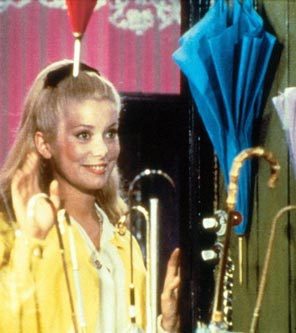
So you’ve written a fairly standard, almost boring script about a young man and woman in love, with many obstacles in their way in the likes of a failing umbrella shop, a disapproving mother, an ill aunt, a rival rich suitor and a war, hired two capable but not great leads, utilised a sickeningly candy-coloured colour scheme and obtained a soundtrack that sounds like someone is randomly sitting on a piano, but don’t know how to make it stand out from the slew of identical dramadies? Well why not make the cast sing every line of dialogue? Every. Damn. Line. My God this is intolerable. I’m all for musicals occasionally breaking into song in ways that are integral to the plot, well written or just entertaining, but please stop for the occasional conversation. It may have worked on paper, but as soon as someone sings a response of “Yeeeeeeeeeeeeees” I wanted to throw a slipper at the screen.
Choose life 3/10

Witchfinder General

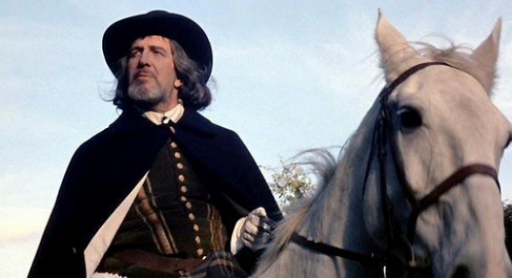
Can a poor accent really spoil a film? Vincent Price, here playing England’s witchfinder general during the English Civil War, doesn’t even attempt a Limey tone, an oversight so distracting it mars the rest of the film. Other than this detail his performance is spot-on as the man bought in to rid villages of accused witches for a princely sum, owning every scene he’s in as he accuses all those in his way of being in league with the devil. When he confronts the accused Satanist uncle of a soldier’s wife, brutally torturing, half-drowning and hanging the poor priest, the soldier sets out to wreck vengeance upon him. The film is at times maddening at what is hoped to be fictionalised accounts of what was gotten up to back then – see the look of mirth upon the face of a torturer when he spies a colleague raping the soldier’s wife, and methods of proving witchcraft include continually stabbing a person until finding a spot that neither bleeds or causes pain, so this isn’t always the easiest film to watch. But get past the gore and inaccurate inflections and what lies beneath is a gripping look at 17th Century brutality.

Choose film 6/10

The Big Lebowski

I’ve made the point before that the list contains films of three varieties; great, popular and important. The greats arrive via the Empire 5-star 500 list, the popular from the two lists voted by the general public, and the important ones are provided by the 1001 Films to See Before You Die. Many films, though arguably important, aren’t actually very good, so one could argue that they should be remembered and acknowledged for their gifts to cinema, but not necessarily watched, as was the case with the Jazz Singer, marking the introduction of spoken dialogue to the big screen, which nowadays is dull, racist and features too many unnecessary songs. The Big Lebowski, on the other hand, is also an important film, spawning a cult following so vast there is a fan club (the Little Lebowski Urban Achievers), several books and an annual festival (creatively named Lebowski-Fest, I hope to attend one day). And yet, it does not appear among the important list, appearing here after being awarded a 5-star review and obtaining positions on both nominated lists. This is less a crime and more a cultural injustice, as the impact this film has had on society is measurable from space. Hell, they even played clips of it recently on Something for the Weekend.

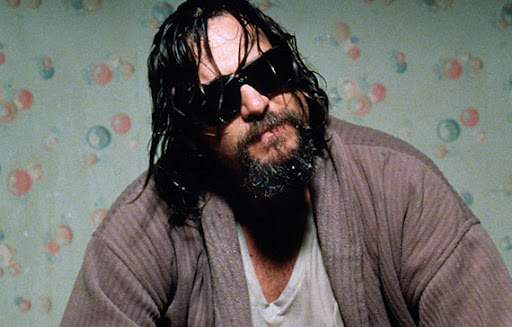
So just what is it that resonates so much with the public? Maybe it’s the snappy, endlessly quotable dialogue (“Obviously you’re not a golfer), particularly everything said in the bowling alley. Or perhaps it’s the borderline caricature roster of characters on display, from John Turtorro’s lilac-hued pederast Jesus (whom nobody fucks with) to Julianne Moore’s naked yet cultured Pollock-esque artist Maud and of course John Goodman’s psychotic ‘Nam vet Walter. It’s probably got something to do with the extremely crowded plot that bears little effect upon the characters it happens to. But mainly, it has to be Jeff Bridges turn as The Dude, a man shambling and smoking his way through life, following the flow it leads him on via nihilists, urinating Chinamen, porn moguls and private detectives. That, and it’s the first great film to feature a pot-smoking lead since Cheech and Chong, and one must conclude that many of those attending Lebowski-Fest, drinking white Russians in their dressing gowns and sunglasses have similar feeling towards the weed as his Dudeness.


Me? I love it because it’s a quintessential Coen Brothers movie. It features everything you need to make a great film – a twisting plot, stellar cast (I haven’t even mentioned Steve Buscemi, Peter Stormare, Philip Seymour Hoffman, Tara Reid, Sam Elliot, David Thewlis, Aimee Mann or the Red Hot Chilli Peppers’ Flea), terrific performances all round and a cracking soundtrack. The film introduced me to my cocktail of choice – Vodka, Kahlua and milk, easy on the Kahlua and heavy on the ice – and every time I watch it I either see something new or am reminded of a moment of pure gold I’d previously forgotten.
Choose film 9/10

Eraserhead

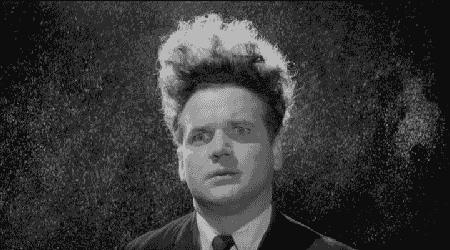
I think this is David Lynch’s idea of a romantic comedy. Shot in stark black and white and sounding like it was filmed underwater or near a busy factory, we follow the bizarrely coiffed Henry Spencer (Jack Nance) through the trials and tribulations of an average young man – meeting his girlfriends parents for dinner, encountering a beautiful woman living in the same apartment building, watching a woman with hideously deformed cheeks dancing deliriously on stage, you know, the usual.

Coming across like a 90-minute montage of nightmares I would not advise watching this before bed. Henry and his partner’s baby has the appearance of a mechanised cow foetus (possibly because undenied rumours suggest this was what was used), the aforementioned dinner sequence involves a tiny roast chicken still moving, bubbling and bleeding on the plate, and a scene where Henry cuts open the deformed baby has it becoming a bile volcano, one of the most horrific images I’ve ever seen. I’m not sure what happened to Lynch growing up, but I damn well hope it doesn’t happen to me.
Choose life 2/10