Harry Potter and the Deathly Hallows Parts 1 & 2

I’m a strange breed of muggle. I’ve seen all the Harry Potter films, most in the cinema. I’ve read all the books. Hell, I own them. Double hell, I was first in line queueing up outside Morrison’s on the morning book 7 was released. But I wouldn’t call myself a Harry Potter fan. So why have I kept with it? I read the first book in school, and found the wizarding world to be quite wonderful, a dream of a place to escape to. Granted, by the time the much darker later books came along I became much happier that this world of dictatorial terrorists with almighty magical powers didn’t actually exist (or so I’m led to believe) but back then it was nothing short of fun, and the fact that I was of a similar age to the protagonist when the books were released made it all the more so.
The books were perfect for film adaptations, and the stylistic choices throughout the series have been close to faultless. Most of the negative aspects, other than the questionable acting abilities of the children early on in the franchise, can be blamed on the books being too labyrinthine to be condensed down into a 150-minute movie, and there are arguments to make as to whether each book would have been better off as a TV series, but it’s doubtful they’d have received such a hefty budget or impressive cast, or made nearly as much money.
Of the films, part 3, Prisoner of Azkaban, is widely regarded as the best, with director Alfonso Cuaron unleashing the franchise’s dark potential, redirecting away from Chris Columbus’ more child-friendly first parts, but personally I prefer part 4, Goblet of Fire, because it’s easily the most fun and structured, following the Tri-Wizard Tournament, and it has dragons in it, which are awesome. Parts 5 and 6 are, in my opinion, the weakest, with my reasoning being that I can barely remember anything that happens in them other than some character deaths and casting decisions, but the final films really kick things into gear.
Many have questioned the decision to split the final book into two halves, citing financial gain as being the true reason, but having seen the results I approve of the choice. Whilst the earlier books could stand to lose some of the lesser plot points without the plot suffering, the amount of closure given in the finale could not have been achieved with a similar level of editing. Whilst the total runtime for the final two films could have been a little shorter than the 4½ hours achieved here, getting it down to a length the core Potter audience would be willing to sit through without complaining would have resulted in almost catastrophic levels of cutting.
The most impressive aspect of the film franchise has always been the cast. Whilst the three leads, Daniel Radcliffe, Rupert Grint and Emma Watson, were never expected to be incredible actors (and, for the most part, lived up to this promise) the film studios ensured this wouldn’t be a problem by surrounding their stars with almost every British actor working today, with more added every film. To list them all would be senseless, but the fact that, Richard Harris’ untimely demise notwithstanding, every actor returned to their roles for every subsequent film shows that the films must have been great to work on too.The Deathly Hallows alone saw the inclusion of Bill Nighy, David O’Hara, Rhys Ifans, Ciarin Hinds and Nick Moran into a cast already including the likes of Ralph Fiennes, Robbie Coltrane, Julie Walters, Helena Bonham Carter, Alan Rickman, Jason Isaacs and Maggie Smith, and the fact that so many notable actors returned for such minuscule roles is incredible. Jim Broadbent, John Hurt and Emma Thompson are barely on screen, but the fact is they are.
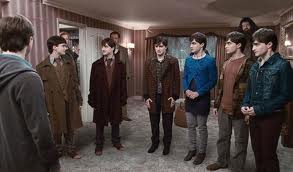
Part 7 is the only one of all eight films not to feature Hogwarts, the wizarding school where our young heroes are taught, and therefore doesn’t feel like part of the Potter pantheon. Freed from the structure of lessons, Quidditch matches and Harry being picked on by Slytherin, the film feels a little meandering, as Harry, Ron and Hermione scour the country looking for a series of magical Maguffins, horcruxes, that for one reason or another must be destroyed to help bring down the evil Lord Voldemort. The film opens strongly, with Harry’s escape from his home assisted by his wizarding friends transformed to be replicas of him, but it’s not until a later infiltration of the Ministry of Magic that any more excitement is had. There’s an awful lot of tension and relationship issues, exacerbated by a locket that builds negative feelings in whoever wears it (so… put it in a bag rather than wear it?) and a particularly cringeworthy scene wear Harry attempts to alleviate some tension by dancing with Hermione in a tent, but it feels empty without the action-balance provided by the second film. The brief animation, depicting the origins of the Deathly Hallows that grant the owner power over death, is easily the highlight of the series in total.
If watched as one long film, the two halves join together to form a perfectly balanced picture, with the final hour-long battle a rewarding epic culmination after a mammoth build-up, so if watching make sure to set aside the best part of an afternoon, however just watching part 8 alone is also acceptable. The infiltration of Bellatrix Lestrange’s Gringott’s vault, with Helena Bonham Carter gleefully impersonating Emma Watson, is tremendous fun (there’s another dragon!) and now they’ve got all the teenage angst and worrying out of the way it’s time for good and evil to get scrapping. The finale is equal parts devastating and spellbinding, as the regular cast is treated with a sporadic survival rate, literally anyone is up for the chop, up to and including Hogwarts itself, as various sets we’ve grown to feel at home in are burned to the ground. Some aspects of the battle feel crowbarred in – Mrs. Weasley’s showdown against Lestrange, Ron and Hermione’s inevitable kiss – but for the most part it’s a cinematic marvel that doesn’t disappoint.
Harry Potter and the Deathly Hallows Part 1: Choose life: 6/10
Harry Potter and the Deathly Hallows Part 2 : Choose film 7/10
Harry Potter and the Deathly Hallows Part 1 & 2: Choose film 8/10

Edward Scissorhands

First off, apologies for the lack of posts recently, I’ve been in hospital for an operation on my nose (inspiring this Top 5). Also, apologies if the posts over the next few days are a little off, I’m on a veritable Pan Galactic Gargle Blaster of meds, but I’ll try and keep everything as on topic as possible.
Johnny Depp successfully accomplished the transition from TV heart throb to serious movie actor with this, Tim Burton’s fourth directorial outing, leading to at present a further seven collaborations between the two bizarelly-haired gentlemen. Depp stars as Edward, the creation of a reclusive inventor (the legendary Vincent Price, in an all too brief cameo in his final film role) who remains incomplete after the inventor passes away. Edward looks human enough, but where five-fingered appendages should be on the ends of his arms, there are instead a multitude of blades, knives and scissors. After being discovered living alone by Dianne Wiest’s kindly Avon lady Peg, Edward is brought into the ‘normal’ world of 1950s suburban American.
As much comedy is made from Edward’s physical impairment as possible, with his blades coming into contact with waterbeds and hindering his ability to get dressed, pick up a glass, open a door or touch his face, but he shows an aptitude for carving meat, topiary, hairdressing, dog grooming, paperchain-cutting and being used as a kebab skewer. This does bring up the subject of exactly how Edward had survived alone in the castle before his ‘rescue,’ but as this is essentially a fairytale, minor plot details can be smoothed over.
As ever, Burton shows a deft hand with his casting. Depp is wonderful as Edward, showing childlike wonder at the new world around him, and expressing true depth of emotion from behind a stark appearance, all pale face, scars, bedraggled mop of hair and tight plastic and leather bondage-inspired clothing, and with minimal dialogue. Winona Ryder is cast against type (in that she wears colourful clothing and has blonde hair) as Peg’s cheerleader daughter Kim, and Alan Arkin and Wiest are wonderful as the parents welcoming Edward into their home. Anthony Michael Hall as Kim’s brutish boyfriend is more of a stretch though; the nerdy Breakfast Club star cannot be taken seriously in a bad guy role.
The film is lighthearted and entertaining, and has some genuine comic moments. The bookends of a clearly aged Winona Ryder are more obvious than the supposed narration reveal of the Notebook, but this features one of the greatest and most memorable character creations of cinema, and some fine acting too.
Choose film 7/10

The Dark Knight

What can I say about the Dark Knight that a thousand others before me haven’t? Of all modern films, this seems to be the one pored over most closely and often, heralded as the saviour of the summer blockbuster, superhero movie and crime thriller, all rolled up in the tightest of scripts. So, to take a fresh perspective, I sought out some people who didn’t like the film (thank the lord for the Internet, it makes people who don’t like something so easy to find) and found myself furious after reading just one and a half 1/10 reviews on IMDb. The sheer level of nitpicking and miniscule plot-hole unravelling proves just how far people are willing to go to disagree with the masses and stand out from the crowd, even when the crowd is so undeniably correct.
Not that this is a perfect film. There are flaws, including the Joker’s plan being at times a tad too pre-emptive, some ominous camera angles and music cues hinting unsubtly a character’s true motives earlier than should have been done, and the bit with the cellphones, which is a bit silly, but is that really enough to warrant a 1-star rating? The fact that these reviewers (I won’t give them the satisfaction of names or links, only seek them out to feel the rage bubble inside you) fail to note even one positive point in a movie overflowing with brilliance negates any opinion they deem worthy of sharing. I personally find it impossible to find nothing good in a movie – The Adventures of Pluto Nash is an abomination unto film, yet Randy Quaid is a delight as Nash’s robotic assistant; Big Trouble in Little China is easily one of the worst films I’ve reviewed from the list so far, but it has imaginative (if insane) monsters and mythology, some dialogue that surpasses cheesy to being inspired, and features Kim Cattrall back when she was attractive. Therefore, with such damning reviews as these ‘people’ have offered, they are in fact unwittingly proving how good a film it is.
Leaping from the tantalising springboard ending of BatmanBegins – Gary Oldman’s Jim Gordon showing Batman a playing card left as the mark of a new criminal, calling himself The Joker, we dive headlong into a wonderfully executed bank heist, as six masked goons effortlessly separate mob money from the vaults it was stored in. Director Chris Nolan has made no secret that Heat, Michael Mann’s superb DeNiro/Pacino cat and mouse crime epic, was a huge influence on the Dark Knight, and it shows, from a William Fichtner cameo to a central meeting of the hero and villain, even mentioning a cup of coffee.
Nolan wisely improved upon some mild mis-steps made in Batman Begins here, replacing Katie Holmes with Maggie Gyllenhall as love interest Rachel Dawes, giving Batman’s mask a cowl so he can turn his head, and giving Batman himself (Christian Bale, good but no Adam West) a little less screen time, allowing alter ego Bruce Wayne and his various accomplices and nemeses some breathing room. Aaron Eckhart is spot-on as Harvey Dent, Gotham’s shining hope against the mob, and Morgan Freeman and Michael Caine remain on hand to add a touch of old school class and grandeur as Wayne’s dependable CEO nad curmudgeonly butler/moral compass, but justifiably most of the praise has been directed at the late Heath Ledger’s Joker. A creation for the ages, his layered performance of a truly maniacal genius reveals more with each viewing, and it is unfortunate that the role showcased the true acting abilities of a man previously thought of merely as a rom-com heartthrob only after he had passed. Plus, it gave us all another Hallowe’en costume to use.
Unusually for Nolan, the film is actually quite funny. It’s not exactly laugh-a-minute (there’s certainly less than 152 jokes here), the script is still a lot more humorous than you might remember. There’s also absolutely no filler, with every strand being integral to the plot; a true achievement when you consider just how engaging the story is, even when new elements are being added right up until the last few scenes.
As always with Nolan’s films, there’s a couple of cinematography moments that I’d have tried differently (see Inception), most notably the scene where the Joker leaves a hospital, which could have looked truly tremendous had it been one unbroken shot, without needlessly cutting away to some pedestrians nearby, but this is a small matter that is more of a personal niggle than a criticism.
Anyway, for those wondering if they should watch the film again before the upcoming trilogy closer The Dark Knight Risesthis summer, the answer is a resounding yes. Even if you don’t intend to see part 3 (I assume you’re planning on gouging out your own eyeballs, just in case it isn’t any good, there’s no other reason not to see it) you should watch The Dark Knight again, just because it’s probably the best film to have been released in the last 5 years, if not more.
Choose film 9/10

Iron Man

Iron Man was the superhero movie we were all waiting for, we just didn’t know it; discovering the missing ingredient from all those that came before it – comedy. Though many that came before it weren’t overly serious, dark or gritty, they still took themselves too seriously, but Iron Man ensures a thick vein of comedy runs right the way through it. Released over 2 months before the masked behemoth and current comic book movie touchstone The Dark Knight, Iron Mancame out of nowhere with an untested star and middling director in Robert Downy Jr, and Jon Favreau. RDJ was still making his comeback after years of exile from Hollywood due to substance abuse, and Favreau’s most mainstream work was Christmas classic Elf, but he wasn’t exactly known for blockbusters, but after the movie’s release both found themselves sitting pretty on the A list.
Stark is such a great creation. By his own admission a “genius billionaire playboy philanthropist,” yet Downey Jr. somehow makes such a character not only likable, but one you’d willingly like to go for a drink with, and not just because he’d not only pick up the tab, but probably already owns the bar. He ably assisted by Gwyneth Paltrow and Terrence Howard as his dependable assistant and best friend, and Jeff Bridges is on fine menacing-brow villain mode as Obediah Stane, the business partner of Stark’s deceased father.
Iron Man has an advantage over other superhero stories in that Stark’s story is actually interesting. A twist of fate doesn’t have him bitten by a spider, he isn’t an alien from a distant planet and he isn’t avenging his parent’s death. No, Stark had all of his superpowers before the film even starts. Wealth, intelligence, a sharp with and an immaculate goatee are goals he’s worked towards and achieved; he just needed the push to fit them all together in the form of a titanium-gold alloy flying suit with a rocket launcher and flamethrower, and what greater motivation than a terrorist attack against him, using the very weapons his company created? This means that the villains are also people every can be against – terrorists and the evil corporation heads who supply them.
The best scenes involve the subtle yet inspired gadgetry around Stark’s house, from the Paul Bettany-voiced quasi-butler Jarvis, to the robotic arms that are a little over zealous with the fire extinguisher. The flawless suiting up sequences and Downey Jr. interacting with nothing but a mechanical three clawed appendage aren’t too showy, yet set the film above its rivals.
The only possibly problems are that Howard’s Officer Rhodes is bland, but then who wouldn’t be compared to Stark, and the Stane-is-a-villain story arc is clearly signposted from the get-go, having been given the perfect set-up as the man who took on Stark Industries when it’s CEO passed away, only to be muscled out by some upstart genius, that and his full head with a thick, lustrous beard mean at some point in the near future he’ll be laughing with maniacal glee and threatening the hero’s love interest. Now that the Avengers (sorry, Avengers Assemble) is in place, this film does seem like a bit of a precursor to it, especially the scenes involving Clark Gregg’s Agent Coulson, which don’t really add anything here other than some fanboy cheers every time someone says Strategic Homeland Intervention, Enforcement and Logistics Division, but the scenes don’t detract too much, and can be forgiven as they tie everything up nicely.
Otherwise, the film is pretty much perfect, and remains enjoyable after many viewings.
Choose film 8/10

An American Werewolf in London

After being attacked on the Moors in rural northern England, a young backpacking American (David Naughton) awakes in a London hospital and falls for his nurse, Walkabout’s Jenny Agutter. This leads to some romcom hijinks, mostly involving Agutter’s Alex not being allowed to sleep with patients, and the vacationing David bored and alone in her apartment all day with no money and no where to go, trying to amuse himself. Oh, one last thing, David’s a werewolf being stalked by the ever-decaying remains of his zombie best friend. Sorry, forgot that bit.
This film is great, mostly memorable for Rick Baker’s stunning effects, featuring a transformation entirely CGI free that looks and feels unbearably painful and has yet to be equalled over thirty years later. There are some good jump scares and creative cinematography, with even a stationery phone box call shot seemingly on a circling bicycle. The subway sequence is particularly exhilarating, and the film is a lot funnier than you might remember, especially the scene in the porn theatre, with various undead suggesting the best ways for David to kill himself (we finally get to see director John Landis’ in-joke movie See You Next Wednesday, referenced in all his films, that turns out to not be that recommendable).
Unfortunately Landis doesn’t follow Spielberg’s rule of not showing too much monster, as the later scenes, before an overly abrupt ending, reveal the creature too clearly, gnawing away at some of the mystery. Frank Oz’s cameo as an American embassy official is also offputting, as I can’t take him seriously when he’s doing a voice that sounds exactly like the one he uses for Fozzie Bear in the Muppets. The most unbelievable part though? It’s possible to get a taxi far in London for £1.50. Ridiculous.
Still, thoroughly enjoyable and worth watching for Baker’s Oscar-winning make-up and effects.
Choose film 7/10

Synecdoche, New York

Charlie Kaufman has often been described as a breath of fresh air in Hollywood. The legend goes that there are twelve different stories in every film in Hollywood, and with his debut script Being John Malkovich, Kaufman wrote the thirteenth, and there’re so many ideas in Adaptation and Eternal Sunshine of the Spotless Mind that they probably count for numbers fourteen through twenty, and fortunately they’re all on the List. So after working on so many inspiring and imaginative modern classics, Kaufman’s directorial debut is a disappointingly convoluted tangle, as Philip Seymour Hoffman’s theatre director Caden Cotard struggles to create a play based on his own life, whilst struggling with a myriad of relationships and a mystery illness.

Whilst the entirety of the plot – also written by Kaufman – is positively brimming with ideas and ingenuity, from Caden seeing himself in cartoons and commercials, to a character living in a perpetually burning house, the lack of clarity between how much takes place in the real world, how much is in the obsessive director’s head and how much is part of the play is at best frustrating and at times infuriating. It doesn’t help that many of the actors look alike, possibly on purpose, with Michelle Williams, Samantha Morton and Emily Watson all used to play the same character in different levels of life, with the play being featured in the play, requiring Caden to cast himself, casting himself in the play of his own life. Time skips in the blink of an eye for us and for him – his four year old daughter with Catherine Keener’s bohemian artist ages seven years in a matter of days.

You get the feeling that the end result of the film is exactly what Kaufman set out to achieve, with every layer of obsession and confusion being carefully planned and perfectly executed, but when I tried to make some sense of it all, my brain started to run out of my ear.

Choose Life
6/10

300

300thmovie! Yes! Nailed it! This has been a plan from the outset, that the 300thfilm just had to be 300, and lo it has been done. Finally I can stop checking the count every day of how many films I’ve watched and just get on with watching more and writing posts (I won’t).
Based on the incredibly stylish graphic novel by Frank Miller (Sin City), it could be argued that this two-hour fight scene suffers from a severe case of style over substance, with a small squadron of 300 Spartan warriors heading out to take on the thousands-strong army of Persians out to conquer their land, but whilst there is some accuracy to this, there is quite enough story behind the oceans of cool.
The Spartans, led by Gerard Butler’s King Leonidas in a role that remains his calling card after six years of mostly forgettable romcoms and mindless shooters, have been trained since birth to feel no pain or mercy – or cold, judging by how little they wear – and all live to fight, and die, honourably in battle. One soldier, when questioned as to why he has brought his adult son along to fight, replies that he has others to replace him.
It’s impossible for a man not to watch this and feel inferior. Some may see it as a rabble-rousing celebration of what it truly means to be a man – fighting and killing, safe in the knowledge your son will carry on your name – but personally I see it as a reminder of the garage-worth of spare tyres congregating about my torso, and how I’ve managed to survive almost 25 years without so much as throwing a punch. I can almost feel my ovaries forming.
The combat, and believe me there’s an awful lot of it, is wonderfully choreographed, and director Zack Snyder utilises a deft blend of colour, lighting, slow motion, shadows and speeding up to showcase its full glory. At times it feels more like a videogame, as the quantity and skill level of the foes to be vanquished steadily increases.
The occasionally flits back to Sparta, where Leonidas’ Queen (Lena Headey) tries to convince their council to send reinforcements, do a good job of breaking away from the otherwise incessant violence, but some touches – the giant troll, a bizarre goat-creature – take away from the experience, and overly-pierced big bad guy Xerxes has a voice comically mismatched to his appearance.
Look out too for an early appearance from LifeVsFilm favourite Michael Fassbender as one of 
the 300.
Choose film 8/10

Platoon

Charlie Sheen is Chris Taylor who, after dropping out of college because he wasn’t learning anything, volunteers to fight in the Vietnam war, amongst recruits including Keith David, Forest Whittaker, Tony Todd, Kevin Dillon and a young Johnny Depp. The platoon is split, with half drawn to Willem Dafoe’s free-thinking, laidback stoner Sergeant Elias, with the rest, including brown-nosing Sergeant O’Neill (John C. McGinley), prefer the ethos of scarred Staff Sergeant Barnes (Tom Berenger), who counts success by how high the bodies are piled, rather than whether peace has been achieved.
There’s an interesting film buried in here somewhere, but it either follows Sheen’s naive, error-realising private or the conflicts between the two sergeants and their unrespected, inexperienced Lieutenant (Desperate Housewives’ Mark Moses). Some gripping moments stand out – a night ambush, and the colour slowly fading back in after a white-out napalm drop – but the rest is underwhelming and littered with trite or cheesy dialogue and 5-cent philosophising: “We did not fight the enemy, we fought ourselves, and the enemy was within us.”
Choose life 6/10

The Fountain

One love story is told across three wildly different time periods as Tom (Hugh Jackman) tries to cure his wife Izzy (Rachel Weisz) of her life threatening disease. Told in the modern day, Elizabethan era and a space-set future time, the film is beautifully shot and lit, effects created using different liquids dispersing into one another to create timeless yet phenomenal scenes. The story strands flow into one another, as the modern day surgeon struggles for a cure, a historic conquistador seeks to discover the fountain of youth and the slap-headed space traveller floats inside a giant bubble talking to – and occasionally eating –  a tree. If this all sounds a little too much for you, you’re not alone, as this is a polarising film that many dismissed for being just too odd. The modern day segments are the easiest to follow, with a straightforward narrative, relatable characters and situations requiring minimal explanation. Director Darren Aronofsky (Requiem for a Dream, The Wrestler) alas does not have much of an eye for combat, with some of the past tense skirmishes coming across muddled and confusing, but otherwise this is a creative and visually stunning depiction of an otherwise done to death story.

Choose film 7/10

Atonement

Based on the book of the same name that swept the country a few years ago, Atonement tells the story of Briony in three stages of her life, as a young writer in her parents stately manor in the early 30s (Saoirse Ronan), training to become a nurse during World War 2 (Romola Garai) and much later, releasing a book on the subject as an old woman (Vanessa Redgrave), cut the story she tells is not only her own, but that of Cecilia and Robbie (Keira Knightley and James McAvoy), her older sister and their gardener.

A childhood misunderstanding of several events lad Briony to make a rash decision she would live to deeply regret, for its consequences had the very real possibility of being incredibly dire. Whilst beautifully shot in every scene, most notably the standout 5 minute continuous steadicam sequence as three soldiers (including Ashes to Ashes’ Daniel Mays) discover a war ravaged beach complete with hundreds of extras, horses and a funfair making the film worthwhile on its own, the film does not quite have the right mix of war and romance to attract both genders, focussing more on the females than males, yet there is still plenty to keep all engaged, and at times agog.
Choose film 7/10