Zodiac

Amidst the 4th of July celebrations in California in 1969, two young romantics drive out to a secluded spot the locals refer to as Lover’s Lane. The mood is of anticipation; anything could happen as the other kids drive away, our lovestruck pair left alone. There’s a spark of romance, playful glances, touches, the gentle ribbing of one another as they become closer. And then they’re shot in cold blood and left for dead with no word of explanation by an unseen killer. This murder, along with the many that follow it, dramatically changes the lives of many people, but our focus here is a select three; Mark Ruffalo’s cop, Robert Downey Jr’s journalist and Jake Gyllenhall’s cartoonist, as they each set out to catch the killer. Their motives are different – Ruffalo’s David Toschi wants justice, RDJ’s Paul Avery is out to further his career and Gyllenhall’s Robert Graysmith is obsessed with the puzzles the killer sends to the local papers, but all three will suffer in terms of careers, personal lives and sanity at the hands of this killer.
Based on the real life Zodiac killer (the influence of the Scorpio killer in Dirty Harry, here namechecked when Toschi can’t sit through a showing), the case remained unsolved when the lead suspect died some years ago, and it’s this sense of inconclusiveness that runs throughout the film – you know there will not be a satisfactory ending. Plaudits should be laden for the realism of the film – not since All the President’s Men has so much paperwork been completed – but unfortunately the dreary, depressing side of catching a killer rubs begins to rub off onto the film during its overlong running time. Director David Fincher (Benjamin Button, Seven) is usually so adept at keeping interest, even when Morgan Freeman went to a library, but here not even a cast including Elias Koteas, Philip Baker Hall, Brian Cox, Anthony Edwards, John Carroll Lynch, Adam Goldberg and Clea Duvall can raise this above tedium. There’s a good film in here somewhere, and a good edit could bring it out. More Downey Jr. and Brian Cox couldn’t hurt though, they’re the best parts of the film and are criminally underused.

Choose life 7/10
Topsy-Turvy

Mike Leigh’s depiction of acclaimed stage show writer and composer Gilbert & Sullivan (Jim Broadbent & Allan Corduner) creating their most famous production, the Mikado, is extremely well performed by all involved, especially the two leads and Timothy Spall as one of several preening thespians. The background is littered with know-the-face British actors (Andy Serkis, Dexter Fletcher, Mark Benton etc.) and the costumes and set design are spectacular. Unfortunately, the film is far too long, and too much time has been given over to the musical numbers, with at least ten being shown throughout the film. A much tighter script, focusing more on the backstage goings-on and less on the show itself, could have led to a bona-fide British classic about two of our most notable showmen.

Choose life 7/10

Fargo

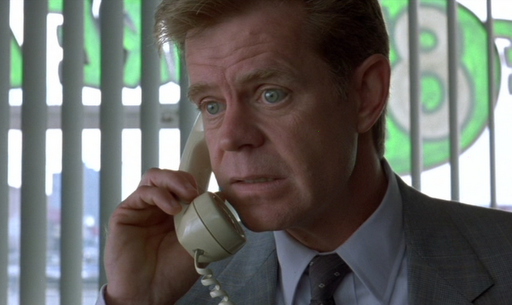
Snivelling, double-talking car salesman Jerry Jundegaard (William H. Macy, Oscar nommed but somehow losing to Cuba Gooding Jr.) has a plan. He needs money. His father-in-law Wade (Harve Presnell) has money, but hates Jerry. So Jerry hires two thugs (Steve Buscemi and Peter Stormare) to kidnap his wife and demand a ransom, of which Jerry will keep half. What could go wrong? Well, quite a lot it turns out, especially if everyone involved is an idiot and you’re being directed by the Coen brothers. The men’s escapades are chaotic, unstructured and are all heading off in different directions until, at the 32 minute mark, heavily pregnant Sheriff Marge Gunderson shows up to set them in order. Frances McDormand deservedly won an Oscar for her portrayal, nailing that wonderful sing-song North Dakota accent “Yah, you betcha” and, once full of eggs, keeping a straight face whilst clearing up the handbasket Hell’s clearly fallen out of around her. 

Few films as short as this (98 minutes) have room to divulge us with background lives – a meeting with an old school friend, conversations about stamps – whilst still keeping the action moving briskly. Every line is considered and real, every character feels genuine, and this is the greatest proof you can find against the argument that the Coens can only write caricatures. Often underrated, this film can never be over-seen, and no-one can call themselves a film fan unless they’ve both seen it, and loved it. The title of this blog was very nearly called Your Accomplice in the Wood Chipper, and a car boot opening has never made me laugh before.
Choose film 10/10

Sweet Smell of Success

I hate disappointment, yet the further into the List I delve, the more used to it I become. Sweet Smell of Success is a film I’ve had sat on my DVD shelf for over a year now (since even before the List entered and devoured my sad excuse for a life), and I’ve been waiting for a chance to watch it. Appearing on 3 lists and this month featured as Empire magazine’s monthly Masterpiece, my hopes were set to high. I knew two things: the film was endlessly quotable (a character in Diner does nothing but quote the script) and it features arguably career-best performances from leads Tony Curtis and Burt Lancaster. Whilst I cannot deny these points, I must take umbrage with the film for being far too dense. Even now I only have a vague idea as to what took place – Curtis’ ambitious yet downtrodden press agent Sidney Falco teamed up/sparred with Lancaster’s ruthless columnist J. J. Hunsecker in an effort to prevent a relationship between Hunsecker’s sister and a young jazz musician, so the Falco can get more column inches in Hunsecker’s paper. Much of the script is quotable (“You’re dead son, get yourself buried)”, but there is so much of it many of the best lines are lost. Doubtless this film will improve with repeat viewings, and if so my score shall be upgraded, but for a one-watch it doesn’t hold up. The score has also received a lot of plaudits, yet I found it really did not fit to the film – a barroom conversation sounds more like a frantic car chase. Here’s hoping the next viewing is more enjoyable.
Choose life 6/10

Requiem for a Dream

DON’T DO DRUGS. There you go, just saved you an hour and three quarters. Except that’s just the thing, although this film can be summed up in just three little words, it’s still an exceptional piece, just thoroughly depressing and cautionary. Easily the reason I’ve never so much as even picked up a joint, this film should be mandatory viewing in schools and rehab centres the world over, with every step taken by the four leads taking them further down a spiral they really don’t want to see the end of. Firstly, there’s Jared Leto’s slacker Harry, living day-to-day by repeatedly stealing and selling his doting mother’s television with best friend Tyrone (Marlon Wayans, surprisingly good) in order to buy drugs. Harry’s girlfriend Marion (Jennifer Connelly) is a promising fashion designer, but occasionally must turn tricks when money runs low, and Harry’s mother Sara (Ellen Burstyn, Julia Roberts has your Oscar) lives alone, glued to her television, unable to deal with the direction her son has taken.

The film is at times incredibly hard to watch (double-ended dildo, anyone?) but when you do it’s nothing short of a cinematic goldmine, with director Darren Aronofsky’s editing and Clint Mansell’s spot-on score fitting the addiction-addled characters lives perfectly. Fish-eye lenses, split-screen, sped-up/slow-down footage and cameras strapped to actors focussed on their faces as they flee from the mess they’re in are all used perfectly. Compare this to Happy Together, where these same devices were used just for the sake of it, to show the director could, and you can really see how relevant they are here. Also, compare the editing, especially that of drug hits; rapid shots of syringes depressing and eyes dilating, with similar edits in Edgar Wright’s Shaun of the Dead. The two use very similar techniques, but with wildly different effects.
I felt the three youngsters should have been scrawnier and more blemished than they were, with Wayans and Leto especially being far too muscular than I’d expected a junkie to be. The storytelling though is excellent, with actions truly speaking louder than words, most shots consisting of close-ups or POV.
I had a couple of “Hey, it’s him” moments: Crash’s Keith David is a lecherous ‘party’ host, Spiderman’s Dylan Baker a Southern doctor and Office Space’s Ajay Naidu is Sara’s mailman. Also, Christopher McDonald needs some recognition for playing almost the same sleazy TV scumbag he played in Quiz Show.
Choose film 9/10

Jaws

Der-dum. Derr-dm. Derrr-dn. Derrrr-dn. Der-dn. Derr-de der-de de-de de-de de-dn-de-de-de-de!
Two notes. The most memorable two notes in history, signalling to the world that a skinny dipper won’t be home for dinner.  Composer John Williams, here winning his second of five Oscars – so far – and whom celebrated his 80th birthday last Wednesday, used these two notes to produce a primitive, devastatingly simple theme tune more recognisable than any other in cinema. Would Jaws have had such an effect without the tune? Probably, but it might not be quite so memorable.
Some credit should be given to the director too. A 26-year old working on only his second feature after the mild success of The Sugarland Express and his direct-to-TV man vs. truck classic Duel, cocky young upstart Steven Spielberg was eager to prove his worth. After purchasing the rights to Peter Benchley’s novel, what followed was one of the most famously arduous shoots ever experienced until Apocalypse Now. The actors hated each other. Boats almost sank or repeatedly drifted unwanted into shot. The pissed off Martha’s Vineyard locals incessantly badgered the crew, it all cost too much and took too long, with reshoots needed to make it just right (some scenes were reshot in the editor’s swimming pool). And of course, the shark didn’t work. The eyes looked weird, the jaws wouldn’t close, the thing wouldn’t float or just didn’t work full stop. Everything had to be geared around that giant mechanical fish. But in a way, all these obstacles came together to add to the whole. The three leads – Roy Scheider’s chief of police Brody, Robert Shaw’s salty sea dog Qunit and Richard Dreyfuss’ techie oceanographer Hooper are supposed to distrust each other, so a mutual dislike between the actors could only heighten that. Continued reshoots allowed shots to be perfected. And a malfunctioning shark meant they couldn’t show the monster, allowing audiences imaginations – always able to outdo any Hollywood special effects – to add in the gnashing teeth, piercing eyes and circling fins where needed. The film set the template for every blockbuster and mainstream monster horror since – only the best creature features save the big reveals to the end.
Whilst there is much to thank Mr. Spielberg for with regard to Jaws’ impact, there are some downsides too. Jaws was released nationwide in over 400 screens – unheard of in its day. Everyone involved assumed it would flop, so they prayed for a fair to middling opening weekend with which to gain back the millions lost in the making. Instead, they found the weekly grosses did nothing but rise, so a complete market saturation became the norm for all summer blockbusters, most notably Star Wars two years later. So nowadays you can blame the tentpole summer pictures – the floods of superheroes and giant robots beating the crap out of each other – at least partially on Jaws.
Not everything good came from the bad or accidental though. The script and staging is impeccable, with one notable scene – the three leads in the galley of Quint’s boat the Orca – passes from tension, to camaraderie, through heavy emotion, back to a sense of fun and then intense action, all without any sense of confusion or feeling rushed. There is some great blindsiding; assuring you something obvious is going to happen, before smacking you in the face with the exact opposite, and even the little moments – the ominous clicking of an unwinding fishing line under Quint’s steely gaze, Hooper’s boyish glee at the menagerie of jawbones hanging in Quint’s shack – all register with great impact.
Choose film 10/10

Dirty Dancing

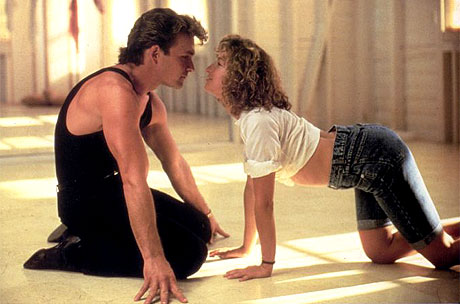
We recently booked tickets to see this on stage at the Mayflower theatre in April (not my idea) and I’ve never seen the film. I know, shocking. I’ve seen Crazy, Stupid Love, so I figure I’d seen the important bit already, but enough goddamn Empire readers voted it onto the top 500 films list that I had to see it. Motherfuckers.

It’s the summer of 1963, and Wayne Knight is working as an entertainer at a holiday camp. He makes a deal to steal some dinosaur DNA hidden in a shaving foam can and smuggle it out during a storm, but doesn’t bank on a dilophosaurus with a penchant for fat, sweaty guys. Some kids nearly diea few times, Laura Dern gets terrified by Samuel L. Jackson’s disembodied hand and a T-Rex eats Patrick Swayze whilst he lifts Jennifer Grey up in the air. Well you can’t blame me for dreaming, can you?
Alas, all we have here is a rather tepid story of a girl getting it off with her rather ‘hands-on’ dance instructor at a summer holiday camp, whilst her parents would rather she dated a rich, boring guy instead. Before this film I’d only ever seen Swayze as a sinister paedophile in Donnie Darko, so to me he comes off as creepy and predatory, praying on the naive young dancer as they are forced together, Swayze’s sleeve-phobic Johnny Castle having to teach Grey’s Baby to dance professionally in a matter of days, so the relationship that built up between them may have appeared more Sordid than perhaps it was supposed to.
I’ll be the first to admit that I’m no dancer – mainly because that means I don’t have to dance – so any dancing seen on film is lost on me. I can’t tell when people are dancing well, or even in time, so showing long routines or montages of improvement have a similar effect as me listening to someone gradually improving their Cantonese.
Grey is a terrible actress – her miming to Mickey & Sylvia’s Loverboy is excruciating, and the most famous line in the film (some crap about a corner) is tossed away so haphazardly I doubt it would have been missed had it been cut.
Anyone want to buy a theatre ticket?
Choose life 3/10

United 93

Paul Greengrass’ (The Bourne Supremacy/Ultimatum) sobering depiction of the events that transpired on the fourth hijacked plane of September 11th 2001 is a film widely regarded as being a great film, but one you only really want to watch once. This was my third time. The first was just me watching the film. The second was due to Aisha never having seen it, and now I’m doing it for the List. I really don’t think I can take it a fourth time, so here’s hoping. Understandably, there is no humour or trace of lightness to this film. It is not enjoyable, but at times is inspiring, though more often devastating, heartbreaking and infuriating. We see the day as experienced by all involved – terrorists, passengers, flight crew and air traffic control, as for most what starts a normal day becomes one of the most significant events in modern history. The cast is impressively filled with unknowns, and in fact some of the air traffic control staff are played by those present there on that day. This greatly enhances the submersion into the film – anyone could die at any second, and any could rise up and become integral to the events. This is a must watch, not just because of the subject matter, but also the technical qualities – a handheld, up close style keeps us in the centre of the action.
Choose film 8/10

The Big Lebowski

I’ve made the point before that the list contains films of three varieties; great, popular and important. The greats arrive via the Empire 5-star 500 list, the popular from the two lists voted by the general public, and the important ones are provided by the 1001 Films to See Before You Die. Many films, though arguably important, aren’t actually very good, so one could argue that they should be remembered and acknowledged for their gifts to cinema, but not necessarily watched, as was the case with the Jazz Singer, marking the introduction of spoken dialogue to the big screen, which nowadays is dull, racist and features too many unnecessary songs. The Big Lebowski, on the other hand, is also an important film, spawning a cult following so vast there is a fan club (the Little Lebowski Urban Achievers), several books and an annual festival (creatively named Lebowski-Fest, I hope to attend one day). And yet, it does not appear among the important list, appearing here after being awarded a 5-star review and obtaining positions on both nominated lists. This is less a crime and more a cultural injustice, as the impact this film has had on society is measurable from space. Hell, they even played clips of it recently on Something for the Weekend.

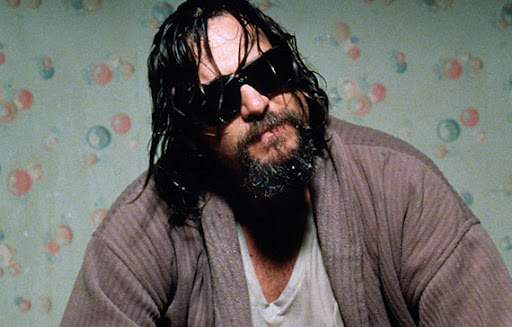
So just what is it that resonates so much with the public? Maybe it’s the snappy, endlessly quotable dialogue (“Obviously you’re not a golfer), particularly everything said in the bowling alley. Or perhaps it’s the borderline caricature roster of characters on display, from John Turtorro’s lilac-hued pederast Jesus (whom nobody fucks with) to Julianne Moore’s naked yet cultured Pollock-esque artist Maud and of course John Goodman’s psychotic ‘Nam vet Walter. It’s probably got something to do with the extremely crowded plot that bears little effect upon the characters it happens to. But mainly, it has to be Jeff Bridges turn as The Dude, a man shambling and smoking his way through life, following the flow it leads him on via nihilists, urinating Chinamen, porn moguls and private detectives. That, and it’s the first great film to feature a pot-smoking lead since Cheech and Chong, and one must conclude that many of those attending Lebowski-Fest, drinking white Russians in their dressing gowns and sunglasses have similar feeling towards the weed as his Dudeness.


Me? I love it because it’s a quintessential Coen Brothers movie. It features everything you need to make a great film – a twisting plot, stellar cast (I haven’t even mentioned Steve Buscemi, Peter Stormare, Philip Seymour Hoffman, Tara Reid, Sam Elliot, David Thewlis, Aimee Mann or the Red Hot Chilli Peppers’ Flea), terrific performances all round and a cracking soundtrack. The film introduced me to my cocktail of choice – Vodka, Kahlua and milk, easy on the Kahlua and heavy on the ice – and every time I watch it I either see something new or am reminded of a moment of pure gold I’d previously forgotten.
Choose film 9/10

Eraserhead

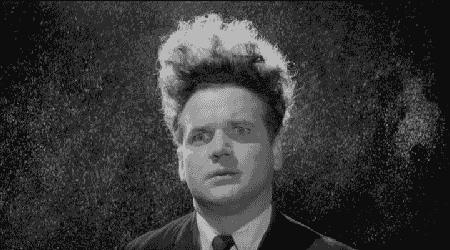
I think this is David Lynch’s idea of a romantic comedy. Shot in stark black and white and sounding like it was filmed underwater or near a busy factory, we follow the bizarrely coiffed Henry Spencer (Jack Nance) through the trials and tribulations of an average young man – meeting his girlfriends parents for dinner, encountering a beautiful woman living in the same apartment building, watching a woman with hideously deformed cheeks dancing deliriously on stage, you know, the usual.

Coming across like a 90-minute montage of nightmares I would not advise watching this before bed. Henry and his partner’s baby has the appearance of a mechanised cow foetus (possibly because undenied rumours suggest this was what was used), the aforementioned dinner sequence involves a tiny roast chicken still moving, bubbling and bleeding on the plate, and a scene where Henry cuts open the deformed baby has it becoming a bile volcano, one of the most horrific images I’ve ever seen. I’m not sure what happened to Lynch growing up, but I damn well hope it doesn’t happen to me.
Choose life 2/10