Mad Max 2 The Road Warrior

If the recent UK petrol strikes had gone on a little longer, chances are we’d have seen something not too dissimilar to the events here, in George Miller’s 1981 sequel to 1979’s Mad Max. Mel Gibson reprises his role of Australian cop Max Rockatansky, but the world he lives in is now a barren, chaotic land left ravaged by a worldwide war, leaving the survivors desperate for any fuel they can find.
Max and his dog roam the landscape looking for gasoline, eventually hearing about an enormous stash not too far away, and so with the guidance of a deranged nutcase with a flying machine (“It’s my snake, I trained it and I’m gonna eat it.”), set out to find it, but alas the compound within which the gasoline is kept is not only heavily guarded, but is also being laid siege to by a ruthless gang of miscreants.
Whilst this is certainly an improvement on the original movie, there are still a lot of things here that don’t make sense. For starters, the motivation for every character is to end up with more fuel, yet all seem to expend an awful lot more than they need to in order to get any. Whole fleets of cars and motorbikes are sent out on scouting missions, showboating and jumping as they go, and even the compound uses a bus as a gate. If fuel is so very precious, why are they all so eager to waste it?
The costume design has progressed from the previous film, and now the rebel gang has an even greater passion for leather, bondage and ass-less chaps than Max himself. The depiction of a lawless, structureless society is well done – one of the gang’s cars is a cop car, suggesting that it’s not just the general population that has lost it’s mind – and Max readily eats cold dog food, straight from the tin. There’s better characters too, including a feral kid with a deadly boomerang (played by the brilliantly named Emil Minty), and there’s some decent action and chase sequences. The epic finale, with the gang attempting to seize a petrol tanker trying to travel 2,000 miles to paradise, does get a little samey after a while, but is impressive nonetheless. The arm-mounted crossbow though is probably the least threatening weapon I’ve ever seen.
Fortunately, Mad Max 3: Beyond Thunderdome isn’t on the list, but this one is deserving of it’s place. It’s by no means the greatest dystopian future survival movie, but it’s still an enjoyable watch, and certainly has it’s moments.
Choose film 7/10


Up in the Air

Jason Reitman’s third directorial outing, after the stellar Thank You For Smoking and the good-the-first-time-you-watch-it Juno takes two done-to-death plot conceits – the business-set rom-com and road movie odd-couple – and reinvigorates them to be not only modern, but impressively timely.
Up in the Air is much more in keeping with the structure of Smoking, as we follow a successful, charming but morally dubious and emotionally detached businessman discovering that his perfect life may not be as ideal as it seems once women step a little too far into it. Previously it was Aaron Eckhart’s fast-talking cigarette peddler Nick Naylor, here it’s George Clooney’s professional corporate downsizer Ryan Bingham, jetting around the country to fire people when their own superiors don’t quite have the balls. And with the economic climate and unemployment rates where they are now, no other film could be quite so prescient.
But it isn’t just that this film rings true with modern times. Clooney channels his inner Cary Grant in the role he was seemingly born to play, whilst Vera Farmiga is wonderful as his female equivalent, Alex. The real surprise though is Anna Vendrick. Formerly most famous as Bella’s best friend in Twilight, here she shows real comic ability and acting prowess as Natalie, the bright young whippersnapper brought in to downsize the downsizers, aiming to revolutionise the business by doing it all online.
The cast is rounded out by some Reitman regulars, including Jason Bateman, J. K. Simmons and Sam Elliott, as well as Danny McBride, Melanie Lynskey and Zack Galifianakis, and a gaggle of non-actors portraying essentially themselves when they were fired, with Reitman instructing them to dwell on their own experiences in some moving moments.
The best scenes involve the principals just sitting down and talking. Be it Ryan and Alex comparing the weight of their loyalty cards, or Natalie learning that, as you get older, your expectations of life lessen to more realistic goals, the script is insightful, sparky and above all else funny. I was a little annoyed at seeing Sam Elliott in the opening credits, and seeing his cardboard-cutout as the Chief Pilot in an airport signposting that, at some point, his character was going to crop up somewhere, but that’s another of those things that only really hurts the film nerds.  Some of the metaphors are a little heavy-handed (at one point Ryan’s family literally doesn’t fit into his suitcase) and the ending feels like a series of devastating gut-punches that kind of spoils the mood, but each one feels perfectly justified and necessary.
If you don’t settle too deeply into the subject matter this is a fun comedy with a great script, and even if you do it’s still thought-provoking and entertaining stuff. I await tracking down Reitman’s latest offering, the Charlize Theron starring Young Adult, with anticipation.
Choose film 8/10

Thelma and Louise

Two girls, a turquoise 1966 T-Bird convertible, a weekend vacation at a friend’s cabin up in the mountains, what could go wrong? Well, in Ridley Scott’s feminist road movie, a heck of a lot, as henpecked housewife Thelma (Geena Davis) and her world-weary waitress best friend Louise (Susan Sarandon) head out from their humdrum lives on more of an adventure than they bargained for, after a run-in with a would-be rapist at a country bar of ill repute.
The titular roles could not be more different, yet both remain well rounded characters, thanks in part to the able performances by the two leads. Though it is the men that seem to shepherd our heroines on the run, they always find a way of fighting back or turning the tables, be it on Harvey Keitel’s cop on their trail (assisted by Stephen Tobolowsky!), Michael Madsen as Louise’s boyfriend Jimmy, Brad Pitt’s first major film role as clothes-shedding hitchhiker J.D. or Christopher McDonald as Thelma’s boorish husband Darryl, eager to get his wife back so she can start making his dinner again.
There’s some great comedy – Darryl unable to watch his beloved football because the cops tapping his phone are too engrossed with Cary Grant in Penny Serenade – and though the story and ending may have been ruined by an overabundance of pop-culture spoofs and references, it is still a very good story. The accents begin to grate after a while, particularly Davis’ pronunciation of Loo-eese, but try to look beyond that at a journey that starts with an accident, and builds to become two strong female characters exploring their own limits, surprising themselves and everyone else.
Choose film 7/10

The Class

Filmed in a real school (and mostly in a real classroom) with an unprofessional cast all playing versions of themselves, Laurent Cantet’s semi-improvised near-documentary follows Mr. Marin (François Bégaudeau), a French teacher at an inner city school as he tries to connect with, further and inspire a class of 13-15 year olds. Bégaudeau co-wrote the script, and stars in his first acting role essentially playing himself, for he used to be a teacher, so it is no surpirse that his performance is wonderfully naturalistic, as are those of the multi-cultural students he presides over.
It is impossible not to feel the frustration felt by Marin, as he does his utmost to help his students, who almost seem to repell any learning, yet even when the other teachers have given up on the more problematic pupils, Marin still endeavours to find ways to reach them.
If this all sounds a little Dead Poet’s Society or Dangerous Minds, fear not. Here there are no last reel acts of defiance or obligatory contests won, life simply goes on. We see the less exciting but still interesting goings-on behind the scenes at the school – teachers debating punishment techniques and coffee machines, warning the new staff about the difficult classes – all shot in a documentarian, handheld style in amongst the desks.
The first half feels a little directionless, yet is still compelling, but the second, following the fallout of Marin saying two students behaved like “sluts” and his endeavours to help troublesome miscreant Souleymane, is much more on target. If you’ve ever been inclined to take up teaching, this film may infuriate you, with regards to how much effort Marin must fight against to even give Souleymane a chance.
Choose film 8/10

Far From Heaven

Hertford, Connecticut; 1957. Cathy Whitaker (Julianne Moore) is at the heart of her picket-fenced community, her husband Frank (Dennis Quaid) is a successful businessman and her two young children are little bundles of perfection, with her daughter wishing to one day grow up to be just like her mother, though her son is a little foul-mouthed (“Ah jeez” is not the kind of language Cathy tolerates).  But beneath the surface of floating dresses and pristine curls, all is not well. It’s clear from Cathy’s expression that, though her friends must all put up with their husbands’ occasional demands for intercourse, Cathy has no such problems, for Frank hides a secret; whenever he is ‘working late’ he tends to be frequenting a bar aimed only at male patrons that want to get to know each other a little better.
Todd Haynes’ movie lovingly recreates an idealised vision of 1950s suburban middle America (“Aw shucks” is uttered in the first four lines, and “jeepers” and “swell” aren’t too far behind) although the rampant sexism and racism would be more than frowned upon today. When Cathy shows sympathetic tendencies towards her black gardener Raymond (Dennis Haysbert, 24‘s President Palmer) she is the subject of mild ridicule and is frowned upon by the society that used to hold her dear. Haysbert is good in another of his solid, decent, all-round nice guy roles, but Dennis Quaid continues his run of being the worst thing about a film. I’m sure in his youth he must have done something to earn a reputation as an actor, but I can’t for the life of me think what it is, I’ve only ever known him as the worst thing in bad films (Flight of the Phoenix, Smart People, The Day After Tomorrow, Vantage Point).
The era is seamlessly recreated, to a point where the film could easily have been made in the 50’s – in which case it would probably be hailed today as a classic. Moore is the best thing in it, so much so that at times she barely seems to be acting, so great is the level of repression she must convey. She received an Oscar nomination for her troubles – Nicole Kidman must have been really great in the Hours to beat her.
Though at times it feels like nothing really happens, that is surely the point. This is more a study of the prejudices of the era – Frank’s grand social indiscretions can be brushed under the carpet or cured (a doctor has a 5-30% success rate for curing homosexual urges) whilst Cathy’s much lesser faux pas sees her outcast from all around her. The plot and script are a little hokey, but the performances and overall feel stay with you after watching this subtle piece.
Choose film 6/10

Satantango

Aisha’s away for the weekend and I’ve got no other plans, the hotbed of social activity that I am, so I’ve made the most of a fairly sunny weekend by staying in and watching the longest film left on the list, Satantango. At 7 ½ hours long, it rounds out the top 5 longest films (though technically two are TV series and one is an eleven-part serial) on the List, which between them have taken up over 48 hours of my life that I’m never getting back. I doubt it’ll come as a surprise to many, but of the 14 films over four hours in length of the List, all of them are from Europe, and only one is in English (Kenneth Branagh’s Hamlet). More than half of them are French. America doesn’t start to get a look in until Sergio Leone’s Once Upon A Time in America (227 minutes), but it’s got a lot around the 3-hour mark instead. Also, of the 4-hour-plus films, three of them are Holocaust-related documentaries. Yay.
So, Satantango. I’m going to try and make this review be not entirely about the length of the film, but it is bloody long. And needlessly so. Many of the sequences involve nothing happening – the first 9 minutes follows cows wandering around in the mud, later a child walks purposefully towards the camera for what seems an eternity – so that whenever a conversation occurs – other than some sporadic narration, dialogue doesn’t kick in for about 15 minutes – it comes as a shock.
The film sees the inhabitants of a run-down Hungarian village. The villagers have a large sum of money they wish to share out, but some want to leave with more than their fair share, whilst others wish to wait for a man believed dead to arrive, with the possibility of making even more money with his help. This is only the central structure of the plot, for there are several detractions, but no real motives or details are ever expanded upon. We see the same events through different viewpoints, at one point witnessing a drunken dancing session (at least 10 minutes long) from the perspective of a young child outside the window, and then later we’re shown it again, longer this time, but from inside the room. This new vantage point offers nothing new, and just serves to make me wish to never hear an accordion ever again, for the same short tune segment is repeated over and over and over again for the entirety of the dance.
This is, however, a great achievement in terms of direction and cinematography. Much of the film takes place in long, unbroken shots, the aforementioned dancing, for example, which at times are truly breathtaking, and others thoroughly unimpressive due to the lack of anything happening onscreen (it’s a completely unbroken shot! Of someone sat down!).
Though I was never bored, and I was also far from entertained or engaged. The large gaps of nothingness allowed my mind to wander and expand upon what I was watching, and also gave me time to jot down the improvements I’m intending to make to the site over the next few weeks. It did, however, feel like an arduous watch, something I had to work at to pay attention, and after seven hours I’d hoped for a satisfying conclusion to make it all worthwhile, a reward for the patience and sacrifice of time, but alas I was left wanting.
Choose life 5/10

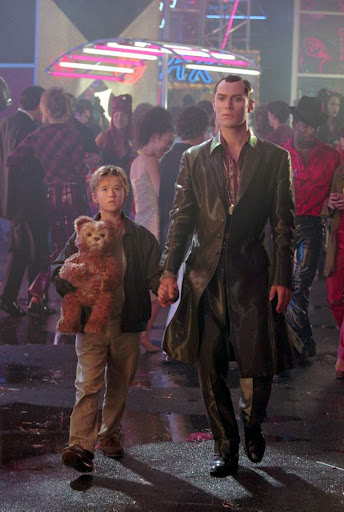
A.I.: Artifical Intelligence

Kubrick’s visionary ideas, social commentaries and moral dilemmas don’t quite gel with Spielberg’s family oriented sentimentality in this disjointed and overlong offering, conceived and planned by the former but implemented by the latter after his death in 1999.

Now, I love me some robots. Whether they’re compacting waste into trash skyscrapers, travelling through time to save Sarah Connor or trying to kill Will Smith, you show me a film with robots in and I’ll watch the Hell out of it (though I’ve never actually seen the 20th Century Fox film Robots starring Ewan McGregor and Robin Williams, just never came around). There’s a robot clock watching me from atop a bookcase in the lounge, robot cushions on the sofa and a robot cookie jar whose head seems to rotate around and look at me wherever I am. But the key characteristic that joins these all together, is that they all look like robots, which is where A.I. looses my interest, for here they look like people. Yes, I know that’s the point. Haley Joel Osment’s mini-mecha David has been created to fill the hole left when his new parent’s son goes into a coma, and Jude Law’s robo-gigolo Joe (that’s fun to say) would be downright weird if he didn’t look a lot like a human, but that’s not what I want to see in a film about mechanical men. It isn’t until over half way through the film that we see some older models and exposed innards, and even then it’s far too briefly.

Osment is good, too good, as the automated child, and occasionally he passes for human, but for the most part he’s in full-tilt terrifyingly creepy mode, following his ‘mother’ Monica (Frances O’Connor) around the house all day, standing and watching her until she justifiably locks him in a cupboard. The first 45 minutes could quite easily be the start of a horror film, so disturbing is David: “I can never go to sleep, but I can lay quietly and not make a peep.” Nothing he does is endearing or even likable, but then I’ve always felt this way about children, but still the brief amount of time it takes for Monica to bond with this mechanised horror is jarring, especially given there seems to be no real scenario that draws them together. Also, David is only programmed to ‘love’ one parent, and his new ‘father’ Henry (Sam Robards) seems devoid of emotions, either for his comatose son or the new replacement, so that fits together nicely.

The movie is comprised of a series of episodes that, once passed, are all but forgotten. The story could have been interesting, and the world has potential for a more enthralling film within it, especially in the city scenes, and the brutal Flesh Fairs, where rogue ‘bots are hunted and tortured to a baying crowd’s delight, but over an hour of watching David desperately wanting to be a real boy becomes terminally dull. The future technology and gadgetry is generally good, subtle yet insightful, although the cars look a bit silly. And the ending is polarising, I found it terrible and unsatisfying, whilst Aisha thought that, whilst it seemed tacked on and unnecessary, it was still very moving.


Choose life 5/10

Iron Man

Iron Man was the superhero movie we were all waiting for, we just didn’t know it; discovering the missing ingredient from all those that came before it – comedy. Though many that came before it weren’t overly serious, dark or gritty, they still took themselves too seriously, but Iron Man ensures a thick vein of comedy runs right the way through it. Released over 2 months before the masked behemoth and current comic book movie touchstone The Dark Knight, Iron Mancame out of nowhere with an untested star and middling director in Robert Downy Jr, and Jon Favreau. RDJ was still making his comeback after years of exile from Hollywood due to substance abuse, and Favreau’s most mainstream work was Christmas classic Elf, but he wasn’t exactly known for blockbusters, but after the movie’s release both found themselves sitting pretty on the A list.
Stark is such a great creation. By his own admission a “genius billionaire playboy philanthropist,” yet Downey Jr. somehow makes such a character not only likable, but one you’d willingly like to go for a drink with, and not just because he’d not only pick up the tab, but probably already owns the bar. He ably assisted by Gwyneth Paltrow and Terrence Howard as his dependable assistant and best friend, and Jeff Bridges is on fine menacing-brow villain mode as Obediah Stane, the business partner of Stark’s deceased father.
Iron Man has an advantage over other superhero stories in that Stark’s story is actually interesting. A twist of fate doesn’t have him bitten by a spider, he isn’t an alien from a distant planet and he isn’t avenging his parent’s death. No, Stark had all of his superpowers before the film even starts. Wealth, intelligence, a sharp with and an immaculate goatee are goals he’s worked towards and achieved; he just needed the push to fit them all together in the form of a titanium-gold alloy flying suit with a rocket launcher and flamethrower, and what greater motivation than a terrorist attack against him, using the very weapons his company created? This means that the villains are also people every can be against – terrorists and the evil corporation heads who supply them.
The best scenes involve the subtle yet inspired gadgetry around Stark’s house, from the Paul Bettany-voiced quasi-butler Jarvis, to the robotic arms that are a little over zealous with the fire extinguisher. The flawless suiting up sequences and Downey Jr. interacting with nothing but a mechanical three clawed appendage aren’t too showy, yet set the film above its rivals.
The only possibly problems are that Howard’s Officer Rhodes is bland, but then who wouldn’t be compared to Stark, and the Stane-is-a-villain story arc is clearly signposted from the get-go, having been given the perfect set-up as the man who took on Stark Industries when it’s CEO passed away, only to be muscled out by some upstart genius, that and his full head with a thick, lustrous beard mean at some point in the near future he’ll be laughing with maniacal glee and threatening the hero’s love interest. Now that the Avengers (sorry, Avengers Assemble) is in place, this film does seem like a bit of a precursor to it, especially the scenes involving Clark Gregg’s Agent Coulson, which don’t really add anything here other than some fanboy cheers every time someone says Strategic Homeland Intervention, Enforcement and Logistics Division, but the scenes don’t detract too much, and can be forgiven as they tie everything up nicely.
Otherwise, the film is pretty much perfect, and remains enjoyable after many viewings.
Choose film 8/10

Chicago

Last Monday I was not having a good day. I don’t remember having a particularly good day at work, and when I came home the LoveFilm disc of The Class (review coming soon) infected my PlayStation 3, my primary film-watching paraphernalia, with an incurable bout of Yellow Light of Death. Fortunately, after a quick 20-minutes of mucking around with SCART leads and speakers, the back-up DVD player was up and running, but alas The Class had no intentions of playing, and to be honest I was in no mood to read subtitles after that debacle, so instead we settled down for a much more easy to watch and far more enjoyable evening of Chicago.
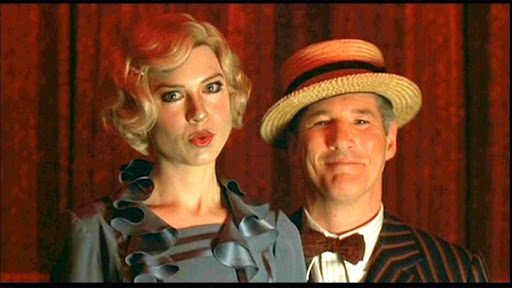
I’ve seen the story twice before, once on film and once on stage, and I think I preferred the small screen to the grand spectacle, though I think on second viewing it isn’t as good as I remembered. Renee Zellweger is as annoying as ever as the naive, waif-like Roxie Hart, incarcerated after killing the man she was sleeping around with (The Wire’s Dominic West). Whilst inside, she meets Catherine Zeta-Jones’ performer Velma Kelly, herself accused of murdering her sister and husband. The two compete for the favours of Matron Mama (Queen Latifah) and super smooth, silver-tongued lawyer Billy Flynn (Richard Gere).
Gere and Latifah seem to be the only ones enjoying themselves, and why Latifah was nominated for Best Supporting Actress I’ll never know, as her performance doesn’t compare to the award winning Zeta-Jones. There’s far too much of Zellweger simpering around the stage, and she seems to have forgotten to tell her face that she’s acting for much of her performance. Her singing is fine, but she is a thoroughly over-rated actress, who in this film is also far too skinny (but then so are all the girls in this film, Latifah aside). More of Gere’s incredibly entertaining Flynn would have gone a long way, as would more screen time for John C. Reilly as Roxie’s cuckolded husband Amos, who’s solo performance of Mr. Cellophane is my personal favourite, along with the wonderfully choreographed Cell Block Tango and Flynn’s marionette manipulation of a gaggle of reporters.
So, whilst it’s not perfect and a recasting of the lead would have been greatly appreciated (though to be honest, I’m not sure who I’d cast in her place) many of the musical numbers are still great fun. Six Oscars and thirteen nominations though? Seems a little excessive.
Choose film 7/10

Good Morning, Vietnam

Barry Levinson can’t work out whether he’s Oliver Stone or Jerry Zucker in this Vietnam-based Robin Williams vehicle. Heavy handed politics and imagery of riots, fire and explosions doesn’t tend to gel with zany antics and improv riffing from one of the world’s leading fast-talking funnymen, but fortunately Williams is on fine enough form to just about rescue the material from an uneven mess, as his radio DJ Adrian Cronauer is brought in to perk up the on-air talent of 1965 Saigon. The troops love him, but his superiors, including the late, great Bruno Kirby’s put upon aggressive peon Lt. Steve, are less keen on his refusal to play approved material and pre-programmed songs, opting for rock and roll over Perry Como. Some storylines seem forced and contrived – Cronauer repeatedly infiltrating an English class just to meet a girl, her entire family accompanying them on a date – and you get the feeling that this is only loosely based on a true story.
Where it shines though is the comedy. Though some of the references are now very dated and probably worked a lot better back in the States (Ethel Merman, Walter Cronkite, Mr. Ed), Williams knack for voices and repartee with a crowd is unparalleled, though a young Forest Whittaker as station lackey Edward Garlick gets his share of decent lines too: “A man does not refer to Pat Boone as a beautiful genius if things are alright.”
The film tries too hard to make a political statement where none is wanted, and the failed attempts at poignancy leave a bad taste in the mouth. Had the serious side been toned down – difficult, I know, given that it’s about war – and the directionless plot been reined in a little this could have been a classic.
Choose life 6/10