Far From Heaven

Hertford, Connecticut; 1957. Cathy Whitaker (Julianne Moore) is at the heart of her picket-fenced community, her husband Frank (Dennis Quaid) is a successful businessman and her two young children are little bundles of perfection, with her daughter wishing to one day grow up to be just like her mother, though her son is a little foul-mouthed (“Ah jeez” is not the kind of language Cathy tolerates).  But beneath the surface of floating dresses and pristine curls, all is not well. It’s clear from Cathy’s expression that, though her friends must all put up with their husbands’ occasional demands for intercourse, Cathy has no such problems, for Frank hides a secret; whenever he is ‘working late’ he tends to be frequenting a bar aimed only at male patrons that want to get to know each other a little better.
Todd Haynes’ movie lovingly recreates an idealised vision of 1950s suburban middle America (“Aw shucks” is uttered in the first four lines, and “jeepers” and “swell” aren’t too far behind) although the rampant sexism and racism would be more than frowned upon today. When Cathy shows sympathetic tendencies towards her black gardener Raymond (Dennis Haysbert, 24‘s President Palmer) she is the subject of mild ridicule and is frowned upon by the society that used to hold her dear. Haysbert is good in another of his solid, decent, all-round nice guy roles, but Dennis Quaid continues his run of being the worst thing about a film. I’m sure in his youth he must have done something to earn a reputation as an actor, but I can’t for the life of me think what it is, I’ve only ever known him as the worst thing in bad films (Flight of the Phoenix, Smart People, The Day After Tomorrow, Vantage Point).
The era is seamlessly recreated, to a point where the film could easily have been made in the 50’s – in which case it would probably be hailed today as a classic. Moore is the best thing in it, so much so that at times she barely seems to be acting, so great is the level of repression she must convey. She received an Oscar nomination for her troubles – Nicole Kidman must have been really great in the Hours to beat her.
Though at times it feels like nothing really happens, that is surely the point. This is more a study of the prejudices of the era – Frank’s grand social indiscretions can be brushed under the carpet or cured (a doctor has a 5-30% success rate for curing homosexual urges) whilst Cathy’s much lesser faux pas sees her outcast from all around her. The plot and script are a little hokey, but the performances and overall feel stay with you after watching this subtle piece.
Choose film 6/10

Unlisted: Iron Man 2

Yesterday I discussed the near flawlessness that is Iron Man, and whilst all these praises remain for the sequel, it suffered from having far greater levels of hype, anticipation and expectation. It seemed that all who had loved the first couldn’t wait for the second, everyone wanted more, and more was most certainly what they got, especially when it comes to an overabundance of supporting characters, superfluous plot strands and men in metal suits hitting each other. Where the original finale, with Stark and his business partner, Jeff Bridges Obediah Stane, knocking seven bells out of each other in their rocket-propelled armour, seemed fresh, new and exciting, in the sequel we get something similar not once, but three times, as well as two metal men fighting an army of remote-controlled drones and an early confrontation between Stark and new villain Ivan Vanko (Mickey Rourke) at the Monaco Grand Prix. Some of the action set pieces, like the aforementioned meeting, seem a little shoehorned in to put an action beat in place, but are still impressive, and the suiting-up sequences have also been greatly improved upon, especially the Suit-case.
All the supporting characters are back, but Don Cheadle has replaced Terrence Howard (Howard apparently wanted more money than Marvel thought he deserved, and seeing how little he brought to the table in the first film I’m inclined to agree with them) as Rhodes, and all the characters get an expanded upon arc, even director Jon Favreau’s background cameo as driver Hogan gets himself something to do. Gwyneth Paltrow’s Pepper Potts is the new Stark Industries CEO, Rhodes wants a suit to take back to the military, Scarlett Johansson is Tony’s new assistant/undercover S.H.I.E.L.D. agent (a welcome addition to the cast, if only for aesthetic reasons), Tony is in talks with Samuel L. Jackson’s one-eyed Nick Fury about his role in the Avengers, weapons rival Justin Hammer (Sam Rockwell) is desperate to better Stark and bird-obsessed Vanko aims to settle the score regarding his father working with Stark’s dear old Dad (Mad Men’s John Slattery). See, that’s a really long sentence. Far too much to take in. The first film was streamlined, with not much chaff around the wheat, but here there’s just too many strands. I didn’t even mention that the arc reactor keeping Stark alive is also killing him, a completely unnecessary plot point that adds nothing and is resolved by the end, so doesn’t affect the series, but takes up about 20 minutes of screen time. Even with so much going on, the film is 5 minutes shorter than the first, but feels half an hour longer, as boredom sets in from watching metal men punch each other repeatedly.
Even more so than in Iron Man, this feels like a prequel to the Avengers, especially with Johansson’s Black Widow, bigger roles for Nick Fury and Agent Coulson and references to Captain America and Thor. That, and the film’s finale feeling disappointing after a protracted build up leaves this film with all the entertaining pats of the first, but an unfulfilling sequel that doesn’t take them anywhere. Favreau has since dropped out of part three, but Kiss Kiss Bang Bang director Shane Black has stepped up instead. He’s worked with Downey Jr. on one of his best roles to date, so here’s hoping.
Choose life 6/10

Good Morning, Vietnam

Barry Levinson can’t work out whether he’s Oliver Stone or Jerry Zucker in this Vietnam-based Robin Williams vehicle. Heavy handed politics and imagery of riots, fire and explosions doesn’t tend to gel with zany antics and improv riffing from one of the world’s leading fast-talking funnymen, but fortunately Williams is on fine enough form to just about rescue the material from an uneven mess, as his radio DJ Adrian Cronauer is brought in to perk up the on-air talent of 1965 Saigon. The troops love him, but his superiors, including the late, great Bruno Kirby’s put upon aggressive peon Lt. Steve, are less keen on his refusal to play approved material and pre-programmed songs, opting for rock and roll over Perry Como. Some storylines seem forced and contrived – Cronauer repeatedly infiltrating an English class just to meet a girl, her entire family accompanying them on a date – and you get the feeling that this is only loosely based on a true story.
Where it shines though is the comedy. Though some of the references are now very dated and probably worked a lot better back in the States (Ethel Merman, Walter Cronkite, Mr. Ed), Williams knack for voices and repartee with a crowd is unparalleled, though a young Forest Whittaker as station lackey Edward Garlick gets his share of decent lines too: “A man does not refer to Pat Boone as a beautiful genius if things are alright.”
The film tries too hard to make a political statement where none is wanted, and the failed attempts at poignancy leave a bad taste in the mouth. Had the serious side been toned down – difficult, I know, given that it’s about war – and the directionless plot been reined in a little this could have been a classic.
Choose life 6/10

Collateral

Michael Mann takes a break from shootouts and dogged cops hunting master criminals in favour of a more laidback, narrative-driven movie about Jamie Foxx’s ambitious yet stunted taxi driver Max carries his fares around the neon-lit streets of L.A. That is, until he picks up Tom Cruise’s hitman Vincent, and Max’s night, and his dreams, are thrown into turmoil as the body count rises.
Cruise seems like an odd choice to play a fairly villainous guys, but he proves spot-on, retaining his usual casual charm but with a steely glint and wolfish menace to go with his salt and pepper hair, leaving Foxx to submit lie in his shadow.
The script relies too much on luck and coincidence, and leaves some pretty gaping plot holes you could drive a cab through, plus those paying attention should see that there’s really only one way the film can end, with a last act twist clearly signposted in seemingly throwaway lines. The writer even resorts to a low cell phone signal and battery as a means of moving the plot along; generally the laziest idea anyone could use.
The film evokes memories of much better films – Leon’s hitman, Taxi Driver, The French Connection’s subway stand-off, every buddy movie ever made – reminding you that there’s little original here. So whilst it’s watchable, it’s by no means worthy of a place on the list, and was wisely cut from the 1001 book some years ago.
Choose life 5/10

Synecdoche, New York

Charlie Kaufman has often been described as a breath of fresh air in Hollywood. The legend goes that there are twelve different stories in every film in Hollywood, and with his debut script Being John Malkovich, Kaufman wrote the thirteenth, and there’re so many ideas in Adaptation and Eternal Sunshine of the Spotless Mind that they probably count for numbers fourteen through twenty, and fortunately they’re all on the List. So after working on so many inspiring and imaginative modern classics, Kaufman’s directorial debut is a disappointingly convoluted tangle, as Philip Seymour Hoffman’s theatre director Caden Cotard struggles to create a play based on his own life, whilst struggling with a myriad of relationships and a mystery illness.

Whilst the entirety of the plot – also written by Kaufman – is positively brimming with ideas and ingenuity, from Caden seeing himself in cartoons and commercials, to a character living in a perpetually burning house, the lack of clarity between how much takes place in the real world, how much is in the obsessive director’s head and how much is part of the play is at best frustrating and at times infuriating. It doesn’t help that many of the actors look alike, possibly on purpose, with Michelle Williams, Samantha Morton and Emily Watson all used to play the same character in different levels of life, with the play being featured in the play, requiring Caden to cast himself, casting himself in the play of his own life. Time skips in the blink of an eye for us and for him – his four year old daughter with Catherine Keener’s bohemian artist ages seven years in a matter of days.

You get the feeling that the end result of the film is exactly what Kaufman set out to achieve, with every layer of obsession and confusion being carefully planned and perfectly executed, but when I tried to make some sense of it all, my brain started to run out of my ear.

Choose Life
6/10

Unlisted: Chocolat

That’s right, some weeks I don’t go to the cinema or watch a new DVD release, I’ve got a fairly large and ever-increasing stack of non-List DVDs I either haven’t seen before or haven’t really watched properly (I have films on in the background a lot, especially when I was at university) and this regular feature gives me some motivation to get through them.
Just in time for Easter, and after a messy, sticky but god damn delicious bout of chocolate egg making, we sat down to watch Chocolat, a film that’s been on my radar ever since it was discussed with much vigour in the disappointing Paul Rudd vehicle I Love You, Man, as his character’s favourite film. Just like when I rushed out to watch Point Break on Danny Butterman’s recommendation (I’ve been known to enjoy Bad Boys 2) I was more than a little disappointed, as I went in with higher hopes than I probably should.
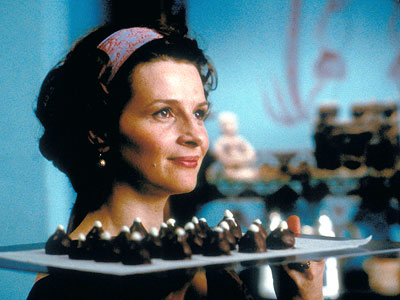
Chocolat sees Juliette Binoche’s master chocolatier opening up a cocoa boutique in a sleepy little French village, just at the start of lent. The villagers initially shun her temptations, before gradually growing to accept them and their delicious ways, assisted by her worldly knowledge, kind soul and the fact that some of her products act as an extreme aphrodisiac, an aspect that was severely underused, and could have led to a much more light hearted and entertaining piece, as at one point it seemed to be heading towards.
Overall, the tone was far too unbalanced; whimsical at times and overly serious at others, and the myriad of diversions – Alfred Molina’s stern mayor attempting to My Fair Lady Peter Stormare’s abusive barman, Binoche’s unfulfilling fling with sailing drifter Johnny Depp – leave the palate tempted but wanting for more depth. The outer shell is sweet and smooth, but alas where a rich praline centre should be there is nought but a hollow cavity. Everything looks delicious though, and I picked up a few tips for my own chocolate making.
Choose life 5/10

Volver

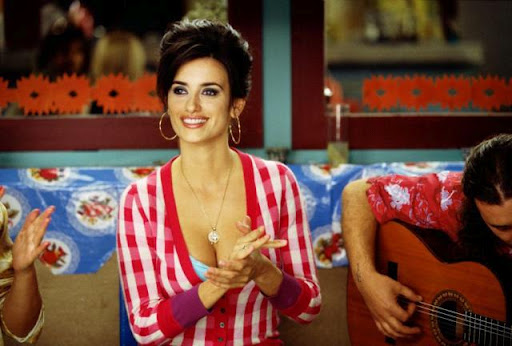
Following Pedro Almodovar’s usual routine of showing women discovering unknown strengths when put under extreme situations, Volver sees two sisters, Lola Duenas and Penelope Cruz, finding new leases on life after a number of unexpected deaths to people close to them.
The film is witty and intelligent, focusing largely on conversations rather than action, and showing that good things can happen if you believe and out your mind to them, and that tragedy can lead to becoming closer to others and a better person in yourself, but my main problem with the film – other than unsuccessfully attempting to make Cruz look frumpy with a prosthetic posterior rumoured to be the same one Dustin Hoffman wore in Tootsie– is that there are certain supernatural elements that take you out of the film completely, as the rest seems so grounded in a reality that is only a little exaggerated, and even then only in the amount of cheeks kissed on a daily basis.
Choose film 6/10

Babel

The first film to arrive from LoveFilm from the recent additions, Babel has seen my List update shoot me in the foot, as Babel is quite a long film that I’ve seen twice before, once just before starting the List, and that to be in honest doesn’t live up to its potential.
We follow the lives of four groups of people, as their existences are disrupted by a single bullet. First, there’s the poverty-stricken goat herder and his two young, competitive sons who purchase a rifle to protect their flock from jackals. We also have a wealthy American couple (Brad Pitt and Cate Blanchett, both excellent if trying a little too hard in largely thankless roles) as they bicker their way through a holiday in Morocco. An Hispanic maid is forced to take the two young children she cares for with her and her nephew (Gael Garcia Bernal) to Mexico for her son’s wedding, and the deaf/mute daughter of a successful Japanese businessman struggles to lose her virginity. The multicultural cast is good, especially Rinko Kikuchi as the Japanese girl, who carries most of her story arc single-handed, but there are several scenes that are very difficult to watch – the younger of the goat-herder’s sons masturbating within earshot of his brother, a disillusioned young boy witnesses the chicken he is about to eat slaughtered in front of him and a troubled teen coming on very strongly to her dentist.
The film is entirely humourless, with barely a smile to be seen either onscreen or off, and it lacks the finesse of director Alejandro González Iñárritu’s Amores Perros. That, and the entire thing is thoroughly depressing, with only some interesting scenes – a nightclub seen from a deaf perspective – to pique the interest.
Choose life 6/10

Alice

Lewis Carroll’s Alice in Wonderland is already pretty mental, so when I read that this version by Czechoslovakian director Jan Svankmajer was “memorably bizarre,” I strapped myself in for a rollercoaster of ridiculousness, and I was not left wanting.
A terrifying stuffed rabbit – animated via stop motion – bites through its restraints with eyes bulging like a cartoon, dons gloves, coat and a hat, checks its pocket watch and escaped through the drawer of a writing desk that is only a little bit like a raven. Oh, and the rabbit has ripped a gash in its chest that continually leaks sawdust like an open wound. The young Alice (Kristyna Kohoutova) follows the rabbit along a carpet of set squares and rulers and down an elevator past jars of drawing pins in chutney and various animal skulls with eyeballs.
I won’t ruin all the insanity, though there is plenty here to suffice, but rest assured some of the regular Alice beats are present – the shrinking potion and growing cake, the caterpillar, the Mad Hatter’s tea party and the King and Queen of Heart’s, but the question begs to be asked that, if everything in between the main points has been dramatically changed, why not just make a different story altogether? Plus, it takes far too long for Alice to get to Wonderland (if that’s what they’re still calling it). Imagine if Frodo didn’t leave the Shire until near the end of the Two Towers, or Harry didn’t get to Hogwarts until two hours into the Philosopher’s Stone, yet the books remained the same.
If I’d seen this as a child, chances are I’d still wake up screaming. From the burrowing inflatable sock-worms, the carnivorous animal skeletons reminiscent of Toy Story’s franken-toys, baguettes sprouting nails, living steaks, Alice crying enough to flood a room and a swimming rat hammering a campfire into Alice’s head, this is nightmarish to the highest degree. Also, who the hell is in charge of screwing on the doorknobs in this world, because they’re doing a terrible job.
Choose life 5/10

Mad Max

Essentially a glorified B-Movie, Mad Max saw Mel Gibson break out as live wire hero cop Max Rockatansky in a not too distant semi-dystopian Australian future. Other than Gibson, and sometimes including him, the acting and scenes are straight out of a direct-to-DVD movie – see Max sitting bolt upright in bed, a red light illuminating his haunted eyes, or his looking under a sheet at the hospital, so I wonder whether this is memorable more for the creation of the character, a Dirty Harry inspired ‘bronze’ who’ll nab his victims by whatever means, and for the supposedly superior sequel (watch this space).

My main issue is that the character of Max is initially built up as being a kind of supercop brought in when no-one else will do, almost robotic in terms of getting the job done, and for the first scene, in which Max steps in to take out a cop killer and his girl when the rest of the force is lying in a heap of wrecked cars, this seems to fit, but for the next hour we see a completely different character, a family man in need of a break from his high stress job. It’s almost as though Gibson is playing twins. Annoyingly, it’s these more sentimental moments, making up the majority of the film, that prevent MM from being the guy’s night in classic it could well have become, for the scenes of brutality, chases and revenge have real potential.
Another problem is that the film has no real message. The gang of the man Max killed at the start end up tracking Max and his family, yet not because he killed their cohort, simply because they run into each other. It could so very easily have been a vengeance plot, but for reasons unbeknownst to all, this was omitted in favour of fate and coincidence.
Choose life 6/10