Election

Apologies, I watched this over a week ago, but haven’t had a chance to write anything until now, sorry. I’ve got a soft spot for Election that is also one of the reasons I don’t necessarily get on well with the film. Growing up, I was always a Tracy Flick kind of student. If there was ever a hand up in class, chances are it would be mine, I took my schoolwork very seriously and wasn’t necessarily the most popular person at school (shock horror),  although I can’t say I distinctly remember sleeping with any members of staff, but I’ve blocked out a lot of my formative years so who knows what happened. So although I empathise with Flick, pitch-perfectly played by the Golden Globe nominated Reese Witherspoon, I feel sorrier for Matthew Broderick’s ethics teacher Jim McAllister, and even more so for my own previous teachers, who had to endure a real life version of Flick’s character.
Continue reading

Unbreakable

Unbreakable is essentially an anti-superhero movie, taking many of the genres staples and applying them to a real-life thriller, years before Christopher Nolan rebooted the Batman franchise with his realistic and plausible worldview. The hero, David Dunn (Bruce Willis) has alliterative initials (Bruce Banner/Peter Parker/Clark Kent), wears a hooded cloak and has a penchant for posing in the rain with a bright light behind him, illuminating a stark silhouette on the screen, yet unlike most comic book heroes, when he tries to chat up a girl (after slyly removing his wedding ring) the attempt fails. That never happened to Tony Stark.  The film is even shot like a comic book, with the aforementioned chat up routine swaying from person to person between seats on a train, and many scenes utilising one bright colour, such a bright orange boiler suit, contrasting against the surrounding dreary muted blacks, browns and greys.
Continue reading

The Great Train Robbery (1903!)

I had a productive lunch break at work today, managed to find The Great Train Robbery on Google Video. Although it was silent, juddery and of poor production quality, I was very impressed with what was capable of being produced 108 years ago, as the film involved explosives, gun fights, stunts on a moving train, a large crowd scene, horseriding, and a gun fight on horseback, all in the space of 12 minutes. That’s more action than a modern day Mike Leigh film. Some of the acting, especially when people were shot, was unintentionally hilarious, with their over-the-top melodramatic deaths. I was also unsure of the final shot, of a man looking into the camera and firing his gun several times. I thought it might have been a scare tactic, trying to emulate the supposed reaction to the first film ever shown in a cinema, Arrival of Train at Station, when apparently the audience were so concerned that the footage of a train arriving at a station was in fact a real train coming towards them that they fled the cinema in terror.
Choose film 7/10

Ocean’s Eleven

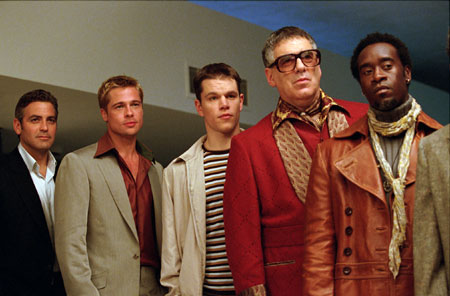
Sneaking its way onto the list at number 500 of Empire’s top 500 films is the 2001 remake of Ocean’s Eleven, one of the few remakes on the list to surpass its original. This film relies on the complexity of the genius heist plot and the easy camaraderie and star wattage of its leads to create an enjoyable and cerebral popcorn flick. But as usual it’s the small moments of humour that meant the most to me, especially how the story and characters play with the real-life personas of the actors playing them. For example, at the beginning of the film Brad Pitt’s Rusty Ryan and George Clooney’s Danny Ocean are teaching ‘movie stars’ how to play poker. The so-called stars they are schooling include small screen heartthrobs Topher Grace (That 70s Show,) Joshua Jackson (Dawson’s Creek) and Holly Marie Combs (Charmed), each playing themselves, and here dubbed as major movie stars, being photographed by the paparazzi whilst Pitt and Clooney, at the time two of the most famous faces in the world, are ignored by everyone. Another parallel is Pitt and Clooney’s teaching of Matt Damon’s rookie conman Linus Caldwell, in a sense showing Pitt and Clooney teaching Damon how to become a star as renowned as them, with Damon continuing his meteoric rise to fame with the Ocean’s Eleven, arguably reaching the same level as Pitt and Clooney. Finally, Pitt’s performance as a fake doctor parodies Clooney’s stint on ER, especially his flamboyant overacting.

Choose film 9/10

The Killing Fields

OK, I’m going to try and post a little more frequently now, instead of allowing a stock pile of watched films to be reviewed en masse at the weekends. I’m thinking maybe if I watch a film, I post about it the same day. Sound good? Awesome. I’ve checked my stats, and I’m a few films behind where I should be (I just made a graph, how I love Excel!), so I need to step this up a little. Also, I’ve had a check on LoveFilm, for when I eventually join, and there’s quite a few films I’m going to have difficulty getting hold of as they’re not available for rental, but we’ll cross that bridge another day.
I’ve just watched The Killing Fields, a film in two halves that deals with Sydney, a reporter for the New York Times (Sam Waterston) stationed in Cambodia, and his interpreter/assistant/friend Dith Pran (Dr. Haing S. Ngor). During the troubles in Cambodia, Sydney and his fellow reporters (including John Malkovich) are taken capture by the Cambodians. If not for Pran, they would surely have been killed, so when the reporters are evacuated and Pran is unable to leave, Sydney does all he can to help his friend escape.

Paths of Glory

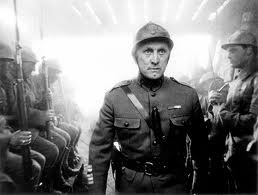
Paths of Glory emphasises the differences between the high ranking officers and the lowly privates during the first world war, as after a failed advance, the general in charge demands three soldiers to be made an example of, via a firing squad. The general assumes cowardice on behalf of the men, yet each of the men chosen has a valid reason for retreat, be it finding themselves alone against an insurmountable challenge, being ordered not to by their superior or being knocked unconscious during the advance.
The film is part war, part courtroom drama, as Kirk Douglas attempts to defend the three against their charges. There were some good shots, such as the tracking shots through the trenches, that I feel would have benefited from being single continuous takes, although perhaps budgetary conditions and the technology available at the time limited this. The final scene, as Douglas stands outside watching the troops leer at a female German singer, makes us think who is worse, the generals more than happy to fire upon their own men to make them attack, or the soldiers themselves, reduced to their base urges in the face of death.
Choose film 7/10

Pirates of the Caribbean: the Curse of the Black Pearl

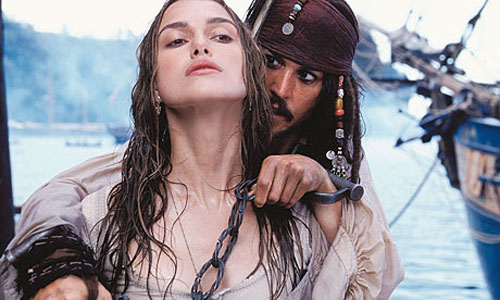
The original Pirates of the Caribbean film, the greatest ever made best on a theme park ride, is tremendous family-friendly fun, especially in its first half. It loses its way towards the end of the second reel, as the plot becomes inundated with various bluffs and double crosses, although in a film about pirates this is only to be expected. The CGI is excellent and well used, as is the comic relief, mainly provided by Lee Arenberg and Mackenzie Crook, surely the closest any human being can get to being a scarecrow without an awful lot of hay. Geoffrey Rush could well have been cast as villain Barbossa on the strength of his piratical laugh alone, and for that deserves at least a mention.Choose film 7/10

L’Avventura

L’Avventura reminded me a lot of Hitchcock’s Psycho, released the same year, in that the first segment set’s the plot up to follow the female lead, only to have her disappear from the screen, never to be seen again before the halfway mark. In this instance, the plot concerns a young woman who, whilst holidaying on an island with her friends, goes missing, causing her best friend and her lover to search for her. When compared to more modern day missing-person films, such as Ben Affleck’s excellent Gone Baby Gone, the plot tends to meander a bit, with the supporting characters not seeming to care about the fate of the missing girl.
I was also reminded slightly of Polanski’s the Tenant, in which a man moves into a new apartment, only to slowly turn into the apartment’s previous occupant, as the missing girl’s best friend seems to inhabit the life of her missing mate, becoming closer with her former lover during the search. It almost seems like this was the plan of the missing girl, setting up the transformation by giving the friend some of her clothes before she goes missing. This all seems an improvement for the friend, and indeed for the life she inhabits, as she seems much happier within it than her predecessor. This is most clearly seen by comparing the almost identical shots of the original girl kissing her lover, and how little emotion she shows during this, contrasting with her friend kissing him much more passionately later in the film. There are other parallels between the two ends of the film, such as the friend being initially concerned at the girl’s disappearance, only to end up more concerned that she has returned to claim her life back.Choose film 7/10

Out of Sight

Last night I watched Out of Sight. I’d seen it before, but never really paid an awful lot of attention to it, but this time I made an effort to follow the plot. I think the film is a little over-rated, with editing style taking precedence over actual substance. In places, it seems to want to be a modernised version of classic cinema, with freezeframes, snappy dialogue and a plot that sees George Clooney’s prison escapee and Jennifer Lopez’s federal marshal thrown together and falling for one another, but it is this plot device that in my opinion lets the film down. I’ve always hated the tacking on of an arbitrary romance subplot almost ruining what would otherwise be an incredible picture (see also the Nightmare Before Christmas, Pulp Fiction, Star Wars), and this is definitely the case with Out of Sight. If the film had focussed on Clooney’s Jack Foley, his escape from prison and the heists before and after, I feel it would have been a far superior picture. By all means keep J-Lo’s character, (but for the love of cinema, recast) but drop the frankly ridiculous romance between the two. The best part of the film was the cast, with Don Cheadle eating up the screen as hoodlum Snoop, whilst Ving Rhames supports well as Buddy, Foley’s redemption-craving partner in crime. And the last minute cameo is one of the greatest I’ve ever seen.

Choose film 7/10

All Quiet on the Western Front

Right, it’s done, the list is complete. It can be found on the Challenge page of this truly marvellous blog. The final count stands at 1,327 films, somewhat less than I was anticipating, but still a decent number to watch in 5 years (0.73 a day, stats fans), considering I’ve got to track most of them down, and a large number won’t be watched by my girlfriend (rules: no subtitles, no gore, minimal swearing, no snakes), severely limiting the days I’ll be able to watch them.

And so, the journey continues, with my watching tonight of the original 1930 version of All Quiet on the Western Front. I recently watched the 1979 TV movie version, and found it entertaining, especially Ian Holm’s moustache, but feel that the original is far superior, not least because all the actors in the remake seem to bring nothing to their roles, copying their predecessors exactly, especially Donald Pleasance as the teacher who inspires his students to enlist. The film is notable for being an American-made film depicting the Germans during World War I, and depicting them sympathetically, as real people with feelings and fears, not just faceless stormtroopers who must be defeated.

Choose film 7/10