Continue reading
Lebanon
Continue reading
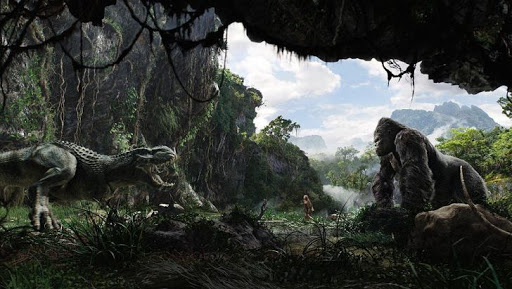
A lot of people dislike Peter Jackson’s remake of 1933’s King Kong, made simply because the original is one of Jackson’s own favourite films, but once you get past the overlong New York-set character establishing and the woeful miscasting of Jack Black as movie producer Carl Denham, what’s left is an entertaining and well realised modern retelling of a well known story with a renowned ending known to all, whether they’ve seen the films or not. Aside from Black, it is this sense of inevitability that lets the film down. We all know going in that at some point a giant gorilla is going to capture, then fall for aspiring actress Ann Darrow (Naomi Watts, doing the best she can as essentially a scream on legs), before being captured himself, shipped to New York and thrown on stage as the latest attraction, ultimately forcing him to escape and take a fateful climb atop the Empire State Building, ultimately being killed not by machine gun-toting bi-planes, but by the bright, bloody blade of beauty. I’m not suggesting for a moment that the ending should have been changed, maybe with Kong swimming back to Skull Island with Ann perched on his head, or perhaps the NY locals gradually accepting Kong for who he is, eventually electing him mayor, paving the way for a comedy-heavy sequel, seeing Ann escorting Kong to various prestigious events, climaxing in an unveiling at the Smithsonian, where confronting a T-Rex skeleton brings back too many memories for the now refined ape, causing him to rip off his custom made tuxedo (with comically oversized and troublesome bowtie), break the skeletons jaw and finally settle down in an overgrown corner of Central Park, or in an enclosure at San Diego Zoo. No, the story was rightfully left intact, if a little extended in places, and mercifully the 1930s setting was also maintained, moving it all to the modern day could have ruined this movie.
As for Black, I’m not sure who could have replaced him as the egotistical, deceitful, driven moviemaker, but I think an older actor could have lent a little gravitas to the role, and since watching Midnight Run I’ve wanted to recast everyone with Charles Grodin, so I’m going to go with him.
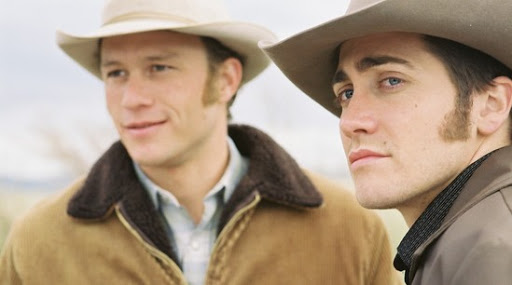
Another one I’d never seen before, Brokeback Mountain has a reputation to live up to, but of what I didn’t really know. Yes, I was aware it was about two cowboys, Heath Ledger and Jake Gyllenhall, and that between these two, something happened in a tent, involving at least one of their man-parts and the other’s posterior, but as to how this would support a feature length picture I did not know. Wisely, director Ang Lee gets past the, ahem, climax early on, spending a greater deal of time depicting the aftermath of the relationship Ledger’s ranch hand Ennis Del Mar and Gyllenhall’s rodeo cowboy Jack Twist form on the time they spend herding goats together. Ledger easily surpasses Gyllenhall on the acting front, mumbling his way through the difficulties that come with having an affair, and Michelle Williams also impresses as his put-upon spouse, realising the truth about her husband yet living in acceptance and despair. The slow pace of the film allowed for some great character interactions too, and I approved of the film only featuring important sections from the central relationship and nothing else, with what some would describe as pivotal events – Twist’s marriage to rodeo girl Anne Hathaway or the birth of Del Mar’s two children – being skipped entirely, as to the main couple these were of secondary importance to the connection the two had with each other.
Choose film 7/10
A fairly standard prophetic drama is elevated above an otherwise also-ran status by an interesting concept (no-one has given birth in 18 years) and an outstanding cast (Clive Owen, Julianne Moore, Michael Caine, Chiwetel Eijofor, Pam Ferris, Danny Huston), as well as Oscar nominated cinematography, an award criminally awarded to Pan’s Labyrinth instead. It is this camerawork, most noticeable in several uncut extended tracking shots involving moving vehicles, gun shots and wounds, crashes, crowd scenes and explosions, that justify its inclusion upon this list, and makes Children of Men a must see, if just for the sheer level of technical accomplishment on display.
Within the Indiana Jones saga, each of the films has a specific role. Raiders is the leader, the well rounded, talented, good looking jock that everyone likes, admires and wants to be friends with. Crusade is the jokester, a tad immature, but loyal and loveable nonetheless. Skull is the one no-one wants to admit is in the gang, the sci-fi nerd with the stupid theories that tags along despite being the butt of all the jokes. And Temple takes life a bit more seriously, is a bit more intense, or so I’ve always remembered. When I’ve thought of it, I tend to remember the dark, mythological plot, involving sacred stones, voodoo, mass child kidnapping and slavery, yet upon rewatching I picked up on the lighter notes, the offsetting of this darkness with two of the series’ more comic (and irritating) supporting characters, various light-hearted moments (generally involving elephants) and a physics/logic defying rollercoaster minecart ride.
Continue reading
I needed a short film today as I was a little pushed for time, so the 74-minute Blair Witch Project was perfect, until I realised I was watching a horror film alone in an empty flat immediately before going to bed, not always a wise decision. You’ll be able to tell when I’m really busy when I post about watching La Voyage Dans la Lune (14 mins) or the Cat Concerto (8 mins).
Continue reading
With the consistently excellent Matthew Vaughn (Kick-Ass) releasing his upcoming X-Men First Class soon, a film about which I am very excited, and not just because it features January Jones and very little clothing, I thought it was apt to cross off X-Men 2. Although there were some excellent scenes, most notably the entrance of fan-favourite Nightcrawler (Alan Cumming) attempting to kill the President, the attack on the Mutant Academy and the fight between Wolverine and Lady Deathstrike, there were some plot holes I just couldn’t get past at the end of the film (spoilers). Firstly, when Magneto (Sir Ian McKellen) breaks into Cerebro, where a brainwashed Professor X (Sir Patrick Stewart) is being used to locate and kill all mutants worldwide, we are shown the mutants writhing in pain for the 30 seconds or so they are being attacked, so when the machine is altered, to affect non-mutants instead, we can only assume that they (we?) are put under a similar level of duress. So we’re talking about everyone driving a car, every pilot flying a plane, every surgeon performing an operation, all these people would be unable to function for a few minutes, causing carnage worldwide, and probably a massive number of fatalities. Secondly, why did Phoenix (Famke Jannsen) die? Yes, she got off the plane to lift it into the air (I’m assuming there are some logistical difficulties with lifting something you yourself are inside), yet there is a period of time between the plane being up in the air and the flood of water, that she is holding back, from engulfing her. She knew there was a teleporter on the plane, as we are told she is preventing Nightcrawler from helping her, but why not let him bamf out and grab her after she’s lifted the plane? It is a completely needless death, present only so when Charles meets the president at the end of the film, he can say there were losses on both sides, even though we are shown she didn’t really die.
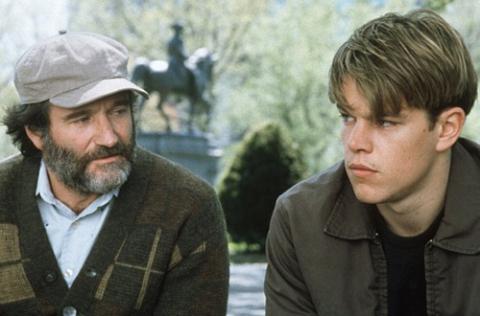
Is anyone else waiting for the second Oscar-winning screenplay from Matt Damon and Ben Affleck? I know they’ve been busy (until recently, Damon more so than Affleck), and that they essentially wrote the script because they weren’t getting the roles they wanted, but the guys obviously have talent, and I hope they start tapping away again soon. Affleck could even direct this time, as he’s shown great promise with Gone Baby Gone and, apparently, The Town (I’ve not seen it yet but am looking forward to, I’ll keep you posted).
Continue reading