Strangers on a Train

You know how the weirdo on the train always ends up sat next to you? The smelly guy, the raging drunk or the raving lunatic? Well any of these would be preferable to Bruno Antony (Robert Walker), a wealthy but evidently psychotic passenger sat across the aisle from Guy Haines (Farley Granger), a promising semi-professional tennis player with political aspirations. You see, Bruno has a plan for the perfect murder, or rather, murders, and wouldn’t you know it but he not only has someone in his life whom he’d like disposed of (his overbearing father, Jonathan Hale), but he also knows Guy is in a similar position with his separated wife, Miriam (Kasey Rogers). Bruno’s plan is for the two of them to swap murders, as that way there’d be no clear motive for their crimes, and whilst Guy forgets all about this after departing the train, Bruno evidently means to carry out his plot, and its not long before Miriam has been slain, and Bruno is hounding Guy to take care of his side of the deal.

Continue reading

Lincoln

Four Years into the American Civil War, Abraham Lincoln (Daniel Day-Lewis), the 16th King of the United States of America, has his eyes set on not just ending the conflict, but abolishing slavery – over which the war is being predominantly fought – in the process. In order to do this he must pass the 13th amendment to the United States House of Parliament, which would outlaw involuntary servitude, but there’s two problems. One, he’s twenty votes short, and two, he needs to pass it before the war ends, or else it may never happen. And on top of this he’s got some familial woes too – a nutty wife and bull-headed son who wants to go off and fight for his beliefs.

Continue reading

Safe

Carol (Julianne Moore) is a bored housewife, sorry, homemaker, in the San Fernando Valley. Her husband Greg (Xander Berkeley) is a successful businessman, and the pair live in a lavish home with Greg’s son Rory (Chauncey Leopardi). Carol has many friends and an active social life, attending various parties and gym classes. There’s nothing wrong in Carol’s life, other than her new sofa being delivered in black rather than teal, yet she suddenly finds herself becoming ill, which she soon believes to be caused by the “chemicals” found in modern life. But is she suffering from a real sickness, or is it all in her head? Maybe moving to the secluded, desert-based Wrenwood Centre, a “chemical-free facility”, will result in a cure.

Continue reading

The Wicker Man

Devout Christian police officer Sergeant Howie (Edward Woodward) receives an anonymous letter telling him that a young girl, 12 year old Rowan Morrison, went missing a year ago and hasn’t been seen since. Armed only with the letter, a photo and his unbreakable religious beliefs, Howie sets out to the secluded island of Summerisle, where he is met by hostility from the locals, who do not approve of a mainlander on their soil, and all deny any knowledge of Rowan’s existence. As Howie investigates further, he is met by obstructions at every turn, and discovers the islands inhabitant’s rituals and ideology may have a more sinister cause for Rowan’s disappearance than the policeman could ever have imagined.

First things first, I’ve not seen the 2006 Nicolas Cage remake, so I can’t really discuss that film here, which is fine, because this post isn’t about that film, it’s about the 1973 original. I have seen a few of Cage’s clips online, and I was glad to see that at no point did Edward Woodward (who, by the way, has the greatest name ever, I can’t stop saying it) explode into a torrent of “How’d it get burned?!?”, have a cage of bees strapped to his head, or perform a running punch whilst dressed as a bear. I had, however, seen this version before, but I now realise it was a heavily edited-for-TV cut, as although I watched it some years ago, I cannot remember nearly as much of the frankly disturbing goings-on that occurred in this film.

Even though it is essentially about a cult, and it’s seen through the eyes of an outsider, there is a lot of this film that’s difficult to fully come to terms with, particularly the downright infuriating manner in which the children of the island are taught. For example, with their forthcoming May Day celebrations, the lessons focus on the maypole, and how it symbolises the penis. Strips of flesh are hung by gravestones, one of which reads ‘Protected by the Ejaculation of Serpents’. Oh, and graveyards are apparently appropriate places to breastfeed children. The children are also encouraged to sing, which I’ve got no problem with, unless the lyrics contain such gems as “On that bed, there was a girl. And on that girl, there was a man. And from that man, there was a seed. And from that seed, there was a boy.” Bear in mind these children are all pre-teen, maybe even by a fair few years in some cases. 

Oh yes, the singing. I’ve decided that if I ever revisit my Top 5 Films That Should Be Musicals, this film is a prime candidate for the sub-list of ones that already pretty much are ones. There are far more songs here than I had expected, and their diversity was something of a surprise. You’ve got a group of naked women prancing around a stone circle singing about pregnancy, and elsewhere there’s an impressively impromptu pub-wide rendition of The Landlord’s Daughter, which must have taken rather a lot of choreographing, seeing as no-one steps on anyone else’s lines. Britt Ekland, who plays Willow, the aforementioned innkeeper’s spawn, even gets her own solo (though I think she was dubbed by someone). Her song, creatively named Willow’s Song on the soundtrack, plays out like a pornographic music video, as Ekland, naked of course, sings directly to the camera as she gyrates ferociously around her room, slapping herself and beating on the wall in an effort to entice the neighbouring Howie to come and attend to her. Understandably, this is one of the more memorable of the film’s scenes, but the breaking of the fourth wall was distracting, and it felt like it went on for far too long.

I very much approved of how we as the audience are kept as much in the dark as Howie is as he goes about his quest, only realising something’s up when he does, at which point of course it’s too late. Woodward also does a good job with Howie’s character, establishing a hero who is something of a dick, and definitely not a people person. I don’t want to get into a debate about religion (in short, it’s not for me), but I’m glad that I’ve never met someone who is quite so steadfast in their beliefs as Howie, who is utterly appalled when he discovers the island education system doesn’t contain anything to do with the teachings of Jesus, as the only religion he even acknowledges the existence of is Christianity, proving he is possibly just as obsessed or bigotted as the islanders themselves.


Even with so many distubing aspects – the thought of the beetle slowly crawling around the desk until it strangles itself still upsets me a little – I can’t help but appreciate this film as being a thoroughly engaging mystery, with an enrapturing plot that, even though I had an inkling of a memory as to what the ending was, I couldn’t wait to see pan out to find out exactly what was going on. Also, Christopher Lee is generally brilliant in anything, here appearing as the charming Lord Summerisle. I’d have appreciated a little less music and a lot less insanity, but I’m still very pleased to have seen it again. Oh, and I’m fairly sure the Salmon of Knowledge was from a lost Monty Python sketch.

Choose film 7/10

Sullivan’s Travels

John Lloyd Sullivan (Joel McCrea) is a big time director of screwball Hollywood comedies, but wants to make something real. Something with a message. Something for the common man. The only problem is Sullivan has never experienced life amongst the common men, so he sets out, against the wishes of his producers, disguised as a hobo and with nothing but 10 cents in his pocket, to see how the other half survives.

I like films with good dialogue. If it’s been written by Aaron Sorkin or the Coen brothers, then chances are I’m a fan of it, so it may come as a surprise to discover that this is the first film I’ve seen from Preston Sturges, widely regarded as one of the finest writer/directors of screwball comedies. Although, to be fair, I’ve not seen other such screwball classics as His Girl Friday or Bringing Up Baby yet either (even though I’ve got both on DVD), so maybe it’s not too much of a surprise that I’ve yet to delve into Sturges’ work either. Now that I’ve seen a Preston Sturges film and know the kind of thing that I’m in for, I look forward to tracking down some of his other work, because this film is quite brilliant. And fortunately some of his other work – Unfaithfully Yours, The Lady Eve, The Palm Beach Story – are also on my various film lists, so all being well I’ll be getting to them soon.

Sullivan’s Travels also marks my first viewing of Veronica Lake, previously only known to me as the girl Kim Basinger supposedly looks like in L.A. Confidential. Here, in her first major role, she plays Sullivan’s travelling companion, charitably credited as ‘The Girl’. When she is supposed to, she looks great (she spends a portion of the film disguised as a fellow hobo), and her chemistry with McCrea is good, if not amazing. McCrea, too, is great, thoroughly convincing as the idealistic yet out of touch director, and the supporting cast all left something of a mark, even if many of them weren’t around for as long as I’d have liked, particularly the snooty, disapproving butlers. 

The first third of the film is certainly the best, and the most comedic, and provides the majority of the most quotable lines (“If they know what they like, they wouldn’t live in Pittsburgh.”), and the film takes a more preachy, dramatic turn once Sullivan sets out on his mission. This is a bit of a shame, as had the film retained the breakneck pace and quality of script as that opening half hour (no-one talks any slower than Steve Buscemi in Miller’s Crossing), this film would be a guaranteed 9/10 (I never award a 10/10 on a first viewing, that score has to be earned after many watches). As it is, the film remains very good, but the plot becomes annoyingly circular, as Sullivan seems unable to escape his own wealthy lifestyle, whether through his own fault or general circumstances. The final third becomes overwhelmingly message-y, when Sullivan learns that making comedies can actually be worthwhile (hence why Sturges dedicated this film to the mirth-makers of the world), and it’s all handled disappointingly heavily.

I think I went a bit negative there for a moment, because I really did like this film. The scene where Sullivan goes to the cinema was brilliant, showing that even back in the 1940s it was occasionally impossible to hear the film over the sounds of screaming children, rustling sweet packets and incessant chomping, crunching and the smacking of jowls. Some moments got a bit farcical – Sullivan attempting to outrun the entourage his producers supply him with by utilising a souped-up boxcar with a chalked-on speedometer, and the amount of people who fall into water throughout this film is simply ridiculous, but it never got too silly for me.

There were some issues with the pacing, as just as the story looked like it was all wrapped up, Sullivan heads out on a new adventure completely different to the rest of the film that felt out of place and a bit too serious, drifting too far from what should have been a straight comedy, that seemed to miss the very point that the film was making. 

If you are going to watch this film, and if you’re a fan of the older Hollywood pictures, then I suggest you do, I recommend at least once skipping the film back a chapter or two and watching the film on fast-forward, as listening to the already rapid dialogue even faster is downright hilarious. Small things, I know.

Choose film 7/10

Nosferatu: Phantom der Nacht

As opening shots go, footage of dead, decomposed babies and children, their faces contorted into richtuses of terror and howls of pain is probably one of the clearest projections for the tone of the ensuing film that I’ve ever come across. Couple this with slow motion shots of bats flying in the dark (used repeatedly throughout the entire film whenever director Werner Herzog takes his fancy, regardless of it’s relevance to the plot) and a woman (Isabelle Adjani) waking up screaming to said bat flying around her window and you’re left with no uncertainty that this isn’t quite your average vampire film.

And that’s OK, because as I’ve discussed before, the tale of Dracula is fairly well known, even if you’ve never seen any of the many, many adaptations. This is my fourth Herzog film. I liked but was relatively underwhelmed by Rescue Dawn, couldn’t get my head around Aguirre and thought Bad Lieutenant was a good fit for Nicolas Cage’s own brand of insanity, but I understand that he has a reputation for being, well, a nutbag. That’s exactly the kind of approach you need to take with such a well versed story, and I approved of the inclusion of some new material. 

The story, in case you’ve been living in a soil-filled coffin for several centuries, concerns Jonathan Harker (Bruno Ganz), who is sent to Transylvania to organise a land deal with Count Dracula (Klaus Kinski), a mysterious recluse who terrifies the locals and has an obsession with the neck of Jonathan’s fiance, Lucy (Adjani). Kinski’s Dracula is a wonderful creation, far more haunted than haunting. He is a very pitiable creature, paper-white with deformed ears, needle-sharp teeth, a bulbous bald head and rat-like claws, as much tormented by his curse as he is a danger to others. His face is often all that can be seen, with his body and black silk robe shrouded in complete darkness. During dinner, when Jonathan cuts his thumb, Dracula is unable to stop himself from stalking over and sucking upon it. The scene is rivetting and unbelievably tense, with utter terror in the eyes of Jonathan. Similarly, Jonathan waking to Dracula in his doorway, slowly advancing upon him, is downright horrifying. Kinski may not be as effective a Dracula as Max Schreck, but he’s still bloody good.

I especially appreciated the switch in focus upon Dracula’s inevitable arrival at Jonathan’s hometown of Wismar. Instead of centring merely on the havoc caused by the presence of a vampire in their society, the attention is paid more to the rats he brought with him aboard his boat, and the plague that lays the town low. I think this is new to the story, and was a nice addition in my opinion, although the group of people enjoying a meal in the village square, over-run by rats to which they are oblivious because they’ve caught the plague but are planning to enjoy themselves regardless was perhaps a bit much.

The role of Van Helsing (Walter Landengast) has been severely reduced from what I expected, but his final moments are genius, plot-wise. The best shot, however, has to be the creative use of a vampire’s innability to appear in mirrors, as Lucy sits brushing her hair, gazing at her reflection. We see in the mirror a door behind her open and close – with the obligatory ominous creak – and a bald, taloned shadow creeping up on her, until claws appear beside her face. It’s brilliant. Roland Topor is also good as Harker’s boss Renfield, doing an impression of both Peter Lorre and Pee-Wee Herman simultaneously.

Something did feel a little off with the setting though, as if the people were walking around the modern day (or the 1970s, at least) and just happened to be wearing period garb. It was a while before I could shake this feeling, and I still can’t put my finger on where it came from. Maybe the locations, especially of Wismar, felt a bit too modern in comparison to the costumes and dialects. My favourite thing about the film? The assistant director is called Remmelt Remmelts.

Choose film 7/10

The Magnificent Seven

A small farming community is being terrorised by a band of thieves and murderers, led by the charismatic but ruthless Calvera (Eli Wallach, previously only known to my girlfriend as the elderly neighbour in The Holiday). He and his gang steal almost everything worth taking from the villagers, leaving them just enough to carry on farming for another year, at which point Calvera will return and repeat the process over again. Sick of this injustice, three villagers head to the nearest saloon and recruit someone to either train or protect them, finding Yul Brynner’s Chris as the perfect fit for the role after he volunteers for something that could get him killed, and offers no reward – a situation very similar to that of defending the village. Chris then goes about assembling a team – you can probably guess how many – of similarly minded men based on Chris’ previous dealings with them or their reputations. 

The line-up has since become a member of the great pantheon of Pub Quiz Questions – I can never remember Brad Dexter or Horst Buchholz, but I’ve won a DVD by naming James Coburn before. The remaining members are Charles Bronson, Robert Vaughn and, of course, Steve McQueen, who all have various reasons for signing up, be it running from the law, spotting a money-making opportunity or just plain boredom.

This is one of those films that I remembered through a rose-tinted haze as being a far greater film than it turned out to be. It’s not a bad film, not at all, it’s just not the stone-cold classic I had remembered. My main problem was in the amount of time it took for the Seven to assemble, and the attempts to shed doubt on whether certain members will join or not. It’s clear from the very title of the film that there will be a group of seven defending the village, but the group isn’t together until about halfway through the film! Also, I felt that for the most part enough screentime was given to each of the seven, except for Buchholz’s Chico being given far too much time as the young rookie looking to prove himself, and Coburn’s stoic knife-throwing Britt barely getting a look in after receiving the best introduction of the guys. I’m especially sore about Coburn because he’s my favourite character (and accent) in The Great Escape (coming soon), and he voiced Waternoose in Monsters, Inc. Most of the seven are given some kind of arc of character trait, but Britt’s appears to be just falling asleep under any available tree, and being completely unable to hide behind cover whilst shooting.

Based on The Seven Samurai, I had hoped to watch Akira Kurosawa’s classic epic before seeing The Magnificent Seven again, but alas my Steve McQueen adventures and requests from my weekly movie night made this impossible, but hopefully I’ll get to it soon. What I hadn’t realised is that this film was also remade (not as Battle Beyond The Stars, I haven’t seen that yet), but as A Bug’s Life. Granted, the plots aren’t identical, but there are some startling similarities. I’m not entirely sure how happy Charles Bronson would be to know he’d been recast as a ladybird.

There are some gloriously over the top death sequences, and the finale is a great shoot out, though it doesn’t compare to some other classic ones. It’s a very enjoyable film, but alas it’s not the one I remembered. Still the best Steve McQueen film I’ve seen so far on this journey.


Choose film 7/10

Hamlet

There are some films on the List that I’ve no idea when I’ll get to them. These films fall into three categories – the ones I absolutely adore but have no clue how I’ll even start writing about them, the ones I desperately do not want to watch (but am too much of an anal completist to ignore) and the really long ones. This four-hour-plus cut of Hamlet obviously falls into the latter, but fortunately for me, my girlfriend opted for Kate Winslet as her Film-Maker of choice, and seeing as I’ve reached that point in Winslet’s career in which she appeared in Hamlet as Ophelia, I can cross off Kenneth Branagh’s opus from the Empire 5-Star 500. As for the unspeakable films I don’t want to see, whenever LoveFilm drop Salo through my letterbox it shall not be a good day, though I could pull an In The Realm Of The Senses and bottle it when I’ve taken as much as I can stand.
Continue reading

Casino Royale

With the imminent release of Daniel Craig’s third outing as James Bond, Sam Mendes’ Skyfall (UK release October 26th), it seems like the perfect time to cross the film ranked 56th greatest film of all time by Empire readers a few years ago, Craig’s first Bond outing, Casino Royale.

Now, if you ask me, #56 is pretty high up, especially when you consider that Goldfinger, my favourite Bond movie, is 110 places lower at #166, and no other Bond movies made it onto that list (You Only Live Twice appears in the Empire 5-star 500). Even if you take into account Casino Royale’s proximity to the release of the list, made just two years later, it’s still pretty damn high. Apparently, it’s better than Lawrence of Arabia, Annie Hall, 12 Angry Men, The Great Escape and literally hundreds of other films that, in my opinion, are far superior. But then I didn’t compile the list (though I did vote on it, and not for this film), so who am I to voice the opinions of others?

Before I continue my now-trademark tirade of negative comments, I should probably point out that this is a very good film. It served as a much needed shot in the arm for a franchise left face down and drowning on a CGI-wave of Pierce Brosnan’s swarm and Madonna’s atrocious Die Another Day theme song. In a post-Bourne world it established itself as a gritty reboot, taking Bond away from the ludicrous gadgets and back to the basics of hand-to-hand scrapping in a public bathroom, whilst still retaining the sheer spectacle of fighting on top of not one crane but two. Every aspect of classic Bond is present, from the impossibly slinky and easily-bedded women to a nefarious villain with a silly name and mild physical deformity (Mads Mikkelsen’s Le Chiffre, with a scarred eye that weeps bloody, and asthma to boot). Yet everything feels a bit more real, a bit dirtier and scuffed around the edges. And this description is none more fitting than of Craig’s Bond himself. Yes, he looks impeccable whether wearing an immaculately tailored dinner jacket or a pair of swimming trunks that apparently make my girlfriend’s mother go all weak at every possible joint, and he’s always got a quip ready in his back pocket, but this is a Bond with flaws and imperfections, all to aware that the men he is up against may be more than his match.

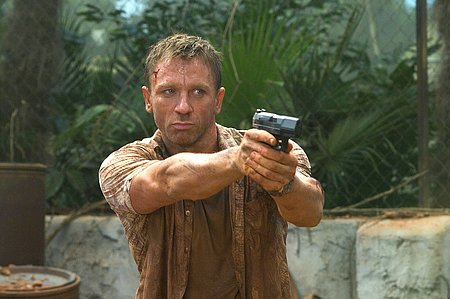
Take the early scene in Uganda, for example. Here, Bond must chase down and apprehend a suspect to obtain the passcode on his mobile phone, yet unfortunately said miscreant (Sebastien Foucan) is rather adept at long-distance sprinting, free-running and jumping off things that are ridiculously high up. Whilst he bounds around without a care in the world, remaining relatively scratch free, Bond is always a fair way behind, getting progressively beaten up and always opting for the easier route – hopping into a JCB digger or shoulder-barging through a wall rather than leaping through an uncomfortably small window. Here is a Bond who doesn’t need to show off when no-one is looking, he just wants to get the job done, and at whatever cost.

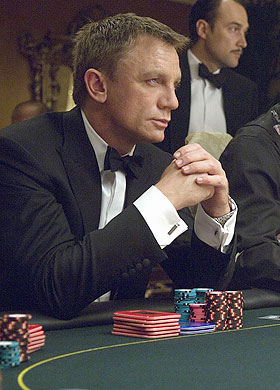
I’ve always had a bit of an issue with Bond films. I’ll gladly watch any of them, even Quantum of Solace if there’s nothing else on, but the plots are usually a bit labyrinthine for me, which is only to be expected if they want to make each film different. I’m not quite sure of the main motivations in Casino Royale, but I’m fairly sure it’s got something to do with the stock market, although the basic point is that Bond infiltrates an extremely high stakes poker game with a $150,000,000 pot, in order to prevent Le Chiffre from winning it and doing something bad with the proceeds. Everything else is fairly superfluous. I’ve read elsewhere that setting most of a Bond film around a poker table is nothing short of sacrilege, but I found those parts to be fraught with tension and often interspersed with enough action to suffice, even if the film made poker out to be a game that only deals in the most improbable card hands ever. There’s a nice running commentary provided by Bond’s accomplices, Vesper Lynd and Mathis (Eva Green & Giancarlo Giannini), but I didn’t think it was that necessary to have so much exposition, considering how dumbed-down the game was.

There were some very memorable set pieces, with the cold open of Bond achieving his double-0 status and the parkour escapade being particular high-lights, though I also enjoyed the stairway scuffle later in the film, showing how Bond had improved his jumping-and-punching skills from earlier. The testicular-torture scene may have gone a little too far, but it was well-handled and didn’t make me feel as squeamish as it could have done, and it’s more than compensated for by the various little moments of humour, and the record number of car rolls a little earlier. 

I approved of the expansion upon the relationship between Bond and M (Judi Dench), whose involvement in this franchise has cemented her presence as something of a British icon, and the rumours that this repartee has been increased ever further in Skyfall excites me no end. Bond is always at his best when bouncing off a superior – best seen with Desmond Llewelyn’s Q, and his utter, barefaced cheek clashes perfectly with Dench’s no-nonsense style. 

Though the last act may drag a little – the film clocks in at 138 minutes – the pace is fairly consistent throughout. There’s a lot here for Bond fans – more in-jokes than I remembered – and plenty for newcomers too. It may not be my favourite Bond film, but it definitely breaks the top 10, and maybe even the top 5.

Choose film 7/10

The Manxman

Pete Quillam (Carl Brisson from The Ring) is a penniless fisherman. His best friend, Philip Christian (Malcolm Keen), is a hot-shot lawyer. The two have been inseparable since birth, being raised as essentially brothers despite their wildly different lifestyles. They’ve even found a way to combine their various career paths, with Philip pushing through a petition that will prevent steam trawlers from encroaching on the fishermen’s haul, but when they meet Kate Cregeen (Anny Ondra), the barmaid daughter of the local pub The Manx Fairy, they both instantly fall for her. Pete, the more headstrong and forward of the pair, is the first to make a move, so the loyal Philip hides his feelings for the sake of his pal. But when Pete heads to Africa to make his fortune to win over Kate’s father (Randle Ayrton), things get complicated when Philip is asked to look after Kate in his absence. 

You cannot imagine how shocked I was to discover that this film has an almost identical central plot to Michael Bay’s Pearl Harbor. I was in no way expecting any similarities between a film made by Alfred Hitchcock and what many believe to be the worst film made by one of the worst blockbuster makers working today, but plot-wise they are pretty much spot on, so I managed to guess almost every element that happened within the first hour of the story. It’s interesting that the love story in Pearl Harbor – a triangle between Ben Affleck and Josh Hartnett’s Army Air Corps pilots and Kate Beckinsale’s nurse – was widely regarded to be the most superfluous and tedious aspect of that film, but here it is the primary – and often sole – focus, and it is handled far more deftly and in depth in Hitchcock’s 80 minutes than Bay’s 3 hours. This is probably because no-one goes to see a Michael Bay film for a tepid, mopey love story, especially when said film is about one of the most momentous events in the history of international warfare that’s literally made from explosions, so those of us who found ourselves having to wade through the hours of treacle to find nowhere near enough shiny fireworks to keep us entertained for even half the film’s length were of course disappointed – a feeling I’ve since become familiar with from Bay’s output. How exactly did this review of a 1929 Hitchcock silent film become me slandering Bay’s 2001 nadir? The two weren’t even made in the same century!

Anyway, The Manxman. The most interesting thing I found about this film was that at the start, the story seemed to be entirely about Philip, and the woes he would endure withholding his unrequited love for the promised bride of his best mate. The story is mostly told from his point of view, which is generally the case of the hero, yet as the plot progresses and the three points of the love triangle become further entangled with one another, it becomes clear that he is not the hero of his own story, but the villain, or at least the antagonist, of Pete’s. Though Philip and Kate never intend to do anything untoward against Pete, they still effectively destroy his life by doing what they believe is right at the time. Pete, meanwhile, is nothing but a lovable, earnest oaf, whose only crimes are an obliviousness to his friends clear affections for a girl, and his shame at believing himself not wealthy enough to be an acceptable husband or son-in-law.

There are no decisions made throughout that can really be judged against, as everyone always acted with the best possible intentions – initially at least – which makes it very easy to empathise with and feel sorry for almost everyone involved, and at times it’s all a bit of a downer. There’s some elements of Cyrano de Bergerac in there as well – Pete asks Philip to put in a good word for him with Kate and her father, because he has a way of making things sound better.

In terms of Hitchcock-ness, there wasn’t anything that stood out thematically or cinematically, although I did like the use of Kate’s diary entries and the way she referred to Philip – Mr. Christian, Phillip and finally Phil – to indicate her growing affection for him and the increasing closeness between the two. That was a nice touch. Also, the climax was delectably tangled, even if it was clear how everything was going to unravel.

Choose film 7/10