Ferris Bueller’s Day Off

This review was originally written for French Toast Sunday as part of my USA Road Trip feature.

How much of an introduction do I really need to give Ferris Bueller’s Day Off? I’m hoping none but, as much as it pains me to say, there’s probably a few unenlightened souls out there who have yet to discover the wonder that is this film. Ferris (Matthew Broderick) is an unimaginably popular and enterprising teenager who, one day, decides to pretend to be ill and skip school. It’s something he’s perfected into an art form – this is far from his first game of hookey – but this time he’s roping in his girlfriend Sloane (Mia Sara) and hypochondriac best friend Cameron (Alan Ruck). Once the gang has been assembled and Ferris has “borrowed” Cameron’s father’s prized Ferrari, the trio head to Chicago for the best day they’ll ever have. Meanwhile, Ferris’ sister Jeanie (Jennifer Grey) and the school’s Dean, Mr. Rooney (Jeffrey Jones) both suspect Ferris to be faking, and set about trying to bring him down.Ferris01 Continue reading

Fargo

This review was originally written as part of my USA Road Trip series for French Toast Sunday.

Car salesman Jerry Lundegaard (William H. Macy) is a bit down on his luck. He’s run up some pretty substantial debts, and will be in trouble for fraudulent affairs any day now, as soon as the bank realise the cars he has been claiming against don’t actually exist. The solution to his problem? Arrange for his wife to be kidnapped, so Jerry can collect on the ransom from his wealthy father-in-law. Unfortunately the miscreants hired to do the kidnapping, Carl and Gaear (Steve Buscemi and Peter Stormare), bungle the escape, leaving enough clues for the police chief, a heavily pregnant Marge Gunderson (Frances McDormand), to begin tracking everyone down and sorting this mess out.

Continue reading

The Back to the Future Trilogy

Marty McFly (Michael J. Fox), a young slacker who dreams of rock and roll stardom but lacks the courage to showcase his talents, finds himself in something of a unique situation when, during a late night experiment with his friend Dr. Emmet ‘Doc’ Brown (Christopher Lloyd), Marty is transported back in time 30 years to 1955. His only way back is to contact the 1955 Doc Brown to help fix the time machine, but in doing so he must also ensure that his own parents (Lea Thompson and Crispin Glover) – now the same age as Marty – get together, which is made all the more complicated by the fact that his own mother has taken a shine to him.
doc_brown_christopher_lloyd_back_to_the_future Continue reading

The Wild Bunch

In the old west, a gang of outlaws led by Pike Bishop (William Holden) attempt to pull one last job and rob a bank. However, things do not go according to plan (when do they ever?) and a bloody shootout ensues, during which some of Pike’s men are injured or killed, and the loot they obtain is found to be worthless. The guys set out to make another big score, but find themselves hampered by one of their former members, Deke Thornton (Robert Ryan) being forced to chase them down. Continue reading

Psycho

On a bright December Friday afternoon, Marion Crane (Janet Leigh) returns to work after some afternoon delight with her similarly cash-strapped lover Sam (John Gavin). When her boss sends Marion to the bank to deposit a client’s $40,000 in cash, on a whim she hastily backs her bags and flees with the money, but draws the attention of a road cop during her escape. When darkness and an incessant downpour prove too much for Marion, she checks into the run down, deserted Bates Motel, where she meets motel manager Norman Bates (Anthony Perkins), a kind yet awkward young man, unfamiliar with pretty young women entering his life. Norman’s bedridden mother disproves of the presence of Marion, and refuses to let her into the house, but this is no concern of the girl’s as she still has to plan what to do with the money.
Continue reading

North By Northwest

This is the last review I’ve got left unposted from the recent reviewing competition at the Lamb, I hope you enjoy it.Is it really possible for North by Northwest to live up to its hype? It’s rare to find a Top Films list deprived of its inclusion, it features scenes that have become the stuff of legend, that also tend to top Best Scene lists, and it’s one of the greatest movies ever made by one of the greatest directors who ever lived.

If you haven’t seen it yet, then I strongly advise you to stop reading anything about it and go and watch it now, for North by Northwest is truly a tremendous film that is best enjoyed with as little outside knowledge as possible. When Cary Grant’s Roger O. Thornhill quips shortly after being kidnapped into the back of a car, “Don’t tell me where we’re going, surprise me,” this is not merely Hitchcock’s intentions for Thornhill, but for all of us watching as well.

There’s really no weak link in the film. From the opening Saul Bass title sequence, utilising the receding parallel lines of a Madison Avenue skyscraper’s windows to perch the credits atop as they rush off into the distance, down to the ever so cheeky closing train tunnel metaphor, every second oozes entertainment. Alfred Hitchcock’s longest film, and his fourth and final with fellow English-born collaborator Cary Grant, is also his most unashamedly fun. There are many people who have an issue with some of the more fantastical elements of the plot – to be fair, a cropduster is hardly the most effective method of assassination – but these people are preventing themselves from what is a truly thrilling experience. And after all, who is watching Hitchcock for realism? The master has always admitted that, whilst some films are a slice of life, his tend to be a slice of cake, and this one has the richest, creamiest filling, not to mention icing, a cherry and some rainbow-coloured sprinkles to boot.
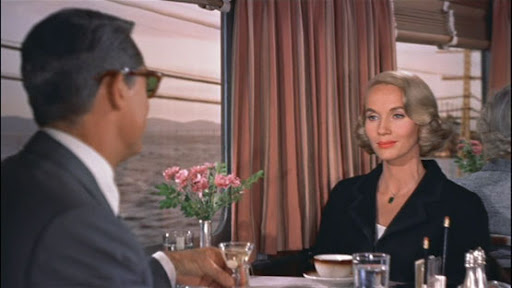
Cary Grant is on his finest, suavest form as New York ad man Roger O. Thornhill, stepping straight from Mad Men into a classic Hitchcock mistaken identity caper. Thornhill is an egotistical chauvinist, totally in control of his superficial advertising world, yet within Grant’s capable hands he remains not simply likable, but enviable. Who wouldn’t want to fill out a suit like that, and have such a wide and successful array of quips and zingers at their disposal? For though he is constantly befuddled and bemused by the adventure he has innocently become swept along in, there is no circumstance that leaves him wanting for a one-liner. Here, Grant perfects the art of the stern expression and the furrowed brow, eternally caught between confusion and frustration, with merely a hint of excitement as his journey takes him across America in the effort to clear his name of a wrongfully accused murder. The role was originally offered to Hitch’s other great collaborator, James Stewart, after the two did such sterling work on Vertigo together, but as soon as Grant became available Stewart was dropped, in favour of a man Hitch believed would not be dwarfed by the extraordinary events going on around him. Whilst Stewart has often been remarkable in his everyman roles, it’s fair to say that Thornhill would not have been the right fit for him.
Such a masculine protagonist would be lost without a suitably feminine love interest, and Eva Marie Saint fits that job nicely as Eve Kendall, a typically beautiful Hitchcock blonde whose porcelain doll exterior hides her ability to use sex like some people do a flyswatter, and she holds her own against the likes of Psycho’s Janet Leigh, Rear Window’s Grace Kelly and Vertigo’s Kim Novak as she dabbles in some of the most forward repartee since Bacall taught Bogart how to whistle. Hitch always preferred the more beautiful but subtly sexy female leads, as he took great pleasure in uncovering their more alluring qualities than he would have with the more self-promoting individuals like Monroe. As with all of Hitchcock’s birds (pun intended) Saint is meticulously and beautifully dressed in every scene. Legend has it that the great director paid her wardrobe so much attention that Grant petulantly demanded advice on what he should be wearing, and was simply told to “Dress like Cary Grant.”
Released three years before Dr. No, this film clearly set the template for almost every Bond movie. With its dashing, smooth talking hero with an easily recognisable voice, the woman who falls for him within seconds of meeting, a villain’s lair in an impressive yet remote location (here James Mason’s Vandamm lives in a condo atop Mount Rushmore), an evil sidekick (Martin Landau, with a severe case of Henchman’s Eyebrow) and a fast-paced, stunt-riddled adventure taking in major cities around the world (or at least central and north-east USA). Thornhill even has the ability to make perfect strangers throw themselves at him; just wait for the reaction from the woman in his neighbouring hospital room. It’s no surprise to learn that Grant himself was an original candidate for what was to eventually become Sean Connery’s Bond.
Even from the trailer, this is one of the most comical of Hitchcock’s endeavours. Speaking directly to the audience, Hitch himself appears, advising the viewers on how to take the perfect vacation without leaving the cinema, keeping his tongue firmly planted in his cheek throughout (“You don’t find a tasteful murder on every guided tour, do you?”). It’s on Youtube, go check it out. Ernest Lehman’s Oscar-nominated script (tragically losing out to Pillow Talk) is full of far too many quotable lines to give justice to here, but it contains more than enough for even three films. My personal favourite? Saint declaring she’s a big girl, followed by Grant’s perfectly timed, effortless rebuttal of “and in all the right places.” The police station phone call is yet another example of solid gold. Occasionally the steady slew of insinuations and double entendres becomes a little cringeworthy, especially when Grant tells Saint he likes her flavour, but that’s a rare misstep for a script that otherwise never puts a foot wrong. There’s far too much excellence on hand to make you forget these, and the film will never fail to raise a smile with every viewing.
It isn’t just the dialogue though; the scenes without any discussions are often just as amazing, if not more so. Early on, after being forcibly imbibed with the best part of a bottle of bourbon, Thornhill is unleashed behind the wheel of a car, in an attempt to instigate his demise. Upon realising what’s going on he awakes in a drunken stupor and does his utmost to keep his car on the increasingly blurred and merging roads in front of him. Grant makes for an amusingly intense drunk, persistently blinking, squinting and staring bug-eyed at the cars he races past, made all the more dramatic by Bernard Herrmann’s  stupendously engaging score. Of course, there’s also the hallowed cropduster chase, as Thornhill, having been lured to the middle of nowhere to meet the man he’s been accused of being, finds himself battling the more painful end of a plane’s propeller. One of the few scenes not set to music – to better emphasise the relentless whirring of the plane and the lack of assistance Thornhill is likely to receive with the matter at hand – the scene is worth watching as a standalone segment. Equal parts exhilarating, terrifying and fun, it’s made all the more hilarious for the entire time Grant dives through dirt and hides amongst crops he is wearing his increasingly worn yet perfectly tailored grey flannel suit, clean shaven and with immaculate hair.
Hitchcock’s regular cinematographer, Robert Burks, excels himself in a manner that by this film is surely only to be expected. The shot of Thornhill fleeing the UN building to a waiting cab is stunning, captured from high above and angled down the side of a skyscraper, a shot I’d happily have framed on my wall, and the revealing shot of a gun hidden in a purse is sly enough to almost go unnoticed, but is sure to pay off later. Hitch ticks off almost all of his standard tropes – a wrongfully accused man on the run, maternal issues (Jessie Royce Landis, who plays Thornhill’s mother, was in real life only 8 years older than Grant), spies, deception, train journeys, height-based peril, an all-but-unnecessary MacGuffin (a statue full of microfilm), bumbling policemen, a tense finale set atop a famous landmark and, of course, an icy blonde. All that’s missing is a self-deprecating scene in a cinema.
When compared to modern day blockbusters, this picture more than holds up. Its unstoppable, kinetic nature will keep fans of both classic cinema and present day fare glued to the screen and on the edge of their seats for the entire 136 minute runtime. Filled with glamour, wit, excitement and big scenes on a large canvas, there’s something here to please everyone, as long as they like really great films. Does it live up to the hype? Yes, and more so.
Choose film 10/10
Guaranteed Happiness: Kiss Kiss Bang Bang

Kiss Kiss Bang Bang is a film I’ve loved since the fist time I watched it, and always proves to be an enjoyable experience, yet I fear that from now on I won’t enjoy it any more, because I will have horrific, Vietnam-style flashbacks to my latest viewing, or rather the repercussions from it. You see, I volunteered to appear on The Lamb‘s weekly podcast, The Lambcast, for their Movie Of The Month segment, and I was overjoyed to discover that said movie was Kiss Kiss Bang Bang. Granted, I may have voted 7 or 8 times for it and hoped that one of the primaries would drop out so I could discuss such a great film with some similarly-minded individuals, so I can’t say I was overly surprised when it won. However, this was my first ever podcast (recorded last Sunday), and I was so horrifically bad in it that I’m not sure I’ll ever be able to enjoy said film again. The episode has now dropped, and is available on iTunes (search Lambcast in podcasts) or via this link. I urge you to listen to it more for the scintillating discussion between Dan Heaton, Justin Gott, Kristen Lopez and Nick Jobe  than for my dismal contribution, however if I’ve ever wronged you in the past (a list longer than I’d like), then you may also enjoy the podcast, for different reasons. If you could just ignore my horribly grating, nasally drone whenever it aggravates your eardrums and pretend instead it was just a four-way chat then I’d appreciate it.
Maybe it was because I’m a first timer and everyone else there seemed far more experienced at it than I, probably because they are and some of them regularly hold podcasts of their own, or maybe it’s that I’m genuinely not very good at talking about films with real live actual people without using a keyboard (it doesn’t happen very often), but I’d like to issue an apology to Dan, Justin, Kristen and Nick for lowering the quality of the podcast, and for relentlessly interrupting and talking over them when I had nothing very interesting to say. I was nervous, and it’s never been more abundantly clear that when talking about films, I truly do not know what I’m talking about. Also, I hate public speaking, so signing up for a podcast was probably a pretty dumb thing to do. Don’t worry, I won’t do it again.
Continue reading

Guaranteed Happiness: Wall-E

Welcome to the first post in my new semi-regular feature, Guaranteed Happiness. I’ve discovered that a lot of the films I’ve watched recently haven’t necessarily dealt with very happy subjects, and this has been getting me down a bit. Now and then, I’d quite like to watch a happy film, or one that’s uplifting and ensures that I’ll have a big stupid grin on my face for at least 80% of it, and definitely at the end. After all, I’d much rather write about a film I’m passionate about, and I tend to have more to say about films that make me smile than those that make me suicidal. Praise should be aimed squarely between the shoulders of my girlfriend then, for sticking on Pixar’s gem Wall-E when I was in a decidedly cranky mood a little while ago. The aim was for me to sit down and write some posts, which to be honest I was in no mood to do after a fairly crappy day at work and having to shell out over a considerable amount of cash to fix my bike, yet as soon as the film began all thoughts of blogging and even glancing at my laptop screen were out the window.So, why do I love Wall-E? The simple answer is robots. It’ll come as no surprise to regular readers that a film featuring robots (or dinosaurs, time travel or Stephen Tobolowsky) will immediately be watched with heightened levels of glee. And the fact that it’s made by Pixar, a company that has made some of my favourite films to date, and is where I’d be willing to sell several members of my immediate family to work at, then so much the better.This is my favourite Pixar film, which is definitely saying something. I adore the Toy Story trilogy (especially, predictably, Rex), but there’s something about Wall-E‘s simplicity, its pared down scope and focus on telling a straightforward story in new, interesting, and above all, beautiful ways.

The plot is basic: in the not-too-distant future, the human race has polluted and destroyed the world so much that life has become unsustainable, and the only hope lies in the Axiom, a titanic spaceship resplendent with every luxurious convenience to fulfil any desire. Earth has been abandoned and left to the robots, who spend the next few hundred years tidying the place up. Wall-E, our intrepid hero, is the last surviving ‘bot, and he spends his days making and stacking little cubes of garbage into towering skyscrapers of trash, accompanied by his only friend, a cockroach. One day, a ship descends from the heavens, carrying EVE, a futuristic, high tech reconnaissance droid, and Wall-E is instantly smitten.

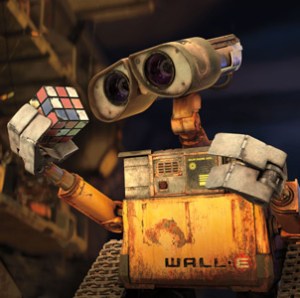
The tale of a schlubby, down-on-his-luck guy falling in love with an out-of-his-league wonder girl is hardly new, but as far as I know this is the first time it’s been told almost entirely wordlessly, and about mechanical beings. A certain amount of disbelief needs to be suspended to watch the film – the robots seem to have far more personality than they should have been implanted with in the factory – but this results in one of the most well-rounded characters in all of Pixar’s history. Wall-E (which stands for Waste Allocated Load Lifter – Earth Class, something I know from memory) has a love for all things quirky, unusual or fascinating, be it a Rubik’s cube, egg whisk or an old VHS of Hello Dolly!, and watching him investigate the functions of each item – wearing a bra like sunglasses, accidentally erupting a fire extinguisher – are a joy to behold. As are his attempts to woo the evidently disinterest EVE (whose acronym would be a spoiler). The couple’s dates are more moving and say far more than any scene of dialogue could.

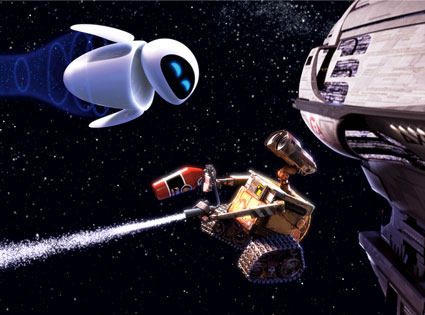
It’s almost impossible to narrow the film down to my favourite scene, but I’d probably say EVE and Wall-E’s space flight. It’s nothing short of a work of art, as the two bots fly a merry courtship dance around one another, set to Thomas Newman’s beautiful score. In fact, every scene between just those two, all almost entirely devoid of dialogue, are so very easily lost in. Their relationship feels natural and real, and if anything the films is at a detriment as the plot moves away from Earth, and the story looks past our central couple.

There’s a few messages hidden not too deeply in the film – stop fucking up the Earth, grow your own food, get off your arse and exercise – but to be fair these are all fairly good messages, when compared to the standard Disney fare of wait for a handsome prince to come and rescue you. Wall-E’s messages are ones I personally agree with (“even if I don’t necessarily live by them,” he says, patting the spare tyre around his midriff) so I don’t really mind such unsubtle preaching in a film, especially one as entertaining as this.

I’ve made no secret of the fact that I’d have loved nothing more than to have been part of the character design team on this film. Wall-E himself has been so carefully thought out with regard to how he works and fits together. I may have appreciated this more than most, being a mechanical engineer by trade, but I think everyone should be impressed by the level of detail. Apparently the design team at Pixar meticulously analysed various machines, working out which ones were ‘male’ and which were ‘female’, and what characteristics defined these genders. Wall-E has clearly been inspired by more clunkier, mechanical machinery, as seen in factories and assembly lines, whilst the sleek, white plastic of EVE is straight out of an Apple store.

As you’ve probably realised, I love this film. The Wall-E poster, a giant pair of his eyes looking inquisitively out of the frame, justifiably hangs in in my lounge, yet I think it almost qualifies as one of the ‘other’ Pixar films that isn’t about toys, fish or superheroes. From the small details – sci-fi queen Sigourney Weaver voicing the Axiom’s tannoy – to the fully realised plot and the brilliance of casting Ben Burtt, the voice of R2D2, as Wall-E, I cannot fault this film in the least, and nor would I want to. And I’d still be trying to get Randy Newman’s closing credits song out of my head if it wasn’t so bloody good.

Choose film 10/10

Seven

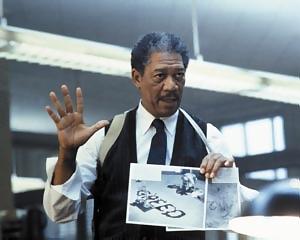
A buddy cop movie with a seasoned old hand so close to retirement they’re already scraping his name off the door and his hotshot, firebrand young replacement, this couldn’t be further from another Lethal Weapon. Yes, one’s a family man and the other’s a loner, one is prone to anger and the other a methodical, careful detective clearly too old for this shit, but where Richard Donner’s 80’s staple is an entertaining, action-packed romp, this is something much darker.After a disturbingly evocative opening credits sequence enriched with depth and meaning on repeated viewings, we meet Morgan Freeman’s detective Somerset, picking up his last case, a sickeningly masterful serial killer with a penchant for the seven deadly sins, the same day as Brad Pitt’s Detective Mills arrives to replace him. That’s as much setup as there is, as we follow the mismatched detectives from crime scene to crime scene, via their headquarters and areas of research, with Somerset whiling a night away poring over books in the library, whilst Mills take a brief glance at the Cliff notes.

The script is dotted with well balanced moments of humour – Somerset having dinner with Mills and his wife Tracey (Gwyneth Paltrow) – and some deep black humour: “this guy’s sat in his own piss and shit; if he wasn’t dead he’d’ve stood up by now,” plus R. Lee Ermey’s belligerent, furious Police Captain (“This is not even my desk” is one of my favourite film quotes, ever).

Crucially, we see none of the killer’s murders onscreen, merely their gruesome aftermaths. It’s not as gory as you might remember, but it evokes imagery and feelings that some may find disturbing, not least what happens to Leland Orser’s character, who probably has the worst memories of those who survive. It could be argues that this is a precursor to the Saw franchise, punishing those that seem to deserve it in creative, torturous ways, but at least here we are saved the nightmarish spectacles of witnessing the deaths.

At times the film feels a bit predictable, like a police procedural itself, but whenever this is about to happen the plot shifts direction, taking an unexpected twist to shake things up again. The colour palette of muted greys and browns, interspersed with deep reds amongst the incessant torrential downpour of the nameless city only adds to the feelings of despair.

There’s small roles for John C. McGinley and Richard Schiff in there as well, a nice surprise for me in the opening credits, but unfortunately at times the acting, especially Pitt during the final scenes, leaves something to be desired. The ending has become the stuff of legend, but I won’t reveal it just in case, save that Pitt’s gurning and crying are a bit over the top and take you out of the scene. This is another one of those films where knowing your actors may ruin the film too, as recognising a voice could cause annoyances later on, but not too badly.

Overall this is director David Fincher’s defining film (better than Fight Club in my opinion, though it’s been a while). The gritty tone is perfectly realised through every medium possible, the plot is gripping, the twists hold up and, though far from an enjoyable experience, it remains worthwhile.

Choose film 10/10

L.A. Confidential

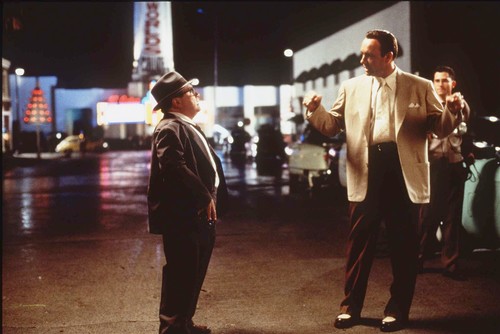
In 1950s Los Angeles, mob boss Mickey Cohen has been put away, and rival crime factions are warring for his place. Against this backdrop, three very different cops are following three very different cases; brutish Bud White (Russell Crowe) despises wife beaters and is more than willing to frame a suspect in the name of justice as he works as hardman for James Cromwell’s kindly police chief. Ed Exley (Guy Pearce) is the straight-laced, ambitious son of a deceased police hero, investigating a multiple homicide at greasy spoon the Nite Owl, whilst Kevin Spacey’s smooth headline-hunting NARC Jack Vincennes traces a lead found on a drugs bust, uncovering a ring of hookers cut to look like movie stars. Throw into the mix Danny DeVito’s sleazy journo, David Straithairn’s oily businessman and Kim Basinger’s high class whore with a strong resemblance to Veronica Lake and you’ve got a top notch cast all bringing their A-game in a stunning film with tight script and direction. Spacey especially is sublime, stealing every scene in a movie full of memorable ones. The little moments are the finishing touches – Exley removing his oversized glasses and pouting for a photographer, Vincennes bumping into a man he put away on the set of TV show Badge of Honor where he acts as technical adviser, but the big scenes – the masterful interrogation of 3 suspects, several showdowns and a final act with all guns blazing are the parts best remembered. Credit of the month: Ginger Slaughter.

Choose film 10/10