Maycomb, Alabama, sometime in the 1930s. Atticus Finch (Gregory Peck) is the town’s lawyer, the lone parent to children Jem (Philip Alford) and Scout (Mary Badham), and potentially the greatest and most noble human being ever conjured up by the mind of a writer. When he is asked to take on an impossible case – defending a young black man accused of raping a white woman in the infuriatingly racist deep south – Atticus takes on the case. The whole thing is shown from the point of view of the children and… wait… is that Robert Duvall?!? With hair?!?
To Kill A Mockingbird is my pick this month for both my blind spot entry for Ryan at the Matinee, and also my Most Anticipated 1001 Movie from the shortlist I created last year. It’s one of those films I’d been meaning to see for a long time – I’ve owned it on DVD for well over a year now – and now I’ve finally gotten around to it, partially inspired by the latest episode of the FilmWhys podcast, which is partially devoted to this film and I look forward to listening to it. I read the book, written by Harper Lee and published in 1960, a little over a year ago, and damn near fell in love with it. I think most people get assigned it in school, but alas that was not the case for me, instead I was lumbered with The Color Purple, of which a review shall appear of the filmed version some point next month, as part of my Least Anticipated 1001 Movies project, which should give you some idea of my feelings towards the book. However, I feel that had I been assigned Mockingbird in school or college I would not have liked it as much, so perhaps I should feel grateful. As it is, and as is more often the case, I feel Mockingbird works better as a book than as a film. That’s not to say it’s a bad film – far from it in fact – it’s just the novel allows for greater depth and the capacity to include more scenes which I missed when watching the film. For example, the impact of the hole in the tree being cemented over is much more keenly felt in the book than here, where it’s almost skipped over. It’s key to a fairly significant relationship which becomes watered down as a result. Elsewhere, I found the lifestyle of the Cunninghams – neighbours of the Finch family, and whose son Walter Jr. attends school with Scout – to be poorly explained, and had I not read the book I might have been a little lost as to why things occur as they do. That being said, other areas are vastly improved upon. The character of Finch – with whom Peck won the Best Acting Oscar, questionably over Peter O’Toole’s Lawrence of Arabia – has a commanding, granite-like presence, with Peck perfectly embodying Atticus’ intolerance of violence and determination to set the right example for his kids. At times the role is subtly underplayed, but I never felt like Peck was just coasting. His closing speech is beyond powerful, and moving in a manner far more affecting than on paper. The fact that it was created via one long take really adds to the effect too.
 Elsewhere, Brock Peters is magnetic in a supporting role as Tom Robinson, the accused man who immediately, unquestionably must be innocent from the moment we lay eyes upon him. When he is called to the stand for questioning he all but blew me away with his performance, with the sweat beading on his brown. I’m not a huge fan of child actors, but the two here performed well enough. I can’t quite comprehend Badham’s Oscar nomination for Supporting Actress however. That doesn’t make a great deal of sense to me, though I’m not too well acquainted with many films from 1963, so perhaps it was a slow year for supporting female performances. Duvall, who crops up in a wordless role, seems to me to be a clear inspiration in movement terms for Johnny Depp’s Edward Scissorhands almost thirty years later. The two both have an innocence and awkwardness about them; an inability to control the dangerous power within. This was Duvall’s first performance in a film, and as a way to begin a career it’s pretty much unparalleled.
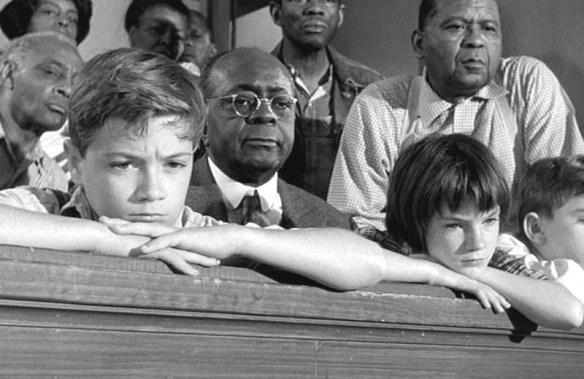 In general I’m not normally a fan of meandering, largely plotless films, especially those regarding life as a child – see my less than positive review of Stand By Me for proof of that – so the first act of the film, which follows the exploits of Jem, Scout and their summertime neighbour Dill (John Megna) is my least favourite. It isn’t necessarily bad, and there are some terrific scenes within it – the rabid dog is a particular highlight – but I was very glad when the court case plot became more prominent far earlier than in the original novel. The way in which we are shown the film, predominantly through the eyes of the children, is extremely well implemented. Some scenes are shot at their head height, such as an early assault on the house of Boo Radley, a legendary but secretive local figure, and during said assault, when the kids are accosted by some unseen man, the person remains concealed in shadows because the children look away or cover their eyes – if they don’t see him, neither do we. This technique is repeated again much later in the film, when a moment of action is lost to us because Scout’s view is once again impaired. I complained about this kind of thing in the recent Godzilla movie – cutting away from the action to someone watching it on TV – but here it works, adding to the sense of us seeing life through the eyes of a child.
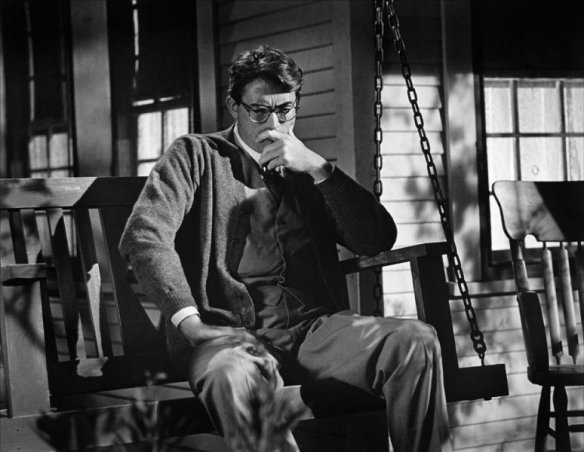 I’ve heard elsewhere that the score has been lauded as one of the film’s most accomplished areas. I’m not a music guy, hence why I rarely discuss it in my reviews, but personally I found it overzealous and at times almost comical. The use of a glockenspiel during the raid on Boo’s porch almost ruined what would have otherwise been a very tense scene. However, fortunately it’s not enough to detract from what is a thoroughly compelling and very moralistic story. As book-to-film adaptations go, I struggle to think of many that I prefer. Were I redo-ing the Top 10 list I created last year, I think it would sit nicely between Into The Wild and High Fidelity. It’s definitely worth a watch – though I’d recommend the book first – and whilst it perhaps isn’t the shining pinnacle of perfection I’d been expecting, it’s still a very good, solid drama.
Choose Film 8/10
 Continue reading


 Life Vs Film