Rain Man

Rain Man usually, and justifiably, receives plaudits for Dustin Hoffman’s performance as the autistic Raymond Babbitt, a role for which Hoffman won his second Oscar (after Kramer vs. Kramer), but it is the performance of Charlie Babbitt by Tom Cruise that should receive accolades too. His Charlie is wound up a little too tightly by the wishes of his recently deceased father to leave his fortune to Charlie’s brother Raymond, a brother Charlie didn’t know he had. He’s angry at his father, angry at his brother, and everyone around him as he struggles to come to terms with the aftermath of his father’s death. I don’t mean to underrate Hoffman’s performance at all, his is the stronger of the two, and it is the little moments that make it so, such as the moment of childlike confusion on the escalator.

Choose film 6/10

Jurassic Park

Last week some friends and I started a Movie Night, an event that will hopefully become a regular occurrence, and should allow me to keep crossing off films, whilst also achieve something approaching a social life. We kicked off the soon-to-be tradition with a film that means a great deal to me, Jurassic Park. I have previously waxed lyrical about the virtues of this cinematic landmark, or rather the shortcomings of the third film in the series, but I’ll try not to repeat myself too much.
 
The plot, and I really hope that none of you need to know this, although one of the attendees at the movie night admitted ashamedly that this was his first ever viewing of Jurassic Park, concerns a group of people traveling to an island where an eccentric (you can’t be mad if you’re rich) scientist (Richard Attenborough) has discovered a way of cloning dinosaurs from DNA found in mosquitoes frozen in amber. Inevitably, not all goes to plan, and there’s much merriment to be had in the dinos vs. people aftermath.
 
Jurassic Park is a masterclass in efficient film-making, showing a lot with a little. This is shown early on, when an early velociraptor encounter is terrifying, yet only a couple of close-ups of the raptors eyes are seen. Shaking leaves, haunting sound effects and shots from the dinosaurs own point-of-view are enough to believe the presence of this creature. When shown, the Stan Winston-created dinosaur models and ILM-rendered CGI are on the whole impeccable and, even though they are obviously fake (obvious for lack of plausibility, not quality) the illusion is so well realised that you almost believe.
 
As with most Spielberg classics, the key is in casting ordinary, relatable characters in extraordinary situations. In this case, Sam Neill’s Dr. Alan Grant has a well rounded persona, a palaeontologist stuck firmly in the past, unable to touch a computer without breaking it and loathing children. Just watch him trying to let go of Lex’s hand after he helps her up, or how he probably scars a child for life with his raptor story at the start of the film. He is ably supported by Attenborough’s scientist and Laura Dern as a paleobotanist, as well as Jeff Goldblum’s excellent interpretation of rock-star chaotician Dr. Ian Malcolm, although I never really understood why he was invited onto the island. Wayne Knight’s Newman-esque bad guy (does he play anyone else? But then why should he, he’s so good at it) is also a joy to behold, especially his childlike glee at the Bond-style gadgetry he’s provided with to steal dinosaur embryos, causing the chaos that ensues.
 
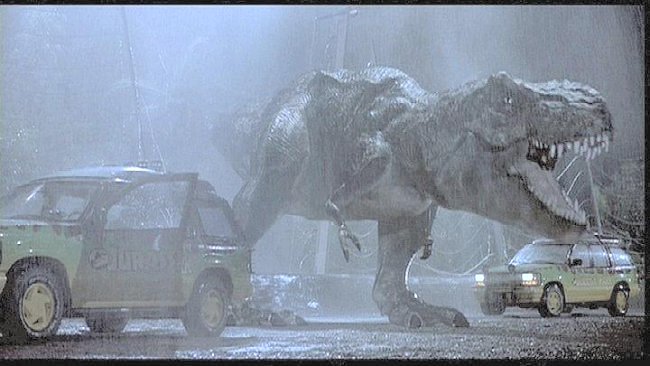
We’re introduced to the dinosaurs gently, first meeting the gentle herbivores and baby dinosaurs, before building up to the more threatening velociraptors and tyrannosaurus rex. The plot is largely dealt with in the first half of the film, leading for the remainder to be made up of unforgettable set pieces, such as the electric fence, or raptor encounter in the kitchen. Greatest of all though must be the introduction of the T-rex. I don’t think I’ve ever seen ripples forming in a glass of water since without being concerned there is a giant dinosaur about to attack me.
 
It’s not just a monster disaster movie though, as there are genuinely hilarious moments of comedy (the blink and you’ll miss it rear view mirror gag is comic perfection), and the scenes are pitched perfectly, with the T-rex car chase immediately calmed by a gentler encounter with a herd of brachiosaurs. All in all, this is an example of movie perfection, and I look forward to enjoying it many more times in the future.


Choose film 10/10

In a Lonely Place

There’s only so much planning I can do towards what I’m going to watch when, but in the end a lot of this challenge will be left up to fate, when I come across films to watch, what films are available to rent, and if some are shown on television. Last Sunday, fate dealt me a kind hand when, after Something for the Weekend, the gods of weekend TV saw fit to show In a Lonely Place at a time when I had nothing else planned. And so, without any planning or preparation, another film has been crossed off.
In a Lonely Place sees Humphrey Bogart play with his romantic persona as Dixon Steele, a thriller writer suspected of murder after he invites a girl back to his apartment to hear a story idea, and the next morning she is found dead. Steele is known to have a temper, and is prone to violent outbursts, and Bogart plays this barely-suppressed rage masterfully. The scene where he describes how he thinks the murder took place is gripping.
I liked the way we are kept unsure for most of the film as to whether Steele is guilty of the crime. We assume he’s innocent, but he very easily couldn’t be, a feeling shared by his neighbour, drawn close to Steele during the investigation.
Choose film 6/10

Scarface (1932)

I’ve seen Brian De Palma’s 1983 Scarface a couple of times, and have never fully understood why it is as revered as it is. I’m not saying it’s a bad film, I just don’t think it’s that great, but more on this another day, for that too is on the list. No, today I’m here to discuss the 1932 original, in my opinion somewhat superior to its remake. The story tells the tale of a young gangster rising up through the mob ranks, and the effect it has on those closest to him. There is far more comedy in this version than the remake, mostly from the dialogue (“I was kissin’” “I don’t like it” “You’re missin’ lots of fun”) and from the bumbling, illiterate secretary and his endeavours to use a telephone.
Technically, there are some creative shots, such as a machine gun shooting away the calendar pages to show both the course of time and the violent acts that take place during it, and the scene of a mass execution being shown only in silhouette. I very much enjoyed this film, and hope to find many more like it as I journey through the list.
Choose film 8/10

Pirates of the Caribbean: the Curse of the Black Pearl

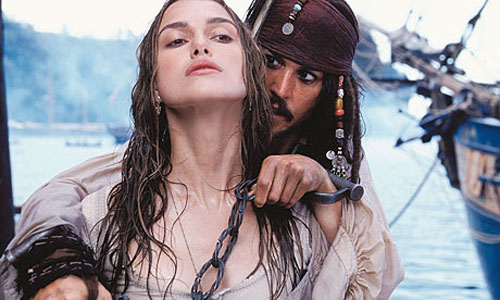
The original Pirates of the Caribbean film, the greatest ever made best on a theme park ride, is tremendous family-friendly fun, especially in its first half. It loses its way towards the end of the second reel, as the plot becomes inundated with various bluffs and double crosses, although in a film about pirates this is only to be expected. The CGI is excellent and well used, as is the comic relief, mainly provided by Lee Arenberg and Mackenzie Crook, surely the closest any human being can get to being a scarecrow without an awful lot of hay. Geoffrey Rush could well have been cast as villain Barbossa on the strength of his piratical laugh alone, and for that deserves at least a mention.Choose film 7/10

L’Avventura

L’Avventura reminded me a lot of Hitchcock’s Psycho, released the same year, in that the first segment set’s the plot up to follow the female lead, only to have her disappear from the screen, never to be seen again before the halfway mark. In this instance, the plot concerns a young woman who, whilst holidaying on an island with her friends, goes missing, causing her best friend and her lover to search for her. When compared to more modern day missing-person films, such as Ben Affleck’s excellent Gone Baby Gone, the plot tends to meander a bit, with the supporting characters not seeming to care about the fate of the missing girl.
I was also reminded slightly of Polanski’s the Tenant, in which a man moves into a new apartment, only to slowly turn into the apartment’s previous occupant, as the missing girl’s best friend seems to inhabit the life of her missing mate, becoming closer with her former lover during the search. It almost seems like this was the plan of the missing girl, setting up the transformation by giving the friend some of her clothes before she goes missing. This all seems an improvement for the friend, and indeed for the life she inhabits, as she seems much happier within it than her predecessor. This is most clearly seen by comparing the almost identical shots of the original girl kissing her lover, and how little emotion she shows during this, contrasting with her friend kissing him much more passionately later in the film. There are other parallels between the two ends of the film, such as the friend being initially concerned at the girl’s disappearance, only to end up more concerned that she has returned to claim her life back.Choose film 7/10

Toy Story Trilogy

Today’s volatile weather conditions allowed for a productive afternoon film-wise, as a planned bike ride along the beaches of Bournemouth was cut short by sporadic torrential downpours, meaning I crossed a trilogy off the list; Toy Story 1-3.

Watching the original Toy Story, the first feature-length motion picture created entirely using computer animation, always send me back to my childhood, aged 8 years old, sat in the cinema watching in wide-eyed wonder as the pixels were brought to life before me, with my Dad sound asleep in the next seat. It’s one of my earliest film-related memories (my earliest cinema experience that I know of was the Lion King, but that’s another post).
Continue reading

Giant

Before watching it, I only knew of Giant as being the last James Dean film. I’d seen Rebel Without a Cause recently, and been thoroughly underwhelmed, so had high hopes for Giant, as surely this, or perhaps East of Eden, were the reason that Dean is now such a cult icon, a supposedly defining character for a generation. Also, by looking at the cover for this film, I expected Dean to be the star of the film, his image appearing no less than five times on the cover, with Elizabeth Taylor appearing just once, and Rock Hudson not at all. It was with some surprise then that I found the stars to be Hudson and Taylor, with Dean a supporting character (granted, the most important supporting character, but supporting no less).


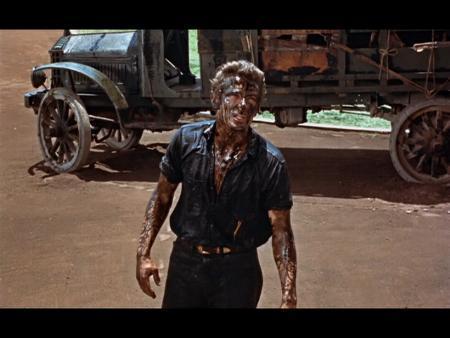
Having now watched the film, it shall be filed alongside the previously reviewed the Jazz Singer as an important film, just not a great one, though this time for being the last film of James Dean, rather than the first feature length to include audible dialogue. Giant documents the life of a young couple, Hudson and Taylor, from the day they meet and through the next 25 years of their lives. Even with an epic run time of almost three and a half hours, the plotting is generally fast, with major events such as their marriage and the birth of their children skipped over, pausing to show the more landmark occasions, for example the dismay of Hudson’s Jordan Benedict as Jordy, his son, cries when set upon his first horse. Along the way, Jordan’s life is besieged at every turn by Dean’s Jett Rink, a ranchhand who, upon inheriting a small patch of land, becomes a billionaire when he strikes oil. Dean overacts to his heart’s content, failing to draw any compassion within his rags-to-riches arc.


There are two main points that I took from the tale. Firstly, that some things never change, and some things do. This seems a fairly pointless ethos, but shown in the films context takes some form, as the menfolk gather to discuss business as the times change around them, but Benedict’s initial negative feelings towards his Mexican ranchhands are subdued when his son, an excellent young Dennis Hopper, marries and produces a son, both Mexican and Benedict. Secondly, the film shows the dramatic effect a small act, in this case purchasing a horse, can have on the rest of your life. So, essentially, Giant is the Butterfly Effect without the nosebleeds.


Choose film 6/10
Out of Sight

Last night I watched Out of Sight. I’d seen it before, but never really paid an awful lot of attention to it, but this time I made an effort to follow the plot. I think the film is a little over-rated, with editing style taking precedence over actual substance. In places, it seems to want to be a modernised version of classic cinema, with freezeframes, snappy dialogue and a plot that sees George Clooney’s prison escapee and Jennifer Lopez’s federal marshal thrown together and falling for one another, but it is this plot device that in my opinion lets the film down. I’ve always hated the tacking on of an arbitrary romance subplot almost ruining what would otherwise be an incredible picture (see also the Nightmare Before Christmas, Pulp Fiction, Star Wars), and this is definitely the case with Out of Sight. If the film had focussed on Clooney’s Jack Foley, his escape from prison and the heists before and after, I feel it would have been a far superior picture. By all means keep J-Lo’s character, (but for the love of cinema, recast) but drop the frankly ridiculous romance between the two. The best part of the film was the cast, with Don Cheadle eating up the screen as hoodlum Snoop, whilst Ving Rhames supports well as Buddy, Foley’s redemption-craving partner in crime. And the last minute cameo is one of the greatest I’ve ever seen.

Choose film 7/10

All Quiet on the Western Front

Right, it’s done, the list is complete. It can be found on the Challenge page of this truly marvellous blog. The final count stands at 1,327 films, somewhat less than I was anticipating, but still a decent number to watch in 5 years (0.73 a day, stats fans), considering I’ve got to track most of them down, and a large number won’t be watched by my girlfriend (rules: no subtitles, no gore, minimal swearing, no snakes), severely limiting the days I’ll be able to watch them.

And so, the journey continues, with my watching tonight of the original 1930 version of All Quiet on the Western Front. I recently watched the 1979 TV movie version, and found it entertaining, especially Ian Holm’s moustache, but feel that the original is far superior, not least because all the actors in the remake seem to bring nothing to their roles, copying their predecessors exactly, especially Donald Pleasance as the teacher who inspires his students to enlist. The film is notable for being an American-made film depicting the Germans during World War I, and depicting them sympathetically, as real people with feelings and fears, not just faceless stormtroopers who must be defeated.

Choose film 7/10