 One of my favourite movie subgenres is the limited cast, limited locations films, where, for whatever reason, only a handful of characters are involved, and are confined to a small number, preferably one or two, of areas. This is best seen in 12 Angry Men, as previously discussed, where the principle cast are the 12 jurors on a case, and the principle sets are the jury room and its adjacent restroom. Similarly, Alien sees the seven crew members of the mining spaceship Nostromo largely confined to the ship and a planet it docks at in response to a distress signal. Things take a turn for the worse when, upon docking, the ship picks up an alien lifeform (later known as a Xenomorph), whose main ambition in life seems to be removing it from other creatures.
 The film shows an interesting depiction of the future far removed from the more utopian worlds of more classic science fiction. Here, men seem to have retained dominance (shown by the exclusion of women from any decision making), and where class separation is still rife (the two engineers, Parker and Brett, are paid half as much as everyone else on board). The ship’s design is a far cry from the gleaming visuals of, say, 2001: A Space Odyssey. The Nostromo is, after all, a mining craft, so the ship’s functional, mechanical nature is only to be expected, although the overly futuristic sleeping pods do jar with the rest of the ship.
 Aside from the infamous ‘chestburster’ scene (of which you can now by lifesize plush toys!), I couldn’t remember most of the film, although in my memory it does tend to blend with the other films from the franchise, as my only previous viewing was in marathon format. That said, there is much that sticks in the mind now, from Hurt’s descent into the alien nest, littered with giant eggs covered in a mysterious fog, or Ripley (Sigourney Weaver) seeing off an 8 ft alien with molecular acid for blood and far too many sets of teeth dressed only in vest and knickers (Ripley’s wearing the knickers, not the alien).
 Having seen many survival films, where the cast is slowly whittled down one by one until the final confrontation, I noticed that with Alien it is not immediately obvious who the main character, and therefore the final survivor, is. Most of the characters are given fairly equal screen time, characterisation and dialogue, so it is not until the numbers start to dwindle that it is clear Ripley is the heroine, as earlier in the film she seemed to be the more heartless, professional crewmember, condemning Hurt’s Kane to death by refusing him entry onto the ship without a proper scan. That being said, she does become stupid later on, stopping to put two suffering crewmembers out of their misery minutes before the entire ship, them included, will be blown up (I’ve never understood this, why do ships have self-destruct mechanisms? Were they expecting an alien lifeform to come aboard, and the only way to kill it would be to blow the whole ship up? If so, surely some other defence mechanisms could be implemented instead?), and then she goes back for the cat, kept on board purely to jump out at random moments to scare the bejesus out of anyone in the vicinity.
Choose film 9/10
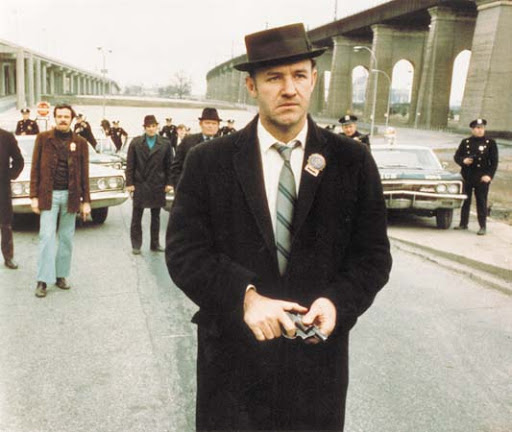 The French Connection started an obsession of Hollywood’s with gritty cop thrillers continued with Serpico and Dirty Harry (both arguably owing their places upon the list to the French Connection). Deciding to portray more than just car chases and shoot-outs, instead including the mind-numbing mundanity of spending hours listening at a wire tap, staking out a suspect’s house and dismantling an entire car to its base components, as well as the gritty violence almost required to make an arrest distances this far from more modern-day blockbuster police movies such as Bad Boys or SWAT. It’s a wonder we’re not shown policemen filling out a mountain of paperwork. Not to say that the shoot-outs and car chases in the French Connection aren’t incredible, with the chase against a criminal-carrying overground train being both the highlight of the film and possibly the greatest car chase in movie history.





 Life Vs Film