Seven

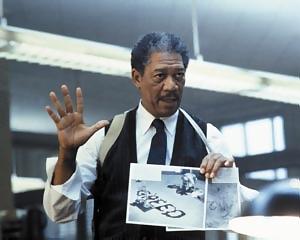
A buddy cop movie with a seasoned old hand so close to retirement they’re already scraping his name off the door and his hotshot, firebrand young replacement, this couldn’t be further from another Lethal Weapon. Yes, one’s a family man and the other’s a loner, one is prone to anger and the other a methodical, careful detective clearly too old for this shit, but where Richard Donner’s 80’s staple is an entertaining, action-packed romp, this is something much darker.After a disturbingly evocative opening credits sequence enriched with depth and meaning on repeated viewings, we meet Morgan Freeman’s detective Somerset, picking up his last case, a sickeningly masterful serial killer with a penchant for the seven deadly sins, the same day as Brad Pitt’s Detective Mills arrives to replace him. That’s as much setup as there is, as we follow the mismatched detectives from crime scene to crime scene, via their headquarters and areas of research, with Somerset whiling a night away poring over books in the library, whilst Mills take a brief glance at the Cliff notes.

The script is dotted with well balanced moments of humour – Somerset having dinner with Mills and his wife Tracey (Gwyneth Paltrow) – and some deep black humour: “this guy’s sat in his own piss and shit; if he wasn’t dead he’d’ve stood up by now,” plus R. Lee Ermey’s belligerent, furious Police Captain (“This is not even my desk” is one of my favourite film quotes, ever).

Crucially, we see none of the killer’s murders onscreen, merely their gruesome aftermaths. It’s not as gory as you might remember, but it evokes imagery and feelings that some may find disturbing, not least what happens to Leland Orser’s character, who probably has the worst memories of those who survive. It could be argues that this is a precursor to the Saw franchise, punishing those that seem to deserve it in creative, torturous ways, but at least here we are saved the nightmarish spectacles of witnessing the deaths.

At times the film feels a bit predictable, like a police procedural itself, but whenever this is about to happen the plot shifts direction, taking an unexpected twist to shake things up again. The colour palette of muted greys and browns, interspersed with deep reds amongst the incessant torrential downpour of the nameless city only adds to the feelings of despair.

There’s small roles for John C. McGinley and Richard Schiff in there as well, a nice surprise for me in the opening credits, but unfortunately at times the acting, especially Pitt during the final scenes, leaves something to be desired. The ending has become the stuff of legend, but I won’t reveal it just in case, save that Pitt’s gurning and crying are a bit over the top and take you out of the scene. This is another one of those films where knowing your actors may ruin the film too, as recognising a voice could cause annoyances later on, but not too badly.

Overall this is director David Fincher’s defining film (better than Fight Club in my opinion, though it’s been a while). The gritty tone is perfectly realised through every medium possible, the plot is gripping, the twists hold up and, though far from an enjoyable experience, it remains worthwhile.

Choose film 10/10

Mad Max 2 The Road Warrior

If the recent UK petrol strikes had gone on a little longer, chances are we’d have seen something not too dissimilar to the events here, in George Miller’s 1981 sequel to 1979’s Mad Max. Mel Gibson reprises his role of Australian cop Max Rockatansky, but the world he lives in is now a barren, chaotic land left ravaged by a worldwide war, leaving the survivors desperate for any fuel they can find.
Max and his dog roam the landscape looking for gasoline, eventually hearing about an enormous stash not too far away, and so with the guidance of a deranged nutcase with a flying machine (“It’s my snake, I trained it and I’m gonna eat it.”), set out to find it, but alas the compound within which the gasoline is kept is not only heavily guarded, but is also being laid siege to by a ruthless gang of miscreants.
Whilst this is certainly an improvement on the original movie, there are still a lot of things here that don’t make sense. For starters, the motivation for every character is to end up with more fuel, yet all seem to expend an awful lot more than they need to in order to get any. Whole fleets of cars and motorbikes are sent out on scouting missions, showboating and jumping as they go, and even the compound uses a bus as a gate. If fuel is so very precious, why are they all so eager to waste it?
The costume design has progressed from the previous film, and now the rebel gang has an even greater passion for leather, bondage and ass-less chaps than Max himself. The depiction of a lawless, structureless society is well done – one of the gang’s cars is a cop car, suggesting that it’s not just the general population that has lost it’s mind – and Max readily eats cold dog food, straight from the tin. There’s better characters too, including a feral kid with a deadly boomerang (played by the brilliantly named Emil Minty), and there’s some decent action and chase sequences. The epic finale, with the gang attempting to seize a petrol tanker trying to travel 2,000 miles to paradise, does get a little samey after a while, but is impressive nonetheless. The arm-mounted crossbow though is probably the least threatening weapon I’ve ever seen.
Fortunately, Mad Max 3: Beyond Thunderdome isn’t on the list, but this one is deserving of it’s place. It’s by no means the greatest dystopian future survival movie, but it’s still an enjoyable watch, and certainly has it’s moments.
Choose film 7/10

Far From Heaven

Hertford, Connecticut; 1957. Cathy Whitaker (Julianne Moore) is at the heart of her picket-fenced community, her husband Frank (Dennis Quaid) is a successful businessman and her two young children are little bundles of perfection, with her daughter wishing to one day grow up to be just like her mother, though her son is a little foul-mouthed (“Ah jeez” is not the kind of language Cathy tolerates).  But beneath the surface of floating dresses and pristine curls, all is not well. It’s clear from Cathy’s expression that, though her friends must all put up with their husbands’ occasional demands for intercourse, Cathy has no such problems, for Frank hides a secret; whenever he is ‘working late’ he tends to be frequenting a bar aimed only at male patrons that want to get to know each other a little better.
Todd Haynes’ movie lovingly recreates an idealised vision of 1950s suburban middle America (“Aw shucks” is uttered in the first four lines, and “jeepers” and “swell” aren’t too far behind) although the rampant sexism and racism would be more than frowned upon today. When Cathy shows sympathetic tendencies towards her black gardener Raymond (Dennis Haysbert, 24‘s President Palmer) she is the subject of mild ridicule and is frowned upon by the society that used to hold her dear. Haysbert is good in another of his solid, decent, all-round nice guy roles, but Dennis Quaid continues his run of being the worst thing about a film. I’m sure in his youth he must have done something to earn a reputation as an actor, but I can’t for the life of me think what it is, I’ve only ever known him as the worst thing in bad films (Flight of the Phoenix, Smart People, The Day After Tomorrow, Vantage Point).
The era is seamlessly recreated, to a point where the film could easily have been made in the 50’s – in which case it would probably be hailed today as a classic. Moore is the best thing in it, so much so that at times she barely seems to be acting, so great is the level of repression she must convey. She received an Oscar nomination for her troubles – Nicole Kidman must have been really great in the Hours to beat her.
Though at times it feels like nothing really happens, that is surely the point. This is more a study of the prejudices of the era – Frank’s grand social indiscretions can be brushed under the carpet or cured (a doctor has a 5-30% success rate for curing homosexual urges) whilst Cathy’s much lesser faux pas sees her outcast from all around her. The plot and script are a little hokey, but the performances and overall feel stay with you after watching this subtle piece.
Choose film 6/10

Edward Scissorhands

First off, apologies for the lack of posts recently, I’ve been in hospital for an operation on my nose (inspiring this Top 5). Also, apologies if the posts over the next few days are a little off, I’m on a veritable Pan Galactic Gargle Blaster of meds, but I’ll try and keep everything as on topic as possible.
Johnny Depp successfully accomplished the transition from TV heart throb to serious movie actor with this, Tim Burton’s fourth directorial outing, leading to at present a further seven collaborations between the two bizarelly-haired gentlemen. Depp stars as Edward, the creation of a reclusive inventor (the legendary Vincent Price, in an all too brief cameo in his final film role) who remains incomplete after the inventor passes away. Edward looks human enough, but where five-fingered appendages should be on the ends of his arms, there are instead a multitude of blades, knives and scissors. After being discovered living alone by Dianne Wiest’s kindly Avon lady Peg, Edward is brought into the ‘normal’ world of 1950s suburban American.
As much comedy is made from Edward’s physical impairment as possible, with his blades coming into contact with waterbeds and hindering his ability to get dressed, pick up a glass, open a door or touch his face, but he shows an aptitude for carving meat, topiary, hairdressing, dog grooming, paperchain-cutting and being used as a kebab skewer. This does bring up the subject of exactly how Edward had survived alone in the castle before his ‘rescue,’ but as this is essentially a fairytale, minor plot details can be smoothed over.
As ever, Burton shows a deft hand with his casting. Depp is wonderful as Edward, showing childlike wonder at the new world around him, and expressing true depth of emotion from behind a stark appearance, all pale face, scars, bedraggled mop of hair and tight plastic and leather bondage-inspired clothing, and with minimal dialogue. Winona Ryder is cast against type (in that she wears colourful clothing and has blonde hair) as Peg’s cheerleader daughter Kim, and Alan Arkin and Wiest are wonderful as the parents welcoming Edward into their home. Anthony Michael Hall as Kim’s brutish boyfriend is more of a stretch though; the nerdy Breakfast Club star cannot be taken seriously in a bad guy role.
The film is lighthearted and entertaining, and has some genuine comic moments. The bookends of a clearly aged Winona Ryder are more obvious than the supposed narration reveal of the Notebook, but this features one of the greatest and most memorable character creations of cinema, and some fine acting too.
Choose film 7/10

The Dark Knight

What can I say about the Dark Knight that a thousand others before me haven’t? Of all modern films, this seems to be the one pored over most closely and often, heralded as the saviour of the summer blockbuster, superhero movie and crime thriller, all rolled up in the tightest of scripts. So, to take a fresh perspective, I sought out some people who didn’t like the film (thank the lord for the Internet, it makes people who don’t like something so easy to find) and found myself furious after reading just one and a half 1/10 reviews on IMDb. The sheer level of nitpicking and miniscule plot-hole unravelling proves just how far people are willing to go to disagree with the masses and stand out from the crowd, even when the crowd is so undeniably correct.
Not that this is a perfect film. There are flaws, including the Joker’s plan being at times a tad too pre-emptive, some ominous camera angles and music cues hinting unsubtly a character’s true motives earlier than should have been done, and the bit with the cellphones, which is a bit silly, but is that really enough to warrant a 1-star rating? The fact that these reviewers (I won’t give them the satisfaction of names or links, only seek them out to feel the rage bubble inside you) fail to note even one positive point in a movie overflowing with brilliance negates any opinion they deem worthy of sharing. I personally find it impossible to find nothing good in a movie – The Adventures of Pluto Nash is an abomination unto film, yet Randy Quaid is a delight as Nash’s robotic assistant; Big Trouble in Little China is easily one of the worst films I’ve reviewed from the list so far, but it has imaginative (if insane) monsters and mythology, some dialogue that surpasses cheesy to being inspired, and features Kim Cattrall back when she was attractive. Therefore, with such damning reviews as these ‘people’ have offered, they are in fact unwittingly proving how good a film it is.
Leaping from the tantalising springboard ending of BatmanBegins – Gary Oldman’s Jim Gordon showing Batman a playing card left as the mark of a new criminal, calling himself The Joker, we dive headlong into a wonderfully executed bank heist, as six masked goons effortlessly separate mob money from the vaults it was stored in. Director Chris Nolan has made no secret that Heat, Michael Mann’s superb DeNiro/Pacino cat and mouse crime epic, was a huge influence on the Dark Knight, and it shows, from a William Fichtner cameo to a central meeting of the hero and villain, even mentioning a cup of coffee.
Nolan wisely improved upon some mild mis-steps made in Batman Begins here, replacing Katie Holmes with Maggie Gyllenhall as love interest Rachel Dawes, giving Batman’s mask a cowl so he can turn his head, and giving Batman himself (Christian Bale, good but no Adam West) a little less screen time, allowing alter ego Bruce Wayne and his various accomplices and nemeses some breathing room. Aaron Eckhart is spot-on as Harvey Dent, Gotham’s shining hope against the mob, and Morgan Freeman and Michael Caine remain on hand to add a touch of old school class and grandeur as Wayne’s dependable CEO nad curmudgeonly butler/moral compass, but justifiably most of the praise has been directed at the late Heath Ledger’s Joker. A creation for the ages, his layered performance of a truly maniacal genius reveals more with each viewing, and it is unfortunate that the role showcased the true acting abilities of a man previously thought of merely as a rom-com heartthrob only after he had passed. Plus, it gave us all another Hallowe’en costume to use.
Unusually for Nolan, the film is actually quite funny. It’s not exactly laugh-a-minute (there’s certainly less than 152 jokes here), the script is still a lot more humorous than you might remember. There’s also absolutely no filler, with every strand being integral to the plot; a true achievement when you consider just how engaging the story is, even when new elements are being added right up until the last few scenes.
As always with Nolan’s films, there’s a couple of cinematography moments that I’d have tried differently (see Inception), most notably the scene where the Joker leaves a hospital, which could have looked truly tremendous had it been one unbroken shot, without needlessly cutting away to some pedestrians nearby, but this is a small matter that is more of a personal niggle than a criticism.
Anyway, for those wondering if they should watch the film again before the upcoming trilogy closer The Dark Knight Risesthis summer, the answer is a resounding yes. Even if you don’t intend to see part 3 (I assume you’re planning on gouging out your own eyeballs, just in case it isn’t any good, there’s no other reason not to see it) you should watch The Dark Knight again, just because it’s probably the best film to have been released in the last 5 years, if not more.
Choose film 9/10

A.I.: Artifical Intelligence

Kubrick’s visionary ideas, social commentaries and moral dilemmas don’t quite gel with Spielberg’s family oriented sentimentality in this disjointed and overlong offering, conceived and planned by the former but implemented by the latter after his death in 1999.

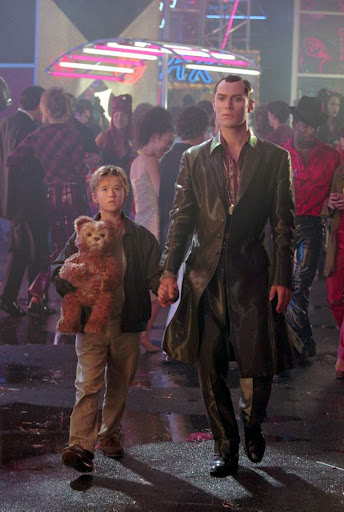
Now, I love me some robots. Whether they’re compacting waste into trash skyscrapers, travelling through time to save Sarah Connor or trying to kill Will Smith, you show me a film with robots in and I’ll watch the Hell out of it (though I’ve never actually seen the 20th Century Fox film Robots starring Ewan McGregor and Robin Williams, just never came around). There’s a robot clock watching me from atop a bookcase in the lounge, robot cushions on the sofa and a robot cookie jar whose head seems to rotate around and look at me wherever I am. But the key characteristic that joins these all together, is that they all look like robots, which is where A.I. looses my interest, for here they look like people. Yes, I know that’s the point. Haley Joel Osment’s mini-mecha David has been created to fill the hole left when his new parent’s son goes into a coma, and Jude Law’s robo-gigolo Joe (that’s fun to say) would be downright weird if he didn’t look a lot like a human, but that’s not what I want to see in a film about mechanical men. It isn’t until over half way through the film that we see some older models and exposed innards, and even then it’s far too briefly.

Osment is good, too good, as the automated child, and occasionally he passes for human, but for the most part he’s in full-tilt terrifyingly creepy mode, following his ‘mother’ Monica (Frances O’Connor) around the house all day, standing and watching her until she justifiably locks him in a cupboard. The first 45 minutes could quite easily be the start of a horror film, so disturbing is David: “I can never go to sleep, but I can lay quietly and not make a peep.” Nothing he does is endearing or even likable, but then I’ve always felt this way about children, but still the brief amount of time it takes for Monica to bond with this mechanised horror is jarring, especially given there seems to be no real scenario that draws them together. Also, David is only programmed to ‘love’ one parent, and his new ‘father’ Henry (Sam Robards) seems devoid of emotions, either for his comatose son or the new replacement, so that fits together nicely.

The movie is comprised of a series of episodes that, once passed, are all but forgotten. The story could have been interesting, and the world has potential for a more enthralling film within it, especially in the city scenes, and the brutal Flesh Fairs, where rogue ‘bots are hunted and tortured to a baying crowd’s delight, but over an hour of watching David desperately wanting to be a real boy becomes terminally dull. The future technology and gadgetry is generally good, subtle yet insightful, although the cars look a bit silly. And the ending is polarising, I found it terrible and unsatisfying, whilst Aisha thought that, whilst it seemed tacked on and unnecessary, it was still very moving.


Choose life 5/10

Iron Man

Iron Man was the superhero movie we were all waiting for, we just didn’t know it; discovering the missing ingredient from all those that came before it – comedy. Though many that came before it weren’t overly serious, dark or gritty, they still took themselves too seriously, but Iron Man ensures a thick vein of comedy runs right the way through it. Released over 2 months before the masked behemoth and current comic book movie touchstone The Dark Knight, Iron Mancame out of nowhere with an untested star and middling director in Robert Downy Jr, and Jon Favreau. RDJ was still making his comeback after years of exile from Hollywood due to substance abuse, and Favreau’s most mainstream work was Christmas classic Elf, but he wasn’t exactly known for blockbusters, but after the movie’s release both found themselves sitting pretty on the A list.
Stark is such a great creation. By his own admission a “genius billionaire playboy philanthropist,” yet Downey Jr. somehow makes such a character not only likable, but one you’d willingly like to go for a drink with, and not just because he’d not only pick up the tab, but probably already owns the bar. He ably assisted by Gwyneth Paltrow and Terrence Howard as his dependable assistant and best friend, and Jeff Bridges is on fine menacing-brow villain mode as Obediah Stane, the business partner of Stark’s deceased father.
Iron Man has an advantage over other superhero stories in that Stark’s story is actually interesting. A twist of fate doesn’t have him bitten by a spider, he isn’t an alien from a distant planet and he isn’t avenging his parent’s death. No, Stark had all of his superpowers before the film even starts. Wealth, intelligence, a sharp with and an immaculate goatee are goals he’s worked towards and achieved; he just needed the push to fit them all together in the form of a titanium-gold alloy flying suit with a rocket launcher and flamethrower, and what greater motivation than a terrorist attack against him, using the very weapons his company created? This means that the villains are also people every can be against – terrorists and the evil corporation heads who supply them.
The best scenes involve the subtle yet inspired gadgetry around Stark’s house, from the Paul Bettany-voiced quasi-butler Jarvis, to the robotic arms that are a little over zealous with the fire extinguisher. The flawless suiting up sequences and Downey Jr. interacting with nothing but a mechanical three clawed appendage aren’t too showy, yet set the film above its rivals.
The only possibly problems are that Howard’s Officer Rhodes is bland, but then who wouldn’t be compared to Stark, and the Stane-is-a-villain story arc is clearly signposted from the get-go, having been given the perfect set-up as the man who took on Stark Industries when it’s CEO passed away, only to be muscled out by some upstart genius, that and his full head with a thick, lustrous beard mean at some point in the near future he’ll be laughing with maniacal glee and threatening the hero’s love interest. Now that the Avengers (sorry, Avengers Assemble) is in place, this film does seem like a bit of a precursor to it, especially the scenes involving Clark Gregg’s Agent Coulson, which don’t really add anything here other than some fanboy cheers every time someone says Strategic Homeland Intervention, Enforcement and Logistics Division, but the scenes don’t detract too much, and can be forgiven as they tie everything up nicely.
Otherwise, the film is pretty much perfect, and remains enjoyable after many viewings.
Choose film 8/10

Good Morning, Vietnam

Barry Levinson can’t work out whether he’s Oliver Stone or Jerry Zucker in this Vietnam-based Robin Williams vehicle. Heavy handed politics and imagery of riots, fire and explosions doesn’t tend to gel with zany antics and improv riffing from one of the world’s leading fast-talking funnymen, but fortunately Williams is on fine enough form to just about rescue the material from an uneven mess, as his radio DJ Adrian Cronauer is brought in to perk up the on-air talent of 1965 Saigon. The troops love him, but his superiors, including the late, great Bruno Kirby’s put upon aggressive peon Lt. Steve, are less keen on his refusal to play approved material and pre-programmed songs, opting for rock and roll over Perry Como. Some storylines seem forced and contrived – Cronauer repeatedly infiltrating an English class just to meet a girl, her entire family accompanying them on a date – and you get the feeling that this is only loosely based on a true story.
Where it shines though is the comedy. Though some of the references are now very dated and probably worked a lot better back in the States (Ethel Merman, Walter Cronkite, Mr. Ed), Williams knack for voices and repartee with a crowd is unparalleled, though a young Forest Whittaker as station lackey Edward Garlick gets his share of decent lines too: “A man does not refer to Pat Boone as a beautiful genius if things are alright.”
The film tries too hard to make a political statement where none is wanted, and the failed attempts at poignancy leave a bad taste in the mouth. Had the serious side been toned down – difficult, I know, given that it’s about war – and the directionless plot been reined in a little this could have been a classic.
Choose life 6/10

An American Werewolf in London

After being attacked on the Moors in rural northern England, a young backpacking American (David Naughton) awakes in a London hospital and falls for his nurse, Walkabout’s Jenny Agutter. This leads to some romcom hijinks, mostly involving Agutter’s Alex not being allowed to sleep with patients, and the vacationing David bored and alone in her apartment all day with no money and no where to go, trying to amuse himself. Oh, one last thing, David’s a werewolf being stalked by the ever-decaying remains of his zombie best friend. Sorry, forgot that bit.
This film is great, mostly memorable for Rick Baker’s stunning effects, featuring a transformation entirely CGI free that looks and feels unbearably painful and has yet to be equalled over thirty years later. There are some good jump scares and creative cinematography, with even a stationery phone box call shot seemingly on a circling bicycle. The subway sequence is particularly exhilarating, and the film is a lot funnier than you might remember, especially the scene in the porn theatre, with various undead suggesting the best ways for David to kill himself (we finally get to see director John Landis’ in-joke movie See You Next Wednesday, referenced in all his films, that turns out to not be that recommendable).
Unfortunately Landis doesn’t follow Spielberg’s rule of not showing too much monster, as the later scenes, before an overly abrupt ending, reveal the creature too clearly, gnawing away at some of the mystery. Frank Oz’s cameo as an American embassy official is also offputting, as I can’t take him seriously when he’s doing a voice that sounds exactly like the one he uses for Fozzie Bear in the Muppets. The most unbelievable part though? It’s possible to get a taxi far in London for £1.50. Ridiculous.
Still, thoroughly enjoyable and worth watching for Baker’s Oscar-winning make-up and effects.
Choose film 7/10

Four Weddings and a Funeral

Richard Curtis and Hugh Grant seem to be a match made in heaven. So far they’ve collaborated on three features (Notting Hill and Love, Actually being the other, equally enjoyable films that, for some reason or another, aren’t on the List), and Grant’s lovably foppish dithering perfectly fits into Curtis’ skill with a subtle put-down or throwaway comment.
Here, Grant plays Charles, terminally lost amidst a sea of acquaintances tying the knot, swinging from one wedding to the next seemingly every weekend. Perpetually late, lost and underprepared, Charles is a creation that, if you don’t know someone just like him, it’s probably you in your circle of friends. And it is this circle, just like in Notting Hill, that makes the film what it is. The supporting characters in any film have the potential to be more layered and interesting than the audience ciphers required as the leads. If need be they can even be people you don’t overly like or agree with, but fortunately here they’re a wonderful bunch, from Kristin Scott Thomas’ heartbreakingly brittle Fiona, John Hannah’s dependable Matthew, Simon Callow’s enigmatic, irascible Gareth and of course James Fleet’s hopelessly wealthy Tom, who trumps Charles for the worst best man come wedding number 3 (sample speech quote: “When Bernard told me he was getting engaged to Lydia, I congratulated him because all his other girlfriends were such complete dogs. Although may I say how delighted we are to have so many of them here today”).
Often hilarious and at times genuinely touching, not the least in Matthew’s moving elegy at the titular funeral, the script is also so much swearier than you remember (“fuck fuckety-fuck”), and deals with all the problems one might encounter at a wedding – drunken bride, boorish guests, horrendous dresses, improbable hats and inappropriate songs (I Will Survive, at a wedding?) as well as the more unusual scenarios, like being sat at a table full of your former partners, or being trapped in the room the happy couple are consummating their vows in.
The only problems occur are the horrendously cliché rain-soaked finale (“Is it still raining? I hadn’t noticed”) and the casting of Andie MacDowell as Charles’ American dream girl, who is only actually desirable the less he gets to know her in my opinion.
Choose film 7/10