Memento

Christopher Nolan’s first major picture (after 1998’s Following, which is interesting but a tad too confusing, and really for completists only) is at first glance nothing but a gimmick, using a reverse-narrative to tell the detective noir of Guy Pearce’s Leonard Shelby as he hunts for the man who raped and killed his wife whilst suffering with a rare condition that prevents him from making new memories. However it turns out that telling the story backwards, scene by scene and with an expositionary telephone conversation spliced in between, is the only way to give the story justice.
Famously, there is an easter egg on the Memento DVD that plays the film in chronological order, and I’ve discovered that in that orientation the film just doesn’t work. It’s not just because the last few seconds of every scene are replayed again moments later at the start of the next one (surely that wouldn’t have taken much to edit out?) but it’s also because the film is completely lacking in tension or pacing when that way round. Which just goes to show that Nolan was able to use a plot technique to it’s fullest advantage, which in the hands of a lesser director could have proved disastrous.
Pearce is excellent in an unforgiving role, especially given that Leonard has no character arc longer than a scene. He’s always been a brilliant actor, and often hides his Brad Pitt-esque looks behind obscuring facial furniture or heavy make-up – see Ed Exley’s glasses in L.A. Confidential, or large amounts of Play-doh in Prometheus – and here is no exception, with Shelby’s body plastered with tattoos and a shock of peroxide blonde hair to distract from those razor-sharp cheekbones. Pearce is ably supported by Carrie-Anne Moss and Joe Pantoliano as Natalie and Teddy, people who may or may not be out to help Leonard on his quest.We discover elements of the story as Leonard does, and the true meaning of almost every scene is altered by the one that immediately precedes/follows it. Surprisingly, a scene can hold just as many surprises, and just as much tension, if you know how it ends but not how it begins. You can’t help but feel sorry for Leonard, in a situation that would drive most of us insane – as long as we could remember the insanity long enough – and his life would be hard enough without everyone screwing with him. Even the clerk at his motel (Batman Begins‘ Mark Boone Junior) charges him for two different rooms, and doesn’t even hide it from Leonard, as there’s no chance he’ll remember.

There’s more comedic moments than you might remember, and some darkly so, for example the conversation where Leonard reveals to Natalie that the last thing he remembers is his wife. She says that’s sweet, before Leonard concludes “…dying.” I probably shouldn’t have, but this got a start of laughter from me.

I remember that my first viewing of this movie was ruined when I borrowed it from a housemate some years ago. He basically told me the ending, and that the film was crap, but I watched it anyway and remained intrigued and fascinated by how the plot would tie together – which it does nicely. Rest assured I never took that housemates movie advice again.

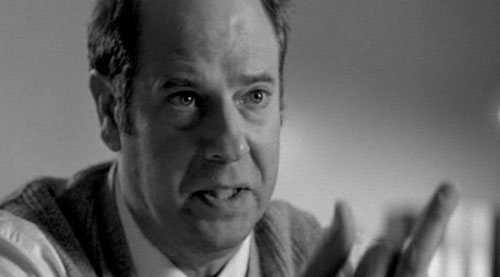
If Stephen Tobolowsky is in a film, then I’m legally obliged to mention him in a review, and here he crops up in grainy, black and white flashback as Sammy Jankis, a case Leonard looked into as an insurance claims investigator before his memory loss. Jankis suffered from a similar condition as Leonard, and Tobolowsky’s wonderfully big blank face is perfect for the look of someone not recognising anything new in the world around him, and his bursts of anger at annoyance – at an elctro-shock test and not understanding TV shows – is also great.

The story, written by Christopher Nolan’s brother Jonathan, is well thought out and takes into account the minutiae of Leonard’s predicament. Such a high concept (though scientifically possible) film could have left many annoyances at skipped over details, loose plot strands or inconsistencies, but by the end/beginning no such problems are left.

Choose film 9/10

The Piano

First off, an apology for the forthcoming review. I watched the film three months ago, and have gotten so far behind on my post writing that I’ve not had any real desire to review it, as to be honest it wasn’t that inspirational of a film. Nonetheless, I shall do my best, but I’m relying almost solely on the notes I made during the movie, as I can’t for the life of me remember very much of it. As you can probably guess, this isn’t going to be much of a recommendation to watch the film.
Holly Hunter plays Ada McGrath, a woman who, aged six, willed herself mute, and has since never spoken a word. She moves from Scotland to New Zealand for an arranged marriage with Sam Neill’s landowner/writer Alisdair, and brings her young daughter Flora (Anna Paquin in her first live action picture) and their piano, Ada’s pride and joy. Neill is less than impressed with his new bride-to-be (“You’re small, I never thought you’d be small”), and refuses to cart her piano across the difficult swampland between the beach and his home, so they abandon it on the sand, much to Ada’s discontent. Fortunately local plantation worker George Baines (Harvey Keitel) takes a shine to Ada, and trades some land with Alisdair for the piano, and agrees to trade it back to Ada in return for ‘piano lessons,’ during which George will get to know Ada far more intimately than she’d like.

Hunter and Paquin both won Oscars for this film, and Hunter at least thoroughly deserved hers (Paquin is excellent for an 11 year old, but though I haven’t seen any of the performances she was nominated against I wouldn’t be surprised if any of the actresses, including Emma Thompson and the aforementioned Hunter, performed more capably). Hunter’s Ada is utterly repressed, yet still emotive and expressive, all pursed lips and passive eyes, her skin a deathly pale against the stark black of her dresses and bonnet. Keitel is also good, though his proclivity for whipping his pecker out is always a distraction, and is for the most part unnecessary.
I got the feeling that the film was made to prove the point that a lead character doesn’t need to speak (see also: Dumbo). There isn’t too much of a story here, with the events built entirely around the character and her very existence rather than the exciting or emotional events in her life. Her character is well realised, especially the bond with her daughter, and her slowly breaking down walls against Baines’ advances. Communicating only through sign language, facial expression and a small chalk-board locket, she says more than any other character, and with far less.
Despite the poetry of the film, such as Keitel’s Baines being willing to just sit and watch the piano hammers dancing gaily along the strings, I didn’t take much away from this film, and it has had little to no lasting impact on me. It’s very slow, and the message is muddled, though I think it has something to do with choosing the correct way to woo someone. Alisdair goes about things in entirely the wrong way with Ada. If only he’d coerced her into, essentially, prostitution, he’d have been much better off. Oh, and the best part about the film? It features an actress called Geneviève Lemon.
Choose life 6/10

The Money Pit

I had high hopes for this film. I’ll gladly watch Tom Hanks in anything (I didn’t even mind Larry Crowne that much), and it co-stars Shelley Long who, having starred in Cheers, must be good for something. Well, OK, maybe not high hopes, but some hopes that I’d enjoy this film, but alas even those hopes were too high. I understand now why ASDA were recently flogging this DVD for £3. It’s not that it’s a terribly bad film, it’s just confused, contrived and desperately unfunny, which considering it’s an 80s comedy, makes it something of a failure.
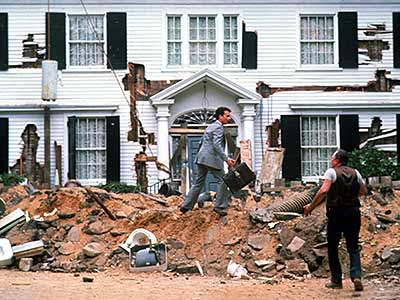
Hanks is Walter Fielding who, along with his partner Anna (Long), find themselves in desperate need of a place to live after a series of silly  and easily avoidable plot points. When they discover an astoundingly cheap yet extravagant mansion, they buy it with an almost reckless abandon, despite the inevitability of it collapsing upon them. Needless to say, everything that can go wrong with the house does.

My main problem with the film is that at no point did I feel sorry for the two leads. I’m a home-owner, and have had a fair few problems with my flat, but unlike Walter and Anna, I didn’t have a wealthy employer/ex-spouse or client who would pay for everything, as is what happens here. Other than having to live in a building site for an extended period of time, the two don’t really have any long term problems, other than each other.
Also, the film is decidedly short on laughs. There were some farcical moments – the bathtub falling through the floor and Hanks getting stuck in the floorboards – that were a bit humorous, but mostly the film tried too hard and came up with nothing. One sequence involved Hanks in a ridiculous chain reaction involving a moved plank, circular saw, pit of wet cement and collapsing scaffolding. The setup can be seen a mile away, and the scene offers almost no payoff. It looks like Walter is about to be ousted as a KKK member when a black builder spots him on the roof dressed head-to-toe in white and wearing a hood, but no, the cement all gets washed off in a fountain, so there isn’t even any chance for him to become a kind of living statue. So many opportunities were missed for greater comedy, and there’s very little else that sticks in my memory about the film.
When Joe Mantegna pops up as a building contractor my hopes picked up, but then he never came back again, so I was deprived of getting to watch Fat Tony as well as listen to him  Even if you’re a Hanks fan and have a desire to watch everything he’s been in I still wouldn’t recommend this film, as though he has great comic timing and can pratfall like the best of them, even he can’t make this film watchable. Avoid.
Choose life 3/10

Born on the Fourth of July

Does anyone else find it funny that Tom Cruise, whose birthday is the third of July, starred in a film called Born on the Fourth of July? No? Just me then.
Olive Stone is one of those film makers that I don’t really get. I’m not that much of a Platoon fan, nor can I say I have any affiliation with Wall Street. Natural Born Killers has it’s moments, and I can’t remember a single scene of Any Given Sunday, though I saw it less than 2 years ago. Other than that, I haven’t seen anything he’s made, though my hopes are up for JFK, whenever I eventually get around to seeing it. Born on the Fourth of July seems like a typical Stone movie, in that it comes deeply ingrained with a message (war is hell and will mess you up), and though at first glance it may seem patriotic, if you look a little deeper it’s really a chance for Stone to voice his own personal feelings about his country.
Tom Cruise is Ron Kovic,who growing up in 1950’s Long Island idolised the war heroes in the Independence Day parades. He looked past the wheelchair, crutches and missing limbs, seeing only the glory and patriotism of being a hero. Kovic spent his school years working hard and being committed to being the best, and after his wrestling attempts didn’t quite work out, he responded positively to a presentation from the US Marine Corps, and signs up with a few buddies, including Stephen Baldwin.The scenes of Kovic’s childhood are shot with a hazy, wholesome, rose-tinted nostalgia, and his family, especially his mother, are all very supportive of Ron’s decision to head to Vietnam and fight for his country, and die there if he has to. The era is well realised – particularly though the soundtrack, as Ron’s brother learns Bob Dylan on the guitar – and the TV broadcasts, with Kennedy’s “What you can do” speech seemingly speaking directly to Kovic.

After signing up and heading to war, the action skips straight over boot camp and the green-horn period – Stone covered all that in Platoon three years earlier – and drops us straight into the now Sergeant Kovic’s Second tour of Vietnam in 1967. These sequences are atmospheric and well-realised, but they’re less impressive than almost any other war film. It’s a good thing then that this film isn’t really aiming to show an accurate, visceral depiction of warfare, instead focusing on the disillusionment of volunteers, the effects that warfare can have on those who fight it, and the disconnect between the soldiers and the families they’ve left behind. For when Ron is discharged – in a wheelchair, with the promise that he’ll never use his legs again (though his main concern is being able to use what is between those legs) – he discovers that his brother doesn’t believe in the war, and his friends that stayed home became prosperous and affluent, whilst he had everything taken away from him.

The cats is full of familiar faces from anyone who’s watched Platoon – alongside Tom Berenger’s Marine recruiter is Willem Dafoe’s similarly paralysed veteran, and John C. McGinley turns up for a very small role (as do Wayne Knight and Tom Sizemore).

The film takes a very long time (145 minutes) to put across some fairly simple ideas. The first 90 minutes are thoroughly predictable, and there were very few surprises in the last hour either. Tom Cruise isn’t bad in the role, but as ever he always does better when he isn’t front and centre (Magnolia, Tropic Thunder), and I couldn’t shake the feeling that he was desperately pursuing an Oscar. Though he was nominated, it’s no surprise that it went instead to Daniel Day-Lewis for My Left Foot, and I’d still have been happy had it gone to fellow nominees Robin Williams or Morgan Freeman, for Dead Poet’s Society or Driving Miss Daisy, instead of Cruise.

It’s worth watching if you’re a Stone or Cruise completist, but there’s little new here, and what there is still won’t surprise, or impress you.

Choose life 5/10

Seven Brides For Seven Brothers

I’m not normally a huge fan of classic musicals. I quite liked West Side Story, but couldn’t abide The Sound Of Music, so my hopes weren’ exactly high for this 1954 classic of which I knew very little, other than there were presumably at least fourteen characters. I’m relieved to tell you that not only did I not find this film terrible, I frickin’ loved it.Set in 1850’s Oregon, the film predominantly follows Adam Pontipee, the eldest of seven brothers (duh) who all live away from society in a secluded shack, as woodsmen. Whilst visiting town to trade, Adam sets out to find a wife, and somewhat surprisingly the local cook Milly agrees to take the position, and they marry as soon as she finished her chores, before heading back to his house. Once home, Milly discovers the rest of her new husband’s clan, whom he’d neglected to tell her about before, and soon finds herself playing Snow White for these seven giants, doing all the cooking and cleaning in their initially disgusting hovel. When the other boys decide they too would like a wife, Milly steps in to see if she can teach them to be gentlemen.

The plot is, frankly, ridiculous, and full of so full of sexism its funny. Adam (Howard Keel) is chauvinistic, slovenly and completely tactless (“What do I need manners for? Already got me a wife.”) and he has absolutely no qualms about essentially conning a woman into being a slave for him and his six siblings. His proposal to Milly (Jane Powell) will probably go down in history as the most romantic in cinematic history. Sidling up to Milly whilst she milks a cow he proclaims “Ain’t got a woman, how ’bout it?” Clearly, back in the 1850s romance was far from dead.

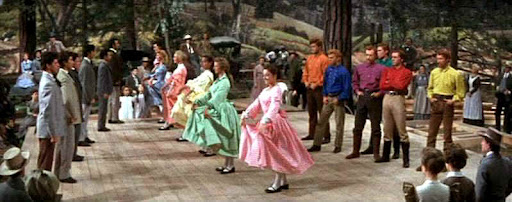
Unusually for a musical, I actually approved of the music, and even the dancing. Some of the songs weren’t terribly memorable, but others are still stuck in my head, most notably “Bless Yore Beautiful Hide” (again with the romance), “Goin’ Courtin'” and “sobbin’ Women.” The dancing too is very impressive, probably because most of the eponymous brides and brothers are professional dancers. The barn-raising sequence is great even though it’s very long, with the brothers competing for the affections of the locals girls against the men that brought them there. A prime opportunity was missed for some colour-coordinated dancing though. Some of the later axe-dancing is a little silly, but it does fit in with the overall tone of the film.

The plot is based on Stephen Vincent Benet’s short story The Sobbin’ Women, itself influenced by the Roman legend of The Rape of the Sabine Women (back then rape meant abduct, this film isn’t that dark). The script takes some interesting turns and has a great, if a little predictable, ending. The brides being just as willing to resort to fisticuffs as the men was a nice touch.

At times the film gets a bit sombre, when various groups become lovesick and lonely, but there’s always an upbeat musical number not too far away, and unlike most classic musicals, this one isn’t unbearably long. I’d quite like to see a remake, with an allstar ensemble cast in the lead fourteen roles, but I get the feeling it would be terrible.

Choose film 7/10

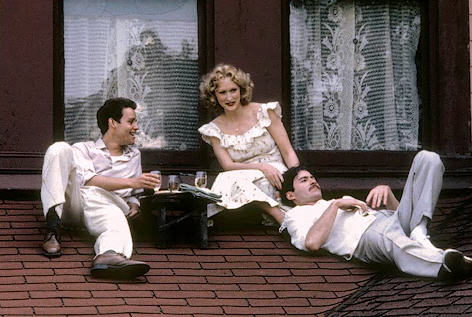
Sophie’s Choice

The unfortunately named Stingo (Peter MacNicol) moves from his southern home to be a writer in New York. He rents a room in a house, and so finds himself firm friends with a neighbouring couple, Sophie and Nathan (Meryl Streep & Kevin Kline). Sophie and Nathan have a tumultuous relationship, as she has a tragic past and he has issues of his own, and slowly Stingo learns of their history, and the hardships Sophie has had to endure.
In the world, there are happy films. They are stories about underdogs overcoming adversaries, battling against hoards of naysayers as they set out to win the court case/football game/heart of the cheerleader. The kinds of films where, upon finishing, you punch the air and yell something, just to join in the triumphant atmosphere. And then there’s Sophie’s Choice. Watching this film is like receiving one punch to the gut after another, rounded out with a swift thwack to the head with a two-by-four. It’s like watching Schindler’s List whilst listening to country music and drinking a glass of orphan’s tears. If you have a big grin plastered over your face after watching the film, I’m guessing you wouldn’t have been out of place in the Hitler Youth back in the 1940’s. The happiest parts of this film occur between the three leads as they enjoy a life of carefree wonder, visiting Coney Island dressed in period garb, but even these moments have the rug pulled out from them eventually.

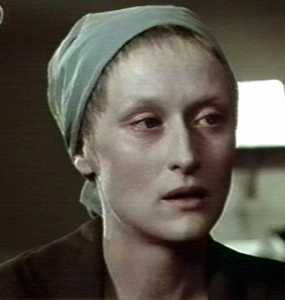
As with many films on this list, I have a history with this movie. I’d heard it was good, so I borrowed a copy from my Grandad – a copy he’d got free from a Sunday newspaper and never intended to watch, yet he still required it returned after I watched it. Free DVDs don’t tend to have much in the way of DVD extras, up to and including DVD menus. In fact, most will just play straight out, without you needing to touch a button. In fact, I’ve watched one before that didn’t even have chapters. I tried to skip back to catch a line I’d missed, and ended up back at the start of the film, and had to fast-forward to the scene again. What a time we’re living in. Anyway, Sophie’s Choice was such a film that had no extras, just a big old ‘PLAY’ button. I’d heard that, for Streep’s Oscar-wining performance she’d learnt Polish and German for the role, which was not something I’d given a second thought to until, over halfway through this 2 1/2 hour film, there’s the first of a few flashback sequences of Streep’s Sophie in WW2-era Germany, and the DVD had no subtitles, leaving me to attempt to watch and understand what are probably the more famous and pivotal scenes of the film, without the aid of knowing what anybody was saying. To the actor’s credit, for the most part I think I understood it, but still. I’ve known someone to go through a similar situation with Vicky Cristina Barcelona, but that was their fault for watching an illegal download.There are some actors who have a very famous role that they simply cannot overcome for some people, or in this case a role they’ve only played once but that has been seen many times. For me, Peter MacNicol will always, and only, be Dr. Janosz Poha from Ghostbusters 2. The mild-mannered southern writer Stingo doesn’t stand much of a chance against Janosz, seeing as he’s given very little characterisation here, but then this isn’t his film, he’s a cypher through which we get to know Sophie. This film belongs entirely to Meryl Streep, whose performance is just as good as it’s ever been suggested. No superlative can be left unused when describing the levels she goes to, mentally, physically and linguistically, to completely transform herself into the concentration camp surviving Sophie. Her accent is spot-on, and you completely forget you’re watching Meryl Streep. If it weren’t for Kline and MacNicol sharing the screen with her, I’d occasionally have sworn it was a documentary. I’m guessing that Julie Andrews, Jessica Lange, Sissy Spacek and Debra Winger, the other Leading Actress Oscar nominees that year, didn’t even bother showing up to the ceremony. Not only did she learn Polish and German, but Streep goes so far as to convince that they are her first languages, as she trips and stumbles her way through near-broken English, whilst during her flashbacks of the camps she looks to be several days passed Death’s door with her pallid skin, sunken eyes, roughly shaved head and frail, skeletal frame. This performance should be mentioned in the same breath as DeNiro in Raging Bull. It’s hardly a surprise that the rest of the cast pale in comparison.

It’s a shame then that her performance is the only outstanding part of the film. I had an understanding of the meaning of the title before watching, so assumed it would play a large focus in the film, but it is only at the climax that we see the pivotal scene, and it’s very nearly glossed over. We get a sense of the ramifications and the how it has made Sophie who she is today, but it eventually turns out that the choice she made would have made absolutely no difference anyway. As a story detailing the personal effects of concentration camps and World War 2 this is compelling, yet there are too many detours to detract from the story in an attempt to lighten the mood – Stingo’s date with the nymphomaniac Leslie Lapidus (Greta Turken). There are some nice comparisons between the camp prisoners and the guards – an officer’s daughter complains about the lack of a heated swimming pool.

The film also falls into two of my bigger pet peeve pits, in that a 28-year old MacNicol, who looks about 35, is playing a 22 year old, and at a couple of times there are phone conversations where the person on the other end is almost inaudible, but not quite, so some volume control had to be undertaken.

Despite possibly the greatest acting performance ever, this film is unfortunately let down by an incredibly depressing plot and an unsatisfying ending. There’s no doubt it’ll stick with you for a long time, but I highly doubt you’ll ever want to watch it again.

Choose life 7/10

Troy

Regardless of whether you know the story of Homer’s Iliad, it’s a certainty that you know of the expressions Helen of Troy, Achilles’ Heel and The Trojan Horse. These plot points have become more than the legend of which they are a part, and have entered the modern lexicon as sayings and day-to-day phrases. They aren’t anything new, you know what is means and have heard them a million times before, and the same can be said for every aspect of this film.

Continue reading

Sense and Sensibility

 Lord Dashwood (Tom Wilkinson) passes away and, unable to split his vast estate between his two families, his wife and three daughters are ousted from their palatial mansion by their half-brother John (James Fleet) and his vile wife Fanny (Harriet Walter), and are forced to considerably downsize their opulent lifestyles. Hope, it seems, arrives in the forms of Fanny’s reserved brother Edward (Hugh Grant) and the dashing Mr. Willoughby (Greg Wise), who each take a shining to two of the Dashwood sisters (Emma Thompson and Kate Winslet).

Continue reading

The Ghost and Mrs. Muir

One of the most unusual romantic stories I’ve ever heard, Joseph L. Mankiewicz’s film sees the widowed Mrs. Lucy Muir (the achingly beautiful Gene Tierney) fleeing her haughty, oppressive in-laws and moving to the seaside with her daughter Anna (a young Natalie Wood) and their maid, Martha (Edna Best). Upon arriving at Whitecliff-by-the-Sea, Lucy seeks the assistance of estate agent Mr. Coombe (Robert Coote) in finding a suitable property. She is immediately taken by Gull Cottage, despite the disapproval of Coombe and the warning that no other resident has managed to stay there for even a night. This probably has something to do with Captain Gregg (Rex Harrison), the former owner who passed away there some time ago, and whose spirit still haunts the house. In spite of all this Lucy moves in, and she and the ghost of Gregg form an unusual bond.

This could quite easily have gone two ways. Firstly, it could have been a horror, as a family moving into a haunted house is the setup for countless creepy films, yet Lucy’s obstinate refusal to be even the least bit scared of a ghost prevents this territory from being breached. Secondly, it could have gone down the Casper/Beetlejuice route and become a saccharine-sweet, child-friendly and frankly silly comedy-romp as Gregg attempts to scare his latest houseguests away. Both of these options are occasionally dallied with – Lucy’s first encounter with Gregg is all candle-lit shadows, and there is some prank-pulling when Lucy’s in-laws come to visit and drag her back home, but for the most part the fact that Gregg is deceased is all but ignored. He acts more as a confidant and adviser to Lucy, becoming something of a catalyst to changing her life.
The casting is spot-on, and no more so than with Harrison. He is the epitome of a salty sea dog, with a rasping, salt-ravaged bark, though his overuse of nautical terms in day-to-day conversation becomes jarring after a while. Tierney is good, and George Sanders is wonderfully sleazy as a suave suitor wooed by Lucy’s beauty. Gregg is a brilliant creation – a man out of his time, especially when it comes to women. His dialogue is peppered with sexism, but it’s delivered in such a way that it’d be difficult to take offence: “You’re a woman, I suppose you can’t help it,” / “Help what?” / “Making a fool of yourself.” Though at times he does come off as more than a little creepy, even for a ghost, when he remarks that Lucy is not a bad looking women (“confoundedly attractive”) even when she’s asleep.
The relationship between Lucy and Gregg is well formed and evolves naturally, as she begins to pick up some of his coarse seahand terms that she previously disapproved of (in this world, “Blast” seems to be the worst word imaginable), and they find a way to make the best of their current situation. Like many films it does seem to imply that the only way a woman can make something of herself is if she receives the help of a man. After her husband dies, Lucy has been left just to live off his funds, and had she not encountered Gregg, all would have been lost had she not married some other man, but this notion could be a product of the times when the film was made (1947).
If I have one major flaw with the film, it’s that we’re never really made privy to the limitations and frustrations of being dead. At no point does anyone ask Gregg what it’s like to die or be dead, and there seems to be little he could do in life that he cannot do in death. He is not bound to his house, and can willingly interact with people and inanimate objects. In most instances it appears to be better to be deceased, as you are able to only appear to the people you wish to, leading to what I can assume would be much hilarity. The characters too seem unsure of Gregg’s abilities, as shown when Lucy feels embarrassed getting undressed in front of his portrait and covers it with a sheet.
 Also, many elements of the plot were quite predictable, but overall this is an original and well told story full of lightness and likable characters, even if the ending seems to forget that she was ever married.
Choose film 7/10

A Night to Remember

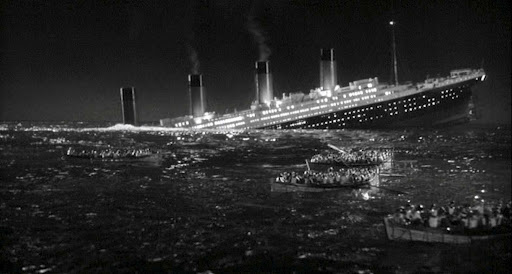
You’re probably wondering how long it’s going to take me, in this review, to mention a certain other film from 1997, directed by James Cameron, that follows a similar plot to this film, and I’ll tell you that it’ll take exactly 48 words for me to mention Titanic. If you’ve never seen A Night to Remember, but are a fan of Titanic (as indeed you should be, for it is a much better film than it’s cool to admit), then you need to start paying more credit towards Night‘s director Roy Ward Baker, for it is from his 1958 picture that Cameron stole most of his film.

Now I’m not saying Cameron stole everything, for if there’s one thing Night is missing, it’s main characters to follow through the events. Instead we follow various groups of people – Second Officer Lightoller (Kenneth More), some steerage passengers, a young 1st class couple (Honor Blackman!) – throughout the night of April 14th, 1912. This lack of focusing on a few people leaves you caring for the characters less, in the same way you didn’t care that much when Fabrizzio got hit with the funnel, here its no bother when the same fate is met by other people we’ve been following. This gives Night a more procedural, re-enactment-like tone, not helped by the generally unmoving performances that leave you cold and distant.Had I never seen Titanic, chances are I’d have been far more impressed with this film, but the remake (that’s essentially what it is) has shown that almost every shot can be composed and recorded at least a little better. The fact that it was made almost 40 years later helped drastically, as the technology did not yet exist to encompass the full scope of Cameron’s vision, but the fact that it does now has left Night a little obsolete.

I found myself mentally checking off every scene that Cameron stole – the steerage dance number, lavish 1st class dining scene, the soot-caked stokers escaping the closing doors in the engine rooms, playing football with ice on the deck, the dining cart gently rolling down an increasingly listing dining room, the steward appalled at the passengers damaging White Star Line property, the musicians disbanding then reforming to play as the boat sinks. The drunken chef even looks the same, and the shot of Murdoch turning his head away in shame, unable to stand watching the boat sink from his wrongfully claimed lifeboat seat is identical! I understand that a lot of these scenes help to set the atmosphere aboard the boat and couldn’t really be avoided, but Cameron should either have admitted he was remaking, paid some form of acknowledgement to the previous film, or at least changed the shot compositions. Mr. Andrews, the boat’s designer, even at one point gives a young couple – who may as well be called Jack and Rose – details on how to survive whilst he’s stood next to the clock on the mantelpiece, and the ‘unsinkable’ Molly Brown, here played by Tucker McGuire but more famously by Kathy Bates in Titanic, vehemently demands that her lifeboat turn around to help drowning survivors.

Based on the book by Walter Lord, and using the real-life experiences of survivors, the film paints an effective picture of the differences between the classes – made particularly clear when some steerage passengers attempt to flee the waters, but recoil in shock at the extent of the upper class facilities. After some initial scene-setting and the launch of the boat, we pick up the action on the night of the 14th, as the supposedly unsinkable liner receives warnings of ice in the area. As opposed to after 90 minutes, the immortal line of “Iceberg, dead ahead” is heard after just half an hour. After the boat has struck and a 300-foot long gash has been haphazardly carved into the hull, events play out largely in real time, and a great deal of time is spent on the engine rooms and the crew’s efforts to contact the nearest boats, of which the Carpathia, a good 58 miles and 4 hours away, is the only one to respond. There are some nice examples of the typical British stiff upper lip – a man putting on a brave face as he waves goodbye to the wife and children he knows he’ll never see again – but there are all in all far too many scenes of the crew trying to convince disbelieving passengers of the seriousness of the situation, to the point where I got so annoyed with some of the passengers that I hoped they’d stay on the boat and attempt to sit it out.

Whilst occasionally moving – the lifeboats forced to listen to the screams of the drowning – there is little reason to watch this now Titanic has made it redundant. In it’s day it was probably a much better film, but alas now it has been surpassed.Choose life 7/10