Mad Max 2 The Road Warrior

If the recent UK petrol strikes had gone on a little longer, chances are we’d have seen something not too dissimilar to the events here, in George Miller’s 1981 sequel to 1979’s Mad Max. Mel Gibson reprises his role of Australian cop Max Rockatansky, but the world he lives in is now a barren, chaotic land left ravaged by a worldwide war, leaving the survivors desperate for any fuel they can find.
Max and his dog roam the landscape looking for gasoline, eventually hearing about an enormous stash not too far away, and so with the guidance of a deranged nutcase with a flying machine (“It’s my snake, I trained it and I’m gonna eat it.”), set out to find it, but alas the compound within which the gasoline is kept is not only heavily guarded, but is also being laid siege to by a ruthless gang of miscreants.
Whilst this is certainly an improvement on the original movie, there are still a lot of things here that don’t make sense. For starters, the motivation for every character is to end up with more fuel, yet all seem to expend an awful lot more than they need to in order to get any. Whole fleets of cars and motorbikes are sent out on scouting missions, showboating and jumping as they go, and even the compound uses a bus as a gate. If fuel is so very precious, why are they all so eager to waste it?
The costume design has progressed from the previous film, and now the rebel gang has an even greater passion for leather, bondage and ass-less chaps than Max himself. The depiction of a lawless, structureless society is well done – one of the gang’s cars is a cop car, suggesting that it’s not just the general population that has lost it’s mind – and Max readily eats cold dog food, straight from the tin. There’s better characters too, including a feral kid with a deadly boomerang (played by the brilliantly named Emil Minty), and there’s some decent action and chase sequences. The epic finale, with the gang attempting to seize a petrol tanker trying to travel 2,000 miles to paradise, does get a little samey after a while, but is impressive nonetheless. The arm-mounted crossbow though is probably the least threatening weapon I’ve ever seen.
Fortunately, Mad Max 3: Beyond Thunderdome isn’t on the list, but this one is deserving of it’s place. It’s by no means the greatest dystopian future survival movie, but it’s still an enjoyable watch, and certainly has it’s moments.
Choose film 7/10

Cowboys and Aliens

Apologies again for the lack of recent posts. I’ve been in hospital again for the past few days (where I managed to watch this film but do little else). All being well my extended medical excursions are now complete, and I can get back to watching films and writing posts. Hopefully there’ll be a steady slew of posts over the next week or so, as there’s about twenty from the List that I’ve watched recently and haven’t reviewed yet. Right, back to today’s feature:

With a title like Cowboys & Aliens, a certain level of expectation is accrued before watching. Along with approximately equal parts ranch hands and space travellers; their respective genres of horse opera and sci-fi melded neatly together, there surely must be a hefty dollop of fun, because the premise is more than a little ridiculous. Yes, it’s just as plausible as any other alien invasion flick, for why necessarily would beings from another planet arrive in present day, but the very notion of cowboys on horseback, with lassos and pistols, taking on intergalactic creatures capable of space travel and ray guns is just insane. So whilst I’d heard mediocre reviews elsewhere of this film, I at least expected to be entertained and amused throughout.

Chances are, this would have had a better chance of happening with a different cast. Though the film’s marketing and other reviewers have revelled in the idea of Bond and Indy together again (The Last Crusade famously saw Sean Connery, the one true Bond, playing Indiana Jones’ father) what director Jon Favreau doesn’t seem to realise is that an older, eye-twinkle-free Harrison Ford and a stoic, seldom talking Daniel Craig just aren’t funny, and have next to no chemistry together.

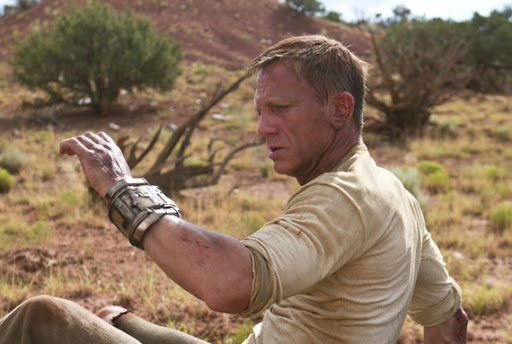
Craig’s Jake Lonergan awakes in the desert with nought but a photograph of a lady, a strange wound on his side and an even stranger chunky bracelet clamped to his arm. He can’t remember his name or anything else, so after seeing to a trio of miscreants, he heads into the nearby town of Absolution, terrorised by Ford’s bitter cattle baron Dolarhyde. The first half hour or so is easily the best in the film, setting up what looks like an interesting traditional western – albeit significantly more polished and brighter than others made recently, and even once the aliens attack, in a gripping sky-lasso sequence, it stays on the rails. Afterwards however, once every named character has either been snatched by the creatures or sets out after them, it loses it’s way.

Lonergan and Dolarhyde’s posse – for it is they that lead the hunt – is made up of some nameless alien-fodder, and is joined by a rag-tag bunch of townsfolk, including Sam Rockwell’s meek doctor-come-bartender and Olivia Wilde’s mysterious stranger. Wilde and Craig look entirely out of place in the Old West, their piercing eyes, clear skin and complete lack of cragginess juxtaposing with the entirety of the rest of the cast, including the likes of Ford, Keith Carradine and Clancy Brown, who appear to have been born to wear a stetson and chaps.

The best characters are easily Rockwell’s doc and Paul Dano’s Percy, Dolarhyde’s obnoxious son, so it’s puzzling just why they were sidelined quite so much. Had they been the central pairing, this could have been a far greater, more entertaining and interesting picture. The aliens, too, were disappointing. Their design isn’t anything overly creative – other than a chest cavity that opens up to reveal two small arms for delicate work – and they had a confusing blend of advanced weaponry and primitive pounce-and-flail combat techniques. They also had absolutely no characterisation, and quite frankly the notion that they invaded to steal gold is beyond ridiculous, and was the point at which I gave up on the film.

It’s my own fault for going in with high hopes after reading middling reviews, but I feel this is a great concept that was floundered on the wrong cast. Favreau as a director seemed a perfect choice, but he forgot to bring the funny. Yes, Craig’s impassiveness did cause humour at times, mainly when he caused people pain, but all-in-all this was a missed opportunity for a great film.

Choose life 5/10

Up in the Air

Jason Reitman’s third directorial outing, after the stellar Thank You For Smoking and the good-the-first-time-you-watch-it Juno takes two done-to-death plot conceits – the business-set rom-com and road movie odd-couple – and reinvigorates them to be not only modern, but impressively timely.
Up in the Air is much more in keeping with the structure of Smoking, as we follow a successful, charming but morally dubious and emotionally detached businessman discovering that his perfect life may not be as ideal as it seems once women step a little too far into it. Previously it was Aaron Eckhart’s fast-talking cigarette peddler Nick Naylor, here it’s George Clooney’s professional corporate downsizer Ryan Bingham, jetting around the country to fire people when their own superiors don’t quite have the balls. And with the economic climate and unemployment rates where they are now, no other film could be quite so prescient.
But it isn’t just that this film rings true with modern times. Clooney channels his inner Cary Grant in the role he was seemingly born to play, whilst Vera Farmiga is wonderful as his female equivalent, Alex. The real surprise though is Anna Vendrick. Formerly most famous as Bella’s best friend in Twilight, here she shows real comic ability and acting prowess as Natalie, the bright young whippersnapper brought in to downsize the downsizers, aiming to revolutionise the business by doing it all online.
The cast is rounded out by some Reitman regulars, including Jason Bateman, J. K. Simmons and Sam Elliott, as well as Danny McBride, Melanie Lynskey and Zack Galifianakis, and a gaggle of non-actors portraying essentially themselves when they were fired, with Reitman instructing them to dwell on their own experiences in some moving moments.
The best scenes involve the principals just sitting down and talking. Be it Ryan and Alex comparing the weight of their loyalty cards, or Natalie learning that, as you get older, your expectations of life lessen to more realistic goals, the script is insightful, sparky and above all else funny. I was a little annoyed at seeing Sam Elliott in the opening credits, and seeing his cardboard-cutout as the Chief Pilot in an airport signposting that, at some point, his character was going to crop up somewhere, but that’s another of those things that only really hurts the film nerds.  Some of the metaphors are a little heavy-handed (at one point Ryan’s family literally doesn’t fit into his suitcase) and the ending feels like a series of devastating gut-punches that kind of spoils the mood, but each one feels perfectly justified and necessary.
If you don’t settle too deeply into the subject matter this is a fun comedy with a great script, and even if you do it’s still thought-provoking and entertaining stuff. I await tracking down Reitman’s latest offering, the Charlize Theron starring Young Adult, with anticipation.
Choose film 8/10

Thelma and Louise

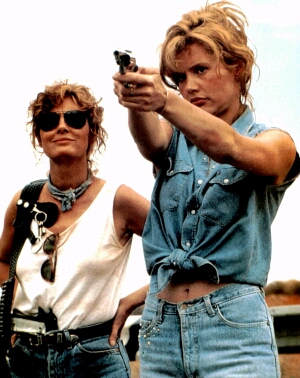
Two girls, a turquoise 1966 T-Bird convertible, a weekend vacation at a friend’s cabin up in the mountains, what could go wrong? Well, in Ridley Scott’s feminist road movie, a heck of a lot, as henpecked housewife Thelma (Geena Davis) and her world-weary waitress best friend Louise (Susan Sarandon) head out from their humdrum lives on more of an adventure than they bargained for, after a run-in with a would-be rapist at a country bar of ill repute.
The titular roles could not be more different, yet both remain well rounded characters, thanks in part to the able performances by the two leads. Though it is the men that seem to shepherd our heroines on the run, they always find a way of fighting back or turning the tables, be it on Harvey Keitel’s cop on their trail (assisted by Stephen Tobolowsky!), Michael Madsen as Louise’s boyfriend Jimmy, Brad Pitt’s first major film role as clothes-shedding hitchhiker J.D. or Christopher McDonald as Thelma’s boorish husband Darryl, eager to get his wife back so she can start making his dinner again.
There’s some great comedy – Darryl unable to watch his beloved football because the cops tapping his phone are too engrossed with Cary Grant in Penny Serenade – and though the story and ending may have been ruined by an overabundance of pop-culture spoofs and references, it is still a very good story. The accents begin to grate after a while, particularly Davis’ pronunciation of Loo-eese, but try to look beyond that at a journey that starts with an accident, and builds to become two strong female characters exploring their own limits, surprising themselves and everyone else.
Choose film 7/10

The Class

Filmed in a real school (and mostly in a real classroom) with an unprofessional cast all playing versions of themselves, Laurent Cantet’s semi-improvised near-documentary follows Mr. Marin (François Bégaudeau), a French teacher at an inner city school as he tries to connect with, further and inspire a class of 13-15 year olds. Bégaudeau co-wrote the script, and stars in his first acting role essentially playing himself, for he used to be a teacher, so it is no surpirse that his performance is wonderfully naturalistic, as are those of the multi-cultural students he presides over.
It is impossible not to feel the frustration felt by Marin, as he does his utmost to help his students, who almost seem to repell any learning, yet even when the other teachers have given up on the more problematic pupils, Marin still endeavours to find ways to reach them.
If this all sounds a little Dead Poet’s Society or Dangerous Minds, fear not. Here there are no last reel acts of defiance or obligatory contests won, life simply goes on. We see the less exciting but still interesting goings-on behind the scenes at the school – teachers debating punishment techniques and coffee machines, warning the new staff about the difficult classes – all shot in a documentarian, handheld style in amongst the desks.
The first half feels a little directionless, yet is still compelling, but the second, following the fallout of Marin saying two students behaved like “sluts” and his endeavours to help troublesome miscreant Souleymane, is much more on target. If you’ve ever been inclined to take up teaching, this film may infuriate you, with regards to how much effort Marin must fight against to even give Souleymane a chance.
Choose film 8/10

Harry Potter and the Deathly Hallows Parts 1 & 2

I’m a strange breed of muggle. I’ve seen all the Harry Potter films, most in the cinema. I’ve read all the books. Hell, I own them. Double hell, I was first in line queueing up outside Morrison’s on the morning book 7 was released. But I wouldn’t call myself a Harry Potter fan. So why have I kept with it? I read the first book in school, and found the wizarding world to be quite wonderful, a dream of a place to escape to. Granted, by the time the much darker later books came along I became much happier that this world of dictatorial terrorists with almighty magical powers didn’t actually exist (or so I’m led to believe) but back then it was nothing short of fun, and the fact that I was of a similar age to the protagonist when the books were released made it all the more so.
The books were perfect for film adaptations, and the stylistic choices throughout the series have been close to faultless. Most of the negative aspects, other than the questionable acting abilities of the children early on in the franchise, can be blamed on the books being too labyrinthine to be condensed down into a 150-minute movie, and there are arguments to make as to whether each book would have been better off as a TV series, but it’s doubtful they’d have received such a hefty budget or impressive cast, or made nearly as much money.
Of the films, part 3, Prisoner of Azkaban, is widely regarded as the best, with director Alfonso Cuaron unleashing the franchise’s dark potential, redirecting away from Chris Columbus’ more child-friendly first parts, but personally I prefer part 4, Goblet of Fire, because it’s easily the most fun and structured, following the Tri-Wizard Tournament, and it has dragons in it, which are awesome. Parts 5 and 6 are, in my opinion, the weakest, with my reasoning being that I can barely remember anything that happens in them other than some character deaths and casting decisions, but the final films really kick things into gear.
Many have questioned the decision to split the final book into two halves, citing financial gain as being the true reason, but having seen the results I approve of the choice. Whilst the earlier books could stand to lose some of the lesser plot points without the plot suffering, the amount of closure given in the finale could not have been achieved with a similar level of editing. Whilst the total runtime for the final two films could have been a little shorter than the 4½ hours achieved here, getting it down to a length the core Potter audience would be willing to sit through without complaining would have resulted in almost catastrophic levels of cutting.
The most impressive aspect of the film franchise has always been the cast. Whilst the three leads, Daniel Radcliffe, Rupert Grint and Emma Watson, were never expected to be incredible actors (and, for the most part, lived up to this promise) the film studios ensured this wouldn’t be a problem by surrounding their stars with almost every British actor working today, with more added every film. To list them all would be senseless, but the fact that, Richard Harris’ untimely demise notwithstanding, every actor returned to their roles for every subsequent film shows that the films must have been great to work on too.The Deathly Hallows alone saw the inclusion of Bill Nighy, David O’Hara, Rhys Ifans, Ciarin Hinds and Nick Moran into a cast already including the likes of Ralph Fiennes, Robbie Coltrane, Julie Walters, Helena Bonham Carter, Alan Rickman, Jason Isaacs and Maggie Smith, and the fact that so many notable actors returned for such minuscule roles is incredible. Jim Broadbent, John Hurt and Emma Thompson are barely on screen, but the fact is they are.
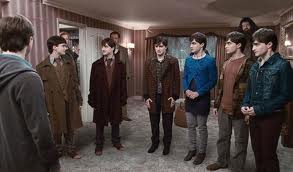
Part 7 is the only one of all eight films not to feature Hogwarts, the wizarding school where our young heroes are taught, and therefore doesn’t feel like part of the Potter pantheon. Freed from the structure of lessons, Quidditch matches and Harry being picked on by Slytherin, the film feels a little meandering, as Harry, Ron and Hermione scour the country looking for a series of magical Maguffins, horcruxes, that for one reason or another must be destroyed to help bring down the evil Lord Voldemort. The film opens strongly, with Harry’s escape from his home assisted by his wizarding friends transformed to be replicas of him, but it’s not until a later infiltration of the Ministry of Magic that any more excitement is had. There’s an awful lot of tension and relationship issues, exacerbated by a locket that builds negative feelings in whoever wears it (so… put it in a bag rather than wear it?) and a particularly cringeworthy scene wear Harry attempts to alleviate some tension by dancing with Hermione in a tent, but it feels empty without the action-balance provided by the second film. The brief animation, depicting the origins of the Deathly Hallows that grant the owner power over death, is easily the highlight of the series in total.
If watched as one long film, the two halves join together to form a perfectly balanced picture, with the final hour-long battle a rewarding epic culmination after a mammoth build-up, so if watching make sure to set aside the best part of an afternoon, however just watching part 8 alone is also acceptable. The infiltration of Bellatrix Lestrange’s Gringott’s vault, with Helena Bonham Carter gleefully impersonating Emma Watson, is tremendous fun (there’s another dragon!) and now they’ve got all the teenage angst and worrying out of the way it’s time for good and evil to get scrapping. The finale is equal parts devastating and spellbinding, as the regular cast is treated with a sporadic survival rate, literally anyone is up for the chop, up to and including Hogwarts itself, as various sets we’ve grown to feel at home in are burned to the ground. Some aspects of the battle feel crowbarred in – Mrs. Weasley’s showdown against Lestrange, Ron and Hermione’s inevitable kiss – but for the most part it’s a cinematic marvel that doesn’t disappoint.
Harry Potter and the Deathly Hallows Part 1: Choose life: 6/10
Harry Potter and the Deathly Hallows Part 2 : Choose film 7/10
Harry Potter and the Deathly Hallows Part 1 & 2: Choose film 8/10
Far From Heaven

Hertford, Connecticut; 1957. Cathy Whitaker (Julianne Moore) is at the heart of her picket-fenced community, her husband Frank (Dennis Quaid) is a successful businessman and her two young children are little bundles of perfection, with her daughter wishing to one day grow up to be just like her mother, though her son is a little foul-mouthed (“Ah jeez” is not the kind of language Cathy tolerates).  But beneath the surface of floating dresses and pristine curls, all is not well. It’s clear from Cathy’s expression that, though her friends must all put up with their husbands’ occasional demands for intercourse, Cathy has no such problems, for Frank hides a secret; whenever he is ‘working late’ he tends to be frequenting a bar aimed only at male patrons that want to get to know each other a little better.
Todd Haynes’ movie lovingly recreates an idealised vision of 1950s suburban middle America (“Aw shucks” is uttered in the first four lines, and “jeepers” and “swell” aren’t too far behind) although the rampant sexism and racism would be more than frowned upon today. When Cathy shows sympathetic tendencies towards her black gardener Raymond (Dennis Haysbert, 24‘s President Palmer) she is the subject of mild ridicule and is frowned upon by the society that used to hold her dear. Haysbert is good in another of his solid, decent, all-round nice guy roles, but Dennis Quaid continues his run of being the worst thing about a film. I’m sure in his youth he must have done something to earn a reputation as an actor, but I can’t for the life of me think what it is, I’ve only ever known him as the worst thing in bad films (Flight of the Phoenix, Smart People, The Day After Tomorrow, Vantage Point).
The era is seamlessly recreated, to a point where the film could easily have been made in the 50’s – in which case it would probably be hailed today as a classic. Moore is the best thing in it, so much so that at times she barely seems to be acting, so great is the level of repression she must convey. She received an Oscar nomination for her troubles – Nicole Kidman must have been really great in the Hours to beat her.
Though at times it feels like nothing really happens, that is surely the point. This is more a study of the prejudices of the era – Frank’s grand social indiscretions can be brushed under the carpet or cured (a doctor has a 5-30% success rate for curing homosexual urges) whilst Cathy’s much lesser faux pas sees her outcast from all around her. The plot and script are a little hokey, but the performances and overall feel stay with you after watching this subtle piece.
Choose film 6/10

Edward Scissorhands

First off, apologies for the lack of posts recently, I’ve been in hospital for an operation on my nose (inspiring this Top 5). Also, apologies if the posts over the next few days are a little off, I’m on a veritable Pan Galactic Gargle Blaster of meds, but I’ll try and keep everything as on topic as possible.
Johnny Depp successfully accomplished the transition from TV heart throb to serious movie actor with this, Tim Burton’s fourth directorial outing, leading to at present a further seven collaborations between the two bizarelly-haired gentlemen. Depp stars as Edward, the creation of a reclusive inventor (the legendary Vincent Price, in an all too brief cameo in his final film role) who remains incomplete after the inventor passes away. Edward looks human enough, but where five-fingered appendages should be on the ends of his arms, there are instead a multitude of blades, knives and scissors. After being discovered living alone by Dianne Wiest’s kindly Avon lady Peg, Edward is brought into the ‘normal’ world of 1950s suburban American.
As much comedy is made from Edward’s physical impairment as possible, with his blades coming into contact with waterbeds and hindering his ability to get dressed, pick up a glass, open a door or touch his face, but he shows an aptitude for carving meat, topiary, hairdressing, dog grooming, paperchain-cutting and being used as a kebab skewer. This does bring up the subject of exactly how Edward had survived alone in the castle before his ‘rescue,’ but as this is essentially a fairytale, minor plot details can be smoothed over.
As ever, Burton shows a deft hand with his casting. Depp is wonderful as Edward, showing childlike wonder at the new world around him, and expressing true depth of emotion from behind a stark appearance, all pale face, scars, bedraggled mop of hair and tight plastic and leather bondage-inspired clothing, and with minimal dialogue. Winona Ryder is cast against type (in that she wears colourful clothing and has blonde hair) as Peg’s cheerleader daughter Kim, and Alan Arkin and Wiest are wonderful as the parents welcoming Edward into their home. Anthony Michael Hall as Kim’s brutish boyfriend is more of a stretch though; the nerdy Breakfast Club star cannot be taken seriously in a bad guy role.
The film is lighthearted and entertaining, and has some genuine comic moments. The bookends of a clearly aged Winona Ryder are more obvious than the supposed narration reveal of the Notebook, but this features one of the greatest and most memorable character creations of cinema, and some fine acting too.
Choose film 7/10

Unlisted: The Cabin in the Woods

Five college kids head for a vacation in a deserted shack (or cabin) in a remote forest (or woods), with no-one around for miles and a very creepy basement. So far, so Evil Dead. Or Texas Chainsaw Massacre. Or… well, you get the point, but the fact this is written and produced by Joss Whedon, and co-written and directed by Drew Goddard, one of the men behind Lost, should tell you that this is no ordinary textbook horror.
The recent years have seen the horror genre be evaluated, analysed and turned on its head, with the likes of Wes Craven’s Scream franchise and Tucker and Dale Vs Evil, and also imbued with a greater sense of comedy, for example Shaun of the Dead and Severance, to name two prime British examples. Cabin in the Woods takes these films and goes much further, leaving you rethinking every slasher movie you’ve ever seen.
I’m going to do my best to not reveal spoilers here, but if you’re trying to avoid them then chances are you probably aren’t reading this. The trailers have been criticised for perhaps showing more plot than is strictly necessary, revealing that there is more to this cabin than meets the eye, but I personally feel this is essential for the trailer (though it could have been hinted at more subtly) else the only trade the film would have made would be from the slasher fans willing to pay to see them at the cinema, of which I most certainly am not. My only trailer annoyance was the use of a scene or two from the third act that, though I’d only seen the trailers once, still stuck with me and left me waiting for them, over-thinking the plot as I went.
The performances are all wonderful, particularly practically unknown Tim De Zarn as the token redneck doomsayer the kids encounter on their way, and there’s some casting coups for fellow Whedon-ites in Dollhouse’s Amy Acker and Fran Kranz (whose Topher Brink is, occasional Firefly cameo aside, the best thing about Dollhouse) as well as Chris Hemsworth, Bradley Whitford and Richard Jenkins.
I have very few faults with the movie. One came because I’m a film nerd, and caught the signposted closing cameo from a recognisable voice, and the third act feels a little off the rails at times, but in an exhilarating, thoroughly entertaining way, although I did question why exactly that big red button was there. I look forward to pouring through the features when it’s released on DVD, and it’s the first film in a while that I’m actually considering going to the cinema and watching again. Go see this film, it’s truly wonderful, especially if you’ve ever seen a film with a cabin and some woods, and chances are you have.
Choose film 9/10

Satantango

Aisha’s away for the weekend and I’ve got no other plans, the hotbed of social activity that I am, so I’ve made the most of a fairly sunny weekend by staying in and watching the longest film left on the list, Satantango. At 7 ½ hours long, it rounds out the top 5 longest films (though technically two are TV series and one is an eleven-part serial) on the List, which between them have taken up over 48 hours of my life that I’m never getting back. I doubt it’ll come as a surprise to many, but of the 14 films over four hours in length of the List, all of them are from Europe, and only one is in English (Kenneth Branagh’s Hamlet). More than half of them are French. America doesn’t start to get a look in until Sergio Leone’s Once Upon A Time in America (227 minutes), but it’s got a lot around the 3-hour mark instead. Also, of the 4-hour-plus films, three of them are Holocaust-related documentaries. Yay.
So, Satantango. I’m going to try and make this review be not entirely about the length of the film, but it is bloody long. And needlessly so. Many of the sequences involve nothing happening – the first 9 minutes follows cows wandering around in the mud, later a child walks purposefully towards the camera for what seems an eternity – so that whenever a conversation occurs – other than some sporadic narration, dialogue doesn’t kick in for about 15 minutes – it comes as a shock.
The film sees the inhabitants of a run-down Hungarian village. The villagers have a large sum of money they wish to share out, but some want to leave with more than their fair share, whilst others wish to wait for a man believed dead to arrive, with the possibility of making even more money with his help. This is only the central structure of the plot, for there are several detractions, but no real motives or details are ever expanded upon. We see the same events through different viewpoints, at one point witnessing a drunken dancing session (at least 10 minutes long) from the perspective of a young child outside the window, and then later we’re shown it again, longer this time, but from inside the room. This new vantage point offers nothing new, and just serves to make me wish to never hear an accordion ever again, for the same short tune segment is repeated over and over and over again for the entirety of the dance.
This is, however, a great achievement in terms of direction and cinematography. Much of the film takes place in long, unbroken shots, the aforementioned dancing, for example, which at times are truly breathtaking, and others thoroughly unimpressive due to the lack of anything happening onscreen (it’s a completely unbroken shot! Of someone sat down!).
Though I was never bored, and I was also far from entertained or engaged. The large gaps of nothingness allowed my mind to wander and expand upon what I was watching, and also gave me time to jot down the improvements I’m intending to make to the site over the next few weeks. It did, however, feel like an arduous watch, something I had to work at to pay attention, and after seven hours I’d hoped for a satisfying conclusion to make it all worthwhile, a reward for the patience and sacrifice of time, but alas I was left wanting.
Choose life 5/10