One Flew Over the Cuckoo’s Nest

Jack Nicholson, in an arguably career best (so far) performance, is R.P. McMurphy, hopes to complete a short prison sentence without resorting to hard labour, and therefore pleads insanity and is transferred to a psychiatric hospital run by the steely Nurse Ratched (Louise Fletcher).  Ratched’s treatment methods, including humiliation and a mind-numbing daily routine appall McMurphy, as he realises the other patients are more focused on their fear of her than of functioning in the outside world. Although the main two performances are excellent, both winning well deserved Oscars, the film remains memorable more for the supporting cast that makes up the other inmates. Each has a specific and instantly recognisable personality, be it Brad Dourif’s stutteringly naive suicide risk Billy, Danny DeVito’s childlike Martini or Christopher Lloyd’s crazed loose cannon Taber, used whenever anyone is required to awake to a surprise situation, as Lloyd owns the greatest instant ‘what the Hell’ face on the planet.

The film is remarkable, not only for the acting but also the depths to which the story plunges, with an ending both horrific and genuinely surprising. Throughout the film it is obvious that McMurphy will be discovered as a fraud (something never actually stated during the film), and will of course be sent back to prison where he belongs (the sentence he is attempting to avoid is the statutory rape of a 15-year old girl), but the fate in store for him is far worse than could possibly be imagined. It also features possibly the most elaborate plan to have sex ever, hijacking a busload of patients, commandeering a boat and teaching said loons how to fish.

Choose film 9/10

King Kong (2005)

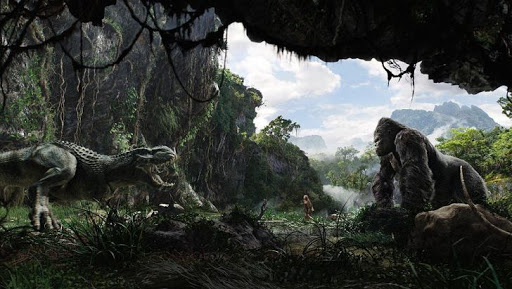
 A lot of people dislike Peter Jackson’s remake of 1933’s King Kong, made simply because the original is one of Jackson’s own favourite films, but once you get past the overlong New York-set character establishing and the woeful miscasting of Jack Black as movie producer Carl Denham, what’s left is an entertaining and well realised modern retelling of a well known story with a renowned ending known to all, whether they’ve seen the films or not. Aside from Black, it is this sense of inevitability that lets the film down. We all know going in that at some point a giant gorilla is going to capture, then fall for aspiring actress Ann Darrow (Naomi Watts, doing the best she can as essentially a scream on legs), before being captured himself, shipped to New York and thrown on stage as the latest attraction, ultimately forcing him to escape and take a fateful climb atop the Empire State Building, ultimately being killed not by machine gun-toting bi-planes, but by the bright, bloody blade of beauty. I’m not suggesting for a moment that the ending should have been changed, maybe with Kong swimming back to Skull Island with Ann perched on his head, or perhaps the NY locals gradually accepting Kong for who he is, eventually electing him mayor, paving the way for a comedy-heavy sequel, seeing Ann escorting Kong to various prestigious events, climaxing in an unveiling at the Smithsonian, where confronting a T-Rex skeleton brings back too many memories for the now refined ape, causing him to rip off his custom made tuxedo (with comically oversized and troublesome bowtie), break the skeletons jaw and finally settle down in an overgrown corner of Central Park, or in an enclosure at San Diego Zoo. No, the story was rightfully left intact, if a little extended in places, and mercifully the 1930s setting was also maintained, moving it all to the modern day could have ruined this movie.
As for Black, I’m not sure who could have replaced him as the egotistical, deceitful, driven moviemaker, but I think an older actor could have lent a little gravitas to the role, and since watching Midnight Run I’ve wanted to recast everyone with Charles Grodin, so I’m going to go with him.
The film doesn’t really get going until the approach to the island, with Jackson using some innovative effects and camerawork (the screaming rocks and the shot of Jamie Bell being flung around in the crow’s nest are particular highlights), but the best parts, in my opinion, involve the creatures of the island. Populated with dinosaurs, creepy-crawlies the size of caravans and creatures that are essentially giant penises with teeth and a penchant for human limbs, it’s not exactly an ideal holiday destination, but the respective battles and chases involving these beasties are the most entertaining and thrilling sequences in the film, the CGI is impeccable if a little soulless at times. Kong’s fight against three Tyrannosaurs over Ann is beautifully choreographed, and worth the three hour runtime alone.
There’s also some nice in-jokes (Denham can’t cast Fay Wray in his picture, as she’s shooting a rival film at RKO with Merian C. Cooper, that’ll be the original Kong then), and the interpretation of Kong is astounding, with Andy Serkis using his motion capture skills seen as Gollum to great effect, soon to be used again in Jackson and Spielberg’s Tintin, and the absurdly named Rise of the Planet of the Apes.
Choose film 7/10
Lord of the Rings Trilogy

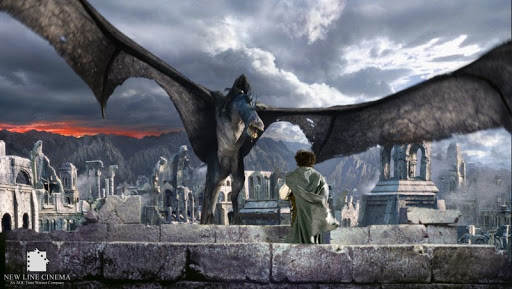
This 1001 book is starting to piss me off. Not only did it count a whole goddamn TV series as one film (slyly writing the length of one hour long episode instead of the full 10-hour marathon) but now it’s counted Peter Jackson’s Lord of the Rings trilogy as one film. This is less annoying, as all three films appear on all of the other lists used, but think, two other films could have been removed to make up the numbers. Maybe two of the crap films I’ve already watched. Thanks book editors, thanks very much. I watched Olympia and the Spider’s Stratagem for nothing. Bastards.
Continue reading

Brokeback Mountain

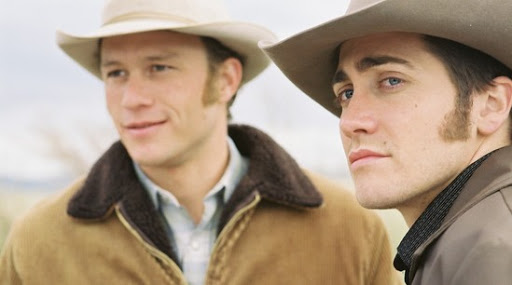
Another one I’d never seen before, Brokeback Mountain has a reputation to live up to, but of what I didn’t really know. Yes, I was aware it was about two cowboys, Heath Ledger and Jake Gyllenhall, and that between these two, something happened in a tent, involving at least one of their man-parts and the other’s posterior, but as to how this would support a feature length picture I did not know. Wisely, director Ang Lee gets past the, ahem, climax early on, spending a greater deal of time depicting the aftermath of the relationship Ledger’s ranch hand Ennis Del Mar and Gyllenhall’s rodeo cowboy Jack Twist form on the time they spend herding goats together. Ledger easily surpasses Gyllenhall on the acting front, mumbling his way through the difficulties that come with having an affair, and Michelle Williams also impresses as his put-upon spouse, realising the truth about her husband yet living in acceptance and despair. The slow pace of the film allowed for some great character interactions too, and I approved of the film only featuring important sections from the central relationship and nothing else, with what some would describe as pivotal events – Twist’s marriage to rodeo girl Anne Hathaway or the birth of Del Mar’s two children – being skipped entirely, as to the main couple these were of secondary importance to the connection the two had with each other.
Choose film 7/10

Alien

One of my favourite movie subgenres is the limited cast, limited locations films, where, for whatever reason, only a handful of characters are involved, and are confined to a small number, preferably one or two, of areas. This is best seen in 12 Angry Men, as previously discussed, where the principle cast are the 12 jurors on a case, and the principle sets are the jury room and its adjacent restroom. Similarly, Alien sees the seven crew members of the mining spaceship Nostromo largely confined to the ship and a planet it docks at in response to a distress signal. Things take a turn for the worse when, upon docking, the ship picks up an alien lifeform (later known as a Xenomorph), whose main ambition in life seems to be removing it from other creatures.
The film shows an interesting depiction of the future far removed from the more utopian worlds of more classic science fiction. Here, men seem to have retained dominance (shown by the exclusion of women from any decision making), and where class separation is still rife (the two engineers, Parker and Brett, are paid half as much as everyone else on board). The ship’s design is a far cry from the gleaming visuals of, say, 2001: A Space Odyssey. The Nostromo is, after all, a mining craft, so the ship’s functional, mechanical nature is only to be expected, although the overly futuristic sleeping pods do jar with the rest of the ship.
Aside from the infamous ‘chestburster’ scene (of which you can now by lifesize plush toys!), I couldn’t remember most of the film, although in my memory it does tend to blend with the other films from the franchise, as my only previous viewing was in marathon format. That said, there is much that sticks in the mind now, from Hurt’s descent into the alien nest, littered with giant eggs covered in a mysterious fog, or Ripley (Sigourney Weaver) seeing off an 8 ft alien with molecular acid for blood and far too many sets of teeth dressed only in vest and knickers (Ripley’s wearing the knickers, not the alien).
Having seen many survival films, where the cast is slowly whittled down one by one until the final confrontation, I noticed that with Alien it is not immediately obvious who the main character, and therefore the final survivor, is. Most of the characters are given fairly equal screen time, characterisation and dialogue, so it is not until the numbers start to dwindle that it is clear Ripley is the heroine, as earlier in the film she seemed to be the more heartless, professional crewmember, condemning Hurt’s Kane to death by refusing him entry onto the ship without a proper scan. That being said, she does become stupid later on, stopping to put two suffering crewmembers out of their misery minutes before the entire ship, them included, will be blown up (I’ve never understood this, why do ships have self-destruct mechanisms? Were they expecting an alien lifeform to come aboard, and the only way to kill it would be to blow the whole ship up? If so, surely some other defence mechanisms could be implemented instead?), and then she goes back for the cat, kept on board purely to jump out at random moments to scare the bejesus out of anyone in the vicinity.
Choose film 9/10

The Shawshank Redemption

This is one of the films I’ve seen more times than any other, up there with Armageddon and Die Hard with a Vengeance (criminally, neither of which appear on the list). Shawshank tells the story of Andy Dufresne (Tim Robbins), wrongly convicted of the murder of his wife and her lover. Really though, the film is about friendship, with Dufresne meeting Morgan Freeman’s Red, a man known to locate certain items from time to time, and the two form a firm bond. The film also shows how to make the best of a bad situation, as before imprisonment Andy was in a relationship with an unfaithful women, a successful but passion-less job as a banker and had few, if any, friends (none seem to visit him throughout his sentence), yet in prison he thrives, providing sound financial advice to the guards, making friends and finding peace within himself with the aid of a newfound routine and meaning. Andy never knew that all he wanted was freedom, until what little he had was taken away from him.

Choose film 9/10

X-Men 2

With the consistently excellent Matthew Vaughn (Kick-Ass) releasing his upcoming X-Men First Class soon, a film about which I am very excited, and not just because it features January Jones and very little clothing, I thought it was apt to cross off X-Men 2. Although there were some excellent scenes, most notably the entrance of fan-favourite Nightcrawler (Alan Cumming) attempting to kill the President, the attack on the Mutant Academy and the fight between Wolverine and Lady Deathstrike, there were some plot holes I just couldn’t get past at the end of the film (spoilers).  Firstly, when Magneto (Sir Ian McKellen) breaks into Cerebro, where a brainwashed Professor X (Sir Patrick Stewart) is being used to locate and kill all mutants worldwide, we are shown the mutants writhing in pain for the 30 seconds or so they are being attacked, so when the machine is altered, to affect non-mutants instead, we can only assume that they (we?) are put under a similar level of duress. So we’re talking about everyone driving a car, every pilot flying a plane, every surgeon performing an operation, all these people would be unable to function for a few minutes, causing carnage worldwide, and probably a massive number of fatalities. Secondly, why did Phoenix (Famke Jannsen) die? Yes, she got off the plane to lift it into the air (I’m assuming there are some logistical difficulties with lifting something you yourself are inside), yet there is a period of time between the plane being up in the air and the flood of water, that she is holding back, from engulfing her. She knew there was a teleporter on the plane, as we are told she is preventing Nightcrawler from helping her, but why not let him bamf out and grab her after she’s lifted the plane? It is a completely needless death, present only so when Charles meets the president at the end of the film, he can say there were losses on both sides, even though we are shown she didn’t really die.
Other than that, Brian Cox makes an excellent Bond-like villain, complete with henchmen, underground lair and, ahem, crippling put-downs (remarking “don’t get up” to a wheelchair-bound Professor X), and making the film more of an ensemble piece, as opposed to the originals Wolverine-show , even though he is the most memorable and fleshed out character. I also approved of director Bryan Singer including elements of his own life, for example Iceman (Shawn Ashmore) ‘coming out’ to his parents as a mutant.
Choose film 7/10

Terminator 2: Judgement Day

How do you make a sequel to Terminator? It seems like the perfect movie to create a franchise with, featuring the possibilities for labyrinthine time-travel plotting, self referencing paradoxes and a villain who can be killed, but can also always return, but therein lays the biggest stumbling block. The villain from the original, Schwarzenegger’s unstoppable mechanical monster, the main draw of the first film, surely must return for the second, especially seeing as, in 1991, he was one of the biggest stars in the world. But how could the same robot come back as the villain? The sequel must somehow build upon the original, develop it further, else why bother? Having the same villain, with essentially the same plot, would seem a waste of time. So, proving that necessity is indeed the mother of invention, director James Cameron pulled a full character flip on not just Arnie’s T-800, now here as protector rather than foe, but also of Linda Hamilton’s Sarah Connor, discarding the ditzy 80s hairdo for some badass fighting skills, tank tops and a permanent ticket to the gun show. The introduction of John Connor (Edward Furlong) as a ridiculously irritating teenager spouting laughable phrases (Asta-la-vista, baby? Seriously?) is also a diversion from the expected, as he’s the so-called saviour of mankind, but he’s so goddamn annoying that whenever he was onscreen I found myself rooting for the bad guy.

Miller’s Crossing

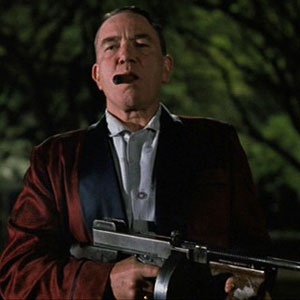
As I’ve previously mentioned in my post about the remake of True Grit, I’m a massive Coen brothers fan, so when my girlfriend selected Miller’s Crossing from the DVD stack to watch last week, I was overjoyed.

Pixar Day

Had a bit of an accident this morning, got knocked off my bike on the way to work. I’m fine, but my bike’s wrecked, and I was confined to the sofa for the day, and couldn’t think of a better way to cheer myself up than watching nothing but Pixar films, and all off the list!
Continue reading