Top 5… Films Aisha Loves That I Don’t Hate

 I’ve been lacking inspiration for a Top 5 this week, with the best I could come up with being Hugh Jackman films, as its his birthday, but I’ve missed too many of his films for it to be a very conclusive list. So, in my desperation, I turned to my girlfriend, something I only ever do in the direst of situations film-wise. I’ve discussed her frankly laughable taste of films in passing before, but I believe I may have been unnecessarily harsh on some of the films she likes, so here’s my Top 5 list of the films she loves that I don’t necessarily hate. Apologies for any extravagant soppiness, it won’t happen again. And yes, Aisha got to choose the pictures.

5. Marley and Me
Now, I wouldn’t like this film if I were to watch it on my own, but at present it’s Aisha’s favourite film, and it makes me happy to see her happy, so technically I must like it. But it can’t be any higher than number 5 on this list because a) it’s a terrible film, and b) she cannot watch it without almost drowning in the flood of dears she seeps towards the end. For you see, Aisha is a dog-person (I’m a no-animals-person, at best a fish-person), so any film featuring dogs, especially [spoiler] the dying of a pet dog, something she has lived through, result in an unquantifiable amount of sadness. But guess who’s around with a shoulder to cry on? That’d be me. Which is another reason I don’t hate the film, it’s made us closer as a couple.
Continue reading →

Songs From The Second Floor

I never knew there were quite so many films out there without plots, and how highly regarded some of them were. I’d heard of Bunuel’s surrealist so-called ‘masterpieces’, though I’m not a fan of them myself, and given their notoriety it was no surprise to find them on the List, but this cine-poem, based on the works of Peruvian poet Cesar Vallejo and directed by Swede Roy Andersson, is a film of which I’ve never heard, and finding it voted the 213th greatest film of all time by Empire readers came as something of a surprise.

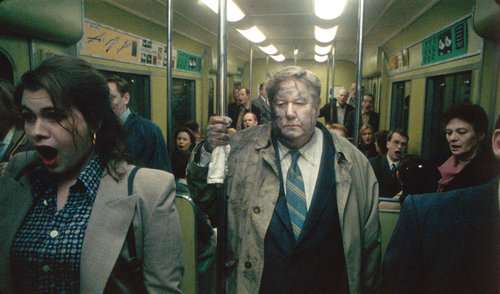
Opening on an overweight businessman addressing a pair of feet with a hacking cough inside the iridescent electric blue light of a tanning bed, we are taken on a journey encountering opera-singing commuters, an endless, near-stationery traffic jam, crucifix salesmen, a moving building and a platoon of marching office drones casting telephone receivers like fishing lines.
The focal point is an obese fellow called Kalle (Lars Nordh). His oldest son is in the hospital, having gone insane from writing poetry, and Kalle cannot visit him without descending into a raving torrent against his offspring. Kalle has other problems – he burns down his business in an attempt to claim the insurance – and is being stalked by a man who killed himself, and still has the blood and cuts on his wrists to prove it. 

I’m not a fan of this kind of film. To me, the one essential ingredient required for a film is a plot, preferably a coherent and well-paced one, but here it’s more a collection of nonsensical scenes that happen to feature either Kalle, someone he knows or someone random. I understand that the purpose of such films is not to tell a story or to entertain, but to evoke a mood, and here I mainly felt despair and sadness. None of the characters are living anything close to a happy existence, many are overweight and all of them are either a sickly grey or deathly white in colour, covered in dust or ash, and becoming increasingly more pallid as the film progresses. The rooms and buildings are similarly shaded, with only the occasionally shock of colour – one man’s bright ginger hair or the aforementioned tanning bed light.

There were some scenes that were genuinely unpleasant to watch – a young girl, perhaps 8 years old, is blindfolded and led before a procession of dignitaries and up to a cliff, where she is left to wander blindly until she falls to her death, and the scream, thud and distant sobbing and crying were almost enough to make me turn the film off. Elsewhere, there was some uncomfortable humour in a man celebrating his 100th birthday by urinating in front of the men who have come to praise him, and by offering a Nazi salute and sending his best to Goerring, having become so far advanced in years he no longer sees the need to hide such tendencies.

So what does it all mean? Well, I’m sorry, but I haven’t a clue. Why are all the corpses walking around and following Kalle? Why was he stroking a golf club whilst a friend of his stared out a hotel window, naked from the waist down? And where was everyone heading at the end, with the endless row of vacant airport check-in desks awaiting the potential passengers and their skyscraping luggage trolleys? No idea, don’t care, didn’t enjoy it.

Choose life 3/10

The Brothers Bloom

There is one benefit to my passing out during Looper last weekend, I’ve now managed to see director Rian Johnson’s second feature before seeing all of his third. It’s streaming on LoveFilm at the moment, so if you’re a member, go forth and watch it now, post haste. All being well, I’ll be seeing Looper before this time next week, and next Sunday should see my review.

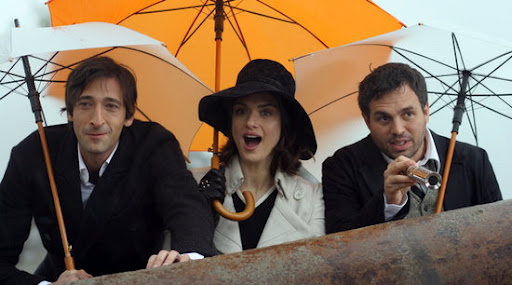
The Brothers Bloom seems on the surface to be far more straightforward than the high-school-noir Brick and time-travel-brain-twister Looper, but in reality its just as subversive as those two. Mark Ruffalo and Adrien Brody are brothers Stephen and Bloom, two con men who have been running scams since their early teens. Stephen (Ruffalo) is the brains of the outfit, and Bloom (Brody) always takes the leading role in the con. Roughly twenty five years after their first con, Bloom wants to quit, but Stephen ropes him in to one last job, conning Rachel Weisz’s ludicrously wealthy yet decidedly eccentric heiress Penelope from some money she’d probably never miss. Along with their near-mute accomplice Bang Bang (Rinko Kikuchi), the brothers set out to dupe Penelope from her riches, but who exactly is the victim in this game?
Continue reading →

Red Surf

Well, we’re still in George Clooney’s pre-E.R. days, so even if this film has a few more recognisable faces in some of the main roles, the fact that a then-no-name Clooney headlines this film should be some clue of how terrible it is. There’s still a few films to go before I get to From Dusk Til Dawn, the first film on his list that I know I like, so my hopes aren’t high for the films inbetween, but hopefully they’ll be better than this one.

Clooney plays Remar, a surfer/drug smuggler who, along with his small gang of friends, including Doug Savant, attempt to set up one last deal before heading their separate ways and going clean. The problem is, Remar is getting too hooked on the drugs, and his girlfriend Rebecca (Dedee Pfeiffer, Michelle’s younger sister) is pregnant, and doesn’t want him to do anymore deals. Also, one of Remar’s cohorts, True Blue (Philip McKeon, I swear it’s really Stephen Baldwin) has got himself arrested for dealing, and gives the cops the details of the guys they’re doing the deal with, who understandably want Blue dead. 
This film is a mess. There is little to no explanation for most of what happens, characters appear and disappear within the same scene and we’re never really introduced to any of our characters or their lives. The opening sees Remar and Savant’s Attila (also, the names are stupid) involved in a prank that doesn’t really go anywhere, but requires their car to be launched off a cliff and ultimately destroyed, for no real purpose. The supply of cocaine that Remar and the gang sell from appears to be stored in a buoy in the middle of the ocean – though where it comes from we never know. Characters behave stupidly and irrationally, generally at their own risks and with no regard for either themselves or their friends. After his arrest, Blue willingly gives up the names of the dealers, despite knowing that anyone who crosses the guy they are dealing with usually gets fed to the pit of wolves he keeps under a trapdoor in his house.

The dialogue is terrible (“You’re pregnant? That’s bitchin’!”) and the police behave in a manner completely unfitting to the situation, presumably in order to make them appear to be the bad guys over Clooney and his band of miscreants. There was a chuckle when the arresting officer told some criminals that they “have the right to do whatever I damn well tell you to do,” but it was only a small chuckle. I think most of the film’s budget went on skintight dressed (apparently, drugs and pretty girls go together, according to the script), sleeveless t-shirts, leather jackets and a seemingly endless supply of denim, as that’s all anyone wears in this film. Were loose leather waistcoats really ever in fashion? Also, for a film supposedly about surfers, there is only one, very short, scene featuring anyone even in the vicinity of a surfboard, and that’s not until 45 minutes in. 

Clooney has never been less likable than here, where is Remar is a selfish, pig-headed addict who wants to do right by his girl and unborn child, but in the worst way possible. He goes surfing instead of taking Rebecca to a doctor’s appointment, and he doesn’t really have any redeeming qualities, other than not wanting to kill the friend who got him into all this trouble in the first place. When he’s given a way out of this mess by his friends, with no risk and no responsibility put on him, he decides to go ahead and get himself in deep anyway.This results in one of the most poorly shot chases I’ve ever witnessed, involving a speedboat and jet skis in the middle of the night. It’s impossible to make anything or anyone out, and generally sees people spinning around in circles until someone explodes. 

The finale at the dealer’s house is clumsily staged and poorly choreographed, and his wolf pit seems to have magnetic powers, with people being drawn in despite being nowhere near it. If you really need a reason to seek this film out, it’s only passable blessing is that I’ve now seen Gene Simmons kill a man with his bare hands. There is literally no other reason to watch this film.

Choose life 2/10

Top 5 Bond Actors

Today is the 50th anniversary of the release of the first Bond film, Dr. No. Also, I reviewed Casino Royale earlier this week (undeservedly voted the 56th greatest film of all time by Empire readers in 2008), and Skyfall, the 23rd official Bond film, is released soon, so this seemed to be the perfect time to do a Top 5 list related to Bond in some way. As much as I would have liked to have done a comprehensive list of my five favourite Bond films, villains, girls, gadgets, cars, locations, henchmen, lairs, guns and kills, I’m afraid I don’t know nearly enough about the series to do that, seeing as I’ve seen quite a few of the films only once, and many of them I can’t remember. I do know that my favourite film is Goldfinger, which also features my favourite henchman, Oddjob. Scaramanga is probably the best villain I can remember, or perhaps Max Zorin, but that’s mainly for the actors playing them. So instead of any of those lists, I’ve compiled my top 5 of the actors who have portrayed Bond onscreen in the main series (I’ve not seen the 1967 David Niven-starring Casino Royale). Seeing as there’s only six actors currently in the series, this was a pretty straightforward list to compile.

Continue reading →

Hamlet

There are some films on the List that I’ve no idea when I’ll get to them. These films fall into three categories – the ones I absolutely adore but have no clue how I’ll even start writing about them, the ones I desperately do not want to watch (but am too much of an anal completist to ignore) and the really long ones. This four-hour-plus cut of Hamlet obviously falls into the latter, but fortunately for me, my girlfriend opted for Kate Winslet as her Film-Maker of choice, and seeing as I’ve reached that point in Winslet’s career in which she appeared in Hamlet as Ophelia, I can cross off Kenneth Branagh’s opus from the Empire 5-Star 500. As for the unspeakable films I don’t want to see, whenever LoveFilm drop Salo through my letterbox it shall not be a good day, though I could pull an In The Realm Of The Senses and bottle it when I’ve taken as much as I can stand.
Continue reading →

Casino Royale

With the imminent release of Daniel Craig’s third outing as James Bond, Sam Mendes’ Skyfall (UK release October 26th), it seems like the perfect time to cross the film ranked 56th greatest film of all time by Empire readers a few years ago, Craig’s first Bond outing, Casino Royale.

Now, if you ask me, #56 is pretty high up, especially when you consider that Goldfinger, my favourite Bond movie, is 110 places lower at #166, and no other Bond movies made it onto that list (You Only Live Twice appears in the Empire 5-star 500). Even if you take into account Casino Royale’s proximity to the release of the list, made just two years later, it’s still pretty damn high. Apparently, it’s better than Lawrence of Arabia, Annie Hall, 12 Angry Men, The Great Escape and literally hundreds of other films that, in my opinion, are far superior. But then I didn’t compile the list (though I did vote on it, and not for this film), so who am I to voice the opinions of others?

Before I continue my now-trademark tirade of negative comments, I should probably point out that this is a very good film. It served as a much needed shot in the arm for a franchise left face down and drowning on a CGI-wave of Pierce Brosnan’s swarm and Madonna’s atrocious Die Another Day theme song. In a post-Bourne world it established itself as a gritty reboot, taking Bond away from the ludicrous gadgets and back to the basics of hand-to-hand scrapping in a public bathroom, whilst still retaining the sheer spectacle of fighting on top of not one crane but two. Every aspect of classic Bond is present, from the impossibly slinky and easily-bedded women to a nefarious villain with a silly name and mild physical deformity (Mads Mikkelsen’s Le Chiffre, with a scarred eye that weeps bloody, and asthma to boot). Yet everything feels a bit more real, a bit dirtier and scuffed around the edges. And this description is none more fitting than of Craig’s Bond himself. Yes, he looks impeccable whether wearing an immaculately tailored dinner jacket or a pair of swimming trunks that apparently make my girlfriend’s mother go all weak at every possible joint, and he’s always got a quip ready in his back pocket, but this is a Bond with flaws and imperfections, all to aware that the men he is up against may be more than his match.

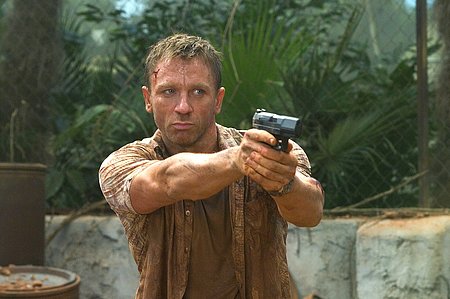
Take the early scene in Uganda, for example. Here, Bond must chase down and apprehend a suspect to obtain the passcode on his mobile phone, yet unfortunately said miscreant (Sebastien Foucan) is rather adept at long-distance sprinting, free-running and jumping off things that are ridiculously high up. Whilst he bounds around without a care in the world, remaining relatively scratch free, Bond is always a fair way behind, getting progressively beaten up and always opting for the easier route – hopping into a JCB digger or shoulder-barging through a wall rather than leaping through an uncomfortably small window. Here is a Bond who doesn’t need to show off when no-one is looking, he just wants to get the job done, and at whatever cost.

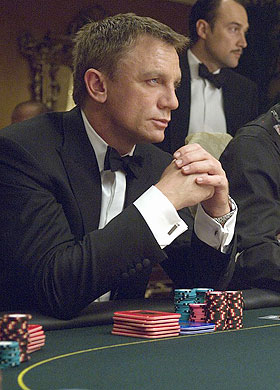
I’ve always had a bit of an issue with Bond films. I’ll gladly watch any of them, even Quantum of Solace if there’s nothing else on, but the plots are usually a bit labyrinthine for me, which is only to be expected if they want to make each film different. I’m not quite sure of the main motivations in Casino Royale, but I’m fairly sure it’s got something to do with the stock market, although the basic point is that Bond infiltrates an extremely high stakes poker game with a $150,000,000 pot, in order to prevent Le Chiffre from winning it and doing something bad with the proceeds. Everything else is fairly superfluous. I’ve read elsewhere that setting most of a Bond film around a poker table is nothing short of sacrilege, but I found those parts to be fraught with tension and often interspersed with enough action to suffice, even if the film made poker out to be a game that only deals in the most improbable card hands ever. There’s a nice running commentary provided by Bond’s accomplices, Vesper Lynd and Mathis (Eva Green & Giancarlo Giannini), but I didn’t think it was that necessary to have so much exposition, considering how dumbed-down the game was.

There were some very memorable set pieces, with the cold open of Bond achieving his double-0 status and the parkour escapade being particular high-lights, though I also enjoyed the stairway scuffle later in the film, showing how Bond had improved his jumping-and-punching skills from earlier. The testicular-torture scene may have gone a little too far, but it was well-handled and didn’t make me feel as squeamish as it could have done, and it’s more than compensated for by the various little moments of humour, and the record number of car rolls a little earlier. 

I approved of the expansion upon the relationship between Bond and M (Judi Dench), whose involvement in this franchise has cemented her presence as something of a British icon, and the rumours that this repartee has been increased ever further in Skyfall excites me no end. Bond is always at his best when bouncing off a superior – best seen with Desmond Llewelyn’s Q, and his utter, barefaced cheek clashes perfectly with Dench’s no-nonsense style. 

Though the last act may drag a little – the film clocks in at 138 minutes – the pace is fairly consistent throughout. There’s a lot here for Bond fans – more in-jokes than I remembered – and plenty for newcomers too. It may not be my favourite Bond film, but it definitely breaks the top 10, and maybe even the top 5.

Choose film 7/10

The Manxman

Pete Quillam (Carl Brisson from The Ring) is a penniless fisherman. His best friend, Philip Christian (Malcolm Keen), is a hot-shot lawyer. The two have been inseparable since birth, being raised as essentially brothers despite their wildly different lifestyles. They’ve even found a way to combine their various career paths, with Philip pushing through a petition that will prevent steam trawlers from encroaching on the fishermen’s haul, but when they meet Kate Cregeen (Anny Ondra), the barmaid daughter of the local pub The Manx Fairy, they both instantly fall for her. Pete, the more headstrong and forward of the pair, is the first to make a move, so the loyal Philip hides his feelings for the sake of his pal. But when Pete heads to Africa to make his fortune to win over Kate’s father (Randle Ayrton), things get complicated when Philip is asked to look after Kate in his absence. 

You cannot imagine how shocked I was to discover that this film has an almost identical central plot to Michael Bay’s Pearl Harbor. I was in no way expecting any similarities between a film made by Alfred Hitchcock and what many believe to be the worst film made by one of the worst blockbuster makers working today, but plot-wise they are pretty much spot on, so I managed to guess almost every element that happened within the first hour of the story. It’s interesting that the love story in Pearl Harbor – a triangle between Ben Affleck and Josh Hartnett’s Army Air Corps pilots and Kate Beckinsale’s nurse – was widely regarded to be the most superfluous and tedious aspect of that film, but here it is the primary – and often sole – focus, and it is handled far more deftly and in depth in Hitchcock’s 80 minutes than Bay’s 3 hours. This is probably because no-one goes to see a Michael Bay film for a tepid, mopey love story, especially when said film is about one of the most momentous events in the history of international warfare that’s literally made from explosions, so those of us who found ourselves having to wade through the hours of treacle to find nowhere near enough shiny fireworks to keep us entertained for even half the film’s length were of course disappointed – a feeling I’ve since become familiar with from Bay’s output. How exactly did this review of a 1929 Hitchcock silent film become me slandering Bay’s 2001 nadir? The two weren’t even made in the same century!

Anyway, The Manxman. The most interesting thing I found about this film was that at the start, the story seemed to be entirely about Philip, and the woes he would endure withholding his unrequited love for the promised bride of his best mate. The story is mostly told from his point of view, which is generally the case of the hero, yet as the plot progresses and the three points of the love triangle become further entangled with one another, it becomes clear that he is not the hero of his own story, but the villain, or at least the antagonist, of Pete’s. Though Philip and Kate never intend to do anything untoward against Pete, they still effectively destroy his life by doing what they believe is right at the time. Pete, meanwhile, is nothing but a lovable, earnest oaf, whose only crimes are an obliviousness to his friends clear affections for a girl, and his shame at believing himself not wealthy enough to be an acceptable husband or son-in-law.

There are no decisions made throughout that can really be judged against, as everyone always acted with the best possible intentions – initially at least – which makes it very easy to empathise with and feel sorry for almost everyone involved, and at times it’s all a bit of a downer. There’s some elements of Cyrano de Bergerac in there as well – Pete asks Philip to put in a good word for him with Kate and her father, because he has a way of making things sound better.

In terms of Hitchcock-ness, there wasn’t anything that stood out thematically or cinematically, although I did like the use of Kate’s diary entries and the way she referred to Philip – Mr. Christian, Phillip and finally Phil – to indicate her growing affection for him and the increasing closeness between the two. That was a nice touch. Also, the climax was delectably tangled, even if it was clear how everything was going to unravel.

Choose film 7/10

October 2012 Update

Farewell September, we hardly knew ye, and hello to the frankly awful weather of October. September was a bumper month blog-wise, as I set myself the challenge of posting every god damn day, and I’m pleased to say I achieved this goal, even if four of the posts were written during August, which I’m allowing because I had two busy weekends away this month. As you may be aware, the four aforementioned pre-written posts were for the LAMB’s So You Think You Can Review tournament, in which I came second, and I promise that’s the last time I mention it until I post my North By Northwest review, when I get to that stage in my Alfred Hitchcock run through.
Speaking of which, September’s Film-Makers films were Hitchcock’s surprisingly funny The Farmer’s Wife and sadly annoying Champagne. George Clooney remains in some awful stuff like Combat Academy and Return of the Killer Tomatoes, whilst Steve McQueen is staying in consistently average fare; The Great St. Louis Bank Robbery and Never So Few. Kate Winslet’s films are ones I wouldn’t recommend for very different reasons: Jude is so very depressing, whilst A Kid in King Arthur’s Court is just terrible. I’m slowing down my advancing through the Coens’ films, just seeing Raising Arizona this month, as I’m aware there’s a few Clooney films coming up and I want to hit them coming from two directions simultaneously.
List-wise, 1001 sees the loss of Clueless, Tinker Tailor Soldier Spy (before it was officially included), Vagabond, Broken Blossoms, Winchester ’73, Silver Lode, Mother and Son and Amelie. The Empire 5 Star 500 lost Battle Royale, Departures, Yojimbo, Raising Arizona and Amelie, whilst the Empire Top 500 is missing #262 The Virgin Suicides, #222 Mother and Son, #196 Amelie, #101 Raising Arizona and #95 Yojimbo. Nothing got crossed off the Total Film Top 100, but then that’s their fault for not including Amelie or Raising Arizona.
Off-list I also reviewed Brave, Napoleon Dynamite and Man on Wire (those last two for the tournament), and had a look ahead at Looper, which would have been reviewed and posted yesterday, but sadly when I went to the cinema I passed out 30 minutes in (I didn’t fall asleep, I literally fainted and apparently had some kind of fit). I’m pretty sure it was sugar-induced, but don’t worry I’ve seen a doctor and I’ll be fine. As for Looper, it was going pretty well in my opinion, though was far more graphic than I was expecting. Joseph Gordon-Levitt seems to have nailed his young Bruce Willis impression, but how it matches up onscreen I don’t yet know, as the point at which I woke up from fainting and decided I should probably leave the cinema was before Willis appeared in the film.
This month sees some new films being added to the List with the release of the latest edition of the book (I don’t know what they are yet, but they’ll be added to the 1001 page once I do). I had a guess on my Top 5 Movies That Should Be In 1001 (2012 Edition), and prepared for a cruise trip by looking at the best boating disaster films. I mourned the sad passing of Michael Clarke Duncan with his best five roles, and celebrated the birthday of one of my favourite funnymen Bill Murray.
This month I intend to go back to the cinema to watch all of Looper this time. Film-Maker-wise next up I’ve got Clooney in Red Surf, the Coen’s brilliant Barton Fink, Hitchcock’s The Manxman, Winslet’s 4-hour epic version of Hamlet as Steve McQueen in this month’s most-anticipated watch, The Magnificent Seven.