HitchcOctober Day 2: Elstree Calling

This review was originally written for Blueprint: Review a few months ago, but I’ve saved it here for HitchcOctober!

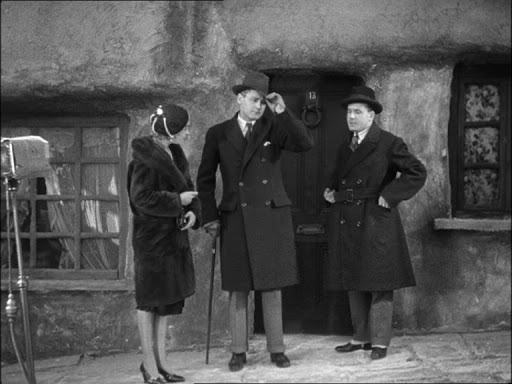
In the late 1920s/early 1930s, Hollywood produced a number of musical and comedy revues; a selection of skits, dances and musical numbers, combined together into one long production, similar to a modern day Royal Variety Performance, but without the obligatory monarch amongst the audience. In response to these, Britain retaliated with Elstree Calling, a more comedic take that almost parodied the American counterparts, whilst still showcasing a range of talented performers from the time, and linked together by a sporadically inept compère, a desperate Shakespearean performer (the greatest Shakespearean actor in captivity) and a man attempting to re-tune his television set to watch the broadcast at home.bfi-00m-dxa
Continue reading

Rich and Strange

Fred Hill (Henry Kendall) is tired of his lot in life. He works a dull job, which he travels to on a packed commuter train, and comes home to a small apartment where he and his wife Emily (Joan Barry) own little in the way of extravagant luxuries. Fred doesn’t think it’s fair that they don’t have expensive things, so he contacts his uncle, who is willing to allow Fred and Emily to have their inheritance now, before he dies, if it will make them happy. This prompts the now-happy couple to board a cruise ship and journey the world, but they discover they might have been happier when they were poorer.

l5z8WRtoGesGrI8HObV7WmzNB20 Continue reading

The 39 Steps

Richard Hannay (Robert Donat), a Canadian man visiting London, thinks nothing of assisting a strange woman (Lucie Mannheim) to escape a theatre riot, especially when, after the melee, she requests he take her home with him. She seems rather odd, with an indistinguishable European accent and clearly fake name, hiding from the windows and the reflection of the mirror, scared of a ringing telephone, and it turns out she’s being pursued by a gunman over some business involving a secret being smuggled out of the country. Hannay of course is sceptical, until she winds up dead on his living room floor, a knife in her back and a map in her hand, with Scotland’s Alt-na-Shellach circled. Hannay suddenly finds himself in the frame for murder, and must flee up north if he hopes to clear his name and save the secrets.

Vertigo

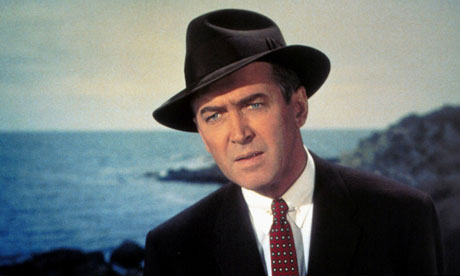
‘Scottie’ Ferguson (James Stewart) is a detective in San Fransisco who suffers from crippling vertigo, exacerbated by his most recent rooftop scuffle culminating in the death of a colleague and the escape of the perpetrator being pursued. He therefore retires, only to be called upon by an old college friend Gavin (Tom Helmore) who is concerned about his wife Madeleine (Kim Novak), who may or may not be occasionally under some form of supernatural possession from an ancestor who committed suicide at the same age Madeleine is now.
Continue reading

The Skin Game

Mr. Hornblower (Edmund Gwenn) has just purchased a rented house from Mr. Hillcrist, under the circumstance that the former does not evict the long-standing tenants of the house, the Jacksons (Herbert Ross and Dora Gregory). However, as soon as Hornblower has bought the place the Jacksons find themselves homeless, which starts a familial war, or ‘skin game’ between the two families.

Psycho

On a bright December Friday afternoon, Marion Crane (Janet Leigh) returns to work after some afternoon delight with her similarly cash-strapped lover Sam (John Gavin). When her boss sends Marion to the bank to deposit a client’s $40,000 in cash, on a whim she hastily backs her bags and flees with the money, but draws the attention of a road cop during her escape. When darkness and an incessant downpour prove too much for Marion, she checks into the run down, deserted Bates Motel, where she meets motel manager Norman Bates (Anthony Perkins), a kind yet awkward young man, unfamiliar with pretty young women entering his life. Norman’s bedridden mother disproves of the presence of Marion, and refuses to let her into the house, but this is no concern of the girl’s as she still has to plan what to do with the money.
Continue reading

Strangers on a Train

You know how the weirdo on the train always ends up sat next to you? The smelly guy, the raging drunk or the raving lunatic? Well any of these would be preferable to Bruno Antony (Robert Walker), a wealthy but evidently psychotic passenger sat across the aisle from Guy Haines (Farley Granger), a promising semi-professional tennis player with political aspirations. You see, Bruno has a plan for the perfect murder, or rather, murders, and wouldn’t you know it but he not only has someone in his life whom he’d like disposed of (his overbearing father, Jonathan Hale), but he also knows Guy is in a similar position with his separated wife, Miriam (Kasey Rogers). Bruno’s plan is for the two of them to swap murders, as that way there’d be no clear motive for their crimes, and whilst Guy forgets all about this after departing the train, Bruno evidently means to carry out his plot, and its not long before Miriam has been slain, and Bruno is hounding Guy to take care of his side of the deal.

Continue reading

Secret Agent

A funeral is being held for British World War I soldier and novelist Brodie (John Gielgud). The thing is, he isn’t dead, as Brodie has been recruited as a spy and renamed Richard Ashenden, and is being sent by the Q-like R (Charles Carson) to Switzerland in order to apprehend and kill a German spy, with the help of an overzealous assassin nicknamed The General (Peter Lorre). Upon arriving in Switzerland, Ashenden discovers a woman has already booked into his room, saying she is his wife, and when he enters his room he finds her to be the not-too-shabby form of Elsa Carrington (Madeleine Carroll), a fellow agent posted to assist Ashenden, but she is already entertaining another guest at the hotel (Robert Young). The three spies must work together, despite not necessarily all getting along, in order to find and stop their adversary before he completes his mission.

Murder!

A member of a travelling theatre company has been murdered in the lounge of the guesthouse in which she is staying, with only a fellow company-member, a discarded poker and an absence of brandy nearby. The trial is quickly over, with the jury swung by the overwhelming evidence pointing towards the defendant’s guilt, but after the verdict has been cast and death has been sentenced, one of the jury members begins to have doubts over their decision.

12 Angry Men is one of my favourite films, and Alfred Hitchcock is one of my favourite directors, so when I discovered this film, I was half expecting to find Hitchcock’s version of 12 Angry Men would rapidly be topping my favourite films list. Alas, this is not the film I’d hoped for, as in fact the jury and trial scenes take up a very small portion of this film, with most of the focus instead going to the investigation held by Sir John Menier (Herbert Marshall), one of the jury members who also has strong connections to the theatre business, in which both the deceased and defendant were employed. Once I was past my initial disappointment, I settled down to watch what turned out to be a fairly standard, by-the-numbers procedural picture, whose only difference from the norm was the general lack of police, detectives or journalists doing the crime-solving.

Before the trial the film has quite a comedic tone, which is odd, seeing as it’s immediately after a murder. The very opening involves two of the theatre company’s members, Mr. and Mrs. Markham (Edward Chapman and Phyllis Konstam) attempting to uncover the source of the recent scream from down the road, only to be prevented from doing so by a window refusing to remain open whilst their heads are protruding from it. A policeman trying to ascertain the events of the evening finds his work cut out for him when he attempts to question the theatre company during a performance, so must fit his interrogations between the sound effects and actors heading on and off stage. Once the trial begins the comedy is still around, but it’s much sparser and broader, for example the dim-witted juror.

The main problem with this film is the story, which although having been based on the play Enter Sir John by Clemence Dane and Helen Simpson, seems to have been written hurriedly and not thought through all that well. It may be due to the large number of whodunnits that I’ve seen, but I’d sussed the plot fairly early on after a piece of evidence the cast seemed fairly unimportant, but clearly left the whole thing wrapped up. Also, the whole thing seems to rely upon the fact that sticking one’s fingers into one’s ears and shutting one’s eyes can prevent a person from sensing absolutely anything that happens directly around them. Sir John’s method of achieving a confession from his assumed culprit is also frankly ridiculous, but does at least comply with his being a theatre producer.

The poor audio of the film didn’t increase my enjoyment of the film either, and the various scenes of characters talking over one another didn’t help either. The most egregious case of this was a fairly superfluous scene of Sir John receiving a cup of tea in bed from his landlady. Their entire conversation could have been vitally integral to the plot, however I didn’t catch a word of it due to her detestable brood of children harassing John and running around screaming. I get enough of that just listening to my neighbours two kids through the wall, thank you very much. The overzealous, unfitting score didn’t help either. What finished everything off was the final shot, which was only recently defeated for audacity and sense of ego by Tarantino in Inglourious Basterds.

Hitchcock may well have a fascination with murder and intrigue, but he also likes to focus on the aftermath of the deed, rather than the actual offence itself, as he also does in Rope and The Trouble With Harry. Unfortunately it didn’t pay off here as much of it did in those other pictures, so I’m afraid I can’t really recommend this film.

Choose life 5/10

North By Northwest

This is the last review I’ve got left unposted from the recent reviewing competition at the Lamb, I hope you enjoy it.Is it really possible for North by Northwest to live up to its hype? It’s rare to find a Top Films list deprived of its inclusion, it features scenes that have become the stuff of legend, that also tend to top Best Scene lists, and it’s one of the greatest movies ever made by one of the greatest directors who ever lived.

If you haven’t seen it yet, then I strongly advise you to stop reading anything about it and go and watch it now, for North by Northwest is truly a tremendous film that is best enjoyed with as little outside knowledge as possible. When Cary Grant’s Roger O. Thornhill quips shortly after being kidnapped into the back of a car, “Don’t tell me where we’re going, surprise me,” this is not merely Hitchcock’s intentions for Thornhill, but for all of us watching as well.

There’s really no weak link in the film. From the opening Saul Bass title sequence, utilising the receding parallel lines of a Madison Avenue skyscraper’s windows to perch the credits atop as they rush off into the distance, down to the ever so cheeky closing train tunnel metaphor, every second oozes entertainment. Alfred Hitchcock’s longest film, and his fourth and final with fellow English-born collaborator Cary Grant, is also his most unashamedly fun. There are many people who have an issue with some of the more fantastical elements of the plot – to be fair, a cropduster is hardly the most effective method of assassination – but these people are preventing themselves from what is a truly thrilling experience. And after all, who is watching Hitchcock for realism? The master has always admitted that, whilst some films are a slice of life, his tend to be a slice of cake, and this one has the richest, creamiest filling, not to mention icing, a cherry and some rainbow-coloured sprinkles to boot.
Cary Grant is on his finest, suavest form as New York ad man Roger O. Thornhill, stepping straight from Mad Men into a classic Hitchcock mistaken identity caper. Thornhill is an egotistical chauvinist, totally in control of his superficial advertising world, yet within Grant’s capable hands he remains not simply likable, but enviable. Who wouldn’t want to fill out a suit like that, and have such a wide and successful array of quips and zingers at their disposal? For though he is constantly befuddled and bemused by the adventure he has innocently become swept along in, there is no circumstance that leaves him wanting for a one-liner. Here, Grant perfects the art of the stern expression and the furrowed brow, eternally caught between confusion and frustration, with merely a hint of excitement as his journey takes him across America in the effort to clear his name of a wrongfully accused murder. The role was originally offered to Hitch’s other great collaborator, James Stewart, after the two did such sterling work on Vertigo together, but as soon as Grant became available Stewart was dropped, in favour of a man Hitch believed would not be dwarfed by the extraordinary events going on around him. Whilst Stewart has often been remarkable in his everyman roles, it’s fair to say that Thornhill would not have been the right fit for him.
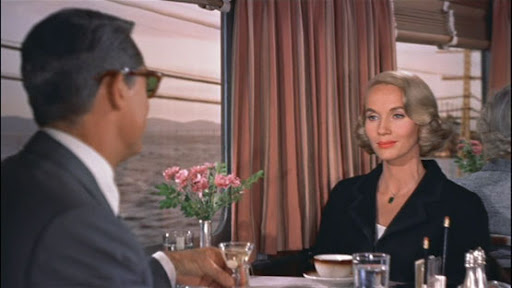
Such a masculine protagonist would be lost without a suitably feminine love interest, and Eva Marie Saint fits that job nicely as Eve Kendall, a typically beautiful Hitchcock blonde whose porcelain doll exterior hides her ability to use sex like some people do a flyswatter, and she holds her own against the likes of Psycho’s Janet Leigh, Rear Window’s Grace Kelly and Vertigo’s Kim Novak as she dabbles in some of the most forward repartee since Bacall taught Bogart how to whistle. Hitch always preferred the more beautiful but subtly sexy female leads, as he took great pleasure in uncovering their more alluring qualities than he would have with the more self-promoting individuals like Monroe. As with all of Hitchcock’s birds (pun intended) Saint is meticulously and beautifully dressed in every scene. Legend has it that the great director paid her wardrobe so much attention that Grant petulantly demanded advice on what he should be wearing, and was simply told to “Dress like Cary Grant.”
Released three years before Dr. No, this film clearly set the template for almost every Bond movie. With its dashing, smooth talking hero with an easily recognisable voice, the woman who falls for him within seconds of meeting, a villain’s lair in an impressive yet remote location (here James Mason’s Vandamm lives in a condo atop Mount Rushmore), an evil sidekick (Martin Landau, with a severe case of Henchman’s Eyebrow) and a fast-paced, stunt-riddled adventure taking in major cities around the world (or at least central and north-east USA). Thornhill even has the ability to make perfect strangers throw themselves at him; just wait for the reaction from the woman in his neighbouring hospital room. It’s no surprise to learn that Grant himself was an original candidate for what was to eventually become Sean Connery’s Bond.
Even from the trailer, this is one of the most comical of Hitchcock’s endeavours. Speaking directly to the audience, Hitch himself appears, advising the viewers on how to take the perfect vacation without leaving the cinema, keeping his tongue firmly planted in his cheek throughout (“You don’t find a tasteful murder on every guided tour, do you?”). It’s on Youtube, go check it out. Ernest Lehman’s Oscar-nominated script (tragically losing out to Pillow Talk) is full of far too many quotable lines to give justice to here, but it contains more than enough for even three films. My personal favourite? Saint declaring she’s a big girl, followed by Grant’s perfectly timed, effortless rebuttal of “and in all the right places.” The police station phone call is yet another example of solid gold. Occasionally the steady slew of insinuations and double entendres becomes a little cringeworthy, especially when Grant tells Saint he likes her flavour, but that’s a rare misstep for a script that otherwise never puts a foot wrong. There’s far too much excellence on hand to make you forget these, and the film will never fail to raise a smile with every viewing.
It isn’t just the dialogue though; the scenes without any discussions are often just as amazing, if not more so. Early on, after being forcibly imbibed with the best part of a bottle of bourbon, Thornhill is unleashed behind the wheel of a car, in an attempt to instigate his demise. Upon realising what’s going on he awakes in a drunken stupor and does his utmost to keep his car on the increasingly blurred and merging roads in front of him. Grant makes for an amusingly intense drunk, persistently blinking, squinting and staring bug-eyed at the cars he races past, made all the more dramatic by Bernard Herrmann’s  stupendously engaging score. Of course, there’s also the hallowed cropduster chase, as Thornhill, having been lured to the middle of nowhere to meet the man he’s been accused of being, finds himself battling the more painful end of a plane’s propeller. One of the few scenes not set to music – to better emphasise the relentless whirring of the plane and the lack of assistance Thornhill is likely to receive with the matter at hand – the scene is worth watching as a standalone segment. Equal parts exhilarating, terrifying and fun, it’s made all the more hilarious for the entire time Grant dives through dirt and hides amongst crops he is wearing his increasingly worn yet perfectly tailored grey flannel suit, clean shaven and with immaculate hair.
Hitchcock’s regular cinematographer, Robert Burks, excels himself in a manner that by this film is surely only to be expected. The shot of Thornhill fleeing the UN building to a waiting cab is stunning, captured from high above and angled down the side of a skyscraper, a shot I’d happily have framed on my wall, and the revealing shot of a gun hidden in a purse is sly enough to almost go unnoticed, but is sure to pay off later. Hitch ticks off almost all of his standard tropes – a wrongfully accused man on the run, maternal issues (Jessie Royce Landis, who plays Thornhill’s mother, was in real life only 8 years older than Grant), spies, deception, train journeys, height-based peril, an all-but-unnecessary MacGuffin (a statue full of microfilm), bumbling policemen, a tense finale set atop a famous landmark and, of course, an icy blonde. All that’s missing is a self-deprecating scene in a cinema.
When compared to modern day blockbusters, this picture more than holds up. Its unstoppable, kinetic nature will keep fans of both classic cinema and present day fare glued to the screen and on the edge of their seats for the entire 136 minute runtime. Filled with glamour, wit, excitement and big scenes on a large canvas, there’s something here to please everyone, as long as they like really great films. Does it live up to the hype? Yes, and more so.
Choose film 10/10