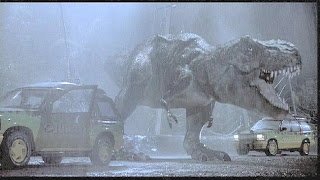
 Last week some friends and I started a Movie Night, an event that will hopefully become a regular occurrence, and should allow me to keep crossing off films, whilst also achieve something approaching a social life. We kicked off the soon-to-be tradition with a film that means a great deal to me, Jurassic Park. I have previously waxed lyrical about the virtues of this cinematic landmark, or rather the shortcomings of the third film in the series, but I’ll try not to repeat myself too much.
The plot, and I really hope that none of you need to know this, although one of the attendees at the movie night admitted ashamedly that this was his first ever viewing of Jurassic Park, concerns a group of people traveling to an island where an eccentric (you can’t be mad if you’re rich) scientist (Richard Attenborough) has discovered a way of cloning dinosaurs from DNA found in mosquitoes frozen in amber. Inevitably, not all goes to plan, and there’s much merriment to be had in the dinos vs. people aftermath.
Jurassic Park is a masterclass in efficient film-making, showing a lot with a little. This is shown early on, when an early velociraptor encounter is terrifying, yet only a couple of close-ups of the raptors eyes are seen. Shaking leaves, haunting sound effects and shots from the dinosaurs own point-of-view are enough to believe the presence of this creature. When shown, the Stan Winston-created dinosaur models and ILM-rendered CGI are on the whole impeccable and, even though they are obviously fake (obvious for lack of plausibility, not quality) the illusion is so well realised that you almost believe.
As with most Spielberg classics, the key is in casting ordinary, relatable characters in extraordinary situations. In this case, Sam Neill’s Dr. Alan Grant has a well rounded persona, a palaeontologist stuck firmly in the past, unable to touch a computer without breaking it and loathing children. Just watch him trying to let go of Lex’s hand after he helps her up, or how he probably scars a child for life with his raptor story at the start of the film. He is ably supported by Attenborough’s scientist and Laura Dern as a paleobotanist, as well as Jeff Goldblum’s excellent interpretation of rock-star chaotician Dr. Ian Malcolm, although I never really understood why he was invited onto the island. Wayne Knight’s Newman-esque bad guy (does he play anyone else? But then why should he, he’s so good at it) is also a joy to behold, especially his childlike glee at the Bond-style gadgetry he’s provided with to steal dinosaur embryos, causing the chaos that ensues.
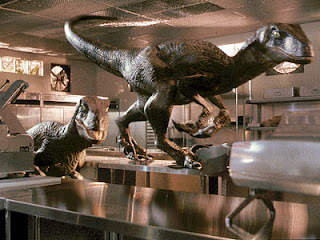
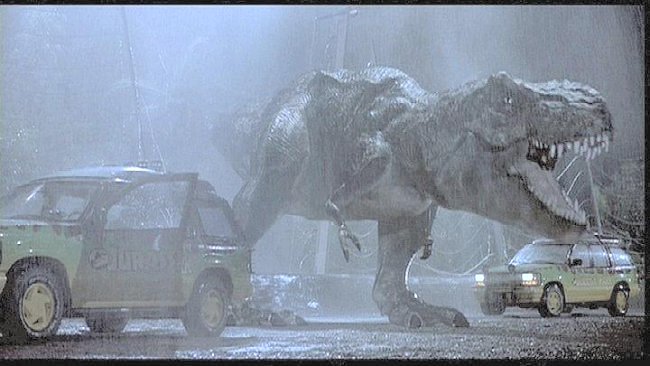
We’re introduced to the dinosaurs gently, first meeting the gentle herbivores and baby dinosaurs, before building up to the more threatening velociraptors and tyrannosaurus rex. The plot is largely dealt with in the first half of the film, leading for the remainder to be made up of unforgettable set pieces, such as the electric fence, or raptor encounter in the kitchen. Greatest of all though must be the introduction of the T-rex. I don’t think I’ve ever seen ripples forming in a glass of water since without being concerned there is a giant dinosaur about to attack me.
 It’s not just a monster disaster movie though, as there are genuinely hilarious moments of comedy (the blink and you’ll miss it rear view mirror gag is comic perfection), and the scenes are pitched perfectly, with the T-rex car chase immediately calmed by a gentler encounter with a herd of brachiosaurs. All in all, this is an example of movie perfection, and I look forward to enjoying it many more times in the future.
Choose film 10/10
 I had a productive lunch break at work today, managed to find The Great Train Robbery on Google Video. Although it was silent, juddery and of poor production quality, I was very impressed with what was capable of being produced 108 years ago, as the film involved explosives, gun fights, stunts on a moving train, a large crowd scene, horseriding, and a gun fight on horseback, all in the space of 12 minutes. That’s more action than a modern day Mike Leigh film. Some of the acting, especially when people were shot, was unintentionally hilarious, with their over-the-top melodramatic deaths. I was also unsure of the final shot, of a man looking into the camera and firing his gun several times. I thought it might have been a scare tactic, trying to emulate the supposed reaction to the first film ever shown in a cinema, Arrival of Train at Station, when apparently the audience were so concerned that the footage of a train arriving at a station was in fact a real train coming towards them that they fled the cinema in terror.




 Life Vs Film