Avengers Assemble

Ugh, typing that name made me feel so dirty. Avengers Assemble. Ugh. There was nothing wrong with just The Avengers, no-one was going to go in expecting umbrellas, bowler hats and catsuits, and even if they had been, they’d have got something better anyway. Plus, ‘Assemble’ is possibly the least exciting word to ever appear in a movie title since The Adjustment Bureau.
Now chances are this isn’t the first Avengers review you’ve read, hell chances are this isn’t even the first Avengers review you’ve read that starts off by telling you it’s not the first Avengers review you’ve read, seeing as this is one of those movies (let’s not kid ourselves by calling it a film, this is for entertainment purposes only) seemingly designed to be discussed at length on the Internet. We’ve sat through 4 years of 5 prequels, and for literally years the Internet has been lying in wait to rip apart this inevitable car crash of a movie. Which makes it something of a surprise that not only is it not bad, it’s bloody good.
No-one saw this coming. They said it couldn’t be done. I agreed. The last few Avengers prequels hadn’t been great, especially Iron Man 2 and Captain America (I don’t know what everyone has against Thor, I thought Kenneth Branagh did a good job with a lesser-known character) and I firmly believed that throwing six superheroes at one another in the same film was going to look like something Hulk had sat on. The only things it had going for it were a stellar cast and a solid director in Joss Whedon, of whom I’m unashamedly a fanboy (other than I’ve never seen an episode of Buffy or Angel). Whedon is known for handling rambling, ensemble casts (Firefly) and has always managed to balance action with snappy dialogue, drama with romance and a hefty dollop of comedy, but I didn’t think there was a great enough female presence here to draw his attention, with Black Widow as the only main girl. So, going in, my hopes were high but my expectations primed for mediocrity, so it’s a pleasure to say that I honestly can’t think of many ways the film could have been handled better.
Essentially, this is an origin movie. What’s unusual is that most of the main characters have already had at least one movie of their own, mostly origin stories, so what we have here is the beginnings of a culmination of pre-established characters. You don’t necessarily need to have seen all of the other films before watching this one, but I think it’d help, as the plot is partially set-up within Iron Man 2, Thor and Captain America, in terms of the basis of the Avengers, the bad guy and the maguffin. I saw this with my girlfriend, who hadn’t seen Thor but had all the rest, and she didn’t need much explaining to her other than that Thor’s devious brother Loki isn’t played by Michael Fassbender, but is instead the brilliant Tom Hiddleston, who performs ably as the primarily sole lead bad guy against an entire team of heroes.
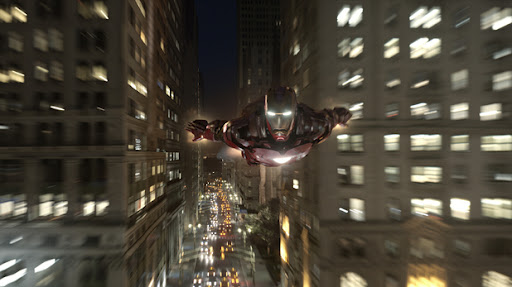
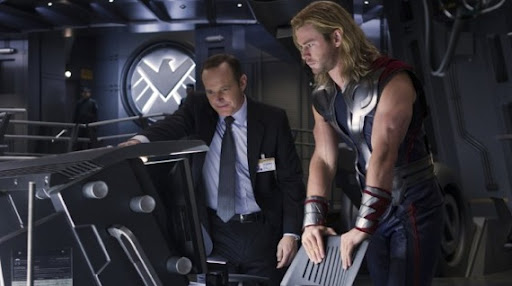
It would have been very easy, and very foolish, to have made this Iron Man & Co, seeing as Robert Downey Jr.’s Tony Stark is undoubtedly the most enigmatic and entertaining character on screen, yet wisely Whedon scaled down the potential for the Stark Show into giving him just as much time on screen as everyone else. There is no lead character here, everyone gets their moments, no-one is our entry point into the team and there appears to be no jostling for the limelight. In fact, the first people we meet are the agents of S.H.I.E.L.D., Samuel L. Jackson’s Nick Fury, Cobie Smulders’ Maria Hill and the ever dependable Clark Gregg’s Coulson (“Phil? His first name is Agent.”). These guys, along with existing Avengers members Black Widow (Scarlet Johansson) and Hawkeye (Jeremy Renner) then set about recruiting the rest of the team from across the world (and a little bit further, in Thor’s case).
Once recruited, the plot revolves around a Transformers-esque power cube known as the Tesseract that Loki has obtained, and intends to use to rule the Earth. Yadda-yadda-ya, it’s not all that important, and isn’t what you’re here to see. No, we’re here to watch some superheroes fight, bicker, argue and smash. I’ve heard arguments that there isn’t quite enough action in this 142-minute movie to satisfy, but I found the dialogue scenes to be just as entertaining. As expected, the superheroes, all previously alphas in their own movies, don’t initially gel together all that easily, and Iron Man keeps the insults flying at his comrades (Thor is referred to as “Shakespeare in the park,” Captain America is ribbed for being an old man). It’s clear this isn’t just friendly banter.
When the action scenes do come along, including one mid-way through worthy of any summer tentpole finale, they will have you marvelling at everything. And the actual finale, involving a mass brawl around New York City, features an incredible tracking shot that finds all the Avengers showing off the only way they know how, that I can only fault by being not long enough. Granted, with such a large cast there are occasional incidents of characters appearing to be forgotten or sidelined temporarily whilst the others are front and centre, but this isn’t too noticeable at the time, and doesn’t distract from the action.
Unlike his previous films, here the Hulk is neither under nor overused, and is easily one of the best aspects of the movie. Mark Ruffalo, taking the giant green reins from Edward Norton, delivers possibly the greatest Hulk yet, portraying Dr. Bruce Banner as an amiable everyman only too aware of the situation he’s in. He’s rewarded with some of the best, and funniest moments from the film, not least his one-on-one meeting with Loki.
Whedon seems unable to let a few trademarks go, though discussing them could be delving a little too deep into spoiler territory, but look out for a couple of cameos from his other projects, as well as appearances from Gwyneth Paltrow, Paul Bettany and Stellan Skarsgard all reprising roles from the prequels. Natalie Portman, however, is conspicuous only by her absence. Bizarrely, the likes of Powers Boothe, Harry Dean Stanton and Jenny Agutter also crop up in tiny roles.
Some moments seem entirely shot for trailers, and I was a bit annoyed that my knowledge of Marvel’s upcoming slate and a couple of shots from the trailers ensured that some of the would-be tense moments were obviously going to be resolved (albeit awesomely), but that’s my fault for watching trailers. There is a scene to wait for after the credits, but unless you’re a fan of the comic books there’s really no point, as I had no idea what the scene was about when it appeared until I delved around the web once home. All-in-all, I’ve very little to fault about the film, other than the incessant use of ass-level shots as characters walks away from the camera. I’m genuinely tempted to go and watch it again at the cinema, something to this day I’ve never done before, and I’m not the least bit annoyed that talks are already being made about an Avengers sequel.
Choose film 9/10

Mad Max 2 The Road Warrior

If the recent UK petrol strikes had gone on a little longer, chances are we’d have seen something not too dissimilar to the events here, in George Miller’s 1981 sequel to 1979’s Mad Max. Mel Gibson reprises his role of Australian cop Max Rockatansky, but the world he lives in is now a barren, chaotic land left ravaged by a worldwide war, leaving the survivors desperate for any fuel they can find.
Max and his dog roam the landscape looking for gasoline, eventually hearing about an enormous stash not too far away, and so with the guidance of a deranged nutcase with a flying machine (“It’s my snake, I trained it and I’m gonna eat it.”), set out to find it, but alas the compound within which the gasoline is kept is not only heavily guarded, but is also being laid siege to by a ruthless gang of miscreants.
Whilst this is certainly an improvement on the original movie, there are still a lot of things here that don’t make sense. For starters, the motivation for every character is to end up with more fuel, yet all seem to expend an awful lot more than they need to in order to get any. Whole fleets of cars and motorbikes are sent out on scouting missions, showboating and jumping as they go, and even the compound uses a bus as a gate. If fuel is so very precious, why are they all so eager to waste it?
The costume design has progressed from the previous film, and now the rebel gang has an even greater passion for leather, bondage and ass-less chaps than Max himself. The depiction of a lawless, structureless society is well done – one of the gang’s cars is a cop car, suggesting that it’s not just the general population that has lost it’s mind – and Max readily eats cold dog food, straight from the tin. There’s better characters too, including a feral kid with a deadly boomerang (played by the brilliantly named Emil Minty), and there’s some decent action and chase sequences. The epic finale, with the gang attempting to seize a petrol tanker trying to travel 2,000 miles to paradise, does get a little samey after a while, but is impressive nonetheless. The arm-mounted crossbow though is probably the least threatening weapon I’ve ever seen.
Fortunately, Mad Max 3: Beyond Thunderdome isn’t on the list, but this one is deserving of it’s place. It’s by no means the greatest dystopian future survival movie, but it’s still an enjoyable watch, and certainly has it’s moments.
Choose film 7/10

Up in the Air

Jason Reitman’s third directorial outing, after the stellar Thank You For Smoking and the good-the-first-time-you-watch-it Juno takes two done-to-death plot conceits – the business-set rom-com and road movie odd-couple – and reinvigorates them to be not only modern, but impressively timely.
Up in the Air is much more in keeping with the structure of Smoking, as we follow a successful, charming but morally dubious and emotionally detached businessman discovering that his perfect life may not be as ideal as it seems once women step a little too far into it. Previously it was Aaron Eckhart’s fast-talking cigarette peddler Nick Naylor, here it’s George Clooney’s professional corporate downsizer Ryan Bingham, jetting around the country to fire people when their own superiors don’t quite have the balls. And with the economic climate and unemployment rates where they are now, no other film could be quite so prescient.
But it isn’t just that this film rings true with modern times. Clooney channels his inner Cary Grant in the role he was seemingly born to play, whilst Vera Farmiga is wonderful as his female equivalent, Alex. The real surprise though is Anna Vendrick. Formerly most famous as Bella’s best friend in Twilight, here she shows real comic ability and acting prowess as Natalie, the bright young whippersnapper brought in to downsize the downsizers, aiming to revolutionise the business by doing it all online.
The cast is rounded out by some Reitman regulars, including Jason Bateman, J. K. Simmons and Sam Elliott, as well as Danny McBride, Melanie Lynskey and Zack Galifianakis, and a gaggle of non-actors portraying essentially themselves when they were fired, with Reitman instructing them to dwell on their own experiences in some moving moments.
The best scenes involve the principals just sitting down and talking. Be it Ryan and Alex comparing the weight of their loyalty cards, or Natalie learning that, as you get older, your expectations of life lessen to more realistic goals, the script is insightful, sparky and above all else funny. I was a little annoyed at seeing Sam Elliott in the opening credits, and seeing his cardboard-cutout as the Chief Pilot in an airport signposting that, at some point, his character was going to crop up somewhere, but that’s another of those things that only really hurts the film nerds.  Some of the metaphors are a little heavy-handed (at one point Ryan’s family literally doesn’t fit into his suitcase) and the ending feels like a series of devastating gut-punches that kind of spoils the mood, but each one feels perfectly justified and necessary.
If you don’t settle too deeply into the subject matter this is a fun comedy with a great script, and even if you do it’s still thought-provoking and entertaining stuff. I await tracking down Reitman’s latest offering, the Charlize Theron starring Young Adult, with anticipation.
Choose film 8/10

Thelma and Louise

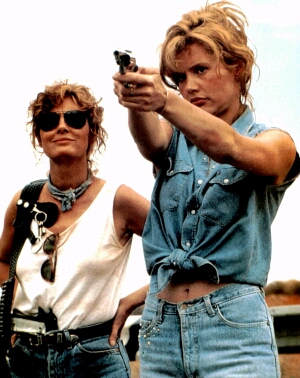
Two girls, a turquoise 1966 T-Bird convertible, a weekend vacation at a friend’s cabin up in the mountains, what could go wrong? Well, in Ridley Scott’s feminist road movie, a heck of a lot, as henpecked housewife Thelma (Geena Davis) and her world-weary waitress best friend Louise (Susan Sarandon) head out from their humdrum lives on more of an adventure than they bargained for, after a run-in with a would-be rapist at a country bar of ill repute.
The titular roles could not be more different, yet both remain well rounded characters, thanks in part to the able performances by the two leads. Though it is the men that seem to shepherd our heroines on the run, they always find a way of fighting back or turning the tables, be it on Harvey Keitel’s cop on their trail (assisted by Stephen Tobolowsky!), Michael Madsen as Louise’s boyfriend Jimmy, Brad Pitt’s first major film role as clothes-shedding hitchhiker J.D. or Christopher McDonald as Thelma’s boorish husband Darryl, eager to get his wife back so she can start making his dinner again.
There’s some great comedy – Darryl unable to watch his beloved football because the cops tapping his phone are too engrossed with Cary Grant in Penny Serenade – and though the story and ending may have been ruined by an overabundance of pop-culture spoofs and references, it is still a very good story. The accents begin to grate after a while, particularly Davis’ pronunciation of Loo-eese, but try to look beyond that at a journey that starts with an accident, and builds to become two strong female characters exploring their own limits, surprising themselves and everyone else.
Choose film 7/10

The Class

Filmed in a real school (and mostly in a real classroom) with an unprofessional cast all playing versions of themselves, Laurent Cantet’s semi-improvised near-documentary follows Mr. Marin (François Bégaudeau), a French teacher at an inner city school as he tries to connect with, further and inspire a class of 13-15 year olds. Bégaudeau co-wrote the script, and stars in his first acting role essentially playing himself, for he used to be a teacher, so it is no surpirse that his performance is wonderfully naturalistic, as are those of the multi-cultural students he presides over.
It is impossible not to feel the frustration felt by Marin, as he does his utmost to help his students, who almost seem to repell any learning, yet even when the other teachers have given up on the more problematic pupils, Marin still endeavours to find ways to reach them.
If this all sounds a little Dead Poet’s Society or Dangerous Minds, fear not. Here there are no last reel acts of defiance or obligatory contests won, life simply goes on. We see the less exciting but still interesting goings-on behind the scenes at the school – teachers debating punishment techniques and coffee machines, warning the new staff about the difficult classes – all shot in a documentarian, handheld style in amongst the desks.
The first half feels a little directionless, yet is still compelling, but the second, following the fallout of Marin saying two students behaved like “sluts” and his endeavours to help troublesome miscreant Souleymane, is much more on target. If you’ve ever been inclined to take up teaching, this film may infuriate you, with regards to how much effort Marin must fight against to even give Souleymane a chance.
Choose film 8/10

Harry Potter and the Deathly Hallows Parts 1 & 2

I’m a strange breed of muggle. I’ve seen all the Harry Potter films, most in the cinema. I’ve read all the books. Hell, I own them. Double hell, I was first in line queueing up outside Morrison’s on the morning book 7 was released. But I wouldn’t call myself a Harry Potter fan. So why have I kept with it? I read the first book in school, and found the wizarding world to be quite wonderful, a dream of a place to escape to. Granted, by the time the much darker later books came along I became much happier that this world of dictatorial terrorists with almighty magical powers didn’t actually exist (or so I’m led to believe) but back then it was nothing short of fun, and the fact that I was of a similar age to the protagonist when the books were released made it all the more so.
The books were perfect for film adaptations, and the stylistic choices throughout the series have been close to faultless. Most of the negative aspects, other than the questionable acting abilities of the children early on in the franchise, can be blamed on the books being too labyrinthine to be condensed down into a 150-minute movie, and there are arguments to make as to whether each book would have been better off as a TV series, but it’s doubtful they’d have received such a hefty budget or impressive cast, or made nearly as much money.
Of the films, part 3, Prisoner of Azkaban, is widely regarded as the best, with director Alfonso Cuaron unleashing the franchise’s dark potential, redirecting away from Chris Columbus’ more child-friendly first parts, but personally I prefer part 4, Goblet of Fire, because it’s easily the most fun and structured, following the Tri-Wizard Tournament, and it has dragons in it, which are awesome. Parts 5 and 6 are, in my opinion, the weakest, with my reasoning being that I can barely remember anything that happens in them other than some character deaths and casting decisions, but the final films really kick things into gear.
Many have questioned the decision to split the final book into two halves, citing financial gain as being the true reason, but having seen the results I approve of the choice. Whilst the earlier books could stand to lose some of the lesser plot points without the plot suffering, the amount of closure given in the finale could not have been achieved with a similar level of editing. Whilst the total runtime for the final two films could have been a little shorter than the 4½ hours achieved here, getting it down to a length the core Potter audience would be willing to sit through without complaining would have resulted in almost catastrophic levels of cutting.
The most impressive aspect of the film franchise has always been the cast. Whilst the three leads, Daniel Radcliffe, Rupert Grint and Emma Watson, were never expected to be incredible actors (and, for the most part, lived up to this promise) the film studios ensured this wouldn’t be a problem by surrounding their stars with almost every British actor working today, with more added every film. To list them all would be senseless, but the fact that, Richard Harris’ untimely demise notwithstanding, every actor returned to their roles for every subsequent film shows that the films must have been great to work on too.The Deathly Hallows alone saw the inclusion of Bill Nighy, David O’Hara, Rhys Ifans, Ciarin Hinds and Nick Moran into a cast already including the likes of Ralph Fiennes, Robbie Coltrane, Julie Walters, Helena Bonham Carter, Alan Rickman, Jason Isaacs and Maggie Smith, and the fact that so many notable actors returned for such minuscule roles is incredible. Jim Broadbent, John Hurt and Emma Thompson are barely on screen, but the fact is they are.
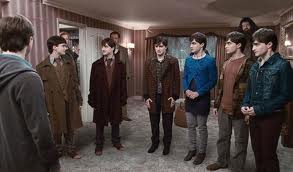
Part 7 is the only one of all eight films not to feature Hogwarts, the wizarding school where our young heroes are taught, and therefore doesn’t feel like part of the Potter pantheon. Freed from the structure of lessons, Quidditch matches and Harry being picked on by Slytherin, the film feels a little meandering, as Harry, Ron and Hermione scour the country looking for a series of magical Maguffins, horcruxes, that for one reason or another must be destroyed to help bring down the evil Lord Voldemort. The film opens strongly, with Harry’s escape from his home assisted by his wizarding friends transformed to be replicas of him, but it’s not until a later infiltration of the Ministry of Magic that any more excitement is had. There’s an awful lot of tension and relationship issues, exacerbated by a locket that builds negative feelings in whoever wears it (so… put it in a bag rather than wear it?) and a particularly cringeworthy scene wear Harry attempts to alleviate some tension by dancing with Hermione in a tent, but it feels empty without the action-balance provided by the second film. The brief animation, depicting the origins of the Deathly Hallows that grant the owner power over death, is easily the highlight of the series in total.
If watched as one long film, the two halves join together to form a perfectly balanced picture, with the final hour-long battle a rewarding epic culmination after a mammoth build-up, so if watching make sure to set aside the best part of an afternoon, however just watching part 8 alone is also acceptable. The infiltration of Bellatrix Lestrange’s Gringott’s vault, with Helena Bonham Carter gleefully impersonating Emma Watson, is tremendous fun (there’s another dragon!) and now they’ve got all the teenage angst and worrying out of the way it’s time for good and evil to get scrapping. The finale is equal parts devastating and spellbinding, as the regular cast is treated with a sporadic survival rate, literally anyone is up for the chop, up to and including Hogwarts itself, as various sets we’ve grown to feel at home in are burned to the ground. Some aspects of the battle feel crowbarred in – Mrs. Weasley’s showdown against Lestrange, Ron and Hermione’s inevitable kiss – but for the most part it’s a cinematic marvel that doesn’t disappoint.
Harry Potter and the Deathly Hallows Part 1: Choose life: 6/10
Harry Potter and the Deathly Hallows Part 2 : Choose film 7/10
Harry Potter and the Deathly Hallows Part 1 & 2: Choose film 8/10

Far From Heaven

Hertford, Connecticut; 1957. Cathy Whitaker (Julianne Moore) is at the heart of her picket-fenced community, her husband Frank (Dennis Quaid) is a successful businessman and her two young children are little bundles of perfection, with her daughter wishing to one day grow up to be just like her mother, though her son is a little foul-mouthed (“Ah jeez” is not the kind of language Cathy tolerates).  But beneath the surface of floating dresses and pristine curls, all is not well. It’s clear from Cathy’s expression that, though her friends must all put up with their husbands’ occasional demands for intercourse, Cathy has no such problems, for Frank hides a secret; whenever he is ‘working late’ he tends to be frequenting a bar aimed only at male patrons that want to get to know each other a little better.
Todd Haynes’ movie lovingly recreates an idealised vision of 1950s suburban middle America (“Aw shucks” is uttered in the first four lines, and “jeepers” and “swell” aren’t too far behind) although the rampant sexism and racism would be more than frowned upon today. When Cathy shows sympathetic tendencies towards her black gardener Raymond (Dennis Haysbert, 24‘s President Palmer) she is the subject of mild ridicule and is frowned upon by the society that used to hold her dear. Haysbert is good in another of his solid, decent, all-round nice guy roles, but Dennis Quaid continues his run of being the worst thing about a film. I’m sure in his youth he must have done something to earn a reputation as an actor, but I can’t for the life of me think what it is, I’ve only ever known him as the worst thing in bad films (Flight of the Phoenix, Smart People, The Day After Tomorrow, Vantage Point).
The era is seamlessly recreated, to a point where the film could easily have been made in the 50’s – in which case it would probably be hailed today as a classic. Moore is the best thing in it, so much so that at times she barely seems to be acting, so great is the level of repression she must convey. She received an Oscar nomination for her troubles – Nicole Kidman must have been really great in the Hours to beat her.
Though at times it feels like nothing really happens, that is surely the point. This is more a study of the prejudices of the era – Frank’s grand social indiscretions can be brushed under the carpet or cured (a doctor has a 5-30% success rate for curing homosexual urges) whilst Cathy’s much lesser faux pas sees her outcast from all around her. The plot and script are a little hokey, but the performances and overall feel stay with you after watching this subtle piece.
Choose film 6/10

Edward Scissorhands

First off, apologies for the lack of posts recently, I’ve been in hospital for an operation on my nose (inspiring this Top 5). Also, apologies if the posts over the next few days are a little off, I’m on a veritable Pan Galactic Gargle Blaster of meds, but I’ll try and keep everything as on topic as possible.
Johnny Depp successfully accomplished the transition from TV heart throb to serious movie actor with this, Tim Burton’s fourth directorial outing, leading to at present a further seven collaborations between the two bizarelly-haired gentlemen. Depp stars as Edward, the creation of a reclusive inventor (the legendary Vincent Price, in an all too brief cameo in his final film role) who remains incomplete after the inventor passes away. Edward looks human enough, but where five-fingered appendages should be on the ends of his arms, there are instead a multitude of blades, knives and scissors. After being discovered living alone by Dianne Wiest’s kindly Avon lady Peg, Edward is brought into the ‘normal’ world of 1950s suburban American.
As much comedy is made from Edward’s physical impairment as possible, with his blades coming into contact with waterbeds and hindering his ability to get dressed, pick up a glass, open a door or touch his face, but he shows an aptitude for carving meat, topiary, hairdressing, dog grooming, paperchain-cutting and being used as a kebab skewer. This does bring up the subject of exactly how Edward had survived alone in the castle before his ‘rescue,’ but as this is essentially a fairytale, minor plot details can be smoothed over.
As ever, Burton shows a deft hand with his casting. Depp is wonderful as Edward, showing childlike wonder at the new world around him, and expressing true depth of emotion from behind a stark appearance, all pale face, scars, bedraggled mop of hair and tight plastic and leather bondage-inspired clothing, and with minimal dialogue. Winona Ryder is cast against type (in that she wears colourful clothing and has blonde hair) as Peg’s cheerleader daughter Kim, and Alan Arkin and Wiest are wonderful as the parents welcoming Edward into their home. Anthony Michael Hall as Kim’s brutish boyfriend is more of a stretch though; the nerdy Breakfast Club star cannot be taken seriously in a bad guy role.
The film is lighthearted and entertaining, and has some genuine comic moments. The bookends of a clearly aged Winona Ryder are more obvious than the supposed narration reveal of the Notebook, but this features one of the greatest and most memorable character creations of cinema, and some fine acting too.
Choose film 7/10

Unlisted: The Cabin in the Woods

Five college kids head for a vacation in a deserted shack (or cabin) in a remote forest (or woods), with no-one around for miles and a very creepy basement. So far, so Evil Dead. Or Texas Chainsaw Massacre. Or… well, you get the point, but the fact this is written and produced by Joss Whedon, and co-written and directed by Drew Goddard, one of the men behind Lost, should tell you that this is no ordinary textbook horror.
The recent years have seen the horror genre be evaluated, analysed and turned on its head, with the likes of Wes Craven’s Scream franchise and Tucker and Dale Vs Evil, and also imbued with a greater sense of comedy, for example Shaun of the Dead and Severance, to name two prime British examples. Cabin in the Woods takes these films and goes much further, leaving you rethinking every slasher movie you’ve ever seen.
I’m going to do my best to not reveal spoilers here, but if you’re trying to avoid them then chances are you probably aren’t reading this. The trailers have been criticised for perhaps showing more plot than is strictly necessary, revealing that there is more to this cabin than meets the eye, but I personally feel this is essential for the trailer (though it could have been hinted at more subtly) else the only trade the film would have made would be from the slasher fans willing to pay to see them at the cinema, of which I most certainly am not. My only trailer annoyance was the use of a scene or two from the third act that, though I’d only seen the trailers once, still stuck with me and left me waiting for them, over-thinking the plot as I went.
The performances are all wonderful, particularly practically unknown Tim De Zarn as the token redneck doomsayer the kids encounter on their way, and there’s some casting coups for fellow Whedon-ites in Dollhouse’s Amy Acker and Fran Kranz (whose Topher Brink is, occasional Firefly cameo aside, the best thing about Dollhouse) as well as Chris Hemsworth, Bradley Whitford and Richard Jenkins.
I have very few faults with the movie. One came because I’m a film nerd, and caught the signposted closing cameo from a recognisable voice, and the third act feels a little off the rails at times, but in an exhilarating, thoroughly entertaining way, although I did question why exactly that big red button was there. I look forward to pouring through the features when it’s released on DVD, and it’s the first film in a while that I’m actually considering going to the cinema and watching again. Go see this film, it’s truly wonderful, especially if you’ve ever seen a film with a cabin and some woods, and chances are you have.
Choose film 9/10

The Dark Knight

What can I say about the Dark Knight that a thousand others before me haven’t? Of all modern films, this seems to be the one pored over most closely and often, heralded as the saviour of the summer blockbuster, superhero movie and crime thriller, all rolled up in the tightest of scripts. So, to take a fresh perspective, I sought out some people who didn’t like the film (thank the lord for the Internet, it makes people who don’t like something so easy to find) and found myself furious after reading just one and a half 1/10 reviews on IMDb. The sheer level of nitpicking and miniscule plot-hole unravelling proves just how far people are willing to go to disagree with the masses and stand out from the crowd, even when the crowd is so undeniably correct.
Not that this is a perfect film. There are flaws, including the Joker’s plan being at times a tad too pre-emptive, some ominous camera angles and music cues hinting unsubtly a character’s true motives earlier than should have been done, and the bit with the cellphones, which is a bit silly, but is that really enough to warrant a 1-star rating? The fact that these reviewers (I won’t give them the satisfaction of names or links, only seek them out to feel the rage bubble inside you) fail to note even one positive point in a movie overflowing with brilliance negates any opinion they deem worthy of sharing. I personally find it impossible to find nothing good in a movie – The Adventures of Pluto Nash is an abomination unto film, yet Randy Quaid is a delight as Nash’s robotic assistant; Big Trouble in Little China is easily one of the worst films I’ve reviewed from the list so far, but it has imaginative (if insane) monsters and mythology, some dialogue that surpasses cheesy to being inspired, and features Kim Cattrall back when she was attractive. Therefore, with such damning reviews as these ‘people’ have offered, they are in fact unwittingly proving how good a film it is.
Leaping from the tantalising springboard ending of BatmanBegins – Gary Oldman’s Jim Gordon showing Batman a playing card left as the mark of a new criminal, calling himself The Joker, we dive headlong into a wonderfully executed bank heist, as six masked goons effortlessly separate mob money from the vaults it was stored in. Director Chris Nolan has made no secret that Heat, Michael Mann’s superb DeNiro/Pacino cat and mouse crime epic, was a huge influence on the Dark Knight, and it shows, from a William Fichtner cameo to a central meeting of the hero and villain, even mentioning a cup of coffee.
Nolan wisely improved upon some mild mis-steps made in Batman Begins here, replacing Katie Holmes with Maggie Gyllenhall as love interest Rachel Dawes, giving Batman’s mask a cowl so he can turn his head, and giving Batman himself (Christian Bale, good but no Adam West) a little less screen time, allowing alter ego Bruce Wayne and his various accomplices and nemeses some breathing room. Aaron Eckhart is spot-on as Harvey Dent, Gotham’s shining hope against the mob, and Morgan Freeman and Michael Caine remain on hand to add a touch of old school class and grandeur as Wayne’s dependable CEO nad curmudgeonly butler/moral compass, but justifiably most of the praise has been directed at the late Heath Ledger’s Joker. A creation for the ages, his layered performance of a truly maniacal genius reveals more with each viewing, and it is unfortunate that the role showcased the true acting abilities of a man previously thought of merely as a rom-com heartthrob only after he had passed. Plus, it gave us all another Hallowe’en costume to use.
Unusually for Nolan, the film is actually quite funny. It’s not exactly laugh-a-minute (there’s certainly less than 152 jokes here), the script is still a lot more humorous than you might remember. There’s also absolutely no filler, with every strand being integral to the plot; a true achievement when you consider just how engaging the story is, even when new elements are being added right up until the last few scenes.
As always with Nolan’s films, there’s a couple of cinematography moments that I’d have tried differently (see Inception), most notably the scene where the Joker leaves a hospital, which could have looked truly tremendous had it been one unbroken shot, without needlessly cutting away to some pedestrians nearby, but this is a small matter that is more of a personal niggle than a criticism.
Anyway, for those wondering if they should watch the film again before the upcoming trilogy closer The Dark Knight Risesthis summer, the answer is a resounding yes. Even if you don’t intend to see part 3 (I assume you’re planning on gouging out your own eyeballs, just in case it isn’t any good, there’s no other reason not to see it) you should watch The Dark Knight again, just because it’s probably the best film to have been released in the last 5 years, if not more.
Choose film 9/10