Battleship Potemkin

Famous for the pram rolling down a staircase, famously ‘homaged’ (stolen?) by Brian de Palma in the Untouchables and parodied in the Naked Gun series, Battleship Potemkin is a silent film about the crew of a Russian battleship who mutiny over the poor food, ultimately causing a mass revolution. There are certain images from the film that are more well known than the film itself – the meat crawling with maggots, the hordes of people mourning the death of a man “killed for a plate of soup” and of course the Odessa staircase scene, that the rest of the film is lost between these set pieces. I think that there are supposed to be parallels between the plot and the Russian revolution, but I’m afraid I don’t know my Russian history as well as is required to appreciate these, so this went over my head a little.
Choose Life. 5/10

The Terminator

Film night strikes again with the Terminator. This is a film that is so deeply ingrained within popular culture that I cannot remember the first time that I saw it, and probably did not even realise it was my first time then, as the character is so well known, from the way he moves to his handful of lines of dialogue, but I tried to watch it afresh, as though it was 1984 and I’d wandered blindly into a cinema and sat down. The most surprising thing I found was that there is no indication that Schwarzenegger is a cyborg until about 45 minutes into the films, though it is now the most famous aspect of the film. Up until Kyle Reese (Michael Biehn) tells Sarah Connor (Linda Hamilton) that he is a robot sent from the future to kill her, preventing the birth of her son and therefore the revolution against the cyborgs that he will eventually cause, we only assume that Schwarzenegger is just a specially trained, seemingly unstoppable killer, possibly a soldier or hitman of some kind. Yes there are some hints; his stiff-legged walking and even stiffer speech mannerisms, but at the time no-one would have been expecting anything more acting-wise from the former bodybuilder. 

Unbreakable

Unbreakable is essentially an anti-superhero movie, taking many of the genres staples and applying them to a real-life thriller, years before Christopher Nolan rebooted the Batman franchise with his realistic and plausible worldview. The hero, David Dunn (Bruce Willis) has alliterative initials (Bruce Banner/Peter Parker/Clark Kent), wears a hooded cloak and has a penchant for posing in the rain with a bright light behind him, illuminating a stark silhouette on the screen, yet unlike most comic book heroes, when he tries to chat up a girl (after slyly removing his wedding ring) the attempt fails. That never happened to Tony Stark.  The film is even shot like a comic book, with the aforementioned chat up routine swaying from person to person between seats on a train, and many scenes utilising one bright colour, such a bright orange boiler suit, contrasting against the surrounding dreary muted blacks, browns and greys.
Continue reading

Ocean’s Eleven

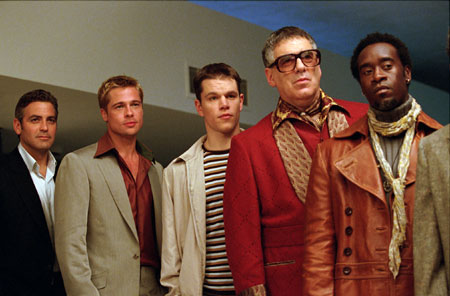
Sneaking its way onto the list at number 500 of Empire’s top 500 films is the 2001 remake of Ocean’s Eleven, one of the few remakes on the list to surpass its original. This film relies on the complexity of the genius heist plot and the easy camaraderie and star wattage of its leads to create an enjoyable and cerebral popcorn flick. But as usual it’s the small moments of humour that meant the most to me, especially how the story and characters play with the real-life personas of the actors playing them. For example, at the beginning of the film Brad Pitt’s Rusty Ryan and George Clooney’s Danny Ocean are teaching ‘movie stars’ how to play poker. The so-called stars they are schooling include small screen heartthrobs Topher Grace (That 70s Show,) Joshua Jackson (Dawson’s Creek) and Holly Marie Combs (Charmed), each playing themselves, and here dubbed as major movie stars, being photographed by the paparazzi whilst Pitt and Clooney, at the time two of the most famous faces in the world, are ignored by everyone. Another parallel is Pitt and Clooney’s teaching of Matt Damon’s rookie conman Linus Caldwell, in a sense showing Pitt and Clooney teaching Damon how to become a star as renowned as them, with Damon continuing his meteoric rise to fame with the Ocean’s Eleven, arguably reaching the same level as Pitt and Clooney. Finally, Pitt’s performance as a fake doctor parodies Clooney’s stint on ER, especially his flamboyant overacting.

Choose film 9/10

Rocky

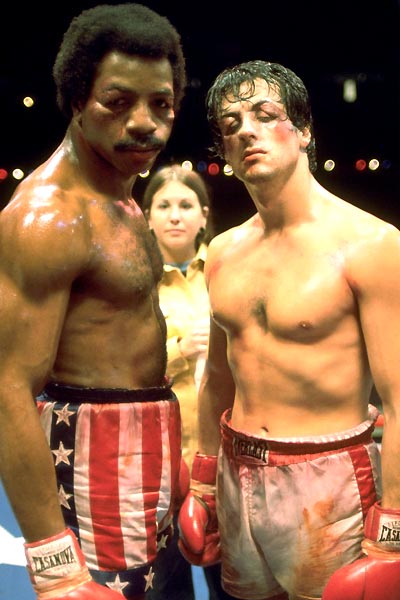
Written by and starring Sylvester Stallone, Rocky tells the story of Rocky Balboa, a small-time boxer working as an enforcer for a loan shark to make ends meet, and clumsily wooing his friends sister, a shop assistant at a pet store. Rocky is given a shot at the big time by superstar world heavyweight champion Apollo Creed (Carl Weathers), Rocky exact opposite in a man seemingly with everything. Rocky won the Oscar for best picture in 1977, beating such classics as Taxi Driver, All the President’s Men and Network, yet I am at a loss for why. Yes, it is enjoyable, with some great dialogue (“It’s Thanksgiving” “Yeah to you, but to me it’s Thursday”) but the acting is mostly passable and the story derivative, but it did birth the training montage, now a staple of any sports movie.
Choose life 6/10

Zelig

Shot completely in a documentary style, complete with narration and interviews with those involved, Zelig tells the story of a man with the ability to transform his appearance, personality and skillset to those around him as a chameleonic defence mechanism. I knew a little of the plot before watching the film, but I found the documentary style to be refreshing, especially the way it limited the lead performances of Woody Allen as Zelig and Mia Farrow as the doctor who falls for him to audio footage, archived interviews and media clips. The film is littered with Allen’s trademark humour and surreal style, and I found the use of different styles of camera to reflect the purpose and technology behind the footage.
Choose life 6/10

Forrest Gump

Forrest Gump is built on one man’s incredible journey through the key moments of recent American history, from landmark events like the Vietnam war and the Watergate scandal, to key figures of pop culture including Elvis Presley, John Lennon and several presidents. The seamless integration of Gump into archive footage subtly shows director Robert Zemeckis’ expansion on the technology he developed in Who Framed Roger Rabbit, and the soundtrack is suitable epic too, especially during the war sequences. As with most films I’m very familiar with, it’s the small touches I like the most, for example the way Gump’s eyes are shut in every photo he’s in, including the lifesize cardboard cutouts used for advertising ping pong bats. Also, the way Zemeckis makes life harder for himself is admirable, such as the shot panning up from [spoiler] Lt. Dan’s new prosthetic leg to his face could have been accomplished much more easily by simply cutting from the leg to his face, yet instead complex CGI is used to mimic the leg on Gary Sinise’s body. Tom Hanks is of course the heart and soul of the film, fully rounding his simple Gump with only admirable qualities, producing a truly heartbreaking performance at times.


Choose film 9/10

Paths of Glory

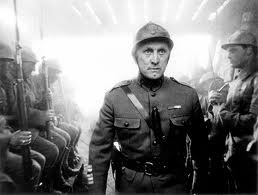
Paths of Glory emphasises the differences between the high ranking officers and the lowly privates during the first world war, as after a failed advance, the general in charge demands three soldiers to be made an example of, via a firing squad. The general assumes cowardice on behalf of the men, yet each of the men chosen has a valid reason for retreat, be it finding themselves alone against an insurmountable challenge, being ordered not to by their superior or being knocked unconscious during the advance.
The film is part war, part courtroom drama, as Kirk Douglas attempts to defend the three against their charges. There were some good shots, such as the tracking shots through the trenches, that I feel would have benefited from being single continuous takes, although perhaps budgetary conditions and the technology available at the time limited this. The final scene, as Douglas stands outside watching the troops leer at a female German singer, makes us think who is worse, the generals more than happy to fire upon their own men to make them attack, or the soldiers themselves, reduced to their base urges in the face of death.
Choose film 7/10

Rain Man

Rain Man usually, and justifiably, receives plaudits for Dustin Hoffman’s performance as the autistic Raymond Babbitt, a role for which Hoffman won his second Oscar (after Kramer vs. Kramer), but it is the performance of Charlie Babbitt by Tom Cruise that should receive accolades too. His Charlie is wound up a little too tightly by the wishes of his recently deceased father to leave his fortune to Charlie’s brother Raymond, a brother Charlie didn’t know he had. He’s angry at his father, angry at his brother, and everyone around him as he struggles to come to terms with the aftermath of his father’s death. I don’t mean to underrate Hoffman’s performance at all, his is the stronger of the two, and it is the little moments that make it so, such as the moment of childlike confusion on the escalator.

Choose film 6/10