I needed to (and to be fair, still do) catch up on my film watching and post writing, so the opportunity to watch several short films that could all be written up in one post was something that needed to be implemented (and will soon be repeated with an upcoming Luis Bunuel collective post, watch this space). So what better way to do this than with an entire weekend devoted to the Mouse House and it’s timeless catalogue of classics? After a quick LoveFilm reshuffle, some DVD borrows and a root through my parents VHS collection the scene was set.
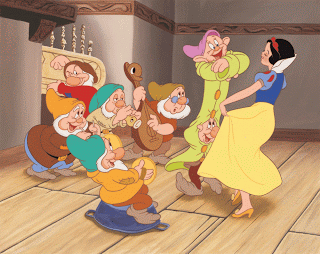 As was the recent Star Wars marathon, progress was made chronologically, so let me begin by taking you back to 1937, when an evil queen kept her beautiful step daughter locked up and dressed in rags, forced to work cleaning the castle, with singing to birds her only enjoyment. When Snow White’s beauty begins to surpass that of her stepmother, the evil queen orders a huntsman to lead the young housemaid into the woods to kill her, but he cannot and she flees instead. Her journey through the woods is terrifying – floating logs become crocodiles, trees grow hands and grab at her (but stop short of Evil Dead-style harassment, this is a kids film after all), but fortunately she finds an abandoned house in the woods and ploughs straight in with half the woodland in tow. A message that should have been made clear in this film, but was bizarrely omitted, is hat wild animals should not be used to aid cleaning, and especially not in serving food. Licking a late clean is an expression uncle Walt took all too literally, and I highly doubt the tails used to dry the crockery and measure ingredients were ever sanitised.
Imagine, if you will, that you’ve been at work all day with your six diminutive brothers. The disreputable state of your house when you left it that morning shows that cleanliness has never been high on your list of priorities, and the lack of a dog bowl shows that animals have no place under your roof, yet when you arrive home you discover an undeniable case of breaking and entering – the culprit is still asleep in 3 of your beds after all – and I’m guessing an at least light scattering of feathers, fur and footprints everywhere you look. If your reaction is celebration rather than immediate calls to the police and pest control, chances are you randomly break into song on a daily basis. Typically for an early Disney film, the plot is non-sensical and wafer thin (so the evil Queen is also a witch who can transform her appearance – why not either make herself more beautiful or Snow White ugly?) and the songs – other than the timeless Hi Ho Hi Ho – are forgettable and saccharine. Often scenes are entirely superfluous – Snow dances with the dwarfs for a straight 5 minutes – and, whilst notable for being the first feature length animation, many better films along similar lines have now eclipsed it.
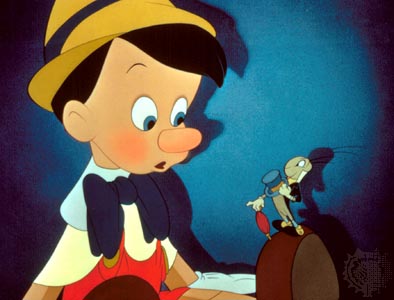
 One such eclipser is Pinocchio, raising the bar in both quality and insanity stakes, as lonely toy maker Geppetto wishes on a star that his latest puppet were a real boy. Of course this happens, and a cricket is made his conscience, (because why not?) and the next day an overjoyed Geppetto sends his new son off to school, presumably to have the sap kicked out of him for being made of pine, threatened with matches, woodpeckers, beavers, or just a good old fashioned junior hacksaw. Arguably saved from this fate, Pinocchio is instead befriended by a couple of talent scouts, who are probably evil because in a film where almost all of the characters are people, these two are a talking fox and cat, wearing hats and smoking cigars. Their boss puts Pinocchio on stage – neglecting the idea that talking animals would prove just as lucrative – and sets him up for more episodic adventures, as Pinocchio learns valuable lessons about not smoking and drinking – they’ll turn you into a donkey – and it’s OK to be eaten by a whale. It’s a testament to Walt’s creativity that Pinocchio’s nose growing whenever he tells a lie is such a small part of the story, yet is the most quoted and parodied aspect, with everything else – all equally ludicrous – being all but forgotten.
The only film appearing here that I hadn’t seen before in Fantasia, though I knew of clips like Mickey cleaning up with magical mops and hippos dancing with crocodiles. It turns out that the reason I’d heard of those two segments and no others is that they are the only ones worth mentioning amongst the 8 extended animated shorts – each set to music played by the Philadelphia Orchestra. The first 7 ½ minutes are wasted on the arrival, tuning and introduction of the various orchestra sections and an introductory speech from the conductor, and more time is wasted in between each song by going back to him to set up the next section. At one point, he ridiculously introduces the soundtrack as a character, showing different instruments causing a line to wiggle differently as though part of a basic music lesson, and do we really need to see the orchestra leaving for a break half way through, then setting their instruments up again upon their return?
As for the shorts, most are tedious and pointless, neither improving nor complementing the music backing them. At one point my hopes were unforgivably raised with the promise of a dinosaur-filled segment, only for the dinos to only appear briefly and not do a great deal whilst on screen. With too much time dallied on single-celled organisms and ambiguous evolution. We also see what appear to be very young centaurettes dolling themselves up, with the help of some naked infant fairies, for a bout of hanky-panky with a gang of much older looking centaurs, the moral to be taken from which is only date someone the same colour as you. I can only recommend the aforementioned Mickey Mouse caper the Sorcerer’s Apprentice and the animal ballet Dance of the Hours, with ostriches, hippos, elephants and crocodiles set to La Gioconda, though I think the elephants should have been replaced with something smaller, like monkeys for instance, to offer a greater level of contrast between themselves and the similarly rotund hippos. 1001 comments that the films contains a good hour and a bad hour – a generous statement in my opinion – which makes me wonder why it was included, and not bumped for the more iconic and prolific Steamboat Willie.

Back to the more traditional Disney – talking animals larking about, learning life lessons and suffering horrific tragedies. Ask someone what they remember about Bambi and just like Pinocchio they’ll all respond in one way, his mother getting shot. Maybe they’ll say they cried, seeing it for the first time as a young child, or how it traumatised them for life. This is nonsense, for nothing is shown, his mother is there one moment, you hear a shot, and then she isn’t. Any traumatising was more likely done by the parents in a presumably well-meaning but poorly handled attempt at an explanation that Bambi’s mum has headed to the big meadow in the sky, or perhaps mounted above a fireplace. The knowledge that the mother will die – shot in a meadow by a hunter – is common information, yet mars every visit to the meadow before it with a layer of apprehension for the viewer, for there is little else in the film even close to depth. The lead is cute but empty, the life lessons – forming friendships, meeting a girl, accepting responsibility, growing up – are all trite, and other than a seamless transition from falling raindrops to the song April Showers one wonders whether the film would still be discussed if the mother had survived.

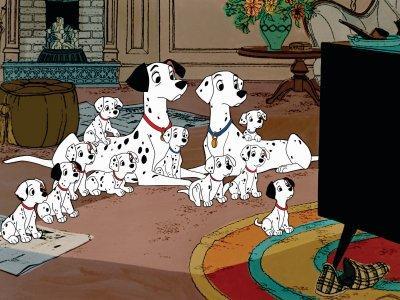
Disney began to develop their winning formula with 101 Dalmatians. What was needed you see was cute protagonists, lovable yet clumsy sidekicks, lessons to be learned on a great adventure, a cracking soundtrack and an iconic villain. All had been seen at least in part across the previous films, and here not all are present – there are no real life lessons and only one song, but one that remains to this day to be a particular favourite from the Disney canon; the catchy yet effortlessly simple Cruella DeVille, also one of the greatest and most memorable bad guys in cinematic history. The plot involves a batch of Dalmatian puppies (I forget how many) DeVille wishes to make a coat from, and though the first half has its moments – dog and owner pacing frantically outside the room the female dog is giving birth in, women outside of a window all bearing a strong resemblance to their dogs – it is the action-packed second half that is the key to this film, possibly the only children’s movie to feature the line “the blacker the better,” a quote I doubt Uncle Walt approved of.

And now we’re on to our first true classic, as young man-cub Mowgli is raised by a pack of wolves in the jungles of India, but is cast out when a tiger threatens his life in this retelling of Rudyard Kipling’s the Jungle Book. The cast of characters is creative and varied, from the hypnotic snake Kaa, sensible panther Bagheera, partying bear Baloo, human mimicking orang-utan King Louie, militaristic elephant herd and of course the menacing, fearsome tiger Sheer Kahn, a clear inspiration for Alan Rickman in Die Hard. The songs are wonderful, particularly Bare Necessities and I Wanna Be Like You, and the animation is spectacular. Other than the inexplicably Liverpublian vultures and the fact that Kaa sounds exactly the same as Winnie the Pooh (both are voiced by Sterling Holloway), the film is flawless, and carries an important message – females are devious.

So how do you improve on the Jungle Book? What was the missing ingredient? Dancing cutlery of course, in what else but Beauty and the Beast. It’s easy to forget just how wonderful this film is, even for an adult male such as myself. Featuring the most recommended female role model in a Disney film (other than perhaps Tiana from the Princess and the Frog, but that wasn’t a very good film) as Belle, a non-princess brunette inventor’s daughter, has inspirations of her own that do not involve a loveless marriage to a handsome yet rude and oafish brute, but she is extraordinarily beautiful, but considered strange by the rest of the village as she always has her nose in a book. When her father is captured by a hideously deformed beast (ooooh, now I get the title), Belle offers to take his place if her father is released. Of course Belle and the beast fall in love (after he gives her a goddamned library he already frickin’ had), but aside from the traditional plot (Remade from 1946’s La Belle et la Bete) the songs are far better than I’m willing to admit without being castrated, and are still stuck in my head more than a month after watching the film, not that I’m complaining. Undoubtedly the character who makes the biggest impact is the Bruce Campbell-chinned, Conan physiqued town meatball Gaston, a complete bastard willing to have Belle’s father committed if it means she will marry him, and who’s only redeemable feature is his brilliant rabble-rousing song (“I’m especially good at expectorating”).

And finally, my personal favourite, and my earliest memory of going to the cinema, The Lion King, or Hamlet for kids. Undoubtedly the greatest soundtrack of any Disney film, and easily among the best of other movies too, composed by Elton John and Tim Rice and featuring classics like I Just Can’t Wait To Be King, Circle Of Life, Be Prepared, Can You Feel The Love Tonight and of course Hakuna Matata (we don’t talk about Rowan Atkinson singing the Morning Report through his nose). The cast is stellar, including Jeremy Irons, Matthew Broderick, Nathan Lane, Whoopi Goldberg and James Earl Jones, and the story is terrific fun, yet still deals with the hardship of losing a parent, as lion cub Simba flees his family after believing he killed his father Mufasa. The scenery is stunning, taking in the African plains, lush jungle and elephant graveyard, and the script is full of humour, laden with lion puns (“a matter of pride,” “the mane event”).
Well that didn’t really work, did it? This was supposed to take less time than writing 8 individual posts. Ah well. I’ve got to say I wouldn’t recommend watching this many Disney films in such a short amount of time. Since watching them all, I’m taken by surprise when a passing animal refuses to have a conversation with me, or when my neighbours fail to spontaneously break into song.
Snow White: Choose life 5/10
Pinocchio: Choose life 6/10
Fantasia: Choose life 3/10
Bambi: Choose life 5/10
101 Dalmatians: Choose film 7/10
The Jungle Book: Choose film 8/10
Beauty and the Beast: Choose film 9/10
The Lion King: Choose film 9/10







 Life Vs Film